Calories Burned by Heart Rate Calculator
Get a science-backed calorie burn estimate using your actual workout heart rate data. The Keytel formula accounts for your age, sex, weight, and aerobic fitness — far more accurate than generic activity tables.
Use the average HR shown on your fitness tracker or heart rate monitor
VO2 max improves Keytel formula accuracy. If unknown, we estimate it from age and fitness level.
Used to estimate your VO2 max
Why Heart Rate Is the Best Proxy for Calorie Burn
Traditional calorie calculators use MET (metabolic equivalent of task) values — standardized numbers assigned to activities like running, cycling, or swimming. MET tables are practical, but they ignore the single most important variable: how hard your cardiovascular system is actually working.
Two people labeled as “running at 6 mph” get the same MET value in a table. But if one is a trained marathon runner and the other a beginner, their heart rates — and calorie burns — will be dramatically different. Heart rate is a direct window into oxygen demand, and oxygen demand is directly linked to calorie expenditure.
The Keytel et al. Formula Explained
Published in the Journal of Sports Sciences (2005), the Keytel formula was derived by measuring actual oxygen consumption (indirect calorimetry) in subjects while simultaneously recording heart rate. The resulting equations use four variables for improved accuracy:
- ✓Heart rate (HR):Your average beats per minute during the workout — the primary driver of the estimate.
- ✓VO2 max:Your aerobic fitness ceiling. A fitter person at the same HR burns fewer calories because their heart is more efficient.
- ✓Body weight:Heavier individuals require more energy to perform the same exercise at the same HR.
- ✓Age:Calorie burn per heartbeat changes with age as cardiovascular efficiency evolves.
Heart Rate Training Zones and Calorie Burn
Your workout's average heart rate determines which training zone you were in — each zone has different calorie burn rates and physiological benefits:
Gentle movement. Low calorie burn per minute but sustainable for hours. Used for active recovery and daily walks.
The foundation of endurance fitness. Burns a significant proportion of fat for fuel. Sustainable for 60–120+ minutes for most people.
Comfortably hard. Substantially higher calorie burn per minute. Ideal for 30–60 minute sustained efforts.
High effort. Near-maximum sustainable calorie burn. Used for interval training and race-pace efforts.
Maximum effort. Highest calorie burn per minute but sustainable only for seconds to a few minutes. Used in sprint intervals.
Understanding VO2 Max in the Formula
VO2 max is the maximum rate at which your body can consume oxygen, expressed in milliliters of O₂ per kilogram of body weight per minute (mL/kg/min). It is the best single measure of aerobic fitness and cardiovascular health.
| Category | Men (mL/kg/min) | Women (mL/kg/min) |
|---|---|---|
| Sedentary / Poor | < 30 | < 25 |
| Below Average | 30–38 | 25–33 |
| Average | 38–45 | 33–40 |
| Above Average | 45–52 | 40–47 |
| Excellent / Trained | 52–60 | 47–54 |
| Elite Athlete | 60–75+ | 54–70+ |
Many modern fitness wearables (Apple Watch, Garmin, Polar) estimate VO2 max automatically from outdoor runs. This estimate is typically accurate to within ±5 mL/kg/min for regular outdoor runners.
Limitations of HR-Based Calorie Estimates
Heart rate-based formulas are significantly more accurate than MET tables for aerobic exercise, but there are important limitations to keep in mind:
- Strength training and HIIT with short rest periods cause disproportionately high HR spikes that do not fully correspond to calorie burn.
- Heat, humidity, dehydration, caffeine, and stress all elevate HR independently of exercise intensity.
- These formulas were validated for steady-state aerobic exercise (running, cycling, rowing) — not for activities with highly variable HR.
- Individual variation of ±10–20% is normal even with VO2 max included.
- Using the wrist-based optical HR sensor rather than a chest strap can introduce measurement errors, especially during high-intensity intervals.
Frequently Asked Questions
How does a heart rate-based calorie calculator work?
Heart rate rises linearly with oxygen consumption during aerobic exercise. By measuring your average HR during a workout and combining it with your age, sex, weight, and VO2 max, the Keytel formula estimates oxygen consumption — and therefore calorie burn — at each moment of the workout.
What is the Keytel formula for calories burned?
The Keytel et al. formula estimates calories burned per minute using heart rate, VO2 max, weight, and age. It was validated against indirect calorimetry (lab-grade measurement) and is one of the most accurate equations available for wearable HR data.
How accurate are fitness tracker calorie estimates?
Consumer fitness trackers typically have 20–40% error versus lab measurements. HR-based formulas with VO2 max are more accurate than accelerometer-only methods. Providing your actual VO2 max (from your watch or a lab test) improves this calculator's accuracy.
What is VO2 max and why does it matter?
VO2 max is your maximum oxygen uptake in mL/kg/min — the standard measure of aerobic fitness. Two people with the same HR, age, and weight but different VO2 max burn different amounts of calories because the fitter person's heart is more efficient. Including VO2 max makes HR-based calorie estimates significantly more accurate.
What heart rate zone burns the most calories?
Higher zones (3–5) burn more calories per minute. However, you can only sustain Zone 4–5 for short periods. Long Zone 2 workouts can burn equal or more total calories than short high-intensity sessions. For fat loss, total calorie deficit over time matters more than the intensity zone.
When is heart rate not a reliable indicator of calorie burn?
HR-based formulas are most accurate for steady-state aerobic exercise. They are less reliable for strength training, HIIT, and activities where HR is influenced by factors other than exercise intensity — such as heat, caffeine, emotional stress, or dehydration.
Related Tools
iPhone app · 3-day free trial
You're likely eating 500 calories more than you think
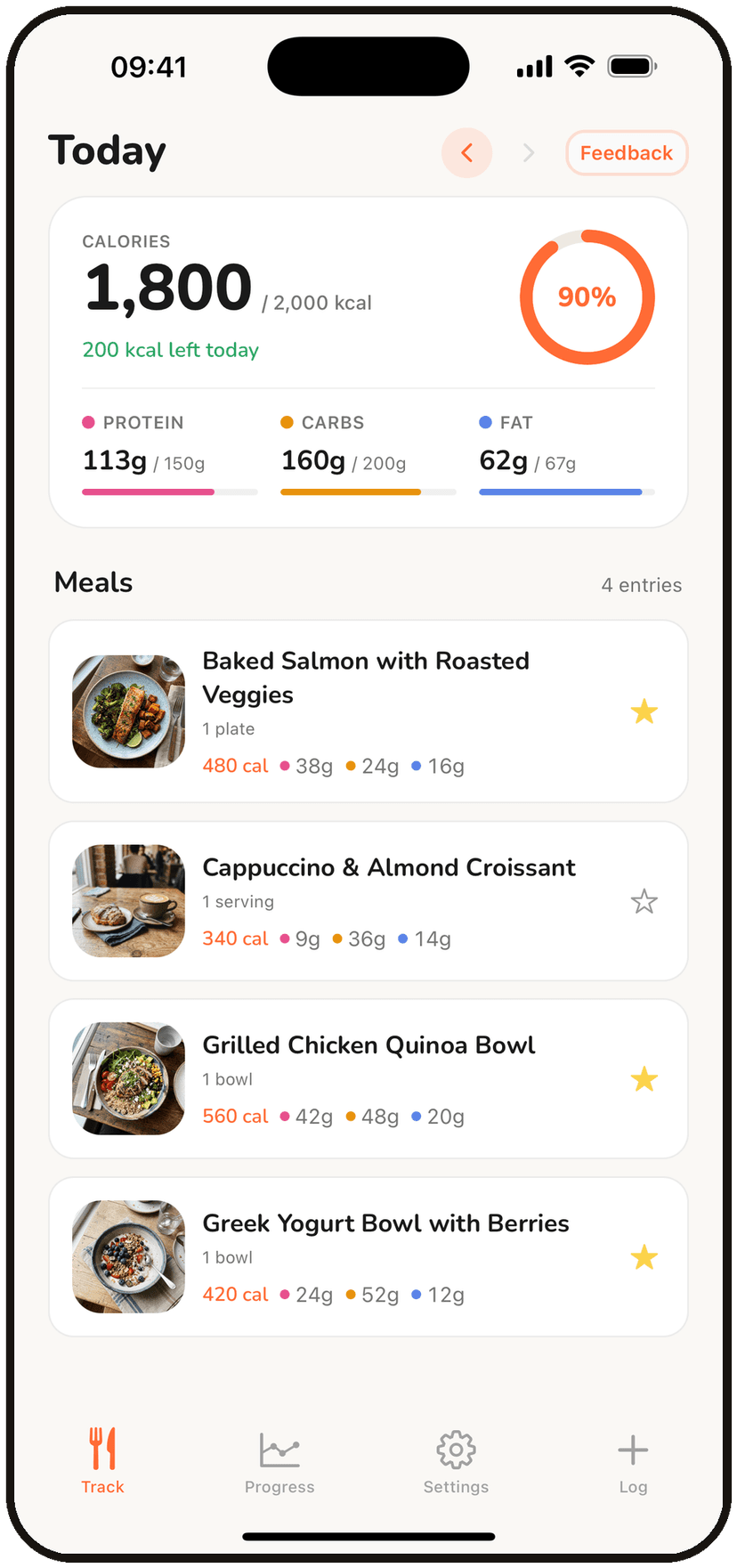
Portion guesses add up fast. BiteKit's AI estimates what's actually on your plate — oils, sides and all — so your log stays close to what you really ate.
- Log meals by photo, voice, or text
- Calories & macros estimated in seconds
- Syncs with Apple Health and Apple Watch
Free download · 3-day free trial, cancel anytime.
Scan with your iPhone camera