Running Split Calculator
Plan even or negative splits for any race distance. Get per-mile or per-km targets, a wall-hitting risk assessment, and a race day cheat sheet — all in seconds.
hr
min
sec
Average pace: 8:01 /mi · 4:59 /km
Why Pacing Strategy Determines Your Finish Time
Of all the variables in a race, pacing is the one you control entirely. Training determines your fitness ceiling; pacing determines how close you get to it. The wrong pacing strategy can cost you minutes — or force you to walk the final miles. The right one lets you run your best possible race on that day.
Research consistently shows that the fastest marathon finishes involve starting at or slightly slower than goal pace, then holding steady or speeding up in the second half. Among amateur runners, studies find that a 3–5% positive split (going out too fast) adds 5–10+ minutes to marathon finish times compared to even or negative splits.
Even Splits
Same pace from start to finish. The safest strategy, easiest to execute, ideal for first-timers.
Negative Splits
Start conservative, finish faster. Used in nearly every marathon world record. Requires discipline early.
Positive Splits
Start fast, slow down late. The most common amateur mistake. High risk of hitting the wall.
How Negative Splits Work (The Math)
A 5% negative split does not mean running the second half 5% faster than the first. It means the difference between halves is 5% of your average pace. This calculator distributes the difference symmetrically: the first half is 2.5% slower than average, and the second half is 2.5% faster — so the projected finish time matches your goal.
Example: 4-hour marathon, 5% negative split
- Average pace: 9:09 /mile
- First half pace (2.5% slower): 9:23 /mile → first half in ~2:03
- Second half pace (2.5% faster): 8:56 /mile → second half in ~1:57
- Net difference: ~6 minutes faster in the second half
A 3% split is appropriate for runners new to negative splitting. A 5% split suits experienced runners with good race fitness. Splits of 8–10% are aggressive and best reserved for runners who specifically train for fast finishes.
Avoiding the Wall: The Science Behind Pace Risk
“Hitting the wall” — the sudden, severe fatigue runners experience around mile 18–22 in a marathon — is almost entirely preventable with correct pacing and fueling. It happens because muscle glycogen (stored sugar) is depleted faster than the body can replenish it when you run too hard early.
High Risk: >5% faster than goal pace
Running more than 5% faster than goal pace in the first half is strongly correlated with severe pace deterioration in the final third. Glycogen burns exponentially faster at higher intensities due to the shifting fuel mixture from fat oxidation toward carbohydrate dependence.
Moderate Risk: 3–5% faster than goal pace
Starting 3–5% faster is a risky gamble. You may get away with it on a good day or in cooler conditions, but it significantly raises the probability of struggling late in the race.
Low Risk: Even pace or negative splits
Starting at or slower than goal pace preserves glycogen, keeps effort aerobic, and allows you to assess how you feel before committing to a faster second half.
Using Your Split Table on Race Day
A split table is only as useful as your ability to act on it during a race. Here are practical tips for turning your calculated splits into a race-day tool:
- Write it on your wrist or race bib: Old-school but effective. Write your key checkpoints (mile 5, 10, half, 20) on a wristband or the back of your race number.
- Program into your GPS watch: Most GPS watches allow you to set pace alerts. Set your pacing band (acceptable range) as the alarm boundaries.
- Use the first mile as a calibration: The first mile is always chaotic. Do not panic if it is slightly off. Focus on being on pace by mile 2–3.
- Check cumulative time, not just current pace: GPS pace fluctuates with every turn and gradient. Your cumulative time at each mile marker is a more reliable indicator of whether you are on track.
- Do not chase the watch on slow miles: If a hill slows you by 15 seconds, do not compensate by running the next mile 15 seconds faster. Maintain consistent effort; the pace will normalize naturally.
Distance-Specific Pacing Notes
5K — Go Controlled, Not Cautious
The 5K is short enough that glycogen depletion is not a concern. The primary risk is lactic acid accumulation from going anaerobic too early. Aim for even splits with a slight negative — the last kilometer should feel like you are truly racing, not surviving.
10K — Threshold Effort Management
A 10K is run at or near your lactate threshold. Even splits with a strong final 2K push is the classic approach. Going out 5% faster than goal pace is a common mistake that causes the pace to crater in the final 3–4 km.
Half Marathon — The Forgiving Distance
The half marathon rewards consistent pacing more than almost any other distance. A 3–5% negative split is attainable for well-trained runners. Start conservatively for the first 5 miles, then gradually build if you feel strong.
Marathon — The Greatest Pacing Test
The marathon is uniquely unforgiving of early pace mistakes. Even a 3% positive split significantly increases the chance of severe fatigue in miles 18–26. Elite runners start at goal pace or slower for the first 10 miles; this is not caution — it is strategy.
Frequently Asked Questions
What are race splits in running?
Race splits are the times recorded at specific intervals during a race — typically each mile or kilometer. A split table shows your target pace and cumulative time at every checkpoint, helping you run a consistently paced or strategically varied race.
What is a negative split in running?
A negative split means running the second half of a race faster than the first half. It is widely considered the most effective pacing strategy for distance events. Running the first half conservatively preserves glycogen and lets you finish strong rather than struggling through the final miles.
How does the negative split calculation work?
For a 5% negative split, the calculator makes the first half 2.5% slower than your overall average pace and the second half 2.5% faster. This keeps the projected finish time equal to your goal while introducing a progressive effort structure.
What causes runners to “hit the wall”?
Hitting the wall happens when glycogen stores are depleted, typically around miles 18–22 in a marathon for runners who start too fast. Starting faster than goal pace burns glycogen at an unsustainable rate. Once glycogen is exhausted, pace collapses dramatically. Proper pacing and fueling together prevent this outcome.
Should I use even splits or negative splits for my first marathon?
Even splits are the safest choice for first-time marathoners. They are straightforward to execute and minimize glycogen depletion. Once you have one or two marathons of experience, experimenting with a modest 3–5% negative split can help you finish stronger.
What is the pacing band and why does it matter?
The pacing band is the acceptable range of paces around your goal — in this calculator, ±10 seconds per mile or km. Staying within this band accounts for natural variation from turns, crowds, hills, and GPS inaccuracies. Consistent pacing within a narrow band is the hallmark of a well-executed race.
Related Tools
iPhone app · 3-day free trial
You're likely eating 500 calories more than you think
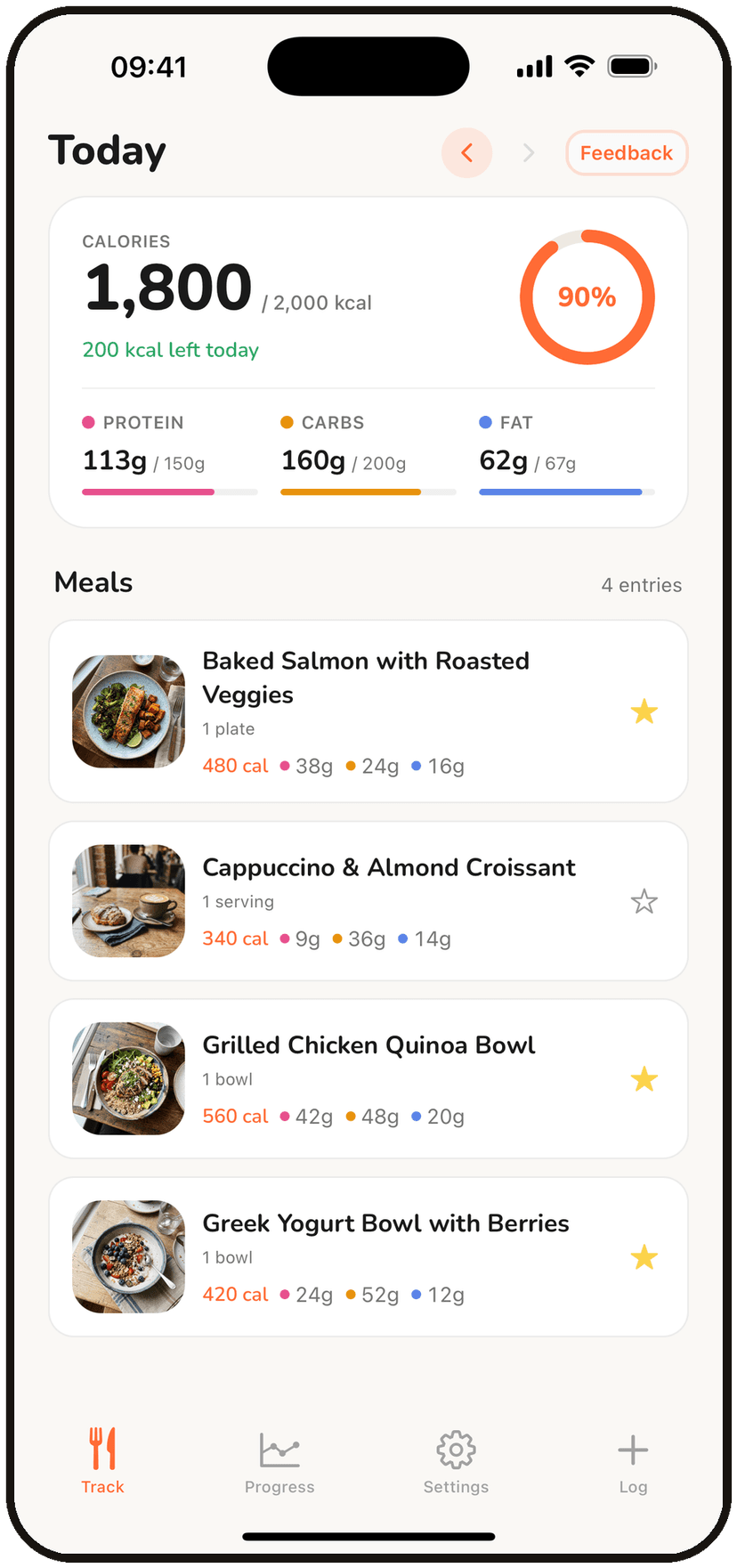
Portion guesses add up fast. BiteKit's AI estimates what's actually on your plate — oils, sides and all — so your log stays close to what you really ate.
- Log meals by photo, voice, or text
- Calories & macros estimated in seconds
- Syncs with Apple Health and Apple Watch
Free download · 3-day free trial, cancel anytime.
Scan with your iPhone camera