Strength Standards Calculator
See how your squat, bench press, deadlift, and overhead press compare to population percentiles. Enter your 1RM for each lift to get your strength classification from Beginner to Elite based on your gender and body weight.
How Strength Standards Work
Strength standards are based on body weight multipliers derived from population-level lifting data. Your 1RM (one-rep max) for each lift is compared against expected thresholds for your gender and body weight to determine your strength level from Beginner to Elite.
Understanding Strength Standards
Strength standards provide a framework for evaluating how your lifting numbers compare to the broader training population. Rather than using absolute weight — which favors heavier lifters — standards are expressed as body weight ratios (your 1RM divided by your body weight). A 100 kg squat means something very different for a 60 kg lifter than a 120 kg lifter. Body weight ratios level the playing field.
The thresholds used in this calculator are derived from population-level data collected across training logs, gym surveys, and competition results. They reflect the typical progression a lifter can expect with consistent, structured training and adequate nutrition. Five levels are used:
Beginner (less than 3 months)
A lifter who is new to barbell training. Strength is close to untrained levels. The focus at this stage should be on learning proper form and building movement patterns. Linear progression (adding weight every session) works well here.
Novice (3-12 months)
A lifter with several months of consistent training. Noticeably stronger than the general untrained population. Still progressing relatively quickly with session-to-session or weekly weight increases.
Intermediate (1-3 years)
A lifter with solid training experience. Stronger than most people in a typical gym. Progress requires more structured programming with periodized volume and intensity. Weekly or bi-weekly progression is typical.
Advanced (3-5+ years)
A lifter approaching their genetic potential in one or more lifts. Competitive at regional or national level meets. Progress is measured in monthly or multi-month cycles. Requires advanced programming, careful recovery management, and dialed-in nutrition.
Elite (5+ years competitive)
Among the strongest lifters for their weight class. Typically competitive at national or international level. Only a small percentage of dedicated lifters ever reach this level. Progress is extremely slow and measured over years.
Strength Standards by Lift
Each of the four main barbell lifts has different expected body weight ratios because they use different muscle groups and movement patterns. Here is what typical male intermediate-level ratios look like and why they differ:
Squat (1.5x BW)
The barbell back squat is the cornerstone of lower body strength. It loads the quadriceps, glutes, and entire posterior chain. Intermediate male lifters typically squat around 1.5x their body weight. The squat is usually the second-heaviest lift after the deadlift. A well-developed squat indicates strong overall leg drive and core stability.
Bench Press (1.15x BW)
The bench press is the primary test of upper body pressing strength, targeting the chest, front delts, and triceps. Intermediate males typically bench about 1.15x body weight. Bench progress tends to be slower than squat or deadlift because it relies on smaller muscle groups. Arch position, leg drive, and bar path all affect performance.
Deadlift (1.85x BW)
The deadlift is generally the heaviest lift for most people because it engages the entire posterior chain — hamstrings, glutes, spinal erectors, traps, and grip. Intermediate males typically deadlift around 1.85x body weight. Both conventional and sumo stances are valid. The deadlift is also the lift where absolute strength tends to be highest.
Overhead Press (0.7x BW)
The standing overhead press is the strictest test of shoulder and upper body pressing strength. It uses the shoulders, triceps, and upper chest without leg drive assistance. Intermediate males typically press about 0.7x body weight. This is the lightest of the four lifts and the one that progresses most slowly, but it builds impressive shoulder strength and stability.
Female standards follow the same tier structure but with lower multipliers, roughly 60-70% of male values. This reflects physiological differences in upper body muscle mass and strength potential, not effort or dedication. A woman squatting 1.0x body weight and a man squatting 1.5x body weight are at the same relative strength level.
How to Progress Through Strength Levels
Moving from one strength level to the next requires progressively more sophisticated training. Here are programming strategies for each stage:
Beginner to Novice: Linear Progression
Add weight every session (2.5 kg for upper body, 5 kg for lower body). Programs like Starting Strength, StrongLifts 5×5, or GZCLP work well. Train 3 days per week. Focus on learning proper technique above all else. Eat at a slight caloric surplus with 1.6g+ protein per kg body weight.
Novice to Intermediate: Weekly Periodization
Switch to weekly progression with light/heavy days. Programs like Texas Method, Madcow 5×5, or 5/3/1 work well. Train 3-4 days per week. Begin incorporating accessory work to address weak points. Use our Protein Intake Calculator to ensure you are eating enough protein to support growth.
Intermediate to Advanced: Block Periodization
Use multi-week training blocks with planned volume, intensity, and peaking phases. Programs like Juggernaut Method, Calgary Barbell, or Sheiko are designed for this stage. Train 4-5 days per week. Recovery management (sleep, nutrition, deload weeks) becomes critical. Track your macros closely with BiteKit to optimize body composition while gaining strength.
Advanced to Elite: Individualized Programming
At this level, programming must be highly individualized based on your strengths, weaknesses, injury history, and competition schedule. Many lifters work with a coach. Progress is measured over months or years. Every detail matters — nutrition timing, sleep quality, stress management, and exercise selection all play a role in continued progress.
Common Strength Imbalances and How to Fix Them
Most lifters develop imbalances over time due to training preferences, programming gaps, or anatomical factors. Here are the most common patterns and how to address them:
Bench Press Stronger Than Squat
Common in lifters who spend more time on upper body training. The typical squat-to-bench ratio for balanced male lifters is roughly 1.3:1 (squat should be about 30% more than bench). If your bench is close to or exceeds your squat, increase squat frequency to 2-3 times per week and add quad-focused accessories like front squats, leg press, and Bulgarian split squats. Ensure you are squatting to proper depth (hip crease below the top of the knee).
Deadlift Far Ahead of Squat
This can indicate quad weakness (the squat is more quad-dominant than the deadlift). A typical deadlift-to-squat ratio is roughly 1.2:1. If the gap is larger, add more squat-specific volume: paused squats, tempo squats, and front squats all build quad strength and confidence in the bottom position. Also check your squat mobility — tight ankles or hips can limit depth and reduce quad engagement.
Overhead Press Lagging Behind
The OHP is naturally the weakest lift, but if it is disproportionately low (less than 55% of your bench press for men), your shoulders or triceps may need extra work. Add a second pressing day with seated dumbbell presses, push presses, or Arnold presses. Include lateral raises and face pulls to build the medial and rear deltoids, which stabilize the shoulder during pressing.
Push vs. Pull Imbalance
While this calculator focuses on pressing and leg movements, many lifters underdevelop their pulling muscles (back, rear delts, biceps) because popular programs emphasize squats, bench, and deadlift. For healthy shoulders and balanced physique, aim for at least a 1:1 ratio of pushing to pulling volume. Add rows, pull-ups, and face pulls to every training week. This protects against shoulder injury and actually improves bench press performance by creating a thicker, more stable base.
Frequently Asked Questions
What is a good squat for my body weight?
For men, squatting 1.5x your body weight is considered intermediate level, typically corresponding to 1-3 years of consistent training. A 2.0x body weight squat is advanced, and 2.5x is elite. For women, intermediate is roughly 1.0x body weight, advanced is 1.35x, and elite is 1.65x. These are based on barbell back squats performed to at least parallel depth.
How are strength standards calculated?
Strength standards are based on body weight multipliers derived from population-level data collected across gyms, competitions, and training logs. Your one-rep max for each lift is divided by your body weight to produce a ratio, which is then compared against established thresholds for each strength level. Separate standards exist for men and women to account for physiological differences.
What is a good bench press for my body weight?
For men, benching 1.15x your body weight is intermediate (1-3 years training), 1.4x is advanced, and 1.75x is elite. For women, intermediate is about 0.75x body weight, advanced is 0.95x, and elite is 1.15x. The bench press is typically the slowest main lift to progress because it relies on smaller muscle groups compared to squats and deadlifts.
What is a good deadlift for my body weight?
For men, deadlifting 1.85x body weight is intermediate, 2.25x is advanced, and 2.75x is elite. For women, intermediate is about 1.25x body weight, advanced is 1.55x, and elite is 1.85x. The deadlift is often the heaviest lift for most people, as it engages the entire posterior chain and allows the most absolute weight to be moved.
How long does it take to reach intermediate strength?
Most lifters reach intermediate strength standards within 1-3 years of consistent, structured training with progressive overload and adequate nutrition. The exact timeline depends on genetics, program quality, recovery, nutrition (especially protein intake), sleep, and starting point. Following a proven program and eating sufficient protein (1.6-2.2g per kg body weight) accelerates progress significantly.
Why is my overhead press so much weaker than my other lifts?
The overhead press is naturally the weakest of the four main barbell lifts because it targets the shoulders and triceps without assistance from the chest, back, or legs. A typical male OHP is 55-65% of the bench press. If your OHP is disproportionately weak, adding dedicated shoulder pressing volume (2-3 sessions per week) and addressing tricep strength with close-grip bench press and dips can help close the gap.
iPhone app · 3-day free trial
You're likely eating 500 calories more than you think
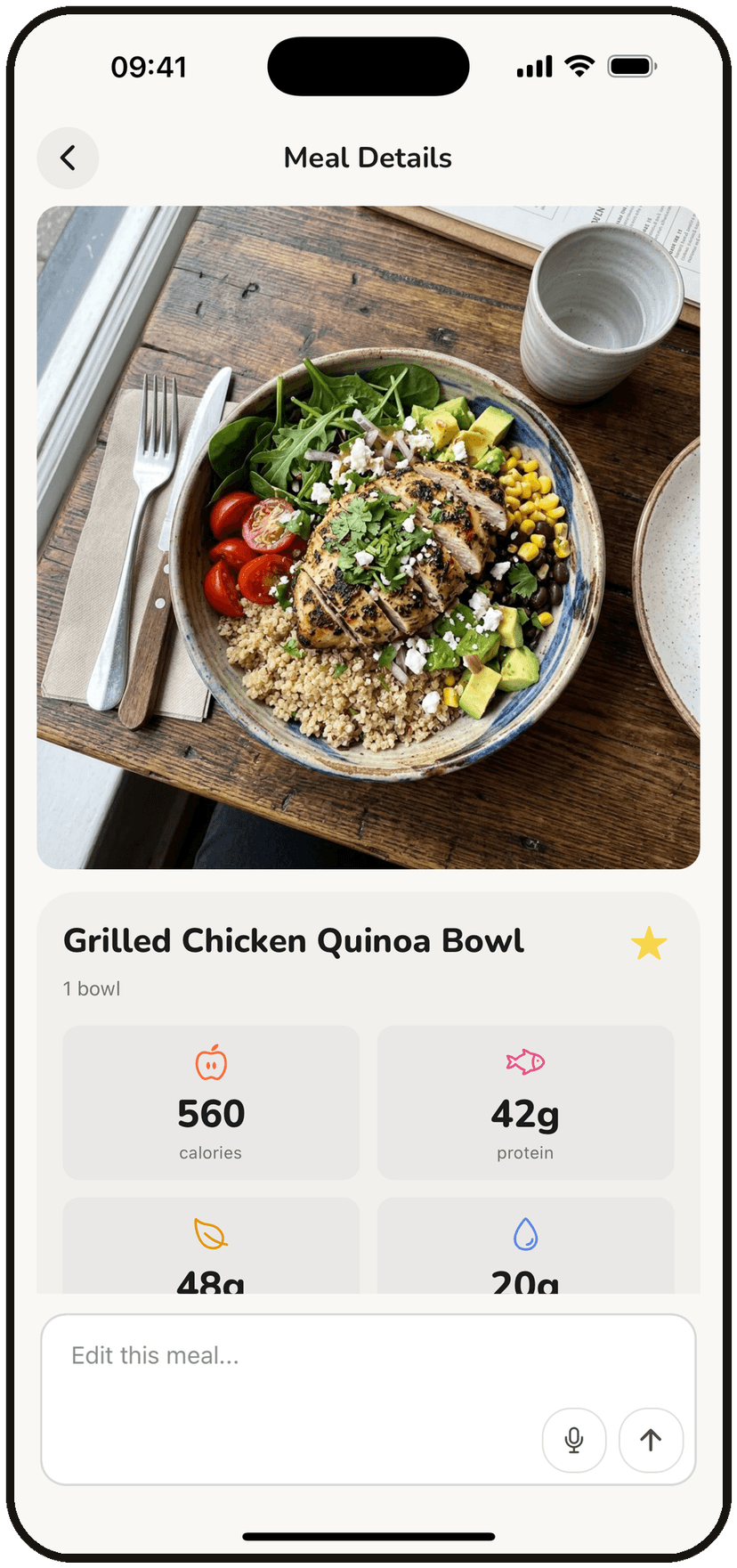
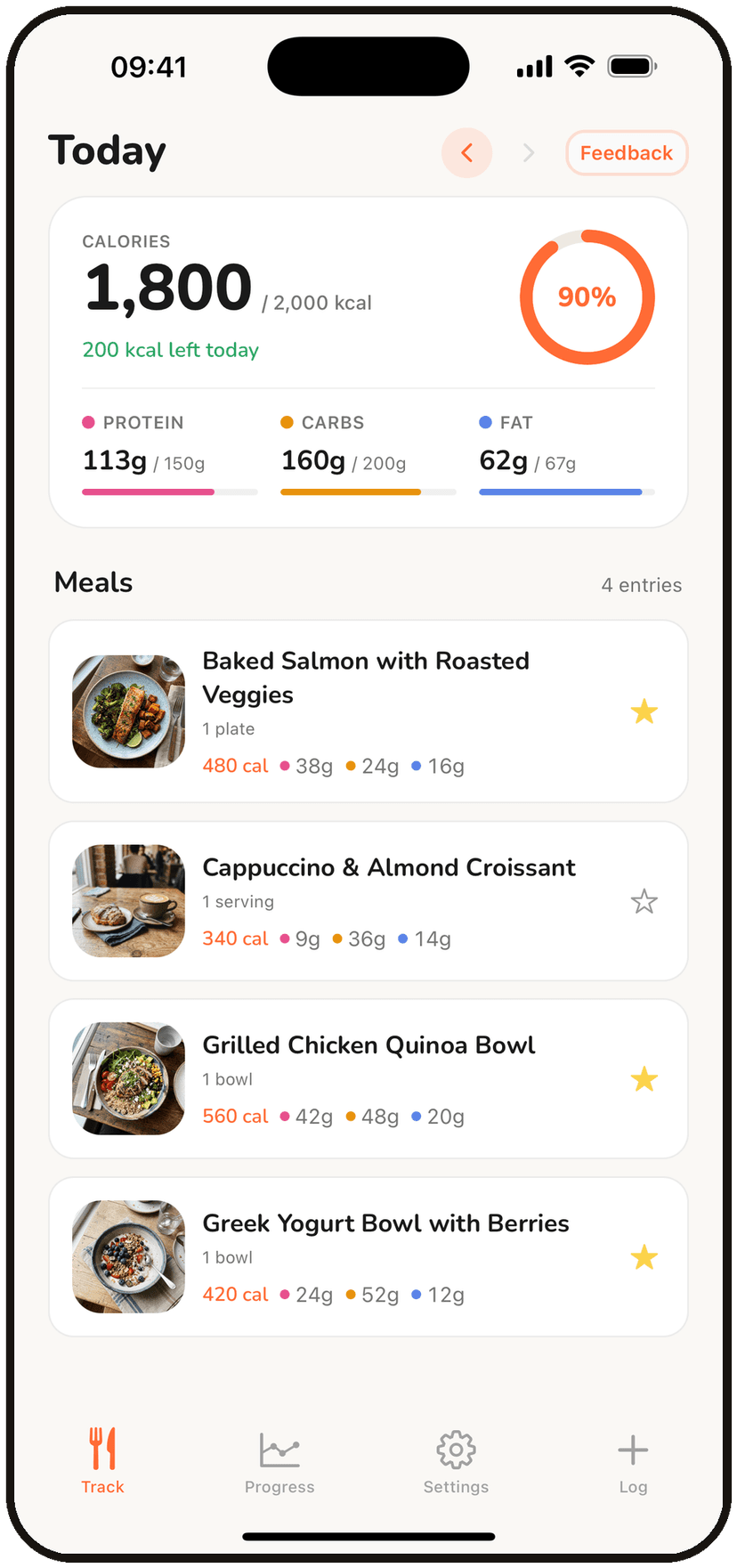
Portion guesses add up fast. BiteKit's AI estimates what's actually on your plate — oils, sides and all — so your log stays close to what you really ate.
- Log meals by photo, voice, or text
- Calories & macros estimated in seconds
- Syncs with Apple Health and Apple Watch
Free download · 3-day free trial, cancel anytime.
Scan with your iPhone camera