Weightlifting Warm-Up Calculator
Enter your working set weight and get a complete warm-up protocol. Progressive sets ramp from the empty bar to your target load with reps, rest times, and exact plate loading per side.
The weight you plan to use for your working sets
Standard Olympic bar: 45 lbs
Warm-Up Tips
- Start light: Always begin with the empty barbell to groove the movement pattern
- Don't rush: Rest 60-120 seconds between warm-up sets to stay fresh
- Lower reps as you go: Reduce reps as weight increases to avoid fatigue
- Stay tight: Treat every warm-up rep like a working rep for proper form
Why Warming Up for Weightlifting Matters
A proper warm-up is one of the most important parts of any strength training session, yet it's frequently rushed or skipped entirely. Warming up before lifting prepares your muscles, joints, and nervous system for the demands of heavy resistance training. It increases blood flow to working muscles, raises tissue temperature, and improves the elasticity of tendons and ligaments.
Research consistently shows that a structured warm-up reduces injury risk and can even improve performance. A 2010 meta-analysis published in the British Journal of Sports Medicine found that progressive warm-up protocols reduced the risk of musculoskeletal injuries by an average of 50%. For lifters handling heavy loads, this is not optional — it's essential.
Beyond injury prevention, warm-up sets serve as technique rehearsal. Each lighter set is an opportunity to refine your movement pattern, establish your bracing sequence, and dial in bar path before the weight gets challenging. Lifters who warm up with intention consistently move heavier weights with better form than those who rush to their working sets.
How the Progressive Warm-Up Protocol Works
The warm-up protocol generated by this calculator follows a proven progressive loading scheme used by strength coaches worldwide. Starting with the empty barbell, the weight increases through specific percentages of your working weight — typically 40%, 55%, 70%, 85%, and 95% — while the rep count decreases at each step. This inverse relationship between weight and reps is by design.
At lighter weights, higher reps (8-10) increase blood flow and rehearse the movement pattern. As the weight approaches your working load, lower reps (1-3) activate the nervous system and acclimate your muscles to heavier loads without accumulating unnecessary fatigue. The rest periods also increase progressively — 60 seconds between lighter sets and up to 120 seconds between heavier warm-up sets — ensuring you're adequately recovered before each jump in weight.
The calculator automatically rounds weights to the nearest plate increment (5 lbs or 2.5 kg) and skips duplicate sets where two percentage steps round to the same weight. For lighter working sets, the protocol will naturally produce fewer warm-up sets since the jumps between percentages are smaller. For very heavy working sets, you'll see the full 5-6 set protocol to ensure a thorough ramp-up.
Understanding Plate Loading
One of the most practical features of this calculator is the plate breakdown shown for each warm-up set. Instead of doing mental math while standing over the barbell, you can see exactly which plates to load on each side. The calculator uses standard plate sizes: 45, 25, 10, 5, and 2.5 pound plates (or 20, 10, 5, 2.5, and 1.25 kg plates in metric).
Plates are always shown "per side," meaning the quantity listed goes on each end of the barbell. The total weight on the bar equals the barbell weight plus twice the per-side plate total. For example, if the calculator shows "1 x 45 lbs + 1 x 10 lbs per side," you would load one 45-pound plate and one 10-pound plate on each end of a 45-pound bar, totaling 155 lbs.
When loading a barbell, always load plates symmetrically — add or remove the same plates from both sides before unracking. Uneven loading is a common gym mistake that can cause the bar to tip, especially on a squat rack. Many experienced lifters also develop the habit of "building up" plates during warm-ups rather than stripping and reloading, which saves time and keeps the flow of the session smooth.
Common Warm-Up Mistakes to Avoid
Even experienced lifters can fall into bad warm-up habits that reduce performance or increase injury risk. Understanding these common mistakes will help you get the most out of every training session.
Jumping Too Quickly to Heavy Weight
Taking large jumps between warm-up sets — or skipping straight to 70-80% of your working weight — leaves your muscles and nervous system unprepared. Each warm-up set builds on the previous one, and skipping steps means you miss the gradual adaptation that keeps you safe. Follow the progressive percentages for best results.
Doing Too Many Reps at Heavy Warm-Up Weights
Performing 8-10 reps at 85% of your working weight will fatigue your muscles before your working sets even begin. As the weight increases during warm-up, the reps should decrease. Your warm-up should prime you for performance, not pre-exhaust you.
Rushing Through Without Rest
Blasting through warm-up sets with no rest turns them into a cardiovascular workout rather than a neuromuscular preparation. Take 60-120 seconds between warm-up sets, especially the heavier ones. Use the time to visualize your working sets and check your equipment.
Skipping the Empty Bar Set
Even advanced lifters should start with the empty barbell. This first set of 8-10 reps establishes your movement pattern, warms up the joints through a full range of motion, and gives you a chance to assess how your body feels that day. It takes less than 30 seconds and pays dividends throughout the session.
General Warm-Up vs. Specific Warm-Up
A complete warm-up strategy includes both a general warm-up and a specific warm-up. The general warm-up involves 5-10 minutes of light cardiovascular activity — walking, rowing, cycling, or jumping rope — to raise your core body temperature and increase overall blood flow. This is especially important if you're training first thing in the morning or after sitting for long periods.
The specific warm-up is what this calculator generates: progressively heavier sets of the exercise you're about to train. While the general warm-up raises your body temperature, the specific warm-up activates the exact muscles, joints, and neural pathways you'll use during working sets. Both are important, but the specific warm-up is the one that most directly impacts your lifting performance and safety.
Some lifters also incorporate dynamic stretching or mobility drills between their general and specific warm-ups. Hip circles before squats, band pull-aparts before bench press, or thoracic spine rotations before overhead press are common examples. These movement preparation drills address individual mobility limitations and can significantly improve your bar path and depth on the first exercise.
Frequently Asked Questions
How many warm-up sets should I do before my working sets?
Most lifters benefit from 4-6 warm-up sets that progressively ramp from the empty barbell to their working weight. The exact number depends on how heavy your working weight is — heavier loads need more ramp-up sets. A good rule of thumb is to increase by roughly 15-20% of your working weight per warm-up set.
How long should I rest between warm-up sets?
Rest 60 seconds between lighter warm-up sets (below 60% of working weight) and 90-120 seconds between heavier warm-up sets (above 70%). The goal is to recover enough to maintain technique without cooling down. Your warm-up should prepare you for the work ahead, not tire you out.
Should I warm up with the same exercise I plan to do?
Yes, specific warm-ups using the same exercise are the most effective way to prepare for heavy lifting. After 5-10 minutes of general warm-up (light cardio, dynamic stretching), perform progressively heavier sets of the exercise you plan to train. This grooves the motor pattern and prepares your joints for the load.
How many reps should warm-up sets have?
Start with higher reps at lighter weights (8-10 reps with the empty bar) and reduce reps as the weight increases. A typical protocol is 10 reps at bar weight, 8 at 40%, 5 at 55%, 3 at 70%, 2 at 85%, and 1 at 95%. This warms you up thoroughly without accumulating fatigue.
Do warm-up sets count toward my training volume?
Warm-up sets are generally not counted toward effective training volume because they're performed at intensities too low to stimulate meaningful muscle growth. When tracking volume for hypertrophy, focus on your working sets performed at or above your target RPE or percentage.
Can I skip warm-up sets if I feel ready?
Skipping warm-up sets is not recommended, even if you feel ready. Warm-up sets increase blood flow, raise joint temperature, activate the nervous system, and rehearse technique. Jumping straight to heavy weights significantly increases injury risk regardless of how you feel.
iPhone app · 3-day free trial
You're likely eating 500 calories more than you think
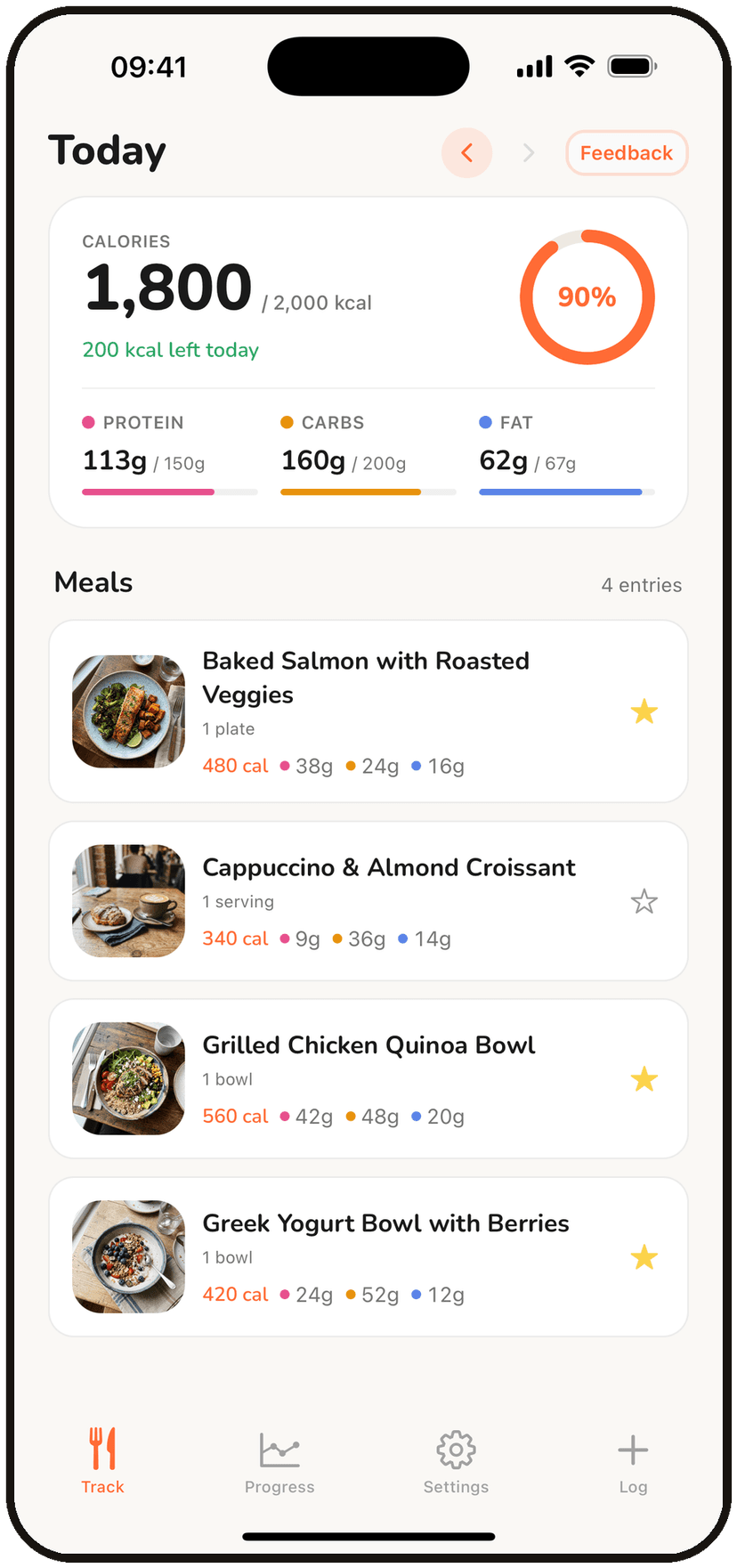
Portion guesses add up fast. BiteKit's AI estimates what's actually on your plate — oils, sides and all — so your log stays close to what you really ate.
- Log meals by photo, voice, or text
- Calories & macros estimated in seconds
- Syncs with Apple Health and Apple Watch
Free download · 3-day free trial, cancel anytime.
Scan with your iPhone camera