How Many Carbs in a Sweet Potato? A Guide to Nutrition and Health
Discover how many carbs in a sweet potato, from raw to baked. Understand net carbs, glycemic impact, and how preparation changes nutritional value.
Ask anyone tracking their macros, and they'll tell you: sweet potatoes are a go-to carb source. But how many carbs are we really talking about? A typical medium sweet potato usually lands around 26 grams of total carbohydrates.
Of that, you're getting a solid 4 grams of dietary fiber, which is fantastic news for your digestion and for keeping your blood sugar stable. This vibrant root vegetable isn't just delicious; it’s a powerhouse of sustained energy.
The Definitive Answer On Sweet Potato Carbs
The exact carb count of a sweet potato really hinges on two things: its size and how you cook it. Still, we can establish a pretty reliable baseline. Sweet potatoes are loaded with complex carbohydrates, which are your body's preferred fuel. Think of them as slow-burning logs for your internal furnace, not the quick-and-done kindling you get from simple sugars.
This is exactly why they're so popular in fitness circles. You get that steady energy release without the dreaded sugar crash. That’s the fiber working its magic.
How Cooking Changes The Numbers
Interestingly, the way you prepare a sweet potato can alter its carb density. When you bake it, for example, some water evaporates, which slightly concentrates its nutrients and sugars. This means the carb count per gram can be a bit higher than if you were to boil it.
Let's get specific. The USDA’s official data tells us that a medium sweet potato—about 5 inches long and weighing around 130 grams—clocks in at 26 grams of total carbohydrates. When baked, its glycemic index is a moderate 64, making it a smart choice for most people.
Knowing the baseline numbers is great, but a complete nutritional picture is even better for dialing in your diet. You can dive into the full details of a baked sweet potato's nutrition facts to see exactly how it fits with your personal goals.
Sweet Potato Carb Count At a Glance (per 100g)
For a quick and easy comparison, here’s a handy table that breaks down the carb content for a 100-gram serving (roughly half a medium sweet potato) prepared in common ways.
| Preparation | Total Carbs | Fiber | Net Carbs |
|---|---|---|---|
| Raw | 20.1g | 3.0g | 17.1g |
| Baked | 20.7g | 3.3g | 17.4g |
| Boiled | 18.3g | 2.5g | 15.8g |
As you can see, the differences aren't huge, but they can add up depending on your tracking goals. Baking concentrates the carbs slightly, while boiling seems to reduce them a bit, likely due to water absorption.
Understanding Net Carbs in Your Sweet Potato
If you’ve ever tracked macros, you've probably run into the term “net carbs.” It’s a really important concept when looking at a food like the sweet potato, because not all carbs are created equal when it comes to how your body actually uses them.
Think of it like this: total carbs are all the passengers on a bus. Net carbs are only the passengers who get off at the "energy" stop to fuel your body. The other passengers, like fiber, stay on the bus and help with other important jobs, like keeping your digestive system running smoothly.
The Simple Math of Net Carbs
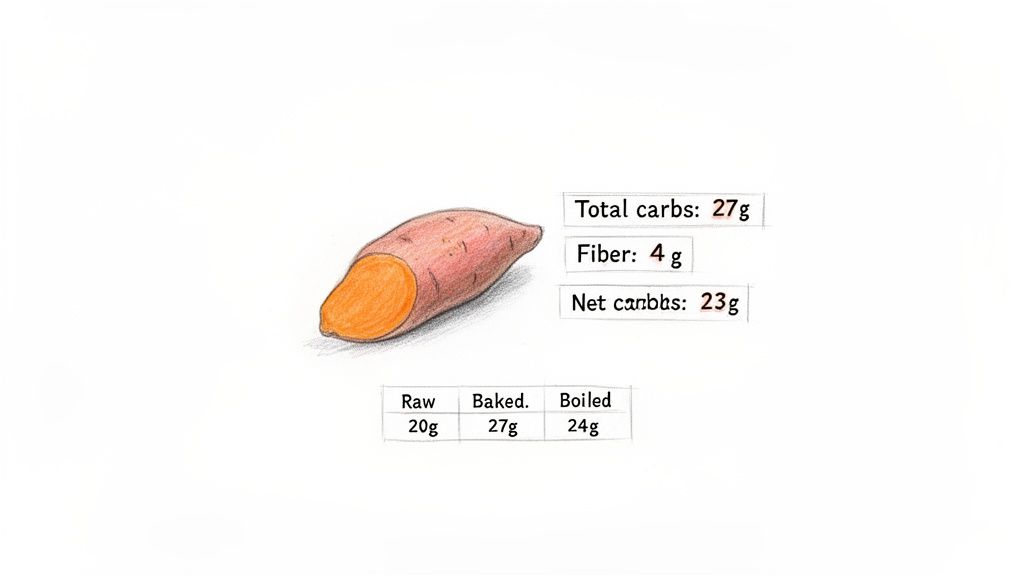
Calculating net carbs is refreshingly simple. You just subtract the fiber from the total carbs, and what's left is a much better indicator of how a food will impact your blood sugar.
Total Carbs - Dietary Fiber = Net Carbs
Let's put this into practice with our medium baked sweet potato. It has about 26 grams of total carbs and 4 grams of fiber. Do the math, and you get 22 grams of net carbs. Those 4 grams of fiber might not seem like a lot, but they make a world of difference.
Because your body doesn't break down fiber into sugar (glucose), it acts like a brake, slowing down the absorption of the other carbs. This prevents the dramatic blood sugar spikes you'd get from a low-fiber food, giving you steady, sustained energy instead of a quick rush and crash.
Why Fiber Makes Sweet Potatoes a Superior Carb Source
That fiber content is exactly what makes a sweet potato a smarter choice than other starchy carbs like a plain white potato or a slice of white bread. Even if the total carb count looks similar on paper, the sweet potato's built-in fiber gives it a huge metabolic advantage.
This is a game-changer for a few key reasons:
- Better Blood Sugar Control: That slower digestion is a huge win for maintaining stable energy and managing insulin sensitivity.
- Keeps You Feeling Full: Fiber adds bulk and helps you feel satisfied long after you've finished eating. This is a massive help if you're managing your weight, as it can curb cravings and prevent overeating.
- Great for Gut Health: A healthy gut needs fiber to thrive. It feeds the good bacteria in your digestive system, promoting regularity and overall wellness.
So, by focusing on net carbs, you get a clearer picture of why the sweet potato is such a nutritional powerhouse. It delivers the energy you need without sending you on a metabolic roller coaster, making it a fantastic addition to almost any diet.
How Cooking Changes Sweet Potato Carbs
Ever notice how a baked sweet potato tastes so much sweeter than a raw one? That's not just your imagination. The way you cook this vibrant root vegetable does more than just soften it up—it fundamentally changes its nutritional profile, especially its carbohydrate content. The heat from your oven or stove kicks off a series of chemical reactions, altering everything from the sugar concentration to how your body actually digests the starches.
For instance, when you bake a sweet potato, some of its water content evaporates. This simple act concentrates all its natural sugars and nutrients. The result? A slightly higher carb and calorie count per gram compared to its raw state. This is what makes a baked sweet potato such a satisfying and dense source of energy.
Baking Versus Boiling
When you slide a sweet potato into a hot oven, the magic really begins. The starches start breaking down into simpler sugars like maltose. This is why a baked sweet potato develops that rich, sweet, caramelized flavor. This process, known as caramelization and gelatinization, essentially "pre-digests" the starches, making the carbohydrates much more accessible for your body to use as quick fuel. It's a fantastic pre-workout snack for exactly this reason.
Boiling, on the other hand, flips the script. Instead of losing water to evaporation, a sweet potato submerged in boiling water absorbs moisture. This plumps it up, leading to a lower carb density for the same 100-gram serving compared to a baked one. The water adds volume and weight without adding a single carb or calorie. This makes boiled or steamed sweet potatoes a great choice if you're looking for a filling, high-volume food with fewer carbs.
The Science of Starch and Sugar
But the changes go deeper than just water content. Let's look at a 100-gram serving of baked sweet potato (about ½ cup). This serving packs 21g of total carbohydrates, which includes 3g of fiber and 6g of sugars. What’s really interesting is that about 11% of those carbs are resistant starch—a special type of fiber that, as its name suggests, resists digestion. It acts more like a prebiotic, feeding good gut bacteria and helping to keep blood sugar levels stable. For a deeper dive, check out these sweet potato nutrition facts from NC State Extension.
This simple graphic breaks down the relationship between total carbs, fiber, and the net carbs that your body actually uses for energy.
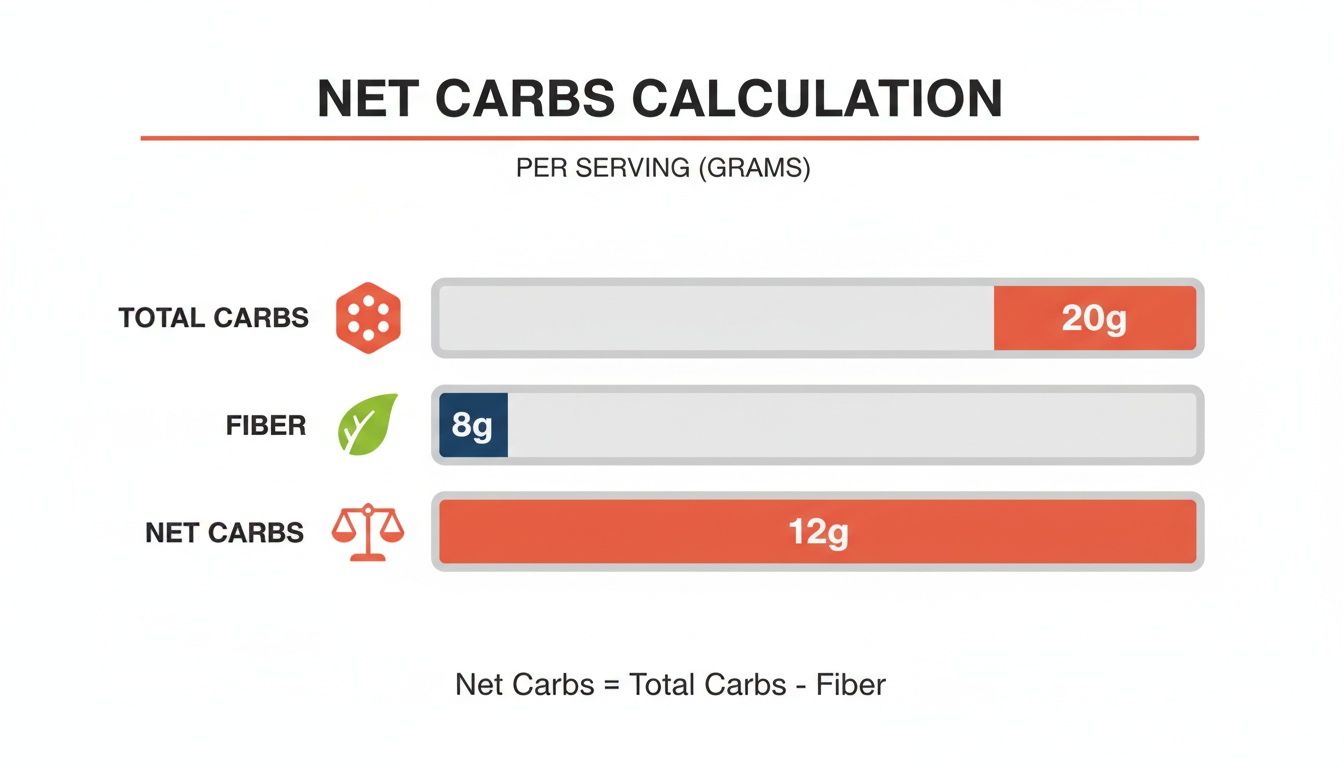
The big takeaway here is that fiber is a game-changer when it comes to understanding how many carbs your body will absorb.
Here's a cool pro-tip: letting a cooked sweet potato cool down actually increases its resistant starch content. Through a process called retrogradation, some of the easily digestible starches revert to a more resistant form. This is great news for your gut health and blood sugar management.
Of course, other cooking methods introduce new variables. Frying, for instance, adds a significant amount of fat and calories from the oil, completely changing the food's macro profile. Roasting, however, offers a fantastic middle ground. You still get that delicious caramelized flavor but with a fraction of the added fat. If you want to learn more, take a look at our guide on the nutritional profile of roasted sweet potato.
To wrap it up, the best cooking method really comes down to what you're trying to achieve:
- For Maximum Energy: Baking or roasting is your best bet. It concentrates the carbs, making it perfect for pre-workout fuel.
- For Lower Carb Density: Go with boiling or steaming. You get more food volume for fewer carbs per bite.
- For Blood Sugar Control: Try cooking your sweet potatoes ahead of time and letting them cool to boost that beneficial resistant starch.
The Glycemic Impact on Your Blood Sugar
Knowing the carb count in a sweet potato is only half the story. The other, arguably more important, piece of the puzzle is how those carbs actually affect your body. This is where the Glycemic Index (GI) comes into play.
Think of the GI as a speed rating for carbs. It’s a scale from 0 to 100 that tells you how quickly a food will raise your blood sugar.
Pure glucose is a perfect 100 on the scale—it's like rocket fuel, hitting your bloodstream almost instantly. On the other end, foods with a low GI score (55 or less) are more like slow-burning logs, giving you a gradual and steady release of energy. This is exactly what you want for sustained fuel, helping you avoid those sharp energy spikes and the inevitable crashes that follow.
Sweet potatoes are a nutritional powerhouse precisely because they tend to fall in that more favorable range. Their GI isn't set in stone, though; it can shift from low to medium depending on how you cook them.
Why Sweet Potatoes Are a Smart Carb Choice
A boiled sweet potato, for instance, often has a GI as low as 44, which is firmly in the “low” category. Baking it can push that number up into the mid-60s, which is considered a medium GI. Even so, that’s still a world away from a regular white potato, which can easily soar into the 80s or 90s.
So, what's the sweet potato's secret? It's all about the fiber.
The fiber acts like a natural braking system, slowing down how quickly your body digests the starches and converts them to sugar. This gradual absorption is what provides that smooth, long-lasting energy. It’s the reason you feel full and satisfied for hours after eating one, instead of getting a quick sugar rush followed by a nasty slump.
For anyone managing blood sugar, fueling for a long workout, or just trying to keep their energy levels stable, choosing foods with a lower glycemic impact is a game-changer. It turns your metabolism from a rollercoaster into a smooth, steady cruise.
Going Deeper with Glycemic Load
To get an even more practical picture, we can look at the Glycemic Load (GL). This metric is a step up because it considers both the GI and the portion size you're actually eating. It answers the real-world question: how much will this specific serving of food raise my blood sugar?
The formula is pretty simple:
(GI x Grams of Net Carbs) / 100 = Glycemic Load
Let’s apply this to our sweet potato. A medium baked sweet potato (GI of 64, ~22g net carbs) has a Glycemic Load of around 14. This is considered a medium GL, making it a well-balanced choice for most people. For context, a GL over 20 is considered high.
You can see how different foods and portion sizes compare by using a glycemic load calculator to get a better handle on your food choices.
Ultimately, this powerful combination of complex carbs and fiber is what makes the sweet potato such a valuable part of a healthy diet. It delivers the energy you need without sending your metabolic system into a frenzy.
Making Tracking Effortless with BiteKit
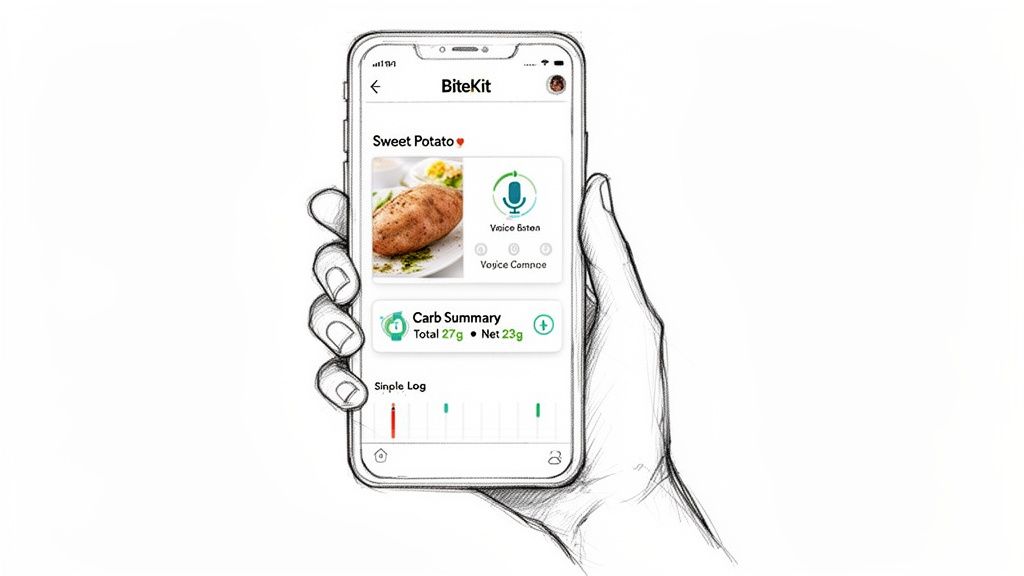
Knowing the carb count of a sweet potato is one thing. Actually using that knowledge day in and day out is where the real work—and the real results—happen. This is precisely where most people fall off the wagon with manual tracking. It just becomes a tedious chore.
Luckily, we don't have to do it the hard way anymore. The right tool can make the entire process feel less like a task and more like a natural part of your routine. This is exactly what BiteKit was built for. It’s designed to eliminate the usual headaches of food logging, letting you track your sweet potato intake in literal seconds and see what it means for your goals.
How to Log Sweet Potatoes in Seconds
Let's say you just polished off a delicious side of mashed sweet potatoes. The old way involved guessing the portion size, scrolling through endless database entries, and hoping you picked the right one.
With BiteKit, you can log it before you even clear your plate. Here are a few ways to do it:
- Photo Logging: Just snap a quick picture of your meal. The app's AI identifies the mashed sweet potatoes, estimates the amount, and logs the carbs for you. Done.
- Voice Logging: Tap the microphone icon and say something like, "I had a medium baked sweet potato and 150 grams of chicken breast." BiteKit transcribes it and adds it to your log instantly.
- Text Logging: You can also just type a quick note, like "sweet potato fries with salmon." The app is smart enough to break that down into individual items and calculate the macros.
This isn't about just being fancy; it's about being practical. When logging is this easy, you’re far more likely to stick with it. It means you spend less time buried in your phone and more time focused on your actual health.
Turning Raw Data into Real Progress
BiteKit goes way beyond simple carb counting. It’s about building a system for yourself that works. When you log a sweet potato, the app doesn't just add a number to your daily total. It confirms that 100 grams of raw sweet potato contain 20.1 grams of carbohydrates and immediately shows you how that fits into your bigger picture. You can see your daily macro bars adjust in real-time.
For a deep dive into the full nutrient breakdown, check out the nutritional profile of sweet potatoes and their health benefits on Healthline.com.
This immediate visual feedback is incredibly motivating. When you see exactly how a single food affects your progress, you start to connect the dots. The abstract numbers become tangible choices.
Think about it: someone just starting out might realize they’re eating sweet potatoes three times a week, which adds up to about 78 grams of carbohydrates. Seeing this clearly laid out allows them to make a simple tweak—maybe smaller portions or swapping one serving for a lower-carb veggie—to better hit their goals.
It transforms tracking from something you have to do into something that empowers you.
Answering Your Top Questions About Sweet Potato Nutrition
Alright, let's dig into some of the most common questions people have when they start tracking the carbs in sweet potatoes. Think of this as the expert FAQ you've been looking for.
Can Sweet Potatoes Actually Help with Weight Loss?
Absolutely. Sweet potatoes can be a fantastic tool for weight loss, and it really comes down to two things: fiber and satisfaction.
A single medium-sized sweet potato packs around 4 grams of fiber. That fiber is crucial because it helps you feel full and keeps you feeling that way longer. When you’re satisfied, you’re much less likely to wander into the kitchen looking for snacks or to overdo it at your next meal.
It's all about getting the most "fullness" for your calories. A 200-calorie baked sweet potato is worlds more satisfying than 200 calories of potato chips. It’s a simple swap that makes sticking to a calorie deficit feel less like a chore.
I once worked with a client who was struggling with high-fat cravings. We made one simple change: he could eat a sweet potato whenever he felt that craving hit. He ended up losing 30 pounds because he found that one potato was usually enough to feel completely full, naturally crowding out the other less-nutritious foods.
This is a perfect example of how high-volume, high-fiber foods can help you regulate your intake without feeling deprived.
So, Are They Low-Carb or Keto-Friendly?
This is where a lot of confusion comes in. While sweet potatoes are bursting with nutrition, they are definitely not a low-carb food. A medium sweet potato has about 22 grams of net carbs, which is a significant chunk of a low-carb dieter's daily budget.
Let's break it down:
- Standard Low-Carb Diets: If you're aiming for 50-150 grams of carbs a day, you might be able to fit a very small portion of sweet potato in. But you’ll have to plan your entire day around it carefully.
- Ketogenic Diets: On a strict keto diet (under 50g, often closer to 20g), a single sweet potato could blow your entire carb allowance for the day.
So, for anyone on keto, sweet potatoes are pretty much off the table. If you’re on a more flexible low-carb plan, a small serving is possible, but you’ll get more bang for your carb buck with veggies like broccoli, zucchini, and leafy greens.
Do Different Types of Sweet Potatoes Have Different Carb Counts?
Yes, but the difference is usually pretty small. For most of us, it’s not something to lose sleep over unless you're tracking your macros with extreme precision.
The common orange-fleshed sweet potatoes you see everywhere (like Jewel or Beauregard varieties) are all very similar nutritionally. The one you might notice a difference in is the Japanese sweet potato—the one with the purple skin and pale, almost white flesh. It tends to be a bit denser, starchier, and sweeter.
Because of this, it’s often slightly higher in calories and carbs per gram. On the flip side, some less common varieties might have more water, making them a little lower in carbs. But for all practical purposes, using a standard estimate of around 20 grams of carbs per 100g is a reliable starting point for any common type.
What's the Healthiest Way to Cook a Sweet Potato?
The "healthiest" method really depends on your goals, but if we're talking about pure nutrient preservation, steaming and boiling are the winners.
These gentler, water-based methods help preserve more of the water-soluble vitamins (like Vitamin C and B vitamins) that can get zapped by high, dry heat.
- Steaming: This is probably the best all-around method for nutrient retention. The potato isn't submerged in water, so fewer nutrients can leach out.
- Boiling: Boiling actually gives the sweet potato a lower glycemic index, which is great if you're focused on managing your blood sugar.
- Baking and Roasting: Don't get me wrong, a baked sweet potato is delicious! The high heat does cause some nutrient loss, but it also concentrates the flavor beautifully.
The one to avoid? Frying. It adds a ton of extra fat and calories, which really undermines the natural goodness of the sweet potato. A great compromise for flavor and health is to steam it first until it's tender, then toss it in the oven for a few minutes to roast.