Unlock Why You're Not Losing Weight: Science-Backed Fixes That Work
Discover why am i not losing weight and get science-backed reasons plus practical fixes to restart your progress today.
"Why am I not losing weight?"
It’s one of the most demoralizing questions you can ask, especially when you feel you're doing everything right. You're eating "clean" and hitting the gym, yet the number on the scale refuses to budge. The truth is, this is an incredibly common roadblock, and it almost always comes down to an unintentional mismatch between the calories you're eating and the calories you're burning.
Think of it like a personal budget. You might track your big expenses, but it’s the small, unaccounted-for purchases—that daily latte, a few extra sauces, or a couple of weekend splurges—that can quietly drain your account. Your body’s energy balance works the exact same way.
The Real Reason Your Weight Loss Has Stalled
If you're stuck in a weight loss plateau, you are not alone. And more importantly, this is a solvable problem. The solution rarely involves more extreme diets or grueling workouts. Instead, it’s about taking an honest look at the subtle, often invisible, factors that are quietly undermining your hard work.
This guide is your troubleshooter. We're not here to offer quick fixes or trendy diet hacks. We're going to dig into the evidence-backed reasons why fat loss stalls and give you a clear, actionable plan to get things moving again.
What We'll Unpack in This Guide
To figure out what's really going on, we have to move beyond generic advice. We’ll focus on the key areas that are almost always the culprits behind a frustrating plateau:
- Inaccurate Calorie Tracking: Humans are notoriously bad at estimating how much we eat. We’ll explore how “calorie creep” from small, overlooked sources can completely cancel out a deficit you think you’re in.
- Metabolic Adaptation: Your body is a master of survival. As you lose weight, it cleverly adapts by slowing down your metabolism to conserve energy, making it progressively harder to keep losing. We'll explain exactly how this works.
- Hidden Lifestyle Factors: Your progress isn’t just about food and fitness. We’ll investigate how things like poor sleep, chronic stress, and even certain medications can throw your hormones and metabolism out of whack.
Think of your weight loss stall not as a personal failure, but as a biological puzzle. Once you identify the missing or misplaced pieces—whether they're hidden calories, a slowed metabolism, or lifestyle habits—you can finally put them together correctly.
Our goal here is to give you the knowledge and the strategy to break through the frustration. By understanding the real reasons your efforts have stalled, you can make smart, targeted adjustments and finally start seeing the results you’ve been working so hard for.
1. You're Eating More Calories Than You Realize
So, you’re eating "healthy" and staying active, but the number on the scale just won't budge. If you're asking, "Why am I not losing weight?" you're not alone. The answer, more often than not, is hiding in plain sight: a simple but profound gap between what we think we’re eating and what we’re actually eating.
This isn’t about a lack of willpower; it's just human nature. We're all prone to underestimating our food intake, and it's the single most common roadblock in people's weight loss journeys. Think of it like trying to manage your finances without ever looking at your bank statement. You might remember the big-ticket purchases, but it’s the small, forgotten expenses—the daily latte, the handful of almonds, the extra splash of olive oil—that silently drain your account. Calories work the exact same way.
This infographic lays out the most common culprits that stall weight loss. As you can see, it's rarely just one thing.
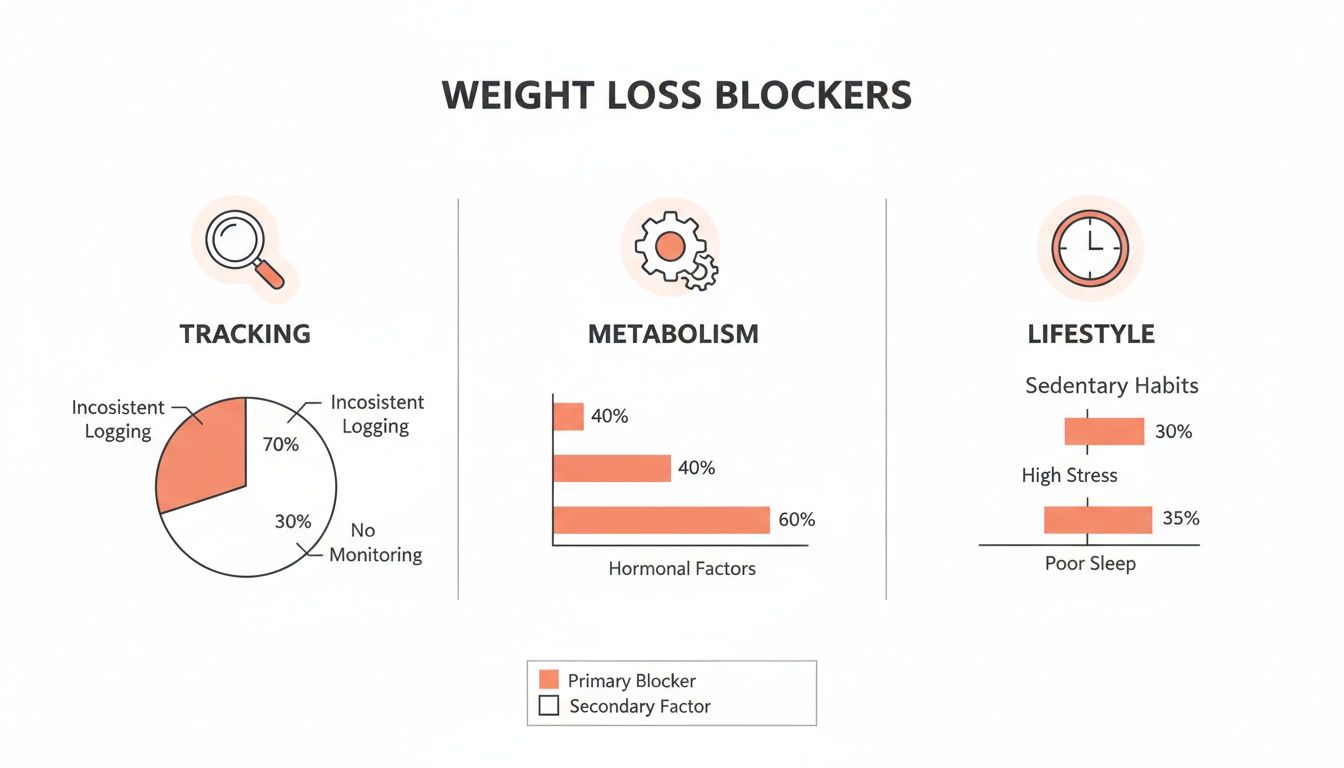
Solving the puzzle requires a holistic view. You have to consider tracking accuracy, metabolic factors, and your overall lifestyle together.
Your Brain Is A Poor Calorie Counter
Here's the thing: our brains evolved to find energy, not to meticulously account for every gram of it. This creates a well-documented phenomenon called under-reporting, where we consistently misjudge our daily food intake. Scientific studies show people can underestimate their calorie consumption by a staggering 20-50%.
Certain foods make this guesswork even harder. Restaurant meals are notorious for hidden fats and sugars, served in portions that have become deceptively large. That "healthy" salad can easily be sabotaged by a creamy dressing that packs more calories than a slice of cake. The same goes for ultra-processed snacks, which are engineered to be so delicious and calorie-dense that you can consume hundreds of extra calories before you even start to feel full.
It all comes down to a fundamental truth: diet has a much bigger impact on the number on the scale than exercise does.
A groundbreaking study analyzing energy expenditure across 34 global populations found that differences in physical activity only explained about 10% of the obesity trend linked to economic development. The other 90% was attributed to excess calorie consumption.
This research drives home a critical point. While exercise is absolutely essential for your health, you simply cannot outrun a diet that you aren't tracking accurately. When your perception of what you're eating is off by hundreds of calories every single day, it's no surprise the scale refuses to cooperate.
Spot the Hidden Calories
It's one thing to hear that we underestimate calories; it's another to see it in action. These "calorie blind spots" are everywhere. A tablespoon of olive oil isn't a "drizzle," and a "handful" of nuts can vary wildly. Let's look at a few common examples where our guesses often go wrong.
Common Food Estimation Errors You Might Be Making
This table reveals the surprising gap between perceived and actual calorie counts for everyday foods, highlighting how easily extra calories can add up.
| Food Item | Your Likely Guess | Actual Average Calories |
|---|---|---|
| 1 Tbsp Olive Oil | "Just a splash," maybe 40 calories? | ~120 calories |
| "A handful" of Almonds (~1/4 cup) | Seems light, maybe 100 calories? | ~205 calories |
| Grande Caffè Latte (2% milk) | It's mostly milk, so 120 calories? | ~190 calories |
| 2 Tbsp Ranch Dressing | It’s just for the salad, 70 calories? | ~140 calories |
| 1/2 Avocado | It's a healthy fat, maybe 90 calories? | ~160 calories |
Seeing the numbers side-by-side makes it clear. Just these five "small" items, if misjudged daily, could add over 400 unaccounted-for calories to your diet. That alone is enough to completely halt fat loss for most people.
From Guesswork to Certainty
The only way to break this cycle is to switch from guesswork to certainty. This doesn't mean you're doomed to a life of tedious food logging. Instead, think of it as a short-term diagnostic project—a tool to find the "energy leaks" in your daily habits.
By tracking your intake honestly for a week or two, you accomplish two crucial things:
- Establish a True Baseline: You finally get a real, objective look at your starting point. You might discover that what you thought was a 2,000-calorie diet is actually closer to 2,500.
- Build Lifelong Awareness: You start to internalize portion sizes and the true calorie cost of different foods. This empowers you to make smarter choices intuitively, long after you stop tracking.
This process is transformative. Suddenly, you see how the "little bit" of creamer, the sauce on your chicken, and the shared dessert all add up. The goal isn't to be perfect forever; it's to become informed.
For anyone ready to get an honest look at their habits, our guide on the best way to count calories provides practical strategies to make the process simple and effective. It's time to stop guessing and start knowing.
2. Your Metabolism Is Fighting Back (And That’s Normal)
So, you’ve been sticking to your calorie goals, but the scale just won’t budge. If you're wondering, "Why am I not losing weight?" when you know you're in a deficit, you’ve likely run headfirst into a powerful survival mechanism.
It’s not in your head, and it’s not a sign of failure. It's a completely normal biological response called metabolic adaptation, sometimes known as adaptive thermogenesis.
Think of your body as a hyper-efficient smartphone. When you run a lot of apps (high calorie intake), the battery drains fast. But when you switch to "low power mode" (a calorie deficit), the phone starts dimming the screen and closing background apps to make the remaining battery last as long as possible. Your body does the exact same thing.
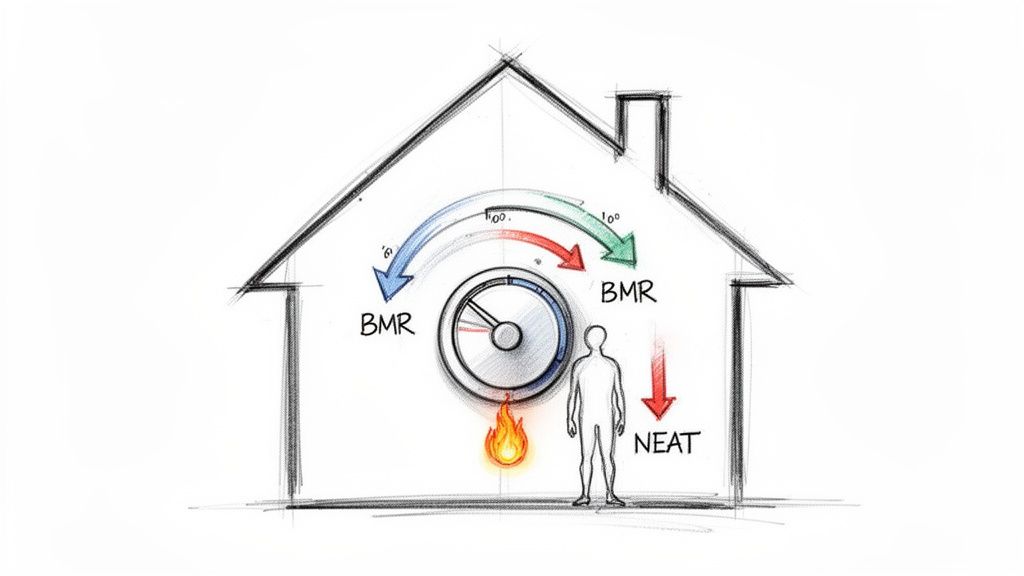
This slowdown is one of the most frustrating parts of any weight loss journey. It means you burn fewer calories than you used to, even when doing the same things. This biological pushback is the very reason weight loss plateaus feel so impossible to break.
How Your Body Cuts Its Energy Bill
Metabolic adaptation isn't just one thing—it’s your body getting smarter about energy conservation. This happens in a few key areas of your Total Daily Energy Expenditure (TDEE).
-
Your Resting Metabolism Slows Down: This is your Basal Metabolic Rate (BMR)—the energy you burn just to stay alive (breathing, circulating blood, etc.). As you lose weight, your BMR naturally drops because a smaller body needs less fuel. But during a diet, research shows BMR can drop even more than expected based on weight loss alone. That's your body's "low power mode" kicking in.
-
Your Activity Becomes More Efficient: The calories you burn from movement also take a hit. First, a lighter body simply requires less energy to move. But there’s a sneakier side to this: your Non-Exercise Activity Thermogenesis (NEAT) often plummets. NEAT is all the subtle movement you do without thinking, like fidgeting, tapping your foot, or taking the long way to the kitchen. Your body subconsciously dials these down to save every last calorie.
This whole process is a brilliant feature leftover from our ancestors. For them, famines were a real threat. A body that could slow its burn rate and conserve energy during lean times was a massive survival advantage. Today, that same survival code just feels like your body is working against you.
Once you get this, you can stop blaming yourself. You aren't doing anything wrong; your body is just running its ancient, very effective survival software.
The One-Two Punch: Hormones and Hunger
As if a slower metabolism wasn't enough, your hormones join the fight, too.
As you lose body fat, your levels of leptin—the hormone that signals to your brain that you're full and satisfied—begin to drop. At the same time, your levels of ghrelin, the "hunger hormone," rev up, making you feel ravenous.
This creates a perfect storm:
- Your metabolism is burning fewer calories.
- Your brain is screaming at you to eat more calories.
It feels like you're fighting a battle on two fronts, and that’s because you are. The frustration you feel is a direct, physical result of these powerful internal signals pushing you back toward your starting weight.
The good news? You’re not helpless. Now that you know metabolic adaptation is a predictable part of the process, you can start using strategies to outsmart it, like implementing planned diet breaks or refeeds. You can get a clearer picture of what's happening with our adaptive thermogenesis calculator, which helps estimate how your metabolism might be adjusting.
Recognizing this biological reality is the first step toward getting your progress back on track.
3. Lifestyle Saboteurs: Stress, Sleep, and Health Conditions
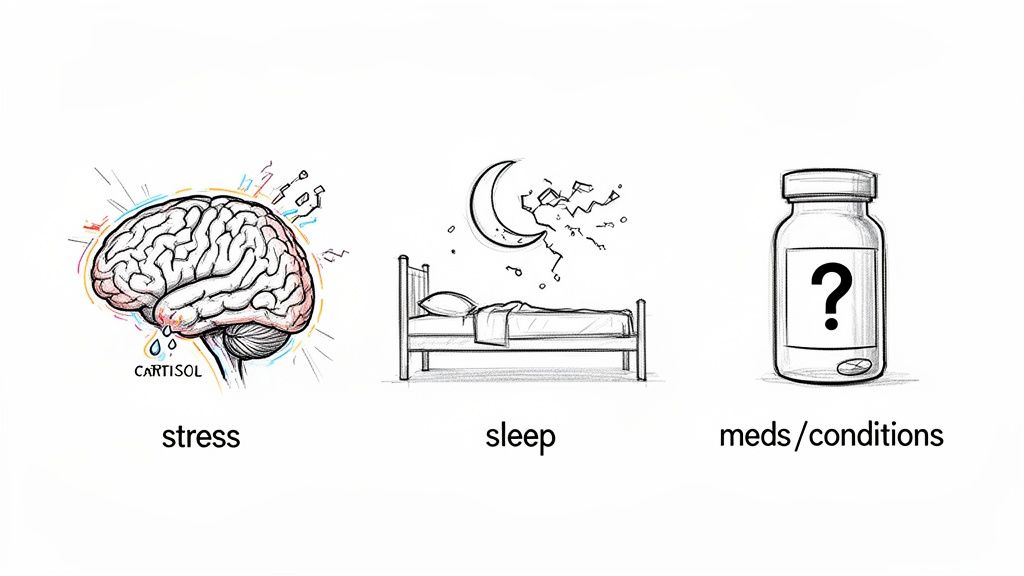
So you’ve tightened up your diet and your metabolism is still putting up a fight. When that happens, it’s time to look beyond what’s on your plate or how you’re moving. More often than not, the real answer to the dreaded "why am I not losing weight?" question lies with a few hidden saboteurs: stress, sleep, and underlying health issues.
These factors can throw a massive wrench into the hormonal machinery that governs your appetite, fat storage, and energy. Even with perfect calorie tracking, they can make fat loss feel downright impossible. It's like trying to row a boat upstream in a powerful current—you can have flawless technique, but the force working against you is just too strong.
The Stress-Fat Connection
In our high-pressure world, chronic stress feels like a permanent fixture for many. But this isn't just a mental burden; it triggers very real physical changes, mostly through a hormone called cortisol. While a little cortisol is fine, consistently high levels can seriously mess with your weight loss efforts.
When your body is swimming in cortisol, it gets a constant signal to prepare for a crisis by storing energy. And it's picky about where it stores it, favoring visceral fat—the dangerous kind that pads your organs deep in your abdomen.
On top of that, cortisol directly influences what you want to eat. It hijacks your brain, revving up cravings for high-fat, high-sugar "comfort" foods. This isn't a lapse in willpower; it's a physiological command that makes sticking to a healthy plan feel like an uphill battle.
How Poor Sleep Rewires Your Appetite
Just one night of bad sleep is enough to throw your body's delicate hormonal balance into chaos. Two key hormones that regulate appetite are the first to go haywire.
- Ghrelin: Think of this as the "go" signal for hunger. When you're sleep-deprived, ghrelin levels shoot up, making you feel far hungrier than usual.
- Leptin: This is the "stop" signal, telling your brain you're full. After a poor night's rest, leptin levels take a nosedive.
You're left with a hormonal double-whammy: you wake up ravenous and find it much harder to feel satisfied after meals. One study highlighted this perfectly, finding that people who slept only four hours ate an average of 300 extra calories the next day compared to when they were well-rested.
This hormonal shift is your body's clumsy attempt to get energy from food when it couldn't get it from rest. It creates a vicious cycle that can make maintaining a calorie deficit feel practically impossible.
When It’s More Than Just Diet and Exercise
Sometimes, no matter how hard you try, the real roadblock is an underlying medical issue or even a medication you're taking. These factors can put up metabolic hurdles that no amount of clean eating or gym time can overcome on their own.
A few health conditions are notorious for making weight loss difficult:
- Hypothyroidism: When your thyroid is underactive, your entire metabolism slows to a crawl, meaning you burn far fewer calories just existing.
- Polycystic Ovary Syndrome (PCOS): This common hormonal disorder often causes insulin resistance, which primes the body to store fat, especially around the midsection.
- Sleep Apnea: By repeatedly interrupting breathing during sleep, this condition tanks sleep quality and triggers the exact hormonal chaos we just talked about.
It's also worth noting that many common medications can cause weight gain as a side effect. These can include certain antidepressants, steroids, and even some drugs for managing diabetes or high blood pressure.
If any of this sounds familiar, it's essential to talk to a doctor. Trying to white-knuckle your way through a medical-related weight plateau is not only frustrating but can be harmful. A professional can run the right tests, get to the root of the problem, and help you create a plan so your hard work can finally start paying off.
4. Inconsistency Is Undoing Your Hard Work
Let's be honest. You were crushing it all week. You tracked your calories, sidestepped the office donuts, and even got your steps in. Then the weekend rolled in. A dinner out with friends, a few drinks to unwind, and suddenly, it feels like all that hard work just vanished. If that cycle sounds painfully familiar, you’ve run headfirst into one of the biggest—and most frustrating—roadblocks to losing weight: inconsistency.
Many of us fall into the “all-or-nothing” trap. We think we have to be perfect, so we follow a super-restrictive plan that’s simply not built for real life. This inevitably leads to a cycle of intense discipline followed by a "what the heck" period of overindulgence, which cancels out any real progress you might have made.
This isn't just a feeling. It's a pattern researchers have seen time and time again. While most people can lose weight for a little while, keeping it off is a whole different ballgame. The problem is that those rigid, hyper-focused habits just aren't sustainable for weeks, months, and definitely not years.
The Weekend Wipeout Effect
Think of your weekly calorie deficit like a savings account. Let's say you stick to your plan and save $20 a day from Monday to Friday. Great! You're up $100. But if you turn around and splurge, spending an extra $50 on Saturday and another $50 on Sunday, you end the week exactly where you started.
That’s precisely what happens with our energy balance. A steady 400-calorie deficit during the week is a fantastic way to build momentum. But a single weekend of untracked meals, a few cocktails, and some "I deserve it" treats can easily tack on an extra 1,500-2,000+ calories. Your hard-earned weekly deficit is gone in a flash. You're not just stalling; you're running in place.
This on-again, off-again cycle is emotionally draining. It reinforces the idea that you’re either “perfect” or a “failure,” with no middle ground for the balanced approach that actually leads to long-term success.
So why does this happen? A lot of it comes down to the sheer hassle of old-school tracking. Scanning barcodes for every little thing, endlessly searching databases for ingredients, and trying to guess the portion size of your mom's lasagna—it's exhausting. That mental fatigue makes it incredibly easy to throw in the towel, especially when life gets stressful.
The Science of Unsustainable Efforts
The struggle with keeping weight off is a well-known reality in clinical research. The data is clear: getting the weight off is one thing, but keeping it off is where the real work begins. This is where we need to shift our focus from temporary dieting to building habits that last.
For instance, some studies have found that a staggering 80-95% of people who lose weight eventually regain it all within five years. People often manage an initial drop of about 10% of their body weight, but they find the behaviors that got them there are nearly impossible to maintain. Other research underscores just how tough it is; one study found only about 1 in 8 men and 1 in 7 women with a BMI over 30 were able to keep off even a 5% weight reduction for a year. You can dig deeper into these challenges in journals like Health Psychology Open.
A major reason for this pattern is the lack of an easy, accurate way to stay aware of what you’re eating. Traditional nutrition apps create so much work that most people just stop using them. When the very tool that’s supposed to help you becomes a chore, consistency falls apart, and the weekend wipeout takes over.
This is why the answer isn't more willpower or even stricter rules. It’s about making consistency feel almost effortless. When you can log an entire meal just by snapping a photo or saying what you ate, the friction disappears. We designed BiteKit to solve this exact problem, using AI to turn a simple photo or voice note into instant, accurate nutritional info.
By taking the tedious work out of the equation, it becomes simple to stay on track, even on your busiest days or during a relaxed weekend. That’s how you build the consistency needed to finally break the cycle and see the lasting change you've been working for.
Your Action Plan to Break the Plateau
Alright, we’ve pinpointed the common culprits behind a weight loss stall. Knowing why you’re stuck is half the battle, but now it's time to actually do something about it.
This isn’t about another drastic diet overhaul. We're going to use a methodical, step-by-step approach to figure out what's really going on and make a few smart adjustments. These small, sustainable changes are what actually deliver results and get the scale moving in the right direction again.
Step 1: Start With a Two-Week Data Sprint
Before you even think about changing a single thing, you need a crystal-clear picture of your starting point. The first thing I have clients do is commit to two weeks of brutally honest food tracking.
The goal isn't to eat "perfectly." It’s to be 100% truthful with yourself. That means logging every last drop of sauce, every splash of cooking oil, that handful of nuts you grabbed on the way out the door, and yes, even the weekend cocktails. This isn't about guilt; it's about gathering accurate data so you can stop guessing.
Step 2: Compare Your Intake to Your Needs
Once you have two weeks of real-world data, it’s time for a quick audit. First, calculate your Total Daily Energy Expenditure (TDEE)—that’s a fancy term for how many calories your body burns in a day. Then, compare that number to the average daily calorie intake from your tracking log.
This is the moment of truth. Are you actually in a calorie deficit? I’ve seen it countless times: people are shocked to discover that what felt like a 500-calorie deficit was barely a deficit at all, or sometimes even a surplus. You can use a solid calorie deficit calculator to get a reliable estimate of your body's energy needs.
The global obesity epidemic is projected to affect 18% of men and 21% of women worldwide by 2025. A massive driver of this is the explosion of ultra-processed foods, which are engineered to be hyper-palatable and make it incredibly easy to overeat without even noticing. You can read more in the World Obesity Federation's global targets report.
This is exactly where tools like BiteKit can make a huge difference. By analyzing a quick photo, voice note, or text, it gives you an instant and accurate calorie breakdown. It turns those mindless nibbles and overlooked calories into clear, actionable data.
Step 3: Make Small Swaps, Not Drastic Cuts
If your audit shows you're not in a consistent deficit, the natural reaction is to want to slash calories dramatically. Resist that urge. The key to long-term success is making small, high-impact swaps you can actually stick with.
Here are a few simple ideas:
- Ditch Liquid Calories: That sugary soda or flavored latte can be a huge calorie bomb. Switching to water, black coffee, or unsweetened tea is one of the easiest wins.
- Watch the Toppings: Just one tablespoon of ranch dressing or mayonnaise can easily add 100+ calories. Try lighter options like salsa, mustard, or a simple vinaigrette instead.
- Go Whole, Not Processed: Instead of a bag of chips for a snack, try an apple with a small handful of almonds. You get far more volume, fiber, and nutrients for your calorie buck, which keeps you feeling full.
These seemingly minor tweaks really add up, helping you create a meaningful deficit without feeling deprived.
Finally, what if you've done the audit, confirmed you're in a real deficit, and the scale still hasn't budged for a few more weeks? It's time to look at those other factors. Consider a planned diet break for 1-2 weeks, eating at your maintenance calories to give your hormones a chance to normalize and combat metabolic adaptation. Double down on getting 7-9 hours of quality sleep and find a stress management practice that works for you, like a daily walk or meditation.
If you’ve tried all of this consistently and are still stuck, it’s a good signal to book an appointment with your doctor to rule out any underlying medical issues.
Common Questions (and Honest Answers) About Weight Loss Stalls
When you're working hard but the scale isn't moving, it’s natural to have questions. Let's tackle some of the most common ones with straightforward, experience-backed answers to help you figure out what's really going on.
How Long Until I Should See Results From a Calorie Deficit?
If you're consistently eating in a 300-500 calorie deficit each day, you should start seeing the number on the scale begin to trend downward within one to two weeks. Don't panic over day-to-day jumps and dips—that's almost always just normal shifts in water weight, not a sign that you've failed.
The real story is in the weekly average. If you've been tracking accurately for two full weeks and your average weight hasn't budged, that's your cue. It’s time to take another look at your calorie target or how much you're moving.
Do I Have to Count Calories Forever to Lose Weight?
Absolutely not. But think of it this way: using a good tracking tool for a little while is like a short-term diagnostic. It's the fastest way to learn what real portion sizes look like and to understand the calorie cost of the foods you eat regularly.
The point isn’t to get stuck counting for life. It's to build the food awareness you need to eventually make smart choices intuitively, without the guesswork.
I Exercise All the Time. Why Am I Not Losing Weight?
This is one of the most common frustrations out there, and it almost always boils down to one simple truth: you can't outrun your fork. Your diet is responsible for about 80% of your weight loss results.
It's also incredibly easy to overestimate how many calories you torch during a workout. We often feel like we've earned a big "reward" meal, but that reward can easily wipe out the entire calorie deficit you just worked so hard to create. Tracking helps ensure your exercise is actually contributing to your goal, not just giving you a license to overeat later.
Should I Focus More on Cutting Calories or Increasing Exercise?
For pure weight loss, adjusting your diet is hands-down the more efficient path. For instance, you could go for a 30-minute run to burn about 300 calories, or you could simply skip the 300-calorie croissant you were eyeing. The second option is a lot easier and takes zero time.
Of course, the best approach does both. Combining a sensible calorie deficit with consistent physical activity is the gold standard. It not only helps with fat loss but also does wonders for your health, muscle tone, and overall body composition.