The Best Way to Count Calories for Sustainable Weight Loss
Discover the best way to count calories for results you can maintain. This guide covers smart tracking methods, accurate portioning, and sustainable habits.

The best way to count calories isn't about rigid, obsessive tracking. It’s about building awareness with a flexible approach—one that uses smart, efficient tools to turn logging from a soul-crushing chore into a sustainable habit.
Why Traditional Calorie Counting Often Fails
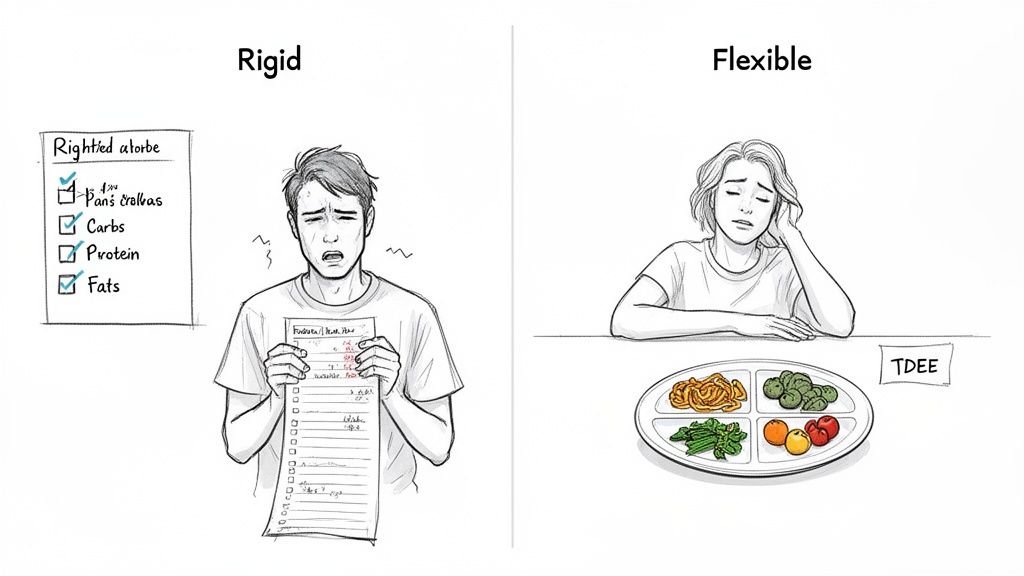
Let's get one thing straight: most people who try counting calories eventually give up. The problem isn't the science of energy balance; it's the old-school, time-consuming methods we were all taught. That frustrating cycle of starting, getting overwhelmed, and quitting is a well-documented phenomenon.
The traditional approach feels like taking on a second job. You’re expected to weigh every morsel, dig through confusing food databases, and agonize over every snack. This manual grind inevitably leads to burnout, making the whole thing feel like a punishment instead of a tool for empowerment.
This is where we separate a frustrating chore from a sustainable habit. It all comes down to building a smart, flexible strategy that actually works with your life, not against it.
Understanding Your Personal Energy Needs
Before you can manage calories effectively, you need a starting point. This begins with understanding your Total Daily Energy Expenditure (TDEE). Think of your TDEE as your body's daily energy budget, covering everything from breathing and digesting to your workouts.
Several factors influence your TDEE:
- Basal Metabolic Rate (BMR): The energy your body burns at complete rest. This is the largest component of your TDEE.
- Thermic Effect of Food (TEF): The calories used to digest and process the food you eat, which can account for up to 10% of your daily energy expenditure.
- Physical Activity: All the calories you burn through movement, from a gym session to walking up the stairs.
Knowing your TDEE gives you a realistic target to work with. While you might see general recommendations, a personalized TDEE calculation, often using formulas like the Mifflin-St Jeor equation, provides a much more effective starting point.
Once you have that number, you can create a sensible goal. For sustainable fat loss, scientific evidence supports a modest deficit of 300-500 calories per day. This approach helps maximize fat loss while minimizing muscle loss and preventing the extreme hunger that can derail progress.
The goal isn't just to eat less; it's to eat smarter. A sustainable calorie target should fuel your body and support your activity levels, not leave you feeling constantly deprived.
Beyond the Numbers: The Role of Macronutrients
Just hitting a calorie number isn't the whole story. The quality of those calories matters—a lot. This is where macronutrients (protein, carbs, and fats) enter the picture. Getting the balance right is the real secret to feeling full, energized, and seeing the results you want.
Think about it: a 400-calorie snack of grilled chicken and broccoli will keep you satisfied for hours, while a 400-calorie pastry will leave you hungry again in no time. This is due to the powerful effect of protein on satiety. Furthermore, protein has a higher thermic effect of food (TEF) than carbs or fats, meaning your body actually burns more calories just digesting it.
A balanced macro split ensures you're not just losing weight, but also preserving lean muscle and fueling your body properly. While the ideal ratio varies, prioritizing protein is a scientifically-backed strategy for managing hunger and supporting muscle mass during weight loss. You can dive deeper into this in our guide on how to count macros for fat loss.
Adopting a Mindset of Awareness, Not Obsession
The most successful people have one thing in common: they shift from rigid counting to mindful awareness. Instead of obsessing over every single calorie, they learn to make informed choices based on a solid understanding of their needs.
This means you don't have to be perfect. If you estimate a restaurant meal and you're off by 50 or 100 calories, it's not going to derail your progress. Research consistently shows that long-term adherence to a dietary plan is a far greater predictor of success than short-term perfection.
By focusing on building a better relationship with food and getting a feel for portion sizes, you develop skills that stick with you for life. This foundation is what allows you to eventually move beyond the numbers and start trusting your body’s own hunger and fullness cues. It’s this sustainable mindset that truly defines the best way to count calories.
Choosing a Calorie Tracking Method You Can Stick With
Let’s get one thing straight: the "best" way to count calories isn't a specific app or a fancy spreadsheet. It’s the one you actually use. Day in and day out. Consistency is the engine that drives results, so forget what you think you should be doing and find a method that feels less like a chore.
Ultimately, the tool you use matters far less than the habit of using it. Scientific evidence backs this up time and again, showing that simply sticking with it—adherence—is the biggest predictor of weight loss success.
For example, a major study with 1,685 participants published in the Journal of Diabetes Research found that the frequency of dietary self-monitoring was a key determinant of weight loss. The people who logged their food most consistently saw the most significant weight loss. Those who tracked less often? Not so much. Consistency is king.
Old School vs. New School Tracking
Not too long ago, calorie counting meant carrying a notepad, guesstimating your portions, and then spending your evening cross-referencing everything with a food value book. It was slow, tedious, and notoriously inaccurate. While some people still love the feel of pen and paper, it’s a high-friction method for most of us.
Thankfully, technology has completely changed the game. Today’s tools are designed to slash that friction, making tracking a seamless part of your daily routine. The goal is to shrink the time between eating and logging to just a few seconds.
Modern methods usually fall into a few camps:
- Manual Database Entry: This is the digital standard. You search a database for "chicken breast" or "avocado" and log it. It's better than a notebook, but it can still get tedious with complex, multi-ingredient meals.
- Barcode Scanning: A lifesaver for packaged goods. Just scan the barcode, and the nutrition info pops right up. The downside? It’s useless for fresh produce, that homemade chili, or your favorite dish from the local cafe.
- AI-Powered Logging: This is where things get really interesting. New apps let you log meals just by snapping a photo, speaking a voice note, or typing a quick description. It's incredibly fast.
The most effective tracking system is the one that demands the least amount of your time and willpower. If logging a meal takes more than a minute, you're far less likely to do it when life gets busy.
Finding Your Perfect Fit
So, which method is right for you? It really comes down to your personality and lifestyle. A competitive athlete might actually enjoy the precision of weighing every gram of food, while a busy parent needs a method that’s practically instantaneous.
To help you decide, let's look at the different approaches you can take.
Comparing Calorie Counting Methods
Choosing a tracking method is a personal decision, and what works for one person might not work for another. This table breaks down the most common methods to help you find your ideal fit based on speed, accuracy, and convenience.
| Method | Speed | Accuracy | Convenience | Best For |
|---|---|---|---|---|
| Photo Logging | Fastest | Good (AI-estimated) | High | Visual people, complex meals, and those who hate typing. |
| Voice Logging | Very Fast | Good to Excellent | High | Multitaskers, people on the go, and verbal processors. |
| Text Logging | Fast | Good to Excellent | High | Detail-oriented people who know precise amounts. |
| Barcode Scanning | Very Fast | Excellent | Medium | People who eat a lot of packaged foods. |
| Manual Search | Slowest | Excellent | Low | Those who need maximum precision and have the time. |
| Pen & Paper | Very Slow | Poor to Good | Very Low | Tactile learners who don't need high precision. |
Ultimately, the best approach is the one that feels the most natural and least disruptive to your daily life.
Let's explore a few of the more modern, streamlined options.
Photo Logging It’s as simple as it sounds. You just snap a picture of your meal, and AI analyzes the image to identify what you're eating and estimate the portions.
- Best for: Visual people, anyone eating complex or homemade meals, and someone who wants the absolute fastest way to log food.
Voice Logging Just say what you ate out loud. Something like, “I had a bowl of oatmeal with blueberries and a scoop of protein powder.”
- Best for: Multitaskers, people who are often driving or have their hands full, and anyone who’d rather talk than type.
Text-Based Logging Type in a natural description of your meal, like “150g grilled chicken with a side of quinoa and roasted broccoli.”
- Best for: People who think in specifics and want a quick way to enter precise amounts without clicking through a bunch of menus.
The real key here is to experiment. Try out a few of the best free nutrition tracking apps, as many of them offer a mix of these features. See which one feels the most intuitive to you. If a method isn’t clicking after a few days, don't be afraid to switch. Your ability to stick with it is the only thing that matters for long-term success.
Mastering Portion Sizes Without a Scale
This is where most calorie counts go off the rails: portion distortion.
We've all been there. An extra splash of olive oil in the pan, a slightly-too-generous scoop of peanut butter, or a chicken breast that's a bit larger than usual. These little things can quietly add hundreds of calories to your day, completely undermining your hard work. Getting a handle on portion sizes is a skill that gives you tracking freedom for life, especially when you’re eating out or away from your kitchen.
While modern apps can identify what you're eating, figuring out how much is on your plate is a different beast entirely. A little upfront effort here pays off in a huge way down the road.
Calibrate Your Eye with a Digital Scale
The best way to get good at estimating portions is to start with the gold standard: a simple digital food scale.
Now, I know what you're thinking. Weighing food sounds tedious, but stick with me. Think of this as a short-term training program, not a lifelong chore. The goal isn't to weigh every meal forever; it's to teach your eyes what a real serving looks like.
For just a few weeks, weigh the foods you eat most often. Measure out 100 grams of chicken, a 30-gram serving of almonds, or a cup of cooked rice. Really look at what these portions look like on your plate, in your bowl, and in your hand.
You’ll have a few "a-ha!" moments. You'll quickly discover that what you thought was a "normal" serving of peanut butter is actually three, or that your "small" bowl of cereal is closer to two standard servings. After a couple of weeks, you'll have built a powerful mental catalog of portion sizes that lets you estimate with surprising accuracy.
Using a food scale for a short period is like learning to ride a bike with training wheels. It gives you the stability you need to build confidence before you can ride freely on your own.
Use Your Hands as a Portable Measuring Tool
Once you've trained your eye, you need a practical way to estimate portions when a scale isn't around. This is where your hands become your secret weapon. They're surprisingly consistent, and best of all, they're always with you.
Here are a few simple, reliable visual cues you can use anywhere:
- Palm for Protein: The size and thickness of your palm (not including your fingers) is a great stand-in for a 3-4 ounce (85-113g) serving of cooked meat, poultry, or fish.
- Fist for Carbs: A closed fist is roughly the same volume as one cup. Use this to gauge servings of rice, pasta, potatoes, or fruit.
- Cupped Hand for Snacks: A cupped handful is perfect for measuring smaller, calorie-dense items like nuts or trail mix, typically about a quarter-cup.
- Thumb for Fats: From tip to base, your thumb is about the size of one tablespoon. This is perfect for eyeballing portions of oils, salad dressings, or nut butters.
These visual guides turn portion control from a guessing game into a quick, reliable check. For more tips on this, check out our guide on how to measure food without a scale.
Real-World Examples in Action
Let's see how this works with a common restaurant meal: grilled salmon with roasted potatoes and a side salad.
- The Salmon: Take a look at the fillet. Does it match the size and thickness of your palm? If so, you can confidently log it as a 4-ounce portion.
- The Potatoes: Now, eyeball the pile of roasted potatoes. Does it look about the size of your closed fist? That’s your one-cup serving.
- The Salad Dressing: The dressing was likely served on the side or drizzled on top. If it looks like about two thumb-sized amounts, you can log it as two tablespoons of vinaigrette.
This whole process takes maybe ten seconds, but it adds a huge amount of accuracy to your log. You can make informed estimates without being that person who pulls out a food scale at the dinner table. It's all about combining that short training period with a scale and then consistently using these hand-based cues to build a lifelong skill for accurate tracking, no matter where you are.
Your Daily Workflow for Effortless Calorie Tracking
Knowing the theory is one thing, but how does this play out on a hectic Tuesday morning when you’re just trying to get out the door? The best way to count calories isn't about being perfect; it's about building a simple system that becomes a natural part of your routine. Think of it as creating tiny, repeatable habits that make consistency feel second nature.
Let’s walk through a realistic day to see how this actually works. You'll see that modern tracking can take just a few seconds per meal, turning what used to be a chore into a quick, empowering check-in.
A Day in the Life of Smart Tracking
Picture your morning. Instead of fumbling through an app, manually searching for every ingredient in your breakfast, you just snap a photo of your oatmeal with berries and almonds. The app instantly recognizes the food, estimates the portion sizes, and logs it. The entire process takes less than 10 seconds.
Lunchtime rolls around, and you've got leftovers from last night’s chili. Since you already logged that meal as a custom recipe, today’s entry is even faster. Just tap "Chili, 1.5 cups," and you’re done. There's no need to re-enter all seven ingredients from scratch.
Later, you grab a protein bar for an afternoon snack. This is where barcode scanning shines. One quick scan, and the exact nutritional info is pulled in and logged instantly. This mix-and-match approach is the secret to making tracking feel easy—using photos for complex plates, custom entries for your go-to meals, and barcodes for packaged goods.
Your tracking method should adapt to your meal, not the other way around. The goal is to use the quickest tool for the job, whether that's a photo, a saved recipe, or a barcode scan.
This is where training your eye becomes a foundational skill. It's a simple process that helps this entire workflow click into place.
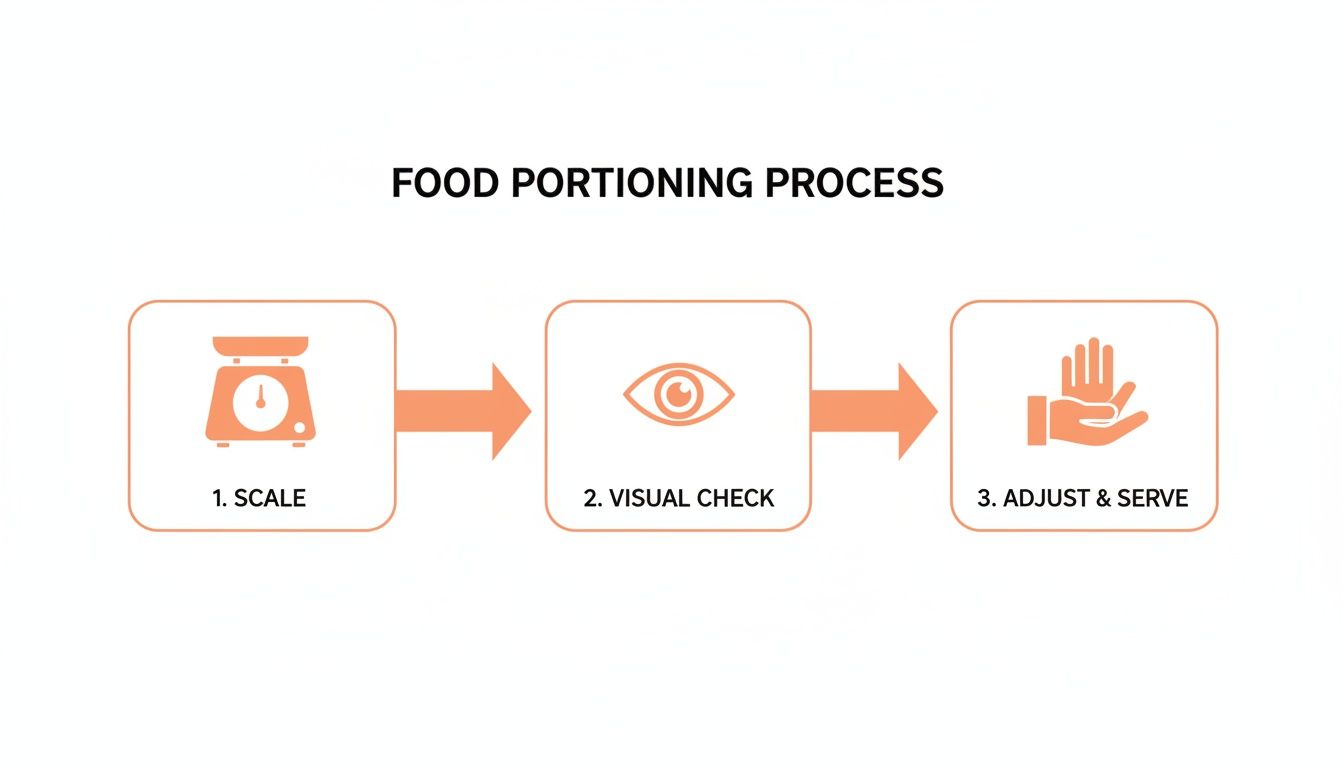
This visual shows you exactly how to progress from relying on a scale for precision to eventually using just your eye for quick, on-the-fly estimations.
Pro Tips for Maximum Efficiency
To make this system even smoother, here are a few strategies I've picked up over the years that have saved me a ton of time. These little adjustments are what really separate a temporary diet from a sustainable lifestyle.
Pre-Log Your Meals If you already know what you're having for dinner, log it in the morning or even the night before. This does two brilliant things:
- It saves time later. When you're wiped out after a long day, the last thing you feel like doing is logging a meal.
- It helps you plan. Seeing your day's calories mapped out helps you make smarter choices with your other meals and snacks, so you can easily stay on track.
Mastering Restaurant Meals Eating out doesn't have to throw a wrench in your progress. Before you even leave, check if the restaurant has nutrition info online. If they don't, it’s time to use your estimation skills. Mentally break the dish down into its main parts (like "grilled chicken," "roasted asparagus," "sweet potato") and log those separately using your hand-portioning guides.
A good-faith estimate is always, always better than not logging at all. For example, using an app like the BiteKit for iOS or Android lets you take a picture of your restaurant meal, giving you a really solid starting point in seconds.
Navigating Common Calorie Counting Hurdles
Even if your tracking system is perfect, life will eventually throw you a curveball. You’ll hit a weight loss plateau, stare down a holiday dinner, or find a food database entry that just feels completely off. This is where most people get frustrated and bail.
But learning how to be flexible and make smart adjustments is what separates short-term dieting from lasting success. It’s about solving problems as they come up, without letting them derail your entire effort. Think of this as your field guide for the most common roadblocks you'll encounter.
When Your Weight Loss Stalls
It's the most common frustration in the book: you've been doing everything right for weeks, and suddenly, the scale just stops moving. Welcome to the weight loss plateau. It's a completely normal part of the process. Your body is smart, and as you lose weight, it adapts by becoming more efficient and burning fewer calories—a phenomenon known as metabolic adaptation.
Instead of panicking, it's time to make a calculated adjustment. Here are a few strategies to break through:
- Make a Small Calorie Tweak: Shave another 100-150 calories off your daily target. This is often just enough to kickstart progress again without making you feel deprived.
- Re-evaluate Your Activity: Have your workouts gotten a little easier? Maybe you're not pushing as hard. A small bump in activity—like adding an extra walk or a few more minutes at the gym—can make a huge difference.
- Focus on Macronutrients: If you haven't been prioritizing protein, now’s the time to start. Protein keeps you full and has a higher thermic effect, meaning your body burns more calories just digesting it.
A plateau isn't a sign that you've failed. It's simply a signal that your body has adapted and needs a new challenge.
Handling Inaccurate Food Database Entries
Nothing is more infuriating than searching for "homemade lasagna" and getting a dozen entries with calorie counts that are all over the map. This database chaos can make you question if any of your logging is accurate. Don't let it.
When you run into a sketchy entry, the best move is to build your own. Just break the dish down into its core ingredients—ground beef, pasta, ricotta cheese, tomato sauce—and log them one by one. Sure, it takes an extra minute the first time you do it. But you can save it as a custom recipe.
The next time you make that meal, you can log it with a single tap, confident that the nutritional information is spot-on. This approach turns a moment of frustration into a long-term time-saver.
Managing Hunger and Cravings
Being hungry all the time is the number one reason people give up. If you're constantly fighting off hunger, it’s a sign your plan needs a tune-up, not that you lack willpower. The quality of your calories matters just as much as the quantity.
To fight back against hunger, focus on nutrient-dense, high-volume foods. These are foods that take up a lot of space in your stomach for relatively few calories, making you feel full.
Foods to Prioritize for Satiety:
- Lean Proteins: Chicken breast, fish, Greek yogurt, and egg whites are incredibly filling.
- Fibrous Vegetables: Broccoli, spinach, leafy greens, and cucumbers add serious bulk to meals without a ton of calories.
- Complex Carbohydrates: Oats, quinoa, and potatoes provide sustained energy that keeps you satisfied way longer than simple sugars.
Often, just swapping a processed snack for a whole-food option can completely change how hungry you feel throughout the day.
Seeking Professional Guidance for Better Results
While tracking on your own can be effective, bringing in an expert can be a total game-changer. The best way to count calories isn't always a solo mission. A pro can offer personalized tweaks and accountability that are tough to replicate by yourself.
This isn't just an opinion; the data backs it up. Professional support transforms how well calorie counting works. Research shows that people who got guidance from a dietitian while tracking lost 9.1% of their body weight and kept it off for 18 months. The self-guided group? They only lost 4.3%.
That's a 111% improvement in weight loss, which proves a critical point: the tracking method itself matters less than the guidance you have around it. You can dive deeper into these powerful findings on this nutrition analysis site.
Navigating Social Events and Holidays
Finally, remember that life is meant to be lived. Holidays, birthdays, and dinners out with friends are a huge part of that. A flexible mindset lets you enjoy these events without feeling guilty or throwing your goals out the window.
Plan ahead a bit. If you can, look at the menu online and decide what you'll have. Then, enjoy it mindfully. One indulgent meal won't undo weeks of progress. Just make your best guess, log it, and get right back on track with your next meal. Consistency over time is what matters, not a single day of perfection.
Got Questions About Calorie Counting? Let's Talk.
When you first start counting calories, a lot of questions pop up. It's totally normal. Let's tackle some of the most common ones I hear so you can track with confidence instead of confusion.
How Long Should I Do This For?
Think of calorie counting as a short-term educational tool, not a life sentence. The real magic happens in the first few months. This is your learning phase.
During this time, you're doing more than just logging numbers—you're training your eyes and your brain. You start to intuitively grasp what a proper portion of rice looks like or how much oil you're really adding to the pan. This is the skill that sticks with you long after you stop tracking every single meal.
Once you’ve built that awareness, you can ease off and shift to a more intuitive style of eating. Of course, if you have a very specific goal—like an athlete dialing in for a competition—you might track more strictly for longer. But for most of us, the goal is to learn the ropes and then fly on our own.
What About When I Eat Out? Can I Still Be Accurate?
Absolutely. Eating out is part of life, and your plan needs to accommodate it. It just takes a little detective work and being okay with a good estimate.
Your first move should always be to check the restaurant's website. You'd be surprised how many chains post their nutrition info online, giving you an exact number before you even walk in the door.
If that's not an option, break the meal down. Instead of trying to log "Grandma's Lasagna," think about the ingredients: pasta, ground beef, ricotta cheese, tomato sauce. Use the hand-portioning tricks we talked about to estimate the amounts. It's not about perfection.
A solid estimate is a thousand times better than logging nothing at all. Skipping an entry breaks your momentum, but a good-faith guess keeps you in the game.
Do I Really Have to Weigh My Spinach?
Great question. The answer depends entirely on the vegetable. For the really low-calorie, watery stuff—think spinach, lettuce, cucumbers, bell peppers—the calorie hit is tiny. They're mostly water and fiber.
For general health and weight management, not logging these specific veggies is perfectly fine. It saves you a ton of time and helps prevent tracking burnout. Your focus should be squarely on the calorie-dense items: proteins, fats, and carb sources.
But here’s the key distinction: you do need to track starchy vegetables like potatoes, corn, and peas. The same goes for all fruit. These foods pack a more significant carbohydrate and calorie punch, so leaving them out of your log will throw your daily numbers off.