How to Measure Food Without a Scale: A Practical Guide
Discover how to measure food without a scale using proven methods. Our guide offers practical, science-backed tips for accurate portion control anywhere.
Let's be real—nobody wants to carry a food scale in their bag. It’s just not practical for managing weight loss or fitness goals long-term. The real trick to nailing your portions on the go is to use consistent, real-world objects as your guide. Think of things you always have with you, like your own hands, or common items you can find in any kitchen.
This is how you learn to estimate portions accurately, whether you’re grabbing lunch out, eating at a friend's place, or on vacation, ensuring your diet stays on track.
Why You Don’t Always Need a Food Scale
A digital scale is great for precision, especially when starting a new diet or fitness plan. But for long-term success with your health goals, it’s not always the best tool. In fact, over-reliance on a scale can turn eating into a stressful math problem centered on exact calories.
When every meal becomes about hitting a specific number, it's easy to lose the joy of eating. For some, this constant measuring can breed food-related anxiety and a sense of control that negatively impacts their mood and relationship with food.
Learning to eyeball portions is a skill that gives you freedom. It’s about building nutritional independence so you can make smart choices anywhere, without being a slave to a device. This isn't about ditching accuracy; it's about developing an intuitive sense of portion sizes that will serve you for life.
The goal is consistency, not perfection. Your body weight naturally fluctuates daily from factors like hydration and stress, so obsessing over a few grams here or there is far less important than maintaining a healthy dietary pattern for sustainable weight loss.
Once you know how to estimate your food without a scale, you build a more confident and adaptable approach to nutrition. You start focusing on the bigger picture of what you're eating, not just a number on a screen. This guide will walk you through the practical, evidence-based methods to do just that.
Building a Foundation for Success
This isn't just about convenience. Learning to estimate portions is a strategy that supports various diet and fitness goals:
- Stay consistent anywhere. At a restaurant, a party, or on the road, you’ll have the skills to gauge your calorie and macro intake.
- Reduce food-related anxiety. Breaking free from the need to weigh everything can create a much healthier mindset around your meals and support long-term adherence to your diet.
- Develop a better visual sense. With a little practice, your eyes will start to automatically recognize what a proper serving size looks like, making portion control effortless.
By mastering these techniques, you can turn those real-world estimations into reliable data for tracking your calories and macros. You'll stay on track with your weight loss goals without being chained to your kitchen.
Your Hands Are Your Most Convenient Measuring Tool
Forget digging through drawers for measuring cups. When you don't have a scale, the best measurement tools are the ones you carry with you everywhere: your hands. The "hand portion" system isn't a fad; it's a method taught by nutritionists and dietitians for decades because it's simple, reliable, and inherently personal.
The scientific magic of this method is its consistency and built-in personalization. Your hand size is proportional to your body size and doesn't change, making it a perfect portable reference for gauging food portions whether you're at home, at a restaurant, or grabbing a bite at a friend's house. This creates a stable baseline for your calorie intake, which is far more valuable for long-term fitness progress than obsessing over gram-perfect accuracy at every meal.
A Practical Guide to Hand Portions
So, how does this actually work? Let's break down how you can use different parts of your hand to eyeball the portions of major food groups. It’s all about visualizing and controlling your intake of proteins, carbs, fats, and vegetables without any extra equipment.
-
Your Palm for Protein: The flat surface of your palm—not including your fingers—is your go-to guide for dense protein sources. A palm-sized portion of chicken breast, steak, or a fish fillet usually works out to about 3-4 ounces (roughly 85-115 grams). Picture a piece of grilled salmon that fits neatly in your palm; that's a solid single serving, essential for muscle repair and satiety in any fitness regimen.
-
Your Cupped Hand for Carbs: When you cup your hand, think of it as a bowl for measuring cooked carbohydrates. One cupped handful is a great estimate for about a 1/2 cup of things like rice, pasta, quinoa, or roasted potatoes, helping you manage your energy intake for workouts and daily life.
-
Your Fist for Vegetables: For non-starchy vegetables like broccoli, spinach, or a pile of mixed greens, your fist is the perfect visual cue. A portion about the size of your closed fist is roughly equivalent to one cup, a great way to ensure you’re loading up on fiber and micronutrients vital for overall health.
-
Your Thumb for Fats: Fats are calorie-dense, so a smaller measurement tool is in order. The size of your thumb, from the tip down to the first knuckle, represents about one tablespoon. This is perfect for portioning out oils, dressings, nut butters, and seeds, which is crucial for accurate calorie tracking in any diet.
Here is a quick reference chart to help you remember these portion guides at a glance.
Quick Hand Portion Reference Chart
| Hand Part | Food Group | Approximate Portion Size |
|---|---|---|
| Palm | Protein (meat, fish, poultry) | 3–4 ounces (85–115g) |
| Cupped Hand | Cooked Carbs (rice, pasta) | 1/2 cup |
| Fist | Non-Starchy Vegetables | 1 cup |
| Thumb | Fats (oils, nut butter) | 1 tablespoon |
Keep this mental chart handy, and you'll find it becomes second nature to size up your plate wherever you are.
This infographic really drives home how mastering these simple skills leads to true food freedom. It empowers you to travel, dine out, and feel genuinely confident in your choices without being chained to a scale.
The big takeaway here is that developing these intuitive skills unlocks a more flexible and sustainable approach to nutrition. It takes the stress out of tracking, especially in situations where weighing isn't practical, which is key for long-term diet adherence.
Why Consistency Trumps Perfection
It’s so easy to fall into the trap of thinking every measurement has to be flawless down to the last gram. But both scientific research and real-world experience show that consistent estimation is more than effective enough for managing weight and hitting your fitness goals.
The hand-portion method provides a reliable framework that adapts to you. A palm of chicken for a larger person will naturally be a bigger portion than for a smaller person, automatically scaling to individual body size and energy needs. This built-in personalization is what makes it so powerful.
By practicing these visual cues over and over, you’re training your brain to recognize appropriate serving sizes on sight. It’s a skill that turns portion control from a daily chore into an effortless, intuitive habit—and that’s the ultimate key to sustainable health and weight loss.
Using Everyday Items for Accurate Portioning
While your hands are always with you, your kitchen is already full of reliable tools that can stand in for a food scale. You can easily figure out how to measure food without a scale just by looking at the common items you use every day. This approach takes the chore out of nutrition tracking and makes it feel like a natural part of your routine.
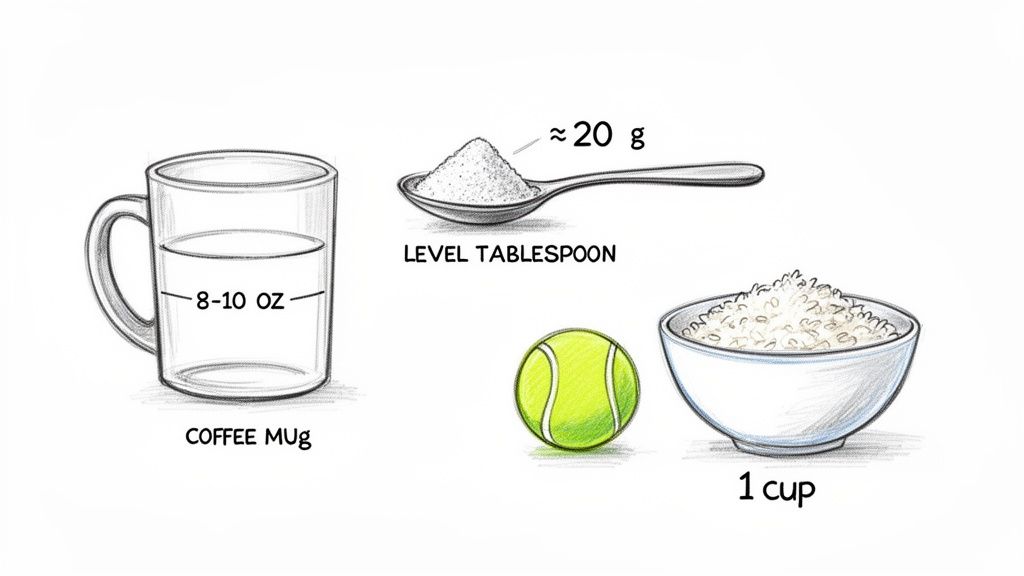
The trick is to connect abstract numbers like grams or ounces to the tangible things you see and touch daily. Think about it: a standard coffee mug isn't just for your morning caffeine fix; it’s a pretty dependable way to measure out 8-10 oz of liquid. In the same way, a level soup tablespoon of something dense like peanut butter consistently lands somewhere between 15-20g.
This isn't a new-age hack. It has deep roots in home cooking. Long before digital scales became a kitchen staple, household utensils were the gold standard for measurements, and that method is still surprisingly effective for any diet.
Your Kitchen's Secret Measuring Tools
Let's break down a few specific examples you can put to use right away. Once you train your eye to recognize these common objects as portion guides, you'll be able to estimate servings with a lot more confidence.
- Spoons for Powders and Dense Foods: Grab a tablespoon. A level scoop of something like granulated sugar is right around 20 grams. For fluffier things like flour, a properly leveled-off tablespoon is closer to 15 grams. So, if you need 100g of flour, about seven of those scoops will get you there.
- Glasses and Mugs for Grains and Liquids: That standard water glass in your cabinet? It holds roughly 180 grams of uncooked rice. It's a dead-simple way to portion out grains before you cook them. If you want to dive deeper, you can see how portioning impacts the final result in our guide on measuring cooked rice.
- Bowls for Larger Volumes: Your go-to cereal bowl is perfect for measuring out oatmeal, soup, or salads. Most hold about 1.5 to 2 cups when filled to a normal level, giving you a quick visual cue for bigger servings.
These aren't just guesses; they're traditional measurement techniques that have been trusted for generations. The key is understanding that while not perfectly precise, they provide the consistency needed for effective calorie and macro management.
The real goal here isn't just to find a replacement for a scale. It's to train your brain to see portion sizes everywhere. Once you realize that scoop of rice on your plate is about the size of a tennis ball (which is roughly one cup), portion control starts to feel second nature, simplifying your weight loss journey.
Creating Your Personal Reference System
The best way to get good at this is to build a system that’s unique to your kitchen. Let's be honest, not all mugs, bowls, and spoons are the same size. So, take a few minutes to "calibrate" the items you reach for most often.
If you happen to have a food scale, use it just once to measure out a typical serving of your favorite foods—oatmeal, rice, yogurt, whatever. Put it in your usual bowl or mug and take a mental snapshot. Notice exactly where it comes up to on the side.
That one-time check creates a powerful visual memory. Before you know it, you won't need that initial measurement. You'll just know what a 150g serving of yogurt looks like in your favorite blue bowl. This simple exercise turns every dish in your kitchen into a trusted tool for effortless portioning.
Training Your Eye to See Serving Sizes
What if you could glance at a plate of food and know, almost instantly, what a proper portion looks like? This isn't some nutritional superpower; it's a skill you can build. It's also one of the most valuable tools you can have when you're eating out at a restaurant, at a friend's house, or anywhere you can't pull out a food scale.
The trick is to create simple mental shortcuts. By comparing food portions to everyday objects, you build a reliable visual library that lets you estimate on the fly.
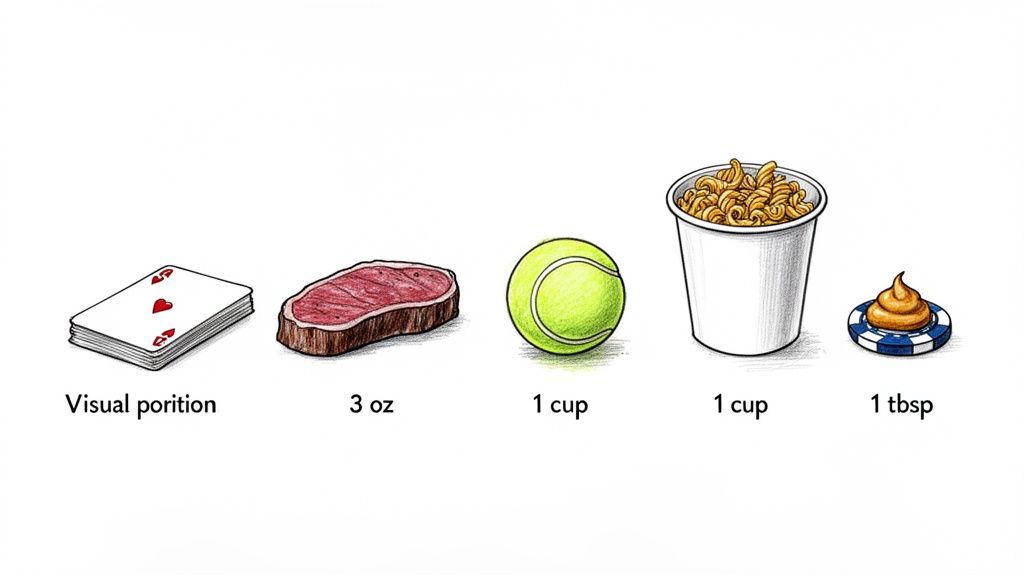
This process trains your brain to stop seeing "a plate of food" and start seeing its components in measurable units. It's a practical skill that helps you figure out how to measure food without a scale when you have zero control over the kitchen, a common challenge for anyone on a diet.
Building Your Visual Reference Library
Let's start with some classic comparisons that are easy to lock into your memory. These cues work because the objects have a consistent size, making them perfect stand-ins when you don't have a scale.
- Protein (Meat/Fish): A 3-ounce serving of cooked steak, chicken, or fish is about the size and thickness of a standard deck of playing cards.
- Carbs (Pasta/Rice): One cup of cooked pasta, rice, or even cereal looks a lot like a tennis ball.
- Fats (Nut Butter/Oils): A single tablespoon of a dense fat like peanut butter is roughly the size of a poker chip.
- Fruits (Whole): A medium apple or orange is about the same size as a baseball.
- Cheese (Hard): One ounce of a hard cheese like cheddar is surprisingly small—think four stacked dice.
The struggle to accurately guess portion sizes isn't new. Scientific studies have shown for decades that people are notoriously poor at it, which led to the creation of 3D food models for dietary research. Today, research continues to show we often underestimate calorie-dense foods like oils and nuts. You can read more about the history of portion size measurement aids at FoodStruct.
Overcoming Modern Portion Distortion
Learning this skill is more important today than ever before. Over the last few decades, restaurant and packaged food portions have exploded—a trend called portion distortion. What looks like a "normal" serving now is often two or three times larger than the standard from 50 years ago, contributing significantly to rising obesity rates.
This shift in our food environment makes visual estimation a crucial line of defense. By having your own internal, calibrated sense of what a serving should look like, you can confidently navigate oversized plates and make informed choices that align with your weight loss goals.
Think about it: when a restaurant plops down a mountain of pasta, you can mentally divide it into "tennis ball" units to see how many servings you're really eating. It’s all about taking back control of your calorie intake.
And for those who want an even simpler way to log meals without weighing, tools like BiteKit's AI photo analyzer for nutrition can help translate a picture of your meal into macro data.
By practicing and consistently applying these visual cues, you give yourself the power to manage your intake accurately, no matter where you are.
How to Log Your Estimated Portions for Real Results
Knowing how to estimate your portions is a great start, but the real magic for fitness and weight loss happens when you log that information. Consistently tracking what you eat—even if it's not weighed to the last gram—is what reveals patterns, keeps you accountable, and helps you make smart adjustments to hit your goals.
Don't think of this as a less-accurate shortcut. It's actually a well-established practice worldwide. Research shows that a staggering 80-90% of dietary assessments, particularly in large-scale nutritional studies where kitchen scales aren't practical, rely on visual estimates and household measures. Millions of people are managing their nutrition this way, proving that consistency truly trumps perfection. You can explore the research on dietary assessment tools to see how widely this method is used.
Turning Visual Cues Into Usable Data
So, how do you translate "a palm of chicken" or "a tennis ball of pasta" into something your tracking app can actually use? The trick is to build your own personal conversion system and stick to it. This creates a reliable baseline, which is infinitely more valuable than a few perfectly weighed meals scattered here and there.
Here's a practical approach:
- Build a "Usual Suspects" List: In your tracking app or a simple note, jot down your most common foods. For instance, decide that "1 palm of chicken breast" will always be logged as a generic entry for 4 ounces (or 115 grams). From now on, you use that exact same entry every single time you have that portion.
- Log in Units, Not Guesses: Stop trying to guess the weight. Instead, log your food in the unit you used to estimate it. If you had a tennis ball-sized portion of rice, search for "1 cup cooked rice" and log that. This keeps the process simple and repeatable.
- Deconstruct Your Meals: Faced with a casserole or a hearty stew? Don't panic. Just mentally break it down into its core components. You might log your bowl as "1 fist of vegetables," "1/2 cupped hand of potatoes," and "1 palm of beef." It feels like a rough guess, but it’s far more accurate than trying to find a generic entry for "beef stew."
Why Consistency Beats Perfection Every Time
It's so easy to fall into the trap of thinking that if your measurements aren't flawless, the data is worthless. That couldn't be further from the truth. Your body doesn't care about daily perfection; it responds to your habits and trends over weeks and months. Your overall calorie balance over time is what drives weight loss.
An estimate that you log consistently is far more valuable than a perfectly weighed meal you only track once in a while. Progress is built on the habit of tracking, not the precision of a single entry.
Modern tools can make this even easier. The BiteKit app, for example, lets you log meals with natural language. You can simply type or say what you ate, and it does the heavy lifting, which helps you build that consistent tracking habit without getting bogged down in databases.
Ultimately, learning to log your estimated portions is about creating a system that works for your life. It gives you the data you need to make adjustments, figure out your ideal intake with our free calorie calculator tool, and stay on track with your fitness goals no matter where you are.
Common Questions About Measuring Food Without a Scale
Switching from a food scale to using your hands and eyes can feel a little strange at first. It’s totally normal to have a few questions as you move from precise numbers to a more intuitive skill. Let's tackle some of the most common ones so you can start estimating with confidence.
How Accurate Is Measuring Food With My Hands Compared to a Scale?
Look, nothing beats a digital scale for pinpoint accuracy. But for real-world results, using your hand is an incredibly effective way to achieve consistency—and that's what truly matters for hitting your weight loss or fitness goals.
Your hand size never changes. A "palm-sized" portion of chicken today is the same as a palm-sized portion next week. For most people trying to manage their nutrition, this consistent baseline is more than enough to see real progress. The aim isn't perfection at every single meal; it's about building a reliable system that works for you, wherever you are.
What’s the Biggest Mistake People Make When Estimating Portions?
Hands down, the most common pitfall is underestimating calorie-dense foods (like fats) and overestimating low-calorie foods (like veggies). Fats and oils are the biggest culprits, where a tiny misjudgment can have a huge impact on your daily calorie total. That "quick drizzle" of olive oil you pour over your salad? It can easily pack an extra 100-200 calories.
The same goes for things like peanut butter, cheese, and nuts. To get this right, be strict with the "thumb" rule for fats—one thumb is roughly one tablespoon. Getting a handle on these high-impact foods is critical for any diet. A small mistake with olive oil affects your daily total way more than a small mistake with broccoli.
If there's one thing to remember, it's this: pay extra close attention to high-calorie items. Your diligence with fats and oils will give you the biggest bang for your buck when it comes to accurate calorie estimates.
Can I Still Track Macros for Complex Meals Like Stews or Casseroles?
You bet. The trick with mixed dishes is to mentally deconstruct them as you spoon them onto your plate. Instead of searching your tracking app for a generic "beef stew" entry, just eyeball the main ingredients in your serving.
Let's say you're having a bowl of chili. You might see:
- Ground beef: About one palm-sized portion.
- Beans: Looks like one cupped handful.
- Tomatoes & Veggies: Roughly a fist-sized amount.
Log those three things separately. This method breaks down even the most complicated meals into simple, trackable parts. It's a game-changer for eating at family dinners or restaurants where you don't have the recipe and need to manage your diet.
How Often Should I Check My Estimates Against a Real Scale?
Calibrating your estimates with a scale every now and then is a fantastic way to sharpen your eye. You don't need to do it all the time, but a quick spot-check really builds confidence in your portion control skills.
Try this: once a week or maybe once a month, grab a food you eat all the time, like oatmeal or chicken breast. First, portion it out using your hand as a guide. Then, pop it on the scale and see how close you got. This little exercise quickly trains your brain to be a better estimator. Before you know it, you'll be able to eyeball your portions accurately without even thinking about it.