How to Count Macros for Fat Loss: A Science-Backed Guide
Learn how to count macros for fat loss with practical, science-backed steps, daily tracking tips, and sustainable meal planning.
If your goal is sustainable fat loss—not just a temporary drop on the scale—a simple calorie-cutting approach won't suffice. The crucial distinction lies in understanding where those calories originate. This is the core principle of counting macronutrients, or "macros." It's a strategic method for creating a necessary calorie deficit while optimizing your intake of protein, carbohydrates, and fats to preserve lean muscle, manage hunger, and improve body composition.
By tracking macros, you shift your focus from generic "weight loss" to a more effective goal: reducing body fat while maintaining metabolic health.
Why Macros Are a Superior Strategy for Fat Loss
Many popular diets focus exclusively on total calorie intake, which overlooks a critical component of body composition. A calorie deficit is the non-negotiable prerequisite for any weight loss, as dictated by the laws of thermodynamics. However, the source of those calories profoundly influences whether you lose unwanted fat or sacrifice metabolically active muscle tissue.
This is where macronutrient tracking becomes an indispensable tool. A calorie is not just a calorie when it comes to physiological effects. Each macro has a distinct metabolic pathway and hormonal impact, and achieving the right balance is fundamental to sculpting a leaner, stronger physique.
The Role of Each Macronutrient
Understanding the specific function of each macronutrient clarifies why a balanced approach is scientifically sound and highly effective for fat loss.
-
Protein: Protein is the structural foundation for muscle tissue. During a calorie deficit, adequate protein intake is essential to prevent muscle catabolism (breakdown). Furthermore, protein has the highest Thermic Effect of Food (TEF); your body expends more energy digesting protein (20-30% of its calories) compared to carbs (5-10%) or fats (0-3%), providing a subtle metabolic advantage.
-
Carbohydrates: Carbohydrates are the body's primary and most efficient energy source. They fuel high-intensity exercise and support cognitive function. Consuming complex carbohydrates provides a sustained energy release, which helps regulate blood sugar levels and prevent the energy crashes that often lead to cravings for high-sugar foods.
-
Fats: Dietary fats are not the enemy of fat loss. Healthy fats are vital for the synthesis of key hormones, including testosterone and growth hormone, which regulate metabolism and appetite. They are also crucial for absorbing fat-soluble vitamins (A, D, E, and K) and contribute significantly to satiety, helping you feel full and satisfied after meals.
By focusing on your macro targets, you move beyond the simple goal of a lower number on the scale. You start working towards genuine body recomposition—losing fat while holding onto the lean muscle that keeps your metabolism fired up.
Scientific evidence strongly supports prioritizing protein. A significant body of research demonstrates that higher protein intake increases satiety and reduces overall calorie consumption. This makes adhering to a calorie deficit more manageable and sustainable, mitigating the persistent hunger that derails many weight loss attempts.
From the get-go, tools like BiteKit can take the headache out of this, making it simple to log your intake and see if you're hitting those crucial numbers.
Nailing Down Your Personal Fat Loss Numbers
Forget those one-size-fits-all online calculators that spit out generic numbers. Effective fat loss requires a personalized plan tailored to your unique body, metabolism, and lifestyle. The process begins with a few key calculations that establish a clear, science-based roadmap to your goal.
It all begins with determining the energy your body expends at rest. This is your Basal Metabolic Rate (BMR)—the calories required for essential functions like breathing, circulation, and cellular activity. From there, we factor in your daily activity to calculate your true maintenance level.
Find Your Daily Calorie Needs
To get the full picture, we need to calculate your Total Daily Energy Expenditure (TDEE). TDEE represents your BMR plus all the calories you burn through physical activity—from structured workouts to non-exercise activities like walking and fidgeting. The entire strategy hinges on consuming slightly fewer calories than your TDEE to create a calorie deficit.
A scientifically supported, sustainable calorie deficit for fat loss is typically 300-500 calories below your TDEE. This moderate deficit promotes the use of stored fat for energy without triggering excessive hunger, metabolic slowdown, or significant muscle loss.
Once you know your TDEE, simply subtract your deficit to find your daily calorie target. For example, if your TDEE is 2,100 calories, a 400-calorie deficit establishes a daily goal of 1,700 calories. This figure becomes your nutritional foundation.
If you want a quick starting point, our macro calculator for fat loss can help you get these baseline figures in seconds.
This simple infographic illustrates how getting your calories right is the first domino to fall, leading to macro-focused nutrition for real, lasting results.
As you can see, controlling calories is step one. But dialing in your macros is what truly helps you preserve muscle and build a leaner, stronger physique.
Convert Calories Into Macro Targets
With your calorie goal locked in, it’s time to slice that pie into protein, carbs, and fats. While standard guidelines offer a pretty wide range, we need to get more strategic for fat loss.
An evidence-based macro split effective for fat loss is often around 40% carbohydrates, 30-35% protein, and 25-30% fat. This configuration is highly effective because it leverages protein's high satiety and thermic effect to preserve muscle and control hunger, while providing adequate carbohydrates and fats for energy and hormonal health.
Here’s how to translate those percentages into actual grams you can track:
- Protein: (Target Calories x 0.30) / 4 calories per gram
- Carbohydrates: (Target Calories x 0.40) / 4 calories per gram
- Fat: (Target Calories x 0.30) / 9 calories per gram
Let's plug in our 1,700-calorie example:
- Protein: (1700 x 0.30) = 510 calories ÷ 4 = 128g
- Carbs: (1700 x 0.40) = 680 calories ÷ 4 = 170g
- Fat: (1700 x 0.30) = 510 calories ÷ 9 = 57g
These are your daily targets. They provide the structure you need to ensure you’re not just losing weight, but specifically targeting fat.
To give you a clearer idea of how different macro splits look, here’s a breakdown for a common 1,600-calorie diet.
Sample Macro Splits for a 1600-Calorie Fat Loss Diet
| Macro Split (P/C/F) | Protein (Grams) | Carbs (Grams) | Fat (Grams) |
|---|---|---|---|
| Balanced (30/40/30) | 120g | 160g | 53g |
| Higher Protein (35/40/25) | 140g | 160g | 44g |
| Lower Carb (35/35/30) | 140g | 140g | 53g |
| Keto-Friendly (30/10/60) | 120g | 40g | 107g |
As you can see, simply changing the percentages can significantly alter your daily food choices, allowing you to find a split that feels sustainable for you.
Why Food Quality Is More Important Than Ratios
Hitting your macro targets is a huge step forward, but let's be honest—it’s only half the story. The real secret to sustainable fat loss isn't just about the numbers. It’s about the quality of the foods you choose to fill those numbers with.
Think of it this way: your body handles 100 grams of carbs from a sweet potato completely differently than 100 grams from a bag of candy. While both might technically fit your macros for the day, their impact on your hormones, energy levels, and even where your body stores fat are worlds apart. This is a crucial piece of the puzzle if you want to master counting macros for fat loss.
Glycemic Load and Its Impact on Fat Loss
One of the most important concepts to get your head around is the Glycemic Load (GL). This is basically a measure of how much a specific food is going to jack up your blood sugar and insulin levels. High-GL foods, like refined sugars and white bread, send your blood sugar on a rollercoaster, triggering a massive insulin release. Do that too often, and you can pave the way for insulin resistance and encourage your body to store fat, especially around your midsection.
On the other hand, low-GL foods—think vegetables, whole grains, and lean proteins—cause a much slower, more stable rise in blood sugar. This gentle response is exactly what you want. It helps keep cravings in check, provides steady energy, and creates a hormonal environment that tells your body to burn fat for fuel, not store it. Switching to nutrient-dense, low-GL options is one of the most powerful moves you can make to speed up your results.
A major study comparing low-GL and high-GL diets found that after a maintenance phase, the low-GL group had 11% less stubborn abdominal fat. When they moved into a calorie deficit, these same people lost 4.4% more total fat mass than the high-GL group. You can learn more about these crucial findings on food quality and fat loss and see just how big of a difference it makes.
Prioritizing Nutrient-Dense Foods
Beyond just keeping your blood sugar stable, focusing on food quality makes sure you're getting the vitamins, minerals, and fiber your body desperately needs to function well, especially when you're in a fat loss phase. Nutrient-dense foods do so much more than just fill your macro buckets.
- Hormonal Balance: Healthy fats from sources like avocado, nuts, and olive oil are non-negotiable. They’re essential for producing hormones that regulate everything from your metabolism to your appetite.
- Reduced Cravings: Foods packed with fiber—leafy greens, beans, and oats—are your best friends. They keep you feeling full and satisfied, making it way easier to stick to your calorie deficit without feeling like you're starving.
- Increased Metabolism: As we've covered, high-quality protein has a powerful thermic effect of food (TEF). This means your body literally burns more calories just digesting it, giving you a slight metabolic edge that adds up every single day.
When you start prioritizing high-quality food sources, you're building a foundation for success that goes far beyond just hitting numbers on a screen. You're fueling your body efficiently, taming hunger, and creating the perfect hormonal environment for faster, more sustainable fat loss.
How To Track Macros Without The Hassle
Understanding your macros is one thing; keeping up with them day after day is a different story. You cook up a homemade stir-fry, and just the thought of measuring every single ingredient turns tracking into a chore.
Old-school methods—like scanning endless barcodes or searching for “grilled chicken breast, 150g”—add unnecessary friction. This extra effort becomes a barrier, and before you know it, many people throw in the towel on macro tracking.
Making Macro Tracking Effortless
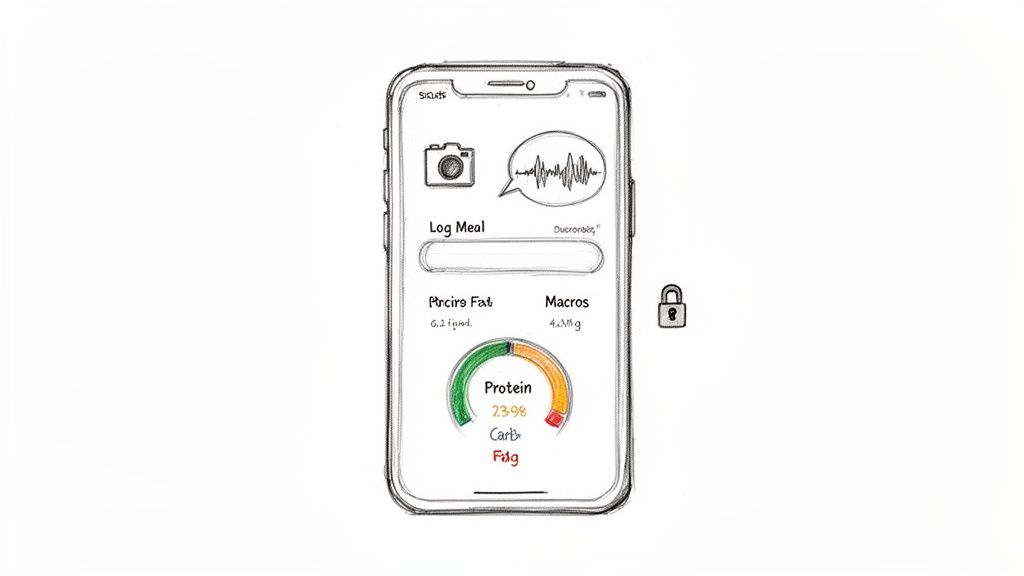
What if you could log your meals in seconds instead of minutes? Modern AI-driven tools remove the roadblocks that slow you down.
- Photo Logging: Snap a picture of your salmon salad. The app identifies each component, estimates portion sizes, and logs macros on the spot.
- Voice Logging: Heading out the door? Say, “An apple and a protein shake,” and your log updates automatically.
- Text Logging: Type a phrase like “a bowl of oatmeal with blueberries and almonds,” and watch it calculate and record your macros.
That’s the kind of hands-free tracking BiteKit delivers. It adapts to how you talk and think, making consistency almost effortless.
By removing tedious data-entry, you free up mental space to focus on choosing better foods and tuning into your body’s signals.
Staying Consistent And In Control
Easy tracking means you’ll actually stick with it. Consistency unlocks valuable insights into your eating habits.
- Real-Time Macros: Watch your protein, carbs, and fats fill progress bars after each meal.
- Quick Adjustments: Spot gaps in your nutrition and tweak your next meal on the fly.
- Data-Organized History: Review past meals to spot patterns that fuel your progress.
To dive deeper, check out our guide on the best way to track your food intake for more tips.
Privacy also matters. Some apps upload your logs to the cloud by default. With local-first solutions, all your data stays on your device. You get the power of AI without handing over your personal information.
Breaking Through Plateaus and Adjusting Your Numbers
Sooner or later, it happens to everyone. The scale just stops moving. You’re doing everything right—hitting your macros, staying consistent—but the fat loss has ground to a halt.
This isn't a sign you've failed; it's a physiological certainty. As you lose weight and consume fewer calories, your body adapts by becoming more energy-efficient. This survival mechanism, known as metabolic adaptation, is the primary reason for weight loss plateaus.
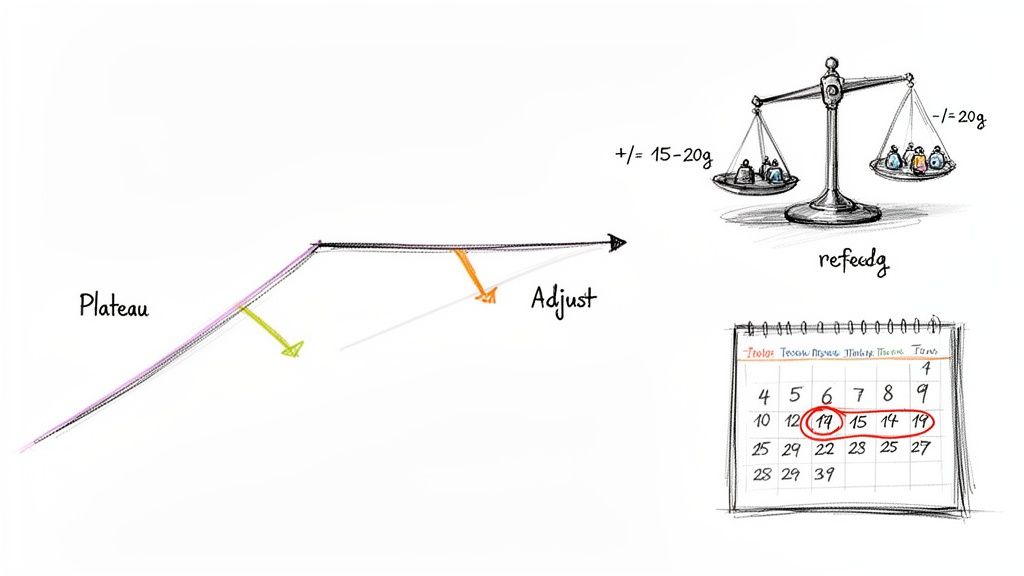
When weight loss has stalled for two to three consecutive weeks, it's time to make a strategic adjustment. This doesn't mean drastic calorie cuts or excessive cardio. The key is to make small, calculated changes to overcome the adaptation.
Making Smart Adjustments
The goal is to gently nudge your metabolism out of its new efficiency setpoint, not shock it into submission. Detailed intake records, such as the meal history in BiteKit, are invaluable for making informed decisions rather than reactive guesses.
Here are two evidence-based strategies for breaking through a plateau:
- A Minor Calorie Reduction: A small reduction of 100-150 calories from your daily target is often sufficient. This is best achieved by decreasing either carbohydrates or fats by approximately 15-20 grams. It is crucial to maintain a high protein intake to continue preserving lean muscle mass.
- The Strategic Refeed: A refeed day is a planned, temporary increase in carbohydrate intake, not an uncontrolled "cheat day." This strategy can help upregulate key metabolic and fat-regulating hormones like leptin. On a refeed day, carbohydrate intake is significantly increased while fat intake is kept low, providing both a physiological and psychological benefit.
At the end of the day, the calorie deficit is what drives fat loss. Your adjustments should always be aimed at maintaining that deficit as your body adapts. While your macro ratios are vital for body composition, the overall deficit is king for weight loss.
A comprehensive 2020 meta-analysis of 121 different diet studies confirmed that as long as a calorie deficit was maintained, participants lost weight. Over the long term, the differences in weight loss between low-fat and low-carb diets were minimal. If you want to dive into the science, you can find a great full analysis on how calorie deficits drive fat loss online.
Listen to Your Body and Play the Long Game
Once you make an adjustment, you have to be patient. Give your body at least two weeks to respond before you even think about changing things again.
Fat loss is rarely a smooth, linear drop. You might hold steady for a bit and then see a sudden "whoosh" on the scale. This is completely normal.
Keep tracking your progress beyond just your body weight. Pay attention to how your clothes fit, take progress photos, and use a tape measure. These data points often tell a more complete story than the scale alone. Using the information you've gathered is the smartest way to bust through a plateau and continue your journey. If you need a quick refresher on setting your initial numbers, our calorie deficit calculator is a great place to start.
Common Questions About Counting Macros
Once you start tracking macros, you quickly realize the real world doesn't always fit neatly into a food log. Life happens. You eat out, you miscalculate, you have an off day. Let's tackle some of the most common questions that pop up when you're trying to make this work long-term.
Do I Need to Hit My Macros Perfectly Every Day?
Absolutely not. In fact, striving for daily perfection is a common cause of burnout and abandonment of the strategy. The objective is long-term consistency, not daily flawlessness. It is more effective to view your macro targets as weekly averages rather than rigid daily mandates.
A more sustainable and less stressful approach is to aim for a reasonable range. Landing within 5-10 grams of your protein and fat targets should be considered a success, as these are most critical for muscle preservation and hormonal regulation. Carbohydrates typically offer the most flexibility. As long as your total calories and protein intake are consistently within the target range, you are on the right path.
How Do I Track Macros When I Eat at a Restaurant?
This is a common challenge, but it is entirely manageable with a strategic approach. The first step should be to check the restaurant's website, as many establishments now provide nutritional information online.
If that information is unavailable, the next step is to deconstruct the meal into its fundamental components. Instead of guessing the macros for a complex dish like "Chicken Parmesan," log its individual parts: "6 ounces chicken breast," "half a cup marinara," "one ounce mozzarella." This method yields a far more accurate estimate. Modern tools can also assist; BiteKit's photo logging can provide a surprisingly accurate estimate from a single picture, which is particularly useful in social dining situations.
When you're eating out, the goal isn't perfect accuracy. It's about making a solid, educated guess to stay in the game. A good-faith effort is infinitely better than throwing your hands up and not tracking at all.
What Should I Do If I Go Over My Goals for the Day?
First, do not panic. A single day of exceeding your targets will not negate weeks of consistent effort. The most significant error is attempting to "compensate" by drastically restricting calories the following day. This behavior often leads to a destructive cycle of restriction and bingeing.
The most effective response is to acknowledge the deviation, learn from it if possible, and resume your established plan with the very next meal. Long-term success is determined by your overall pattern of behavior, not by occasional, isolated incidents.
Is a Low-Carb or Low-Fat Plan Better for Fat Loss?
This is a perennial debate, but the scientific consensus is quite clear. For fat loss, neither dietary approach is inherently superior to the other, provided that two conditions are met: a consistent calorie deficit is maintained, and protein intake is adequate.
The "best" diet is the one that is most sustainable for the individual.
- Some individuals report higher satiety and more stable energy levels on a lower-carbohydrate diet.
- Others experience lethargy and diminished performance without a higher carbohydrate intake to fuel their activities.
The optimal approach can only be determined through personal experimentation. Monitor your energy levels, hunger signals, and overall mood to find a macronutrient balance that aligns with your physiology and lifestyle. Adherence is the most critical variable for achieving long-term results.