Best Way to Track Food Intake: A Modern, Evidence-Based Guide
Discover the best way to track food intake with practical tips, tools, and a modern approach to mindful eating.
The most effective way to track food intake is to adopt a method that seamlessly integrates into your daily life without creating friction. For most people, this means moving beyond manual logs and clunky apps toward AI-powered tools. Scientific evidence suggests that self-monitoring is a cornerstone of successful weight management, but adherence is the biggest hurdle. Using modern methods like photo and voice logging makes the process faster and more accurate, fostering the consistency needed to achieve tangible results.
Why Most Food Tracking Methods Fail
Have you ever started a food journal with intense motivation, only to abandon it a week later? You're not alone. The intention is sound—you want to understand your nutrition to reach a weight loss or fitness goal. But then, reality sets in.

The process often becomes an unsustainable chore. It's tedious, time-consuming, and prone to inaccuracies. Many find themselves spending more energy scrolling through vast app databases and scanning barcodes than mindfully enjoying their meals.
The Friction of Traditional Logging
The primary killer of consistency is friction. Consider logging a simple homemade dinner: you weigh the chicken, search for the correct database entry, estimate the olive oil used, and repeat for the broccoli. This meticulous process is precisely why so many people abandon tracking.
Here are the common frustrations:
- It’s a Time Sink: Manually logging a multi-ingredient meal can easily take 5 to 10 minutes. Multiplied across a day, this commitment feels less like a wellness habit and more like a part-time job.
- Databases are a Mess: Many popular apps rely on user-submitted data, which can be chaotic and unreliable. A search for "grilled chicken" might yield dozens of entries with wildly different nutritional values, leading to confusion and inaccurate tracking.
- Homemade Meals are a Nightmare: Anything without a barcode, such as a restaurant dish or a family recipe, requires significant guesswork. Accurately estimating ingredients and portion sizes in complex meals is nearly impossible with traditional methods.
This hassle can build a negative association with eating. Mealtime shifts from an act of nourishment and enjoyment to a data-entry task. The cognitive load required to maintain this habit often leads to burnout.
The problem isn't a lack of discipline; it's that the process itself is often flawed. When a tool is frustrating to use, adherence naturally declines. Without consistent data, making meaningful progress toward fitness or weight loss goals is incredibly difficult.
A Realistic Look at Food Tracking Methods
To understand why traditional methods fall short, it's helpful to compare them with modern solutions.
| Feature | Manual Logging (Pen & Paper, Spreadsheets) | Traditional Apps (Barcode Scanning, Database Search) | AI-Powered Apps (Photo/Voice Logging) |
|---|---|---|---|
| Speed | Very slow; requires manual lookup and writing. | Slow to moderate; searching databases takes time. | Extremely fast; often under 30 seconds per meal. |
| Accuracy | Prone to human error and guesswork. | Inconsistent; relies on often-inaccurate user data. | High; uses computer vision and verified databases. |
| Convenience | Low; requires carrying a journal or constant updates. | Moderate; needs phone and internet access. | High; just snap a photo or speak a sentence. |
| Effort | High; feels like a constant chore. | Medium; tedious but more structured than manual. | Low; minimal effort to capture and log food. |
This table highlights how the evolution of tracking tools is focused on removing the very friction that undermines consistency.
A Smarter, Modern Approach
Thankfully, the demand for better solutions is driving significant innovation. The global market for diet and nutrition apps is projected to reach USD 10.15 billion by 2030, a testament to the number of people seeking effective tools. You can find more details in this market analysis from Mordor Intelligence.
This growth isn't just about more apps; it's about smarter ones. The best way to track food today is by leveraging technology to handle the tedious work. AI-powered photo and voice logging are revolutionary. Instead of manually entering data, you simply take a picture of your plate or state what you ate. The technology analyzes the meal in seconds.
This fundamental shift transforms tracking from a dreaded chore into a sustainable habit, providing the consistent data necessary for success without causing burnout.
Set Clear Nutrition Goals Before You Log Anything
Tracking your food intake without a clear goal is like driving without a destination—you’re active, but you’re not making progress. Before logging a single meal, the most critical step is to define what success means for you. This transforms daily logging from a tedious task into a focused, powerful tool for achieving your fitness and weight loss objectives.
Vague aspirations like "I want to eat healthier" are a good start but lack the specificity needed for effective action. To see real results, you need measurable nutrition targets. Whether your goal is sustainable weight loss, building lean muscle, or enhancing athletic performance, a clear roadmap is essential.
Define Your Primary Objective
First, clarify what you are trying to achieve. Your primary goal dictates the specific nutritional targets you'll need to hit.
- Weight Loss? This is primarily achieved by maintaining a consistent calorie deficit, where energy intake is less than energy expenditure.
- Muscle Gain? This requires adequate protein intake and a modest calorie surplus to provide the building blocks and energy for muscle synthesis.
- Better Athletic Performance? This often involves optimizing carbohydrate intake for energy and timing meals around training sessions.
- General Health? Your focus might shift to achieving fiber targets, ensuring sufficient micronutrient intake, or balancing macronutrient ratios.
Once you’ve identified your primary goal, you can determine the specific numbers that will help you get there, connecting your "why" with the "how."
The foundation of effective food tracking isn't the act of logging itself, but the clarity of the target you're aiming for each day. Without a target, you're just collecting data.
Calculate Your Calorie and Macro Needs
To set meaningful targets, you need a scientific baseline. This begins with understanding your Total Daily Energy Expenditure (TDEE)—the total number of calories your body burns in a 24-hour period. You can get a reliable estimate using a TDEE calculator, which considers your age, gender, weight, height, and activity level.
Once you know your maintenance calories, you can adjust this number based on your goal. For sustainable fat loss, creating a moderate deficit of 300-500 calories per day is a well-established strategy. For muscle gain, a slight surplus of 200-300 calories helps fuel growth while minimizing fat accumulation.
Next, you'll set your macronutrient targets—protein, fat, and carbohydrates. While optimal ratios vary, here are some evidence-based starting points:
- Protein: Crucial for muscle repair, satiety, and preserving lean body mass during weight loss. A meta-analysis published in the British Journal of Sports Medicine supports aiming for 1.2 to 1.6 grams of protein per kilogram of body weight for active individuals.
- Fats: Essential for hormone production and overall health. The Dietary Guidelines for Americans recommend that fats comprise 20-35% of total daily calories.
- Carbohydrates: Your body's primary fuel source. After setting your protein and fat targets, carbohydrates will make up the remainder of your daily calorie budget.
Setting these specific targets gives your tracking a clear purpose, ensuring every logged meal is measured against a concrete goal. This process turns small daily actions into significant long-term results.
Find a Food Logging Style That Actually Works For You
The best way to track your food isn't about finding the most scientifically perfect method; it's about finding one you'll consistently use. A flawless plan is useless if it feels like a chore and you abandon it after a few days.
Sustainability is the key to long-term success in any fitness or diet plan.
Let's explore the three main approaches to food logging, examining their real-world trade-offs in terms of time, accuracy, and mental effort.
This chart illustrates how a clear nutrition goal flows into the daily habit of tracking, which in turn informs your progress.
As shown, tracking is the critical feedback loop that connects your long-term goals with your daily dietary choices.
The Old-School Method: Manual Logging
This is the classic pen-and-paper or spreadsheet approach, where you manually write down everything you eat and look up its nutritional information.
- The Good: It offers absolute control over every entry and doesn't require a specific app. The act of writing can foster a deeper awareness of your eating habits.
- The Bad: It is incredibly time-consuming and tedious. Determining the nutritional profile of a homemade meal becomes a major research project. This high level of friction makes it the most difficult method to sustain.
While some may enjoy the ritual, for most, it's an outdated and inefficient process in the age of modern technology.
The Familiar Standard: App-Assisted Logging
This is the most common method, involving apps that use barcode scanners and large food databases. These tools brought food tracking to the mainstream but are not without their frustrations.
The popularity of apps like Cronometer, with over 2 million users, and FatSecret, with 50 million downloads, shows a strong desire for digital tracking solutions. An impressive 80% of Cronometer users report improving their diet, proving the method's potential.
However, the user experience is often built around a clunky cycle of searching, scrolling, and estimating. Logging a homemade salad requires individually searching for "chicken breast," "romaine lettuce," "avocado," and "salad dressing." While faster than a notebook, it remains inefficient. It also relies heavily on your ability to accurately estimate portion sizes, a skill that takes time to develop. Our guide on how to measure food without a scale can help with this.
The Modern Solution: AI-Powered Logging
This new frontier in food tracking focuses on eliminating manual data entry. With a tool like BiteKit, you can log your meal by simply taking a photo or describing it with your voice. The AI handles the analysis.
This approach shifts your effort away from tedious data entry and back to mindfully enjoying your food. The technology recognizes ingredients, estimates portions, and calculates the nutritional information for you in seconds.
Revisiting the salad example: instead of searching for multiple ingredients, you take one picture.
This is a game-changer for consistency. The speed and convenience, particularly for homemade or restaurant meals, remove the friction that causes most people to quit. It makes consistent tracking nearly effortless, finally turning it into a sustainable habit.
See How BiteKit Makes Daily Food Logging Effortless
Enough theory—let's discuss practical application. Here’s how you can build a modern, frictionless food tracking habit with BiteKit. The goal is simple: log your meals in seconds, not minutes, and transform food tracking into an automatic, thoughtless part of your routine.
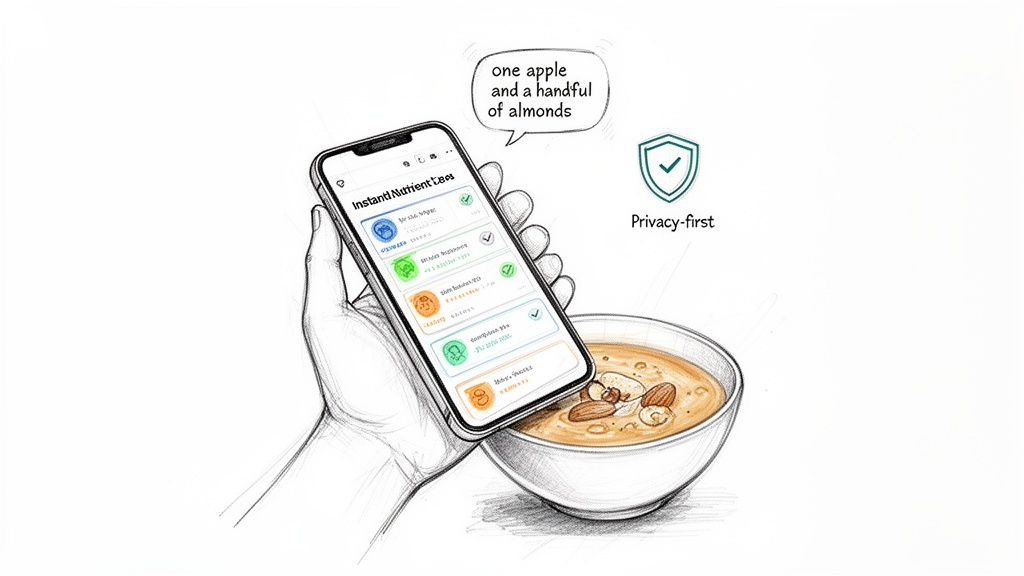
Forget searching through confusing databases or scanning every barcode. This is about using smart technology to make tracking feel intuitive, allowing you to focus on your nutrition goals rather than the tedious process of data entry.
Logging Meals in Seconds, Not Minutes
Let's get specific. Imagine you've prepared a large pot of homemade lentil soup. With a traditional app, you'd be stuck searching for each ingredient—lentils, carrots, celery, broth—and estimating the amounts. This can easily take 10 minutes, providing a convenient excuse to skip logging altogether.
With BiteKit, you just snap a photo. The AI analyzes the image, identifies the ingredients, and provides an instant nutritional breakdown. It's the difference between a chore and a simple tap of a button. You can see this technology in action with BiteKit's AI photo analyzer.
This speed applies to everything you eat:
- Voice Logging: Finished a workout? Say, “one scoop of protein powder with almond milk.” Logged.
- Text Logging: Grabbing a snack? Type “one apple and a handful of almonds.” Logged.
- Photo Logging: Dining out? Snap a quick picture of your grilled salmon with quinoa and asparagus. Logged.
This is the key to building a sustainable habit: removing the friction points that lead to quitting. The process is so fast that it becomes second nature.
Custom Goals and Real-Time Feedback
After setting your daily calorie and macronutrient targets in the app, BiteKit provides clear, real-time visual feedback. As you log each meal, you’ll see your progress bars update instantly. This isn't just a collection of data; it's a direct visual answer to the question, "How am I progressing toward my goals today?"
This immediate feedback loop is incredibly powerful for behavior modification. You can see precisely how your food choices impact your daily targets, helping you make smarter decisions for subsequent meals without feeling overwhelmed by numbers.
Your health data is personal and should remain private. BiteKit is built on a privacy-first foundation: no accounts, no cloud sync. All your food logs and health information are stored exclusively on your device.
Privacy and Automation Are the New Standard
Users are increasingly frustrated with clunky, invasive apps. The demand for smarter, more private tools is reshaping the nutrition app market. The trend is clearly moving toward intelligent, automated food tracking. Leading apps are integrating more AI-driven features, while European platforms are focusing on localized data to comply with strict privacy regulations like GDPR.
This global shift demonstrates that users want technology that reduces manual effort and respects their privacy—a philosophy central to BiteKit's design.
By combining lightning-fast logging with a strong commitment to data privacy, you get a tool that fits a modern, health-conscious lifestyle. It's not just a smarter way to track; it's a system designed to help you succeed by making consistency the easiest choice you'll make all day.
Build a Consistent Habit and Overcome Common Hurdles
Knowing the best way to track your food is just the first step; consistency is where the real results are achieved. The goal is to make logging meals as automatic as brushing your teeth. This is how you transition from tracking sporadically to building a resilient system that fits your real life.
A powerful psychological technique is habit stacking. Instead of trying to create a new routine from scratch, link it to an existing one. For example, make a rule: the moment you finish clearing your plate, you log your meal. The established habit (clearing the plate) acts as a trigger for the new one (logging food).
Another effective strategy is the "don't break the chain" method. Use a calendar and mark a large 'X' on every day you log all your meals. After several days, a chain will form. Your sole objective is to not break it. This visual representation of progress creates powerful momentum.
Navigating Real-World Tracking Challenges
Life is unpredictable, and perfect tracking isn't always feasible. The key is not to aim for perfection but to have a strategy for when challenges arise.
Here’s how to handle common obstacles without derailing your progress:
- Eating at Restaurants: When a menu lacks nutritional information, don't give up. Deconstruct the dish into its basic components. If you had salmon with asparagus and rice, log those three items separately. It is far better to be approximately right than to skip logging entirely.
- Estimating Portions on the Fly: You won't always have a food scale. Your hand can serve as a surprisingly accurate and portable measurement tool. A palm-sized portion of protein like chicken or steak typically contains 20-25 grams of protein. A cupped hand is a reliable estimate for a serving of carbohydrates like pasta or quinoa.
- Forgetting to Log Immediately: It happens. You finish a meal, get distracted, and hours pass. The longer you wait, the less accurate your memory becomes. The simplest solution? Snap a photo of your plate before you start eating. The picture serves as a perfect visual reminder for logging later.
The goal isn't perfection; it's consistency. One imperfectly logged meal is infinitely better than an unlogged one. You're building a resilient habit, not an unbreakable streak of flawless data entry.
By equipping yourself with these practical solutions, a busy day or a night out won't derail your progress. This approach turns a short-term diet into a sustainable, long-term nutritional strategy.
Answering Your Top Food Tracking Questions
As you begin your food tracking journey, questions are inevitable. Turning this practice into a lasting habit often involves overcoming a few common hurdles. Let's address the most frequent questions to help you feel confident in your approach.
How Accurate Is Photo-Based Food Tracking?
For most individuals and their goals, AI-powered photo tracking is remarkably accurate. Modern algorithms are trained on millions of food images, making them highly proficient at recognizing ingredients and estimating portion sizes.
Is it as precise as weighing every gram of food on a digital scale? No. However, for goals like weight management, muscle gain, or improving general dietary habits, its accuracy is more than sufficient.
The primary benefit extends beyond precision; it lies in the significant time savings and convenience, which are the key drivers of long-term adherence.
Consider this trade-off: being 90% accurate with 100% consistency will yield far better long-term results in fitness and weight loss than being 100% accurate but only managing to track 20% of the time.
Do I Need to Track My Food Intake Forever?
Absolutely not. Think of food tracking as an educational tool, not a life sentence. The primary purpose is to develop your nutritional intuition.
After a few months of consistent tracking, a remarkable thing happens: you begin to internalize portion sizes, learn the caloric density of different foods, and can accurately estimate the macronutrient content of your favorite meals. You will instinctively know what 30 grams of protein looks like on a plate or how a handful of almonds contributes to your daily fat intake.
Once this knowledge is ingrained, you can transition to a more intuitive eating style. Many people stop daily tracking but may check in for a week every few months to recalibrate and ensure their habits remain aligned with their goals. The initial phase of tracking is an investment in your nutritional education.
What if My Food Is Not in the App’s Database?
This is a classic frustration with older tracking apps, which rely on user-generated databases that are often riddled with inaccurate, outdated, or missing entries.
Modern tools like BiteKit circumvent this problem entirely. Instead of searching a database, you simply describe your meal.
You can use:
- A photo: Snap a picture of your meal, whether from a restaurant or your kitchen.
- Your voice: Say, “I had 150 grams of salmon, a cup of quinoa, and some asparagus.”
- Simple text: Quickly type out the ingredients.
The AI deconstructs your meal into its core components and calculates the nutritional information using verified, standardized food data. This fundamentally changes the process of logging homemade meals, restaurant food, and anything else that lacks a barcode, making accurate tracking accessible for everything you eat.