Your Guide to the 1800 Calorie Diet for Real Weight Loss
Discover the 1800 calorie diet. Our complete guide explains how it works for sustainable weight loss with meal plans, food lists, and expert tips.
An 1800-calorie diet often represents an ideal balance for achieving steady, sustainable weight loss. For many moderately active women and some less active men, it creates a gentle calorie deficit that can lead to a manageable loss of about 0.5 to 1 pound per week without feeling overly restrictive.
Understanding the 1800 Calorie Diet
While the concept of counting calories has been understood for over a century, modern scientific understanding has refined its application. We have moved beyond simple estimations to using precise tools and a clearer knowledge of human metabolism.
The scientific rationale behind an 1800-calorie diet is based on the principle of energy balance: to lose weight, energy expenditure must exceed energy intake. For a significant portion of the population, 1800 calories is an effective target. It is low enough to promote fat oxidation but high enough to prevent excessive hunger, supply essential nutrients, and mitigate the metabolic adaptation often associated with very-low-calorie diets.
This structured approach is particularly relevant in the modern food environment. A 2021 study published in JMIR mHealth and uHealth found that 39% of individuals managing their weight used calorie-tracking applications. Considering that the average daily energy intake for Americans was approximately 2,481 calories in 2010—a 23% increase from 1970—the need for a structured plan becomes evident. For many women, reducing intake to 1800 calories establishes a daily 500-calorie deficit, a scientifically supported target for losing approximately one pound per week.
Who Is This Diet Best For?
An 1800-calorie diet is not a universal prescription, but it serves as an excellent starting point for specific demographics. It tends to be particularly effective for:
- Moderately active women: For women engaging in physical activity 3-5 days per week, this calorie level typically provides sufficient energy for performance while promoting gradual fat loss.
- Sedentary or lightly active men: Men with desk-based occupations or low levels of physical activity can often create a sustainable energy deficit at this intake.
- Individuals transitioning from a very low-calorie diet: Increasing intake to 1800 calories can improve sustainability and help prevent the rebound weight gain that can follow extreme energy restriction.
- People seeking gradual, long-term results: This plan is designed for a weight loss rate of 0.5 to 1.5 pounds per week, a pace conducive to establishing lasting behavioral changes.
The objective is not rapid, dramatic weight loss. It is to create a balanced, sustainable energy deficit that facilitates the development of long-term healthy habits.
Is 1800 Calories Right For You?
The only way to know for sure is to figure out your body's unique energy needs. This all comes down to your Total Daily Energy Expenditure (TDEE)—the total number of calories you burn in a 24-hour period, from basic functions like breathing to your daily walk or gym session. Your age, sex, weight, height, and activity level all factor into this number.
To see if 1800 calories will put you in a weight-loss zone, you first need to find your maintenance calories (your TDEE). A great way to get a reliable estimate is by using a TDEE calculator. This will give you a solid baseline, and from there, you can adjust your calorie intake to match your goals.
Despite the popularity of various diet paradigms like ketogenic, paleo, and intermittent fasting, a single, unifying principle underpins all successful weight loss strategies: the calorie deficit.
Think of it this way: your body runs on energy, which we measure in calories. If you eat just enough calories to fuel your daily activities (your "maintenance" level), your weight holds steady. But if you consistently consume fewer calories than you burn, your body has to find that missing energy somewhere. It turns to its built-in energy reserves—your stored body fat. That process is the calorie deficit in action.
An 1800-calorie diet is just a clear, structured plan designed to create that exact energy gap for many people.
Why Deliberate Calorie Planning Matters More Than Ever
If the concept is so simple, why does managing weight feel like such an uphill battle? The answer is all around us. Our modern food environment is packed with cheap, hyper-palatable, and incredibly calorie-dense foods.
The numbers don't lie. Research looking at the American diet between 1970 and 2010 found that our average daily calorie consumption shot up by a staggering 22%. Where did those extra calories come from? Mostly from a 66% jump in added fats and oils and a 42% increase in flours and grains.
By 2010, those two categories alone made up almost half of the calories available to us. Meanwhile, fresh fruits and vegetables accounted for a tiny 7.9%. You can dig into how the American diet has evolved over the years on Pew Research.
In an environment practically engineered for overeating, a plan like an 1800-calorie diet isn’t about harsh restriction. It’s about taking back control with a simple, sustainable framework.
Finding Your Personal Calorie Starting Point
Before you can create a deficit, you need to know your baseline. This is your Total Daily Energy Expenditure (TDEE), which is just a technical term for all the calories your body burns in a 24-hour period.
Your TDEE is unique to you and is determined by four key things:
- Basal Metabolic Rate (BMR): The energy you burn just to stay alive—breathing, circulating blood, and so on, even while sleeping.
- Thermic Effect of Food (TEF): The calories your body uses to digest and process the food you eat.
- Exercise Activity Thermogenesis (EAT): The calories you burn during intentional workouts, like a run or a gym session.
- Non-Exercise Activity Thermogenesis (NEAT): All the other energy you use throughout the day, from fidgeting at your desk to walking the dog or carrying groceries.
As you can see, this number can vary quite a bit based on your age, sex, body size, and how active you are. A good way to see where you might stand is to look at general maintenance estimates.
Estimated Daily Calorie Needs for Weight Maintenance
This table gives a rough idea of how many calories people typically need to maintain their current weight. An 1800-calorie plan creates a deficit for many individuals, especially those in the 'moderately active' and 'active' categories, leading to steady weight loss.
| Sex/Age Group | Sedentary | Moderately Active | Active |
|---|---|---|---|
| Female 19-30 | 2,000 | 2,000-2,200 | 2,400 |
| Female 31-50 | 1,800 | 2,000 | 2,200 |
| Female 51+ | 1,600 | 1,800 | 2,000-2,200 |
| Male 19-30 | 2,400-2,600 | 2,600-2,800 | 3,000 |
| Male 31-50 | 2,200-2,400 | 2,400-2,600 | 2,800-3,000 |
| Male 51+ | 2,000-2,200 | 2,200-2,400 | 2,400-2,800 |
Source: Dietary Guidelines for Americans, 2020-2025
These are just estimates, of course. For a more personalized number, a great first step is to use a calorie deficit calculator. Once you have your maintenance figure, you'll know for sure if 1800 calories is the right target for your goals.
To really nail your daily targets, especially with home-cooked meals, it helps to know how to calculate calories in a recipe by ingredient. This simple skill is a game-changer for anyone wanting to eat delicious food while staying on track.
Building Your Plate for Satiety and Success
Okay, so you have your target: 1800 calories. But let's be honest, the number itself is only half the battle. The real secret to making this work isn't just how many calories you eat, but what those calories are made of. This is what determines whether you feel energized and full or constantly hungry and frustrated.
This is where your macronutrients—protein, carbs, and fats—come into play. Think of them as the building blocks of your meals. Getting the right balance is the key to crushing hunger, holding onto your muscle, and actually sticking with your plan long-term.
The Power of Protein and Balanced Macros
When you're eating in a calorie deficit, protein becomes your best friend. It’s the most satiating macronutrient, which is just a technical way of saying it keeps you feeling full longer than anything else. This is a total game-changer for managing cravings and staying within your daily 1800-calorie budget.
Protein does another critical job, too: it protects your muscle. When you lose weight, your body doesn't just burn fat; it can also burn muscle for energy. A high-protein diet sends a clear signal to your body to burn fat for fuel while preserving that hard-earned muscle, which is vital for keeping your metabolism humming.
So, what does a good balance look like? A great starting point for an 1800-calorie diet is a split like this:
- 40% Carbohydrates (180g): Your primary fuel source for energy throughout the day and for powering workouts.
- 30% Protein (135g): Crucial for feeling full, muscle repair, and maintaining your metabolism.
- 30% Fat (60g): Essential for hormone function, absorbing nutrients, and providing steady energy.
These aren't strict rules set in stone, but rather a solid framework. The most important takeaway is to prioritize getting enough protein. Using a tool like BiteKit makes this incredibly simple. You can see your macros add up with each meal, so you'll know at a glance if you need to add a little more protein to your dinner or ease up on the carbs at lunch.
Learning from Past Diet Trends
This balanced philosophy is a far cry from some of the diet fads we've seen in the past, especially the low-fat craze of the 1980s. After the 1977 Dietary Goals report, fat became public enemy number one. People started swapping out fats for highly processed, sugary carbs, but it backfired. Between 1970 and 2010, the average calorie intake in the U.S. actually shot up by 22%.
It was a tough lesson, but a valuable one: demonizing one macronutrient while ignoring total calories just doesn't work for sustainable weight management. The chart below really drives this point home, showing how our calorie sources shifted toward more processed grains and added fats, making it easier than ever to overeat.
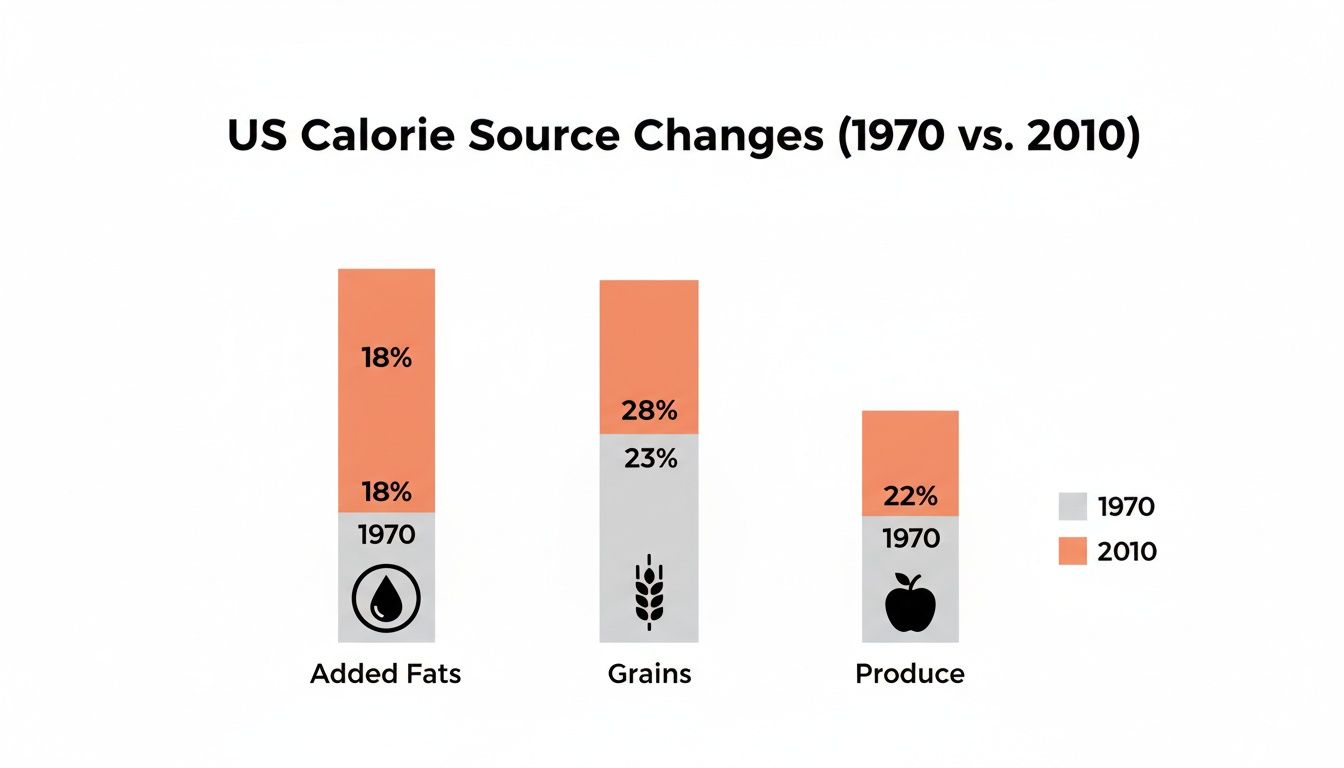
This data shows a clear move toward calorie-dense, processed foods that offer very little in terms of satiety. It makes a thoughtful, structured approach like an 1800-calorie diet more important now than ever before.
We now know that a balanced diet—one that embraces healthy fats, complex carbs, and plenty of protein—is far more effective and sustainable than any extreme approach. It's not about cutting out entire food groups. It's about managing your total energy intake and choosing foods that keep you feeling satisfied.
When you focus on whole, nutrient-dense foods, you'll probably be surprised by how much food 1800 calories really is. To get an even better handle on which foods pack the biggest punch for fullness, check out our satiety score calculator. It's a handy tool designed to help you make smarter choices. Ultimately, building a successful plate is all about picking high-quality calories that work with your body, not against it.
Sample 1800 Calorie Meal Plans You Will Actually Enjoy
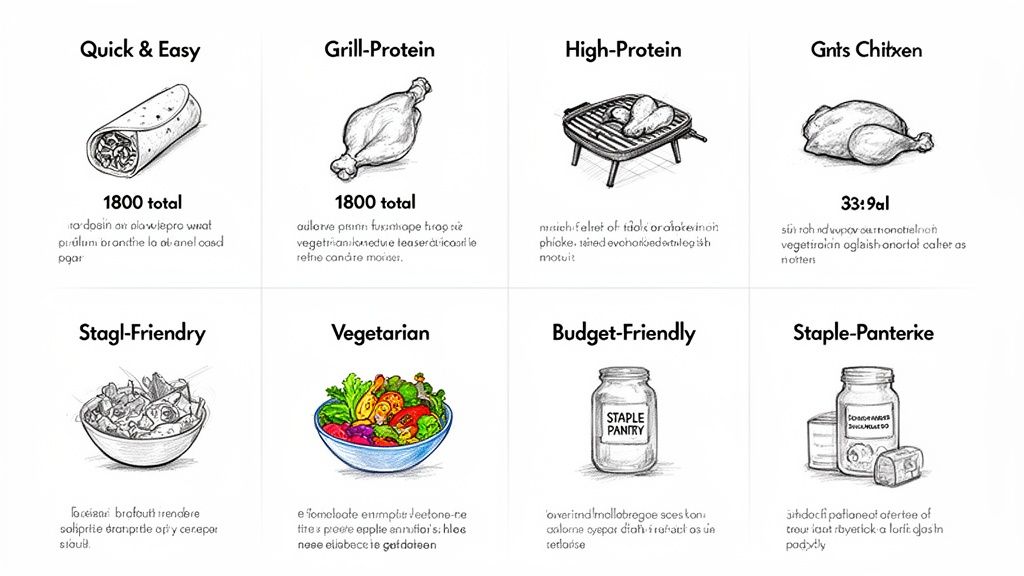
Okay, let's get into the fun part—the food! The best diet plan is one you can actually stick with, and an 1800 calorie diet gives you plenty of room to eat delicious, satisfying meals.
Think of these plans as a starting point, not a strict set of rules. They're here to show you what’s possible and prove that you don’t have to eat bland, repetitive food to hit your goals. We've put together four different full-day examples to fit various needs and lifestyles.
Plan 1: The Quick and Easy Day
Life gets busy. This plan is for those days when you're short on time but don't want to derail your progress. Everything here is designed for speed and convenience, keeping you out of the kitchen and away from the drive-thru.
- Breakfast (≈400 calories): A cup of 2% Greek yogurt with ½ cup of mixed berries and a tablespoon of chia seeds. No cooking required, just a powerful, protein-rich start.
- Lunch (≈500 calories): Grab a large pre-made salad with 4 oz of grilled chicken strips (store-bought is perfect!), mixed greens, cucumber, and tomatoes. Drizzle with a light vinaigrette and pair with a whole-wheat pita.
- Dinner (≈600 calories): A simple stir-fry. Use 4 oz of pre-cut beef strips, a bag of frozen stir-fry veggies, and a low-sodium teriyaki sauce. Serve it over ¾ cup of instant brown rice. Done in minutes.
- Snack (≈300 calories): One medium apple with 2 tablespoons of almond butter and a small handful of almonds for a satisfying crunch.
Plan 2: The High-Protein Power Day
If you’re focused on fitness, building muscle, or just want to feel fuller for longer, this plan is for you. We’ve prioritized protein in every meal to support your body and keep hunger at bay.
Protein becomes especially important as we age, particularly for active women over 50 who need it to maintain muscle mass. While some guidelines suggest around 51 grams for this group, a fitness-focused plan often aims much higher to support those body composition goals.
Here’s a look at how you can pack in the protein while staying within your budget.
| Meal | Food Item | Approx. Calories | Approx. Protein (g) |
|---|---|---|---|
| Breakfast | Omelet with 3 large eggs, ½ cup spinach, and ¼ cup low-fat shredded cheese. Served with ¼ avocado. | 450 | 30 |
| Lunch | 5 oz grilled salmon fillet on a bed of 1 cup cooked quinoa and 2 cups of mixed greens with lemon-tahini dressing. | 550 | 40 |
| Dinner | 5 oz lean ground turkey meatballs, served with 1.5 cups of zucchini noodles and ½ cup marinara sauce. | 500 | 45 |
| Snack | 1 cup of low-fat cottage cheese mixed with ½ cup of pineapple chunks. | 300 | 30 |
This sample day delivers over 140 grams of high-quality protein, helping you feel fueled and satisfied, all while staying right at 1800 calories.
Plan 3: The Vibrant Vegetarian Day
This plant-based menu is bursting with fiber, vitamins, and flavor. It’s a perfect example of how you can easily hit your protein targets without any meat, thanks to powerhouse foods like legumes, tofu, and whole grains.
- Breakfast (≈450 calories): Cook ½ cup of rolled oats with water or unsweetened almond milk. Top it with ½ a sliced banana, 1 tablespoon of flax seeds, and a scoop of your favorite plant-based protein powder.
- Lunch (≈550 calories): A big "Buddha bowl" with a base of ¾ cup cooked brown rice. Top it with ½ cup each of chickpeas and edamame, shredded carrots, bell peppers, and a drizzle of peanut-lime dressing.
- Dinner (≈500 calories): Pan-fry 4 oz of firm, cubed tofu until golden. Serve it alongside 1 cup of steamed broccoli and a ½ medium sweet potato.
- Snack (≈300 calories): Enjoy ¼ cup of hummus with 1 cup of carrot and celery sticks. Add a small handful of walnuts for healthy fats.
Plan 4: The Budget-Friendly Day
Eating well doesn't have to break the bank. This plan relies on affordable, nutrient-dense staples like eggs, beans, and oats to create satisfying meals that are easy on your wallet.
- Breakfast (≈350 calories): Two scrambled eggs, a slice of whole-wheat toast, and a medium orange. Simple, classic, and effective.
- Lunch (≈550 calories): A hearty lentil soup (1.5 cups) made with carrots, celery, and onions. Serve it with a small whole-wheat roll to soak up every last drop.
- Dinner (≈600 calories): Make a big batch of black bean and corn salsa (using canned goods is a great money-saver!). Serve a large portion over ¾ cup of cooked brown rice and top with a dollop of Greek yogurt instead of sour cream.
- Snack (≈300 calories): A medium banana and a large handful of peanuts. It's a cheap and surprisingly filling combination.
Remember, these are just templates. Don't be afraid to mix and match meals from different plans to keep things exciting. For more detailed, week-long layouts, you can explore specific 1800 calorie meal plans that offer even more variety and structure for your journey.
Sticking With It: Strategies for Long-Term Success
Having an 1800-calorie meal plan is like having a great road map. But we all know real life is full of detours, traffic jams, and unexpected stops. The real secret to reaching your destination isn’t about being a perfect driver; it's about building habits that make the healthy choice the easy choice, especially when you’re tired, busy, and just plain hungry.
It all comes down to being prepared. Having a healthy, pre-made meal waiting for you is your single best defense against the siren song of the drive-thru. This is where a little bit of meal prep becomes your secret weapon.
Make Meal Prep Work For You
Don't worry, this doesn't mean you have to lose your entire Sunday to a mountain of Tupperware. Smart meal prep is all about doing a little work upfront to save yourself a ton of time and decision-making later in the week.
Here are a few simple ways to get started:
- Batch-Cook Your Base: Take 30 minutes to cook up a big pot of quinoa, brown rice, or even a few baked sweet potatoes. Stash them in the fridge, and you have a ready-to-go base for bowls, salads, and sides all week long.
- Pre-Portion Your Snacks: It's so easy to overeat straight from the bag. Spend five minutes portioning out almonds, seeds, or trail mix into small baggies or containers. When you need a snack, you can just grab one and go, no guesswork required.
- Wash and Chop Your Veggies: This one is a game-changer. A container of freshly washed and chopped bell peppers, cucumbers, and celery in the fridge is practically begging to be added to a stir-fry, thrown into a salad, or dipped in hummus.
Think of meal prep as a gift to your future self. You're making it incredibly easy to make a good decision when you're tired and your willpower is low.
Smart Swaps That Save Big on Calories
Following a diet plan doesn't mean you have to ditch all your favorite meals. Often, it's just about making a few clever substitutions that slash calories without you even noticing the difference. These little changes add up in a big way, helping you stick to your 1800-calorie target without feeling deprived.
Give these simple swaps a try:
| Instead of This... | Try This... | The Smart Switch |
|---|---|---|
| Sour Cream | Plain Greek Yogurt | You get the same creamy tang, but with a huge protein boost and way fewer calories. |
| White Rice or Pasta | Quinoa or Zucchini Noodles | Quinoa adds valuable fiber and protein, while zoodles give you that pasta feel for almost no calories. |
| Sugary Coffee Drinks | Black Coffee with Cinnamon | You'll sidestep hundreds of empty calories from sugar and cream while getting a great flavor boost. |
| Mayonnaise-Based Dressings | Vinaigrette or Hummus | This trades heavy fats for healthier ones (vinaigrette) or adds a dose of plant-based protein and fiber (hummus). |
How to Handle Plateaus and Stay Motivated
Let’s be realistic: weight loss is never a smooth, straight line down. You’ll hit a week where the scale doesn’t budge. A birthday party or a stressful day will test your resolve. Your initial motivation might start to fade. This is completely normal—and it’s not a sign of failure. It's just part of the process.
When the scale gets stuck, don't panic. First, take an honest look at your food tracking in an app like BiteKit. It's common for small handfuls and extra bites to sneak back in without you realizing it. Next, try shaking up your routine—add a 20-minute walk to your day or try a new type of workout. Sometimes a small shift is all it takes to get things moving again.
And for those social events? Plan ahead. You could have a protein-rich snack before you go so you aren't starving, scan the menu online for a healthy option, or simply decide you're going to enjoy a slice of cake and get right back on track with your next meal. One off-plan meal won't derail your progress. It's the consistency over time that truly builds lasting results.
What If Tracking Wasn't Such a Chore?
Let's be honest. The hardest part of sticking to an 1800 calorie diet often isn't choosing the right foods—it's the tedious, soul-crushing task of logging every last bite. We've all been there.
Think about logging a homemade meal. A simple Greek salad with grilled chicken suddenly becomes a chore. You have to find and enter the chicken, the lettuce, tomatoes, cucumbers, feta, and dressing, all while guessing the portion sizes. It’s slow, it's frustrating, and it’s why so many of us just throw our hands up and quit.
Logging in Seconds, Not Minutes
This is where a little help from technology can make all the difference. An AI-powered tracker like BiteKit was built to solve this exact problem, turning a dreaded task into something you can do in seconds. It feels less like data entry and more like having a conversation.
Instead of fumbling through databases, you can:
- Snap a Photo: Just take a picture of your meal. The AI sees the food, identifies what’s on the plate, estimates the amounts, and gives you the calorie and macro breakdown instantly.
- Use Your Voice: Say what you ate out loud, like, “a bowl of oatmeal with blueberries and a handful of almonds.” The app gets it and logs the entry for you.
- Type a Quick Note: You can also just type in plain English, like “chicken breast with a side of roasted broccoli,” and it does the rest.
Suddenly, that ten-minute logging session becomes a ten-second habit. This small shift is what separates giving up from consistently hitting your goals day after day.
Accuracy Without the Hassle
The best part is that you don't have to sacrifice accuracy for speed. Whether you’re a busy professional trying to log a quick lunch or someone laser-focused on hitting specific macro targets, the tech is reliable enough to give you solid data without all the manual work.
The real win here is that your 1800 calorie diet starts to feel manageable and even empowering, not like a homework assignment.
When tracking is this easy, you can finally put your mental energy where it belongs: enjoying your food and celebrating the results you're working so hard for. With an app like BiteKit, your data is kept private and secure right on your device, giving you a clear, honest picture of your progress without any compromises. It’s all about making good habits stick by making them as simple as possible.
Your Questions About the 1800 Calorie Diet Answered
It's natural to have questions before you jump into a new way of eating. Let's clear up some of the most common ones about the 1800-calorie diet so you can get started with total confidence.
How Much Weight Can I Realistically Lose?
The science of weight loss is pretty straightforward: a deficit of about 3,500 calories typically leads to one pound of fat loss. Since an 1800-calorie plan creates a gentle, consistent deficit for most people, a healthy and realistic goal is losing 0.5 to 1.5 pounds per week.
Slow and steady really wins the race here. This pace is far more sustainable, helps you hold onto precious muscle, and gives you the time to build new eating habits that actually last for the long run.
Can I Build Muscle on This Diet?
You absolutely can. It's even possible to build muscle while losing fat, especially if you're relatively new to lifting weights. The magic combination is pairing your 1800-calorie diet with two non-negotiables: plenty of protein and consistent strength training.
When you lift weights, you're telling your muscles they need to get stronger. By eating enough protein—aiming for 1.6 to 2.2 grams per kilogram of body weight is a great target—you give your body the raw materials it needs to repair and build that muscle, all while using your stored body fat for energy.
Tracking calories isn't meant to be a lifelong chore. Think of it as a temporary educational tool—like training wheels for your nutrition.
Do I Have to Track Calories Forever?
Definitely not. Think of calorie tracking as a short-term learning phase, not a life sentence. The whole point is to develop an intuitive sense for what your body needs, what portion sizes look like, and how different foods fuel you.
After a while, you'll just know what an 1800-calorie day feels like without having to log every bite. You'll gain the confidence to eat well on your own, maybe just using a tracking app occasionally to check in and make sure you’re still on the right path.