Calories in Roasted Vegetables: Quick & Accurate Guide
Get accurate calories in roasted vegetables. Our guide includes a detailed chart, explains oil's impact, and shows how to log them fast with BiteKit.
You pull a sheet pan out of the oven, and dinner looks great. The vegetables are browned at the edges, soft in the middle, and glossy enough that you know some oil made it onto the plate. Then you open your tracking app and hit the part that trips people up.
Was that serving mostly zucchini and peppers, or did it include more sweet potato than you realized? Did the oil stay on the pan, or coat the vegetables? Did roasting shrink the vegetables enough that your “one cup” is carrying more calories than the raw version you usually log?
A healthy meal can then feel oddly hard to track. As a dietitian, I see this often. People aren’t confused because roasted vegetables are unhealthy. They’re confused because calories in roasted vegetables can swing a lot based on oil, moisture loss, and portion size.
The good news is that roasted vegetables are still one of the most practical foods for calorie-conscious eating. You just need a method that matches how people cook and eat.
The Roasted Vegetable Logging Dilemma
A common scene goes like this. Someone meal preps a big tray with carrots, broccoli, bell peppers, onions, and sweet potatoes. They toss everything with olive oil, roast it until caramelized, divide it into containers, and feel prepared for the week.
Then the logging questions start.
Did each container get the same amount of oil? Did the denser vegetables settle into some portions more than others? If the tray lost volume in the oven, should the meal be logged raw or cooked?
Those aren’t small details. They’re exactly why roasted vegetables frustrate careful trackers.
Why this meal gets mislogged so often
Roasted vegetables look simple, but they combine several moving parts:
- Water cooks off and changes weight and volume.
- Oil can raise calorie density quickly even when the meal still looks “light.”
- Mixed trays are uneven because one scoop may have more squash while another has more zucchini.
- Serving size is slippery because roasted vegetables collapse and concentrate.
I don’t tell people to stop tracking these meals. I tell them to stop pretending they’re easy to estimate without a system.
Practical rule: If you can identify the vegetables, estimate the oil, and stay consistent with portioning, you can log roasted vegetables accurately enough for real progress.
That matters whether your goal is weight loss, macro control, or just reducing the mental load around dinner. Precision helps, but repeatability matters more in everyday life.
How Roasting Transforms Vegetables and Calories
Roasting changes the math before it changes the flavor. The vegetables lose water, shrink, and become more calorie-dense per bite, even though their total calories stay the same unless you add fat or other ingredients.
That distinction matters when you log food.
Water loss changes calorie density
Raw vegetables are heavy with water. After roasting, they weigh less and take up less room on the plate. Roasting doesn't create calories. It concentrates them into less weight and volume.
That is why a cup of roasted zucchini or broccoli usually logs differently from a cup of the raw version, even if both came from the same pan. If you use a raw database entry for a cooked portion, the estimate can come in low because the cooked serving is more compact.
I see this mistake often with meal prep. Someone starts with a full sheet pan, ends with half the volume, and logs the finished portion as if nothing changed.
Browning changes flavor more than nutrition
Roasting also changes taste and texture. High heat drives off moisture, softens fiber, and creates browning that makes vegetables taste sweeter and richer. Carrots, cauliflower, Brussels sprouts, onions, and squash all become easier to eat in larger portions for that reason.
From a dietitian's perspective, that is a good trade-off for many people. A vegetable you eat consistently beats a perfectly planned one that stays in the fridge.
The practical logging rule
Use the form you measured.
If you weighed the vegetables raw before they went into the oven, log the raw ingredients and the oil you used. If you portioned them after roasting, log the cooked food or convert the weight with a cooked vs raw weight converter for vegetables.
Consistency matters more than chasing a perfect number every time. The goal is to use one method repeatedly so your calorie tracking stays close enough to guide decisions.
The Overlooked Impact of Roasting Oils and Seasonings
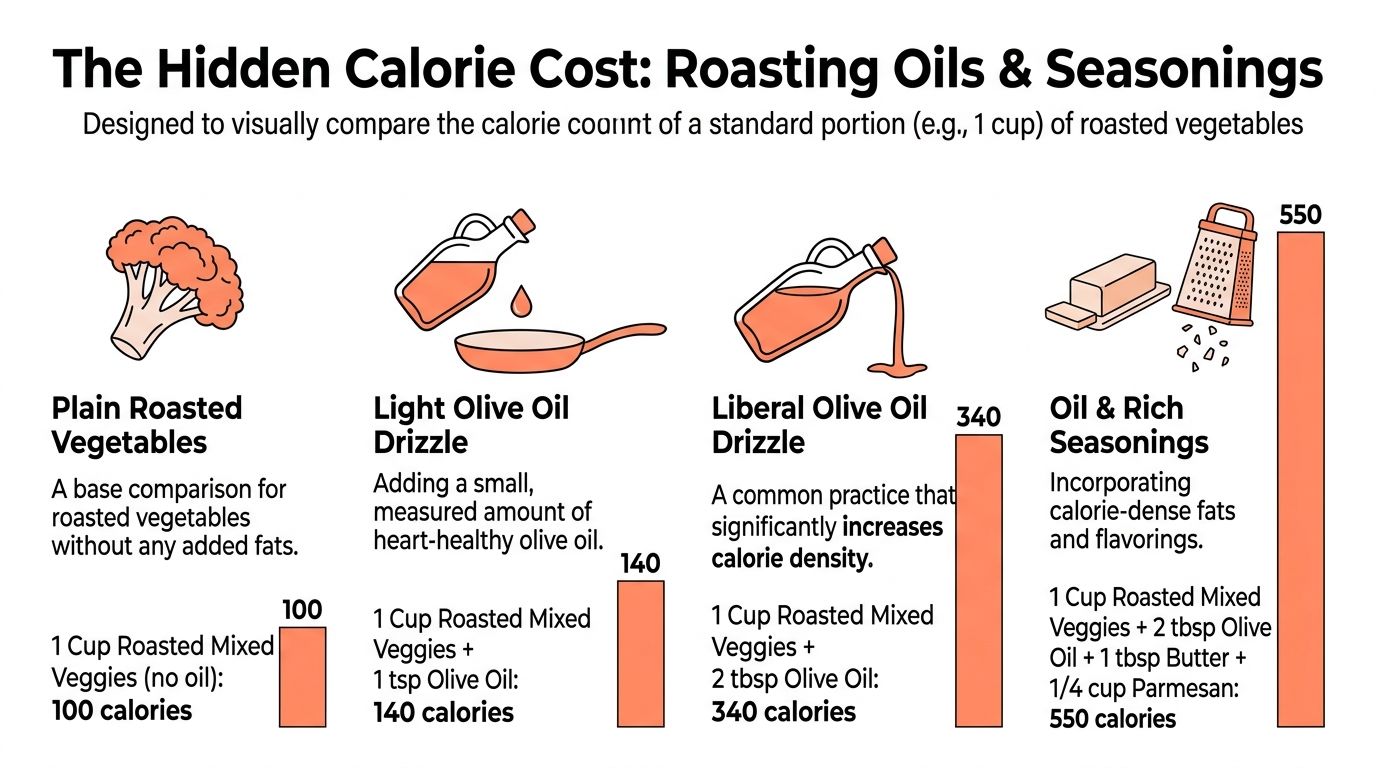
You roast a full tray of broccoli, carrots, and onions because dinner needs to be easy. The vegetables are still a low-calorie base. The part that changes the log fast is the oil, plus any calorie-dense finish added after roasting.
One tablespoon of olive oil adds about 120 calories. In practice, that can shift roasted vegetables from a light side dish to a much denser entry, especially when the oil is poured straight from the bottle instead of measured first.
That is why I tell clients to log the oil as its own ingredient every time. It takes a few extra seconds, but it fixes one of the biggest undercounts I see in food tracking apps.
Where calorie creep usually happens
The vegetables themselves are rarely the problem. The common calorie jumps come from:
- Oil absorbed during roasting
- Extra oil added after roasting for shine or flavor
- Butter or ghee tossed in while hot
- Cheese, breadcrumbs, or nuts added before serving
- Sweet glazes or sauces such as honey, maple syrup, teriyaki, or balsamic glaze
A tray of roasted vegetables with salt, pepper, garlic powder, and paprika logs very differently from the same tray finished with parmesan and two extra tablespoons of olive oil.
What works in real kitchens
These habits make tracking much more accurate without making cooking annoying:
- Measure oil before tossing. Then divide it across the number of servings you got.
- Coat vegetables in a bowl. You use less oil and get more even coverage than pouring onto the pan.
- Use a spray or a measured teaspoon first. Add more only if the vegetables still look dry.
- Log finishing ingredients separately. Parmesan, tahini drizzle, pesto, and aioli often matter more than the spices.
If you need a quick estimate, use a cooking oil calorie calculator instead of guessing what “a drizzle” meant.
Seasonings are usually low-calorie, but not always
Dry herbs and spices contribute very little energy in normal amounts. The exceptions are seasoning blends with sugar, ranch-style packets, curry pastes, and anything creamy or glossy enough to cling like a sauce.
A practical rule works well here. If the vegetables look dry and spice-coated, the extra calories are probably modest. If they look shiny, sticky, buttery, or creamy, log more than just the vegetables.
Quick Reference Calorie Chart for Common Roasted Vegetables
You pull a tray from the oven, log “roasted vegetables,” and get five very different calorie results. That is a normal tracking problem. Roasted vegetables vary a lot by water loss, vegetable type, and how much oil stayed on the food, so a short benchmark table helps more than scrolling through random app entries.
Benchmarks worth saving
| Preparation | Calories | Notes |
|---|---|---|
| Generic roasted vegetables, 100g | Typical calories | A reasonable default for a lightly oiled mix, including typical amounts of fat, carbs, fiber, protein, and sodium. |
| Mixed roasted vegetables, 100g | A common user-tracked estimate | An estimate for a mix with mushrooms, zucchini, green beans, red bell pepper, spinach, and olive oil. |
| Roasted vegetable side dish, 1 serving | A useful calorie anchor per serving | A useful anchor for a modest home-cooked side portion. |
| Hannaford Roasted Vegetable Medley, 110g | 90 calories | 3.5g fat, 14g carbs, 2g fiber, 1g protein, 340mg sodium |
| Well Informed Roasted Vegetables, 113g | 70 calories | Macro split reported as 57% carbs, 32% fat, 11% protein |
| Trader Joe’s Roasted Vegetables, 170g | 170 calories | Higher-calorie commercial example |
A practical shortcut works well here. Use 50 to 70 calories per 100g for lightly roasted non-starchy vegetables. Use a higher entry when the mix includes carrots, potatoes, parsnips, or visibly heavier oil.
That keeps logging fast and close enough for daily use.
If you want a more specific match than “mixed roasted vegetables,” check a food-level entry like this roasted Brussels sprouts nutrition page. It is usually easier to log one close match in BiteKit, then adjust the portion, than to hunt for the perfect custom entry every time.
For home cooking, I usually treat 98 calories per serving as a decent anchor only when the portion looks like a standard side and the oil was modest. If your tray was glossy, crowded with denser vegetables, or finished with extras after roasting, choose a higher log entry instead.
How to Estimate Portion Sizes Without a Scale
A food scale is the cleanest method. Real life doesn’t always cooperate.
At restaurants, family dinners, or office lunches, you often need a visual estimate and a quick decision. That’s still workable if you use the same cues every time.
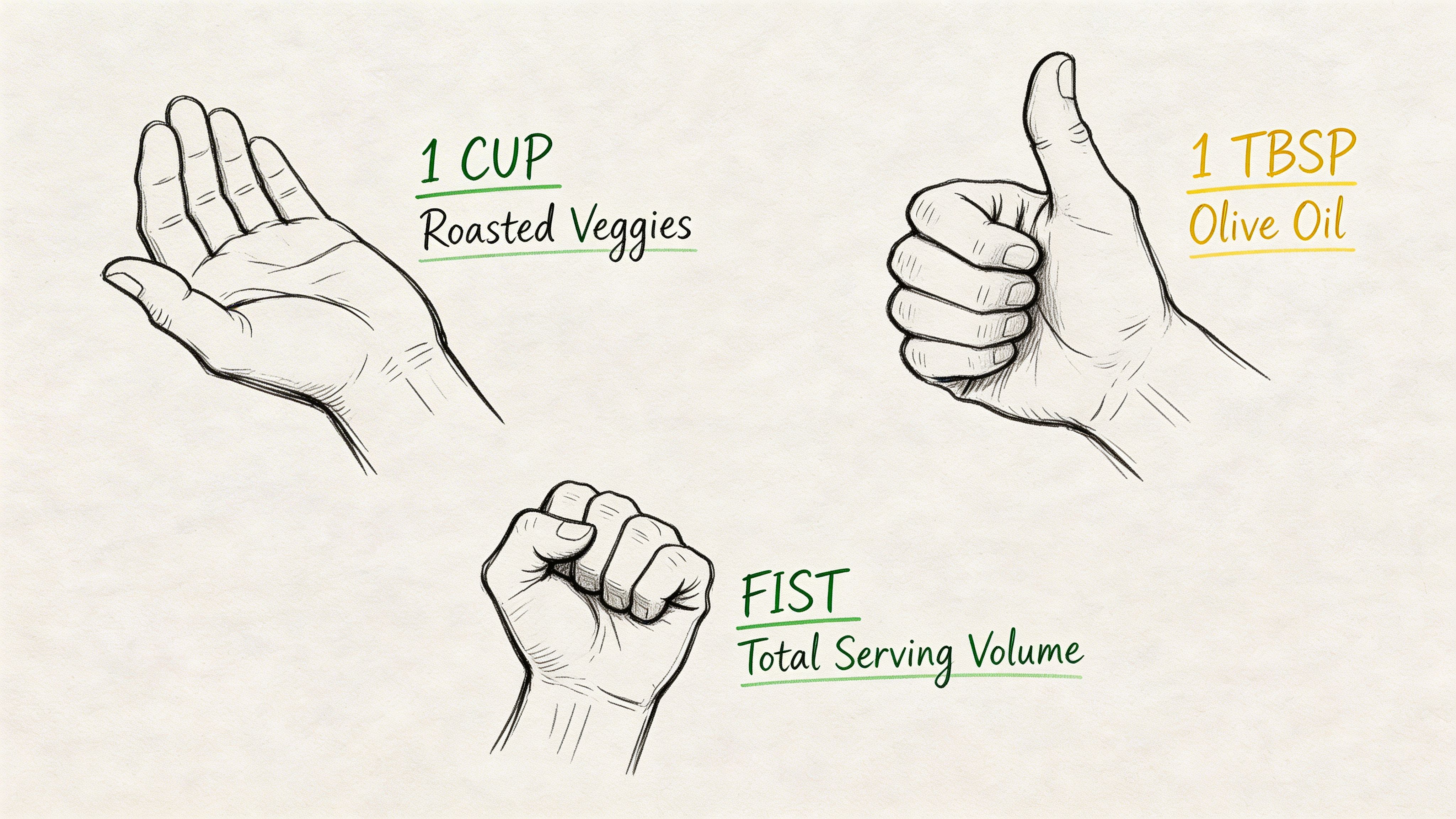
Hand guides that make sense for vegetables
These are the visual rules I find most practical:
- Closed fist: Think roughly one cup of roasted vegetables.
- Cupped hand: A smaller side portion, useful for denser vegetables.
- Palm area: Helpful when the vegetables are packed tightly on a plate rather than piled into a bowl.
- Thumb amount for fats: Useful when estimating visible added oil, butter, or dressing on top.
The point isn’t anatomical perfection. The point is using one repeatable visual system so your logging stays consistent.
Object comparisons help when plating is messy
If the plate is crowded, compare the vegetables to common objects:
- Tennis ball: About a cup-sized mound
- Deck of cards footprint: A compact side portion
- Small cereal bowl: Often more than people realize once vegetables are roasted down
This quick visual guide can help if you want a demonstration of hand-based estimates.
What to prioritize when you’re estimating
Estimate the part that matters most.
For roasted vegetables, that usually means:
- Portion volume
- Whether the mix is starchy or non-starchy
- How oily it looks
If you can judge those three, your log will usually be good enough to support progress.
Log Roasted Vegetables in Seconds with BiteKit
Dinner is plated, the vegetables have roasted down to half their original volume, and the oil is no longer sitting in the pan where you can see it. That is the moment manual logging starts to break down.
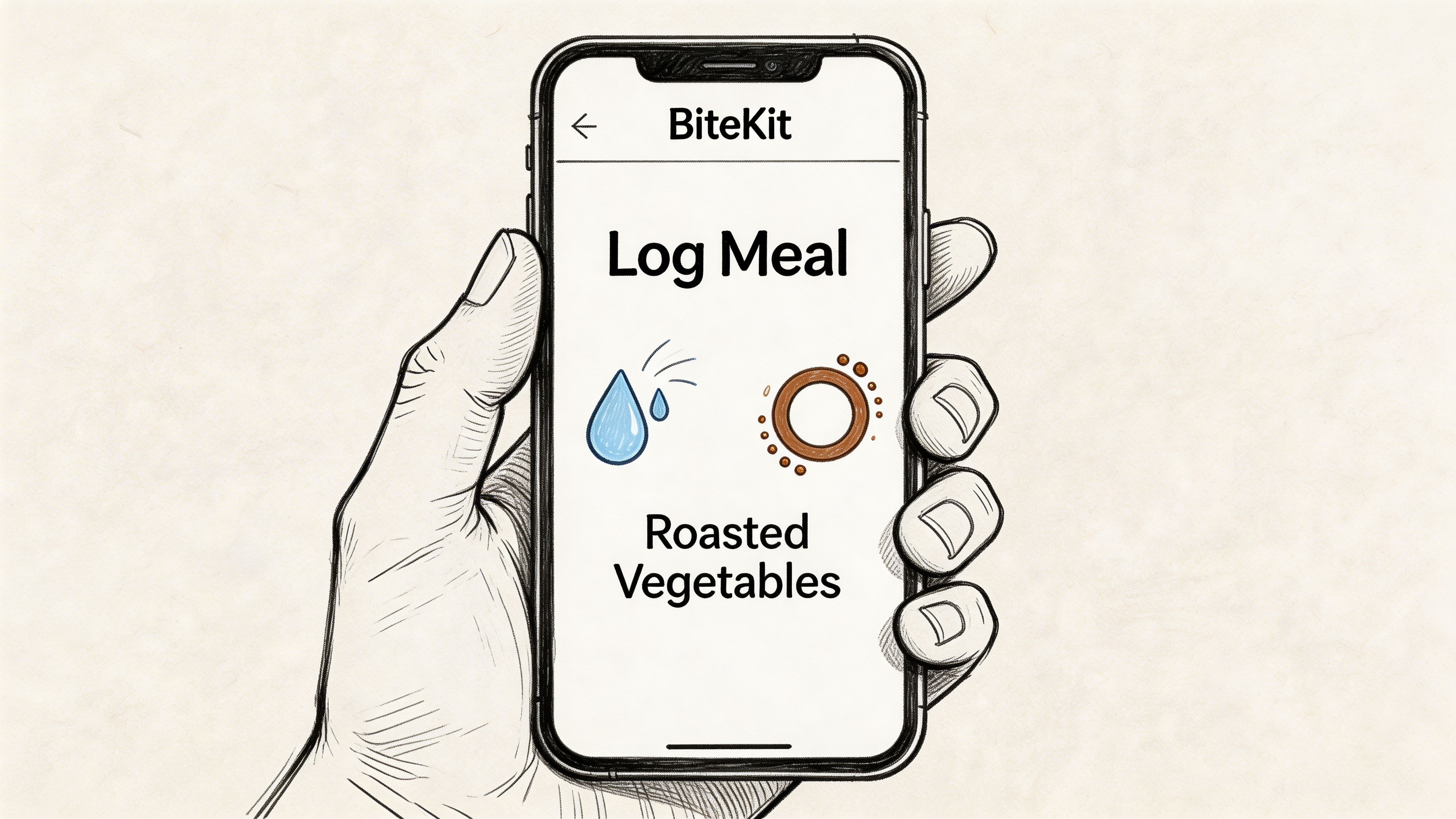
BiteKit solves the practical problem. It helps you record what is on the plate, including the vegetables, the likely cooking fat, and the rest of the meal, without forcing you to build the entry ingredient by ingredient. For people who track consistently, that time savings matters more than a tiny gain in precision that never gets logged.
Photo logging for mixed plates
Photo logging works best when the meal is already served and you want a fast estimate.
If your plate has roasted vegetables, salmon, and rice, a photo usually captures the context better than a manual search. The app can interpret mixed meals, which is useful with roasted vegetables because calorie errors often come from the oil and from how much the vegetables shrank in the oven. As noted earlier, roasting fat can account for a large share of total calories in a tray of vegetables.
I recommend photo logging most often for restaurant sides, sheet-pan dinners, and leftovers, where portions are uneven and memory is unreliable.
Voice logging when your hands are full
Voice entry is practical after cooking, during cleanup, or when you are packing meals away.
A useful entry sounds like this: “Large bowl of roasted root vegetables with a salmon fillet and olive oil.”
That one sentence gives the app the three details that matter most for accuracy:
- Portion size
- Vegetable type
- Added fat
If you want extra support interpreting meals and nutrition data, an AI nutritionist can also help you sanity-check entries and spot patterns in your logs.
Text logging when you want tighter control
Text entry works well when you know the details and want a cleaner record.
For example: “1.5 cups roasted asparagus and Brussels sprouts with 2 tsp olive oil.”
That format is efficient because it matches how dietitians estimate meals in practice. It separates the vegetables from the fat source and gives you a better calorie range than logging “roasted veggies” as a generic item.
The best logging method is the one you will still use when dinner is hot and you are tired. For roasted vegetables, BiteKit reduces enough friction that accurate tracking becomes realistic, even on busy nights.
Beyond Calories The Macro and Micronutrient Benefits
Dinner logging often goes off track here. Someone enters “roasted vegetables, 1 cup,” sees a low calorie number, and assumes the job is done. From a dietitian’s perspective, that misses the part that affects fullness, blood sugar response, and how satisfying the meal feels two hours later.
Roasted vegetables earn their place because they add fiber, water, and volume along with calories. That combination helps meals feel larger and more balanced, especially if you are trying to stay in a calorie target without finishing dinner still hungry.
Fiber and blood sugar stability
Non-starchy roasted vegetables usually work well for appetite control because they add bulk without much energy density. They also tend to digest more slowly than refined carbohydrate sides, which can help keep energy steadier across the evening.
One roasted vegetable entry in the LogiFoodCoach database reports a low glycemic index and glycemic load per 100 grams. In practice, that fits what I see in food logs. A plate built around roasted broccoli, cauliflower, Brussels sprouts, zucchini, peppers, or green beans usually lands very differently from a plate built around bread, fries, or a large serving of white rice.
The macro profile still changes a lot based on preparation. The same database shows that some roasted vegetable mixes are relatively fat-heavy, while lighter versions shift more of the calories toward carbohydrate. That matters if you are tracking macros closely. Logging “roasted veggies” as a generic item hides whether the tray was mostly carrots and potatoes, mostly non-starchy vegetables, or heavily coated in oil.
Micronutrients still matter
Roasted vegetables also contribute nutrients many people underconsume, including potassium, vitamin A precursors, vitamin C, and a range of plant compounds tied to overall diet quality. Roasting can soften texture and deepen flavor, which makes vegetables easier to eat consistently for people who do not enjoy them raw.
That consistency matters more than chasing a perfect nutrition label.
With BiteKit, better logging helps. A quick photo or text entry can capture the vegetable type, rough portion, and visible oil, which gives you a more realistic calorie estimate and a better read on fiber and carb intake. If you want broader support connecting meal quality, tracking habits, and nutrition goals, an AI nutritionist can complement app-based logging.
A lower-calorie meal is not automatically the better meal. A meal with fiber, volume, and enough staying power is often the one that makes calorie targets easier to hit later.
Common Roasting Mistakes That Inflate Calories
Roasted vegetables only stay “light” when the cooking method stays light. A few habits push the calories up fast.
The oil deluge
The mistake is pouring directly from the bottle onto the tray.
That usually coats some vegetables heavily and leaves a puddle in the pan. It also makes logging harder because you don’t know how much you used.
A better move is to measure the oil first, toss in a bowl, then roast.
Treating starchy and non-starchy vegetables the same
A tray of zucchini, mushrooms, and peppers won’t log like a tray built around sweet potatoes and other root vegetables. Both can fit well in a balanced diet, but they serve different purposes.
If your goal is fullness for fewer calories, go heavier on non-starchy vegetables. If your goal is adding more carbohydrate around training, the root vegetables may make more sense.
Forgetting the extras
Butter finishes, Parmesan, balsamic glaze, honey, and creamy sauces can turn a straightforward vegetable side into a very different dish.
This doesn’t mean you shouldn’t use them. It means they need to be counted.
Assuming the restaurant version is “just veggies”
Restaurant roasted vegetables often carry more oil than home versions. They may also be finished with extra fat for shine and flavor.
When in doubt, log the restaurant portion conservatively. It’s usually safer to choose a richer entry than a plain one.
Frequently Asked Questions About Tracking Roasted Vegetables
Should I log roasted vegetables raw or cooked
Log them in the form you measured. If you weighed ingredients raw before cooking, log the raw vegetables and the oil you used. If you portioned the finished tray, use a cooked entry that reflects the prepared dish.
Why do my roasted vegetables seem higher in calories than expected
Usually because of oil, not because vegetables changed dramatically on their own. Roasting also reduces water, so the finished serving is denser than the raw one.
Are roasted vegetables good for weight loss
Yes, often very good. They can be high in fiber and satisfying. The catch is portioning the oil and recognizing when the tray includes more calorie-dense vegetables.
What’s the easiest way to estimate a homemade batch recipe
Build the recipe from ingredients you used, then divide by the number of servings you got. If you want a simple walkthrough for how many calories are in your recipe, this guide from Mise on recipe calorie calculation is useful.
Do I need to log every herb and spice
Usually no. Focus first on the big movers: vegetables, oil, butter, cheese, glazes, and sauces.
Is a mixed roasted vegetable entry good enough
Often yes, especially if you stay consistent. If your progress stalls or your meals vary a lot, tighten the estimate by logging the main vegetables and the measured oil separately.
If you want the fastest way to track calories in roasted vegetables without manually splitting every ingredient, BiteKit makes it simple. You can log meals by photo, voice, or text, and it’s especially helpful for mixed dishes where oil and portion size are easy to misjudge. See how it works at https://bitekit.app.