The Nutritional Impact of Almond Flour in Modern Diets
Confused about carbs in almond flour? This guide breaks down net vs. total carbs, nutrition, and keto baking tips for effortless macro tracking.

For those closely monitoring carbohydrate intake, every ingredient plays a crucial role. Almond flour emerges as a standout, with a standard 1/4 cup (28g) serving containing just 2.4 grams of net carbohydrates. This remarkably low count has cemented its status as a staple in low-carbohydrate and ketogenic culinary practices.
Almond Flour's Role in Low-Carbohydrate Eating
For individuals adhering to a low-carbohydrate diet, almond flour represents a fundamental shift in baking and cooking. Its popularization, particularly with the rise of the ketogenic diet around 2015, unlocked a vast array of recipes previously considered incompatible with carbohydrate-restricted lifestyles. Suddenly, items like fluffy pancakes, crispy pizza crusts, and decadent cakes became viable options.
The nutritional science is straightforward: almond flour is simply finely ground almonds. It retains the nut's original nutritional profile, which is naturally high in beneficial fats, a good source of protein, and very low in carbohydrates.
A Comparative Analysis: Almond vs. White Flour
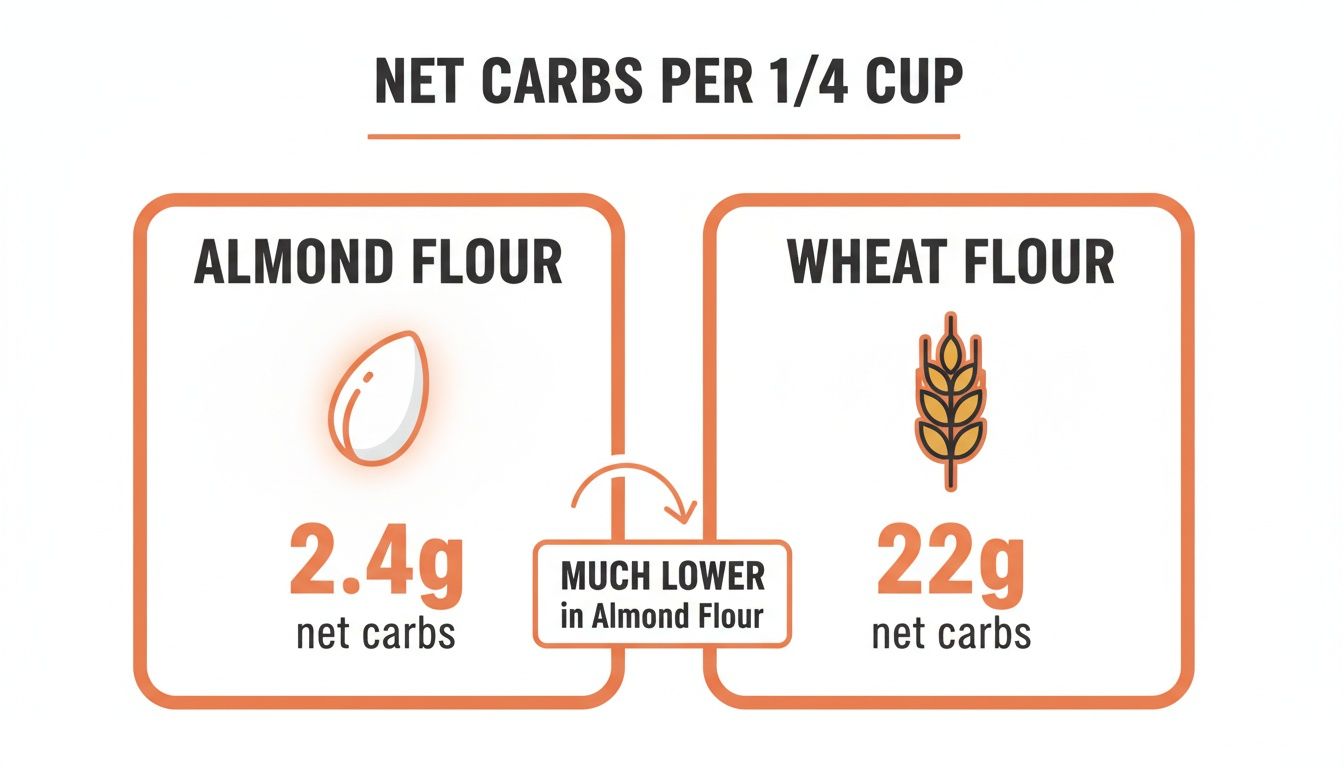
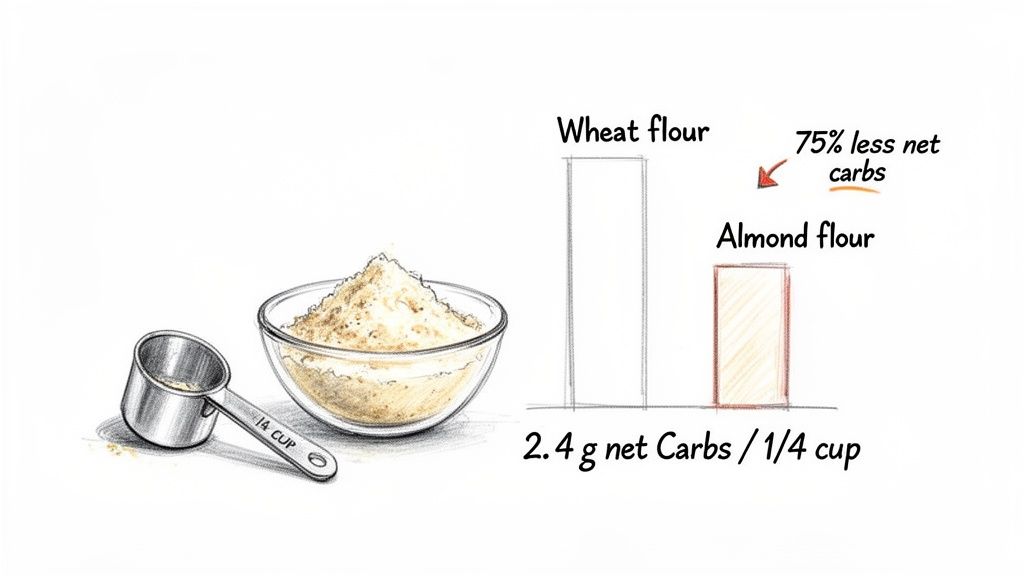
Let's examine the quantitative data. A typical 1/4 cup (28g) serving of almond flour has approximately 5.5 grams of total carbohydrates and 3 grams of dietary fiber. By subtracting the fiber, the resulting net carbohydrate count is 2.4 grams—the amount metabolized by the body.
In stark contrast, the same serving size of traditional all-purpose white flour contains a substantial 22 grams of net carbohydrates. The difference is nutritionally significant.
The following table provides a side-by-side comparison of these two flours per 1/4 cup (28g) serving.
Almond Flour vs. White Flour Carbohydrate Profile Per 1/4 Cup (28g)
| Nutrient | Almond Flour | White Wheat Flour | Carb Reduction |
|---|---|---|---|
| Total Carbs | 5.5 g | 23 g | -76% |
| Dietary Fiber | 3.1 g | 0.8 g | +287% |
| Net Carbs | 2.4 g | 22.2 g | -89% |
This substitution can reduce the net carbohydrate load in a recipe by nearly 90%. This is not a minor adjustment but a foundational strategy for maintaining ketosis or adhering to a low-carbohydrate diet.
Impact on Glycemic Response
Beyond its low carbohydrate content, almond flour possesses an extremely low glycemic load—estimated at 0.43. This means it has a minimal impact on blood glucose levels, helping to prevent the glycemic spikes and subsequent crashes associated with high-carbohydrate foods.
This property is highly beneficial for individuals managing blood sugar or seeking sustained energy. Whether used as a coating for chicken or in keto-friendly muffins, almond flour is an ingredient that supports metabolic health.
For detailed nutritional data, food tracking applications offer a valuable resource. The complete nutritional breakdown for almond flour and its role in daily macronutrient goals can be explored on platforms like Carb Manager.
Understanding Net Carbohydrates in Dietary Planning
In the context of low-carbohydrate eating, the concept of "net carbs" is fundamental. This metric is particularly relevant for baking and food preparation. It is crucial to understand the distinction between "Total Carbohydrates" on a nutrition label and net carbohydrates.
An effective analogy is to view your daily carbohydrate allowance as a financial budget. Total carbohydrates represent the gross income, while net carbs are the disposable income—the figure that truly affects your metabolic state and which must be managed.
The Calculation of Net Carbs
The formula for calculating net carbohydrates is simple and relies on two figures from a standard nutrition label.
Net Carbs = Total Carbohydrates – Dietary Fiber
For example, if a serving of almond flour contains 6 grams of total carbohydrates and 3 grams of dietary fiber, the net carbohydrate count is 3 grams. These 3 grams represent the carbohydrates that the body can digest and convert into glucose, making it the primary metric for tracking on a low-carb diet.
Fiber is excluded from this calculation because it is a type of carbohydrate that the human body cannot fully digest or break down into sugar. Consequently, it does not elicit a significant blood sugar response. Instead, it passes through the digestive system, contributing to satiety and supporting gut health.
This is why understanding the distinction between net carbs and total carbs is critical. It allows for the inclusion of high-fiber foods like almond flour without compromising ketogenic or low-carb goals.
Practical Application
To apply this principle, examine the nutrition facts on a package of almond flour. For a typical 1/4 cup (28g) serving, you will find:
- Total Carbohydrates: 5.5 g
- Dietary Fiber: 3.1 g
Applying the formula: 5.5 g (Total) - 3.1 g (Fiber) = 2.4 g Net Carbs.
This simple calculation demonstrates why the low carbs in almond flour make it an indispensable ingredient in ketogenic and low-carbohydrate lifestyles.
While manual calculation is straightforward, digital tools can streamline the process. For rapid analysis of different foods or portion sizes, our Atkins Net Carb Calculator provides quick and accurate results. Focusing on net carbs enables the enjoyment of baked goods while maintaining dietary adherence.
The Broader Nutritional Merits of Almond Flour
While celebrated for its low-carbohydrate profile, the benefits of almond flour extend far beyond its suitability for ketogenic diets. Replacing conventional flour with almond flour reduces carbohydrate intake while simultaneously enhancing the nutritional value of foods.
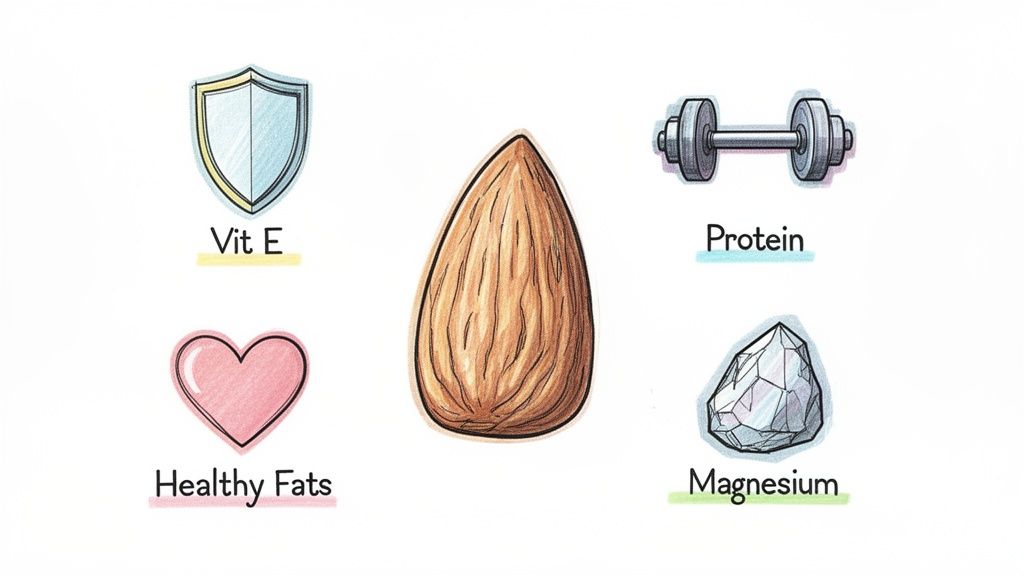
Almond flour is rich in heart-healthy monounsaturated fats, the same type found in olive oil. These fats provide a slow, steady release of energy, promoting sustained satiety and mental clarity without the sharp fluctuations in blood sugar. Furthermore, it contributes a significant amount of plant-based protein, which is essential for muscle maintenance and appetite control.
A Micronutrient-Rich Addition to Baking
Beyond its macronutrient profile, almond flour is a concentrated source of essential micronutrients vital for physiological functions. It effectively fortifies baked goods with vitamins and minerals.
- Vitamin E: A single ounce of almond flour provides a substantial portion of the recommended daily intake of Vitamin E. As a potent antioxidant, it helps protect cells from oxidative stress.
- Magnesium: This essential mineral participates in over 300 enzymatic reactions in the body. It plays a critical role in blood sugar control and neuromuscular function. The magnesium content in almond flour, approximately 10% of the RDA per ounce, is associated with a reduced risk of developing type 2 diabetes.
- Manganese: This trace mineral is crucial for bone health, metabolic regulation, and the body's endogenous antioxidant defense systems.
The nutritional quality of the source ingredients, such as organic raw almond nuts, is directly concentrated in the flour. These nutrients provide genuine nourishment, not just empty calories.
The Science Behind the Low-Carb Baking Revolution
This unique nutritional composition has driven a significant shift in the baking industry. For example, finely ground varieties with just 3 grams of total carbs per 1/8 cup (16g) (equating to 2 net carbs) are now common. This move away from high-starch wheat flours has fueled substantial market growth, with the global almond flour market experiencing a 12.5% CAGR from 2016-2023, driven by demand in the US and Europe. Data supporting these trends can be found on resources like King Arthur Baking's product information page.
The satiating effect of almond flour is attributable to its combination of high fat content (approximately 50g per cup) and significant protein (23.2g per cup). This profile is highly effective at managing hunger. It's no coincidence that Google search interest for almond flour increased by 250% after 2019 as consumers recognized its role in creating satisfying, nutrient-dense foods that can mitigate the "keto flu."
Modern applications simplify nutrient tracking. Using a macro tracker like the BiteKit app, a user can log "quarter cup almond flour in my mug cake," and the software automatically calculates the nutritional impact, demonstrating that almond flour is not merely a substitute but a nutritional upgrade.
Technical Considerations for Baking with Almond Flour
 Understanding the low carbs in almond flour is the first step; translating that knowledge into successful baking requires technical skill. It is not a direct 1:1 substitute for wheat flour, but mastering its properties ensures consistently excellent results.
The primary challenge is that almond flour contains zero gluten. Gluten is the protein network that provides traditional baked goods with their characteristic elastic, airy structure. Without it, products can be dense, heavy, or crumbly if not properly formulated.
Adjusting for Structure and Moisture
To compensate for the absence of gluten, structural binders are necessary. This is why many almond flour recipes incorporate an additional egg or binding agents like psyllium husk and xanthan gum. These ingredients replicate the "glue" function of gluten, creating the desired texture in muffins and cookies.
On the other hand, almond flour's high content of healthy fats contributes to exceptionally moist and tender baked goods, such as rich, fudgy brownies and scones. However, this same high fat content causes it to brown more rapidly than wheat flour.
Pro Tip: I recommend reducing the oven temperature by 25°F (approximately 15°C) when baking with almond flour. It is also advisable to begin checking for doneness several minutes earlier than the recipe suggests. This technique helps prevent burnt exteriors with undercooked centers.
Blanched vs. Unblanched Almond Flour
In the baking aisle, two primary types of almond flour are available: blanched and unblanched. The distinction significantly affects the final product.
- Blanched Almond Flour: Made from almonds with their skins removed, this type has a superfine, light texture and a neutral flavor. It is the preferred choice for delicate items like cakes, macarons, and light pancakes.
- Unblanched Almond Flour (Almond Meal): This version is made from whole almonds with skins intact, resulting in a coarser texture and a nuttier, more robust flavor. It is well-suited for rustic recipes like pie crusts, breadings, or hearty cookies.
For most baking applications aiming to replicate traditional textures, blanched almond flour is the superior choice. If you are unsure which to use, a digital flour substitution calculator can provide guidance.
With practice in adding binders, adjusting oven temperatures, and selecting the appropriate flour type, baking with almond flour becomes a more intuitive and rewarding process.
Streamlining the Tracking of Almond Flour Carbohydrates
Consistent macronutrient logging is a cornerstone of any successful low-carbohydrate diet. However, the manual process of looking up and entering nutritional data for each ingredient can be laborious and demotivating, particularly for complex recipes involving almond flour.
Imagine preparing a batch of ketogenic almond flour muffins. Instead of pausing to manually calculate the nutritional information for each component, what if you could simply capture an image of the final product?

This is the functionality offered by tools like the BiteKit app. Its AI can identify the meal from a photograph, estimate the portion size, and provide an immediate, complete macronutrient breakdown, including the crucial carbs in almond flour.
Making Nutritional Tracking Fast and Intuitive
The purpose of tracking is to build a sustainable habit, not to become entangled in complex calculations. BiteKit is designed to minimize the friction between eating and logging, a significant benefit for anyone striving to meet dietary goals without the burden of constant manual data entry.
The app also supports voice logging. For instance, a user could state:
"I had a keto muffin made with a quarter cup of almond flour."
The application processes this natural language input, identifies the ingredients, and automatically calculates the net carbs, protein, and fat. This feature removes the cognitive load of remembering specific carb counts. You can learn more about this technology in the AI meal analyzer.
When logging becomes this efficient, users can focus on what truly matters: enjoying their food and achieving their health objectives.
Almond Flour Measurement Guide for Accurate Logging
For those committed to a low-carbohydrate diet, precision in macronutrient tracking is non-negotiable. Measuring almond flour by volume (e.g., with a measuring cup) can introduce inaccuracies, as the density of the flour can vary depending on how it is packed.
This variability can significantly alter the final almond flour carbs count. For serious dietary management, a digital food scale is an indispensable tool, replacing estimation with precise measurement.
To simplify this process, I have compiled a reference chart that converts common baking volumes to their corresponding weight in grams and provides the associated net carbohydrate count. This eliminates guesswork and facilitates rapid, accurate logging.
Almond Flour Volume to Weight and Net Carb Quick Guide
Here is a convenient reference chart for converting common baking volumes to grams and their corresponding net carbs, ensuring fast and accurate nutritional tracking.
| Volume Measurement | Weight (grams) | Approx. Net Carbs (grams) |
|---|---|---|
| 1 Tablespoon | 7 g | 0.6 g |
| 1/4 Cup | 28 g | 2.4 g |
| 1/3 Cup | 37 g | 3.2 g |
| 1/2 Cup | 56 g | 4.8 g |
| 1 Cup | 112 g | 9.6 g |
Bookmarking this guide can streamline the process of logging almond flour macros, contributing to greater consistency and success in your dietary goals.
Frequently Asked Questions About Almond Flour
As you become more familiar with using almond flour, specific questions often arise. Addressing these common points can prevent baking failures and lead to more successful low-carbohydrate culinary creations.
Is Almond Flour the Same as Almond Meal?
This is a frequent point of confusion. The short answer is no, they are not identical. While both are made from ground almonds, the manufacturing process differs.
- Almond Flour is produced from blanched almonds (skins removed). The resulting product is a fine, pale powder ideal for light, delicate textures in cakes, macarons, and pancakes.
- Almond Meal is made from whole, unblanched almonds (skins intact). This results in a coarser, heavier texture and a more rustic flavor profile, suitable for breadings, pie crusts, and hearty cookies.
While they can sometimes be used interchangeably, substituting almond meal for almond flour will likely produce a denser, heavier result. For optimal outcomes, adhere to the ingredient specified in the recipe.
A useful analogy: Almond flour is comparable to all-purpose flour—refined and light. Almond meal is more akin to whole wheat flour—heartier and more rustic.
Why Did My Almond Flour Cookies Turn Out Dense or Crumbly?
If your almond flour baked goods are dense or overly crumbly, the issue is almost certainly the absence of gluten. In wheat flour, gluten forms an elastic protein network that traps air, enabling baked goods to rise and maintain their structure.
Almond flour lacks this property entirely. Therefore, structure must be added back in through other ingredients. This is why many ketogenic recipes include an extra egg or a binding agent like xanthan gum or psyllium husk.
Another common error is over-packing the flour into a measuring cup, which disrupts the ratio of ingredients. Using a kitchen scale to weigh almond flour is the most reliable method for achieving consistent and successful results.
Can I Make My Own Almond Flour at Home?
Yes, you can. Homemade almond flour is a cost-effective way to ensure maximum freshness. The only equipment needed is a high-quality blender or food processor and blanched, slivered almonds.
The key technique is to use short, quick pulses. Continuous blending will generate heat and friction, quickly turning the almonds into almond butter. Pulse briefly, then sift the mixture to remove any larger pieces. This process yields a fine, fresh almond flour ready for your next baking project.