Carbs in Brown Rice: A Complete Guide for 2026
Learn the exact carbs in brown rice per 100g and cup, how to calculate net carbs, and its impact on weight loss. Your guide to tracking macros accurately.

You order a grain bowl at lunch because you’re trying to eat better. It has salmon, vegetables, sauce, and a generous scoop of brown rice. Then the familiar question hits: how many carbs did I just eat, and does that fit my goal?
That confusion is normal. Many individuals are not eating plain rice from a measuring cup at home. They’re eating takeout, meal prep leftovers, restaurant sides, and mixed bowls where the rice is only one part of the story.
Brown rice also gets talked about in two unhelpful ways. One side treats it like a perfect “healthy carb.” The other treats all rice like a blood sugar problem. Neither view helps when you’re trying to lose weight, fuel workouts, or log your meals with some confidence.
The useful question is not “is brown rice good or bad?” The useful question is how do carbs in brown rice work in real life, and how do you track them without obsessing over every grain?
The Essential Question About Brown Rice Carbs
A lot of readers are not asking for a chemistry lesson. They’re asking something more practical.
You might be standing in a cafeteria line, looking at two scoops of brown rice, and wondering whether that choice supports fat loss or blows up your carb budget for the day. Or maybe you switched from white rice to brown rice because it sounds healthier, but you still feel unsure what changes in your tracking.
That is the core issue. You want enough detail to make a good decision, but not so much detail that eating becomes homework.
Why people get stuck
Brown rice sounds simple until you start logging it.
- Cooked vs uncooked confusion: People often read a package label for dry rice, then try to compare it with a cooked portion on their plate.
- Total carbs vs net carbs: Many people see one carb number, then hear someone mention fiber and net carbs, and the whole thing gets muddy.
- Healthy food halo: Because brown rice is a whole grain, some people stop paying attention to portions entirely.
- Mixed meals: Rice rarely shows up alone. It comes with beans, chicken, tofu, oil, sauces, and vegetables.
A similar kind of ingredient confusion happens with sweeteners too. If you cook often and want a practical guide for swaps, this resource on brown rice syrup alternatives is useful because it shows how one “healthy sounding” rice-based ingredient can still require context.
Key takeaway: Brown rice can absolutely fit a weight loss or fitness plan. The part that matters is knowing what portion you ate, how much of those carbs are fiber-buffered, and how that serving fits the rest of your meal.
The skill that matters most
You do not need perfect precision every single time.
You need a working framework. If you understand what the carb number means, how cooking changes volume, and how to estimate portions consistently, your logs get much better. That matters more than chasing false precision.
The Anatomy of a Brown Rice Carb
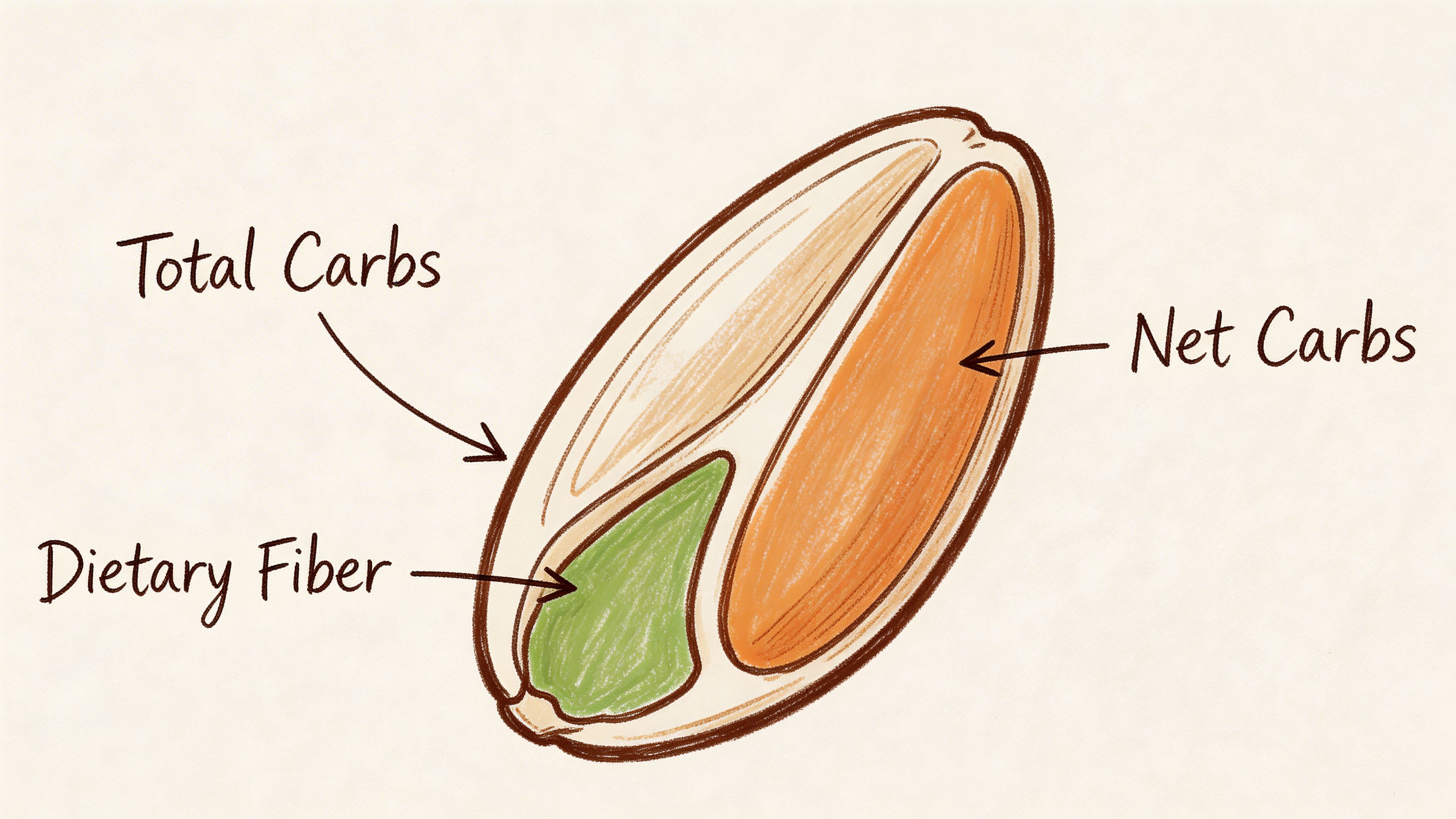
A brown rice entry only makes sense once you separate three label terms: total carbs, fiber, and net carbs.
Total carbs, fiber, and net carbs
Total carbs are the full carbohydrate count on the label. In brown rice, that total is made up mostly of starch plus a smaller amount of fiber.
Fiber is the part your body does not fully digest for direct energy. It still matters because it can slow digestion, support fullness, and change how the meal feels compared with a lower-fiber carb source.
Net carbs are the digestible portion, usually calculated as total carbs minus fiber. If you track net carbs, this is the number you care about most. If you track total carbs for performance or calorie control, start with the full carb line and use fiber as added context.
For a concrete example, FoodStruct’s cooked long-grain brown rice data lists 100 grams of cooked brown rice at 26 grams of total carbs and 2 grams of fiber, which leaves about 24 grams of net carbs.
That simple subtraction clears up a lot of label confusion.
Why cooked and dry entries create logging mistakes
Brown rice changes a lot once it is cooked. The grain absorbs water, becomes heavier, and spreads the same original carbs across a larger cooked weight.
That is why a dry rice label can look dramatically higher per 100 grams than a cooked entry, even though it started as the same food. The carb content did not disappear. Water changed the weight and volume.
This matters in real meals. A scoop from a takeout bowl is almost always cooked rice, while a package nutrition panel often shows dry rice. If you log the wrong state, your numbers can drift fast. A cooked rice nutrition guide makes it easier to match the entry to what is on your plate.
Why brown rice feels different from refined rice
Brown rice keeps its bran layer, which is where much of the fiber comes from. That extra structure is one reason it often feels chewier and more satisfying than white rice.
You may also hear terms like glycemic index. That refers to how quickly a carb food tends to raise blood sugar in a standard test. Brown rice often lands lower than white rice because its fiber and intact grain structure slow things down for many people. Glycemic index is useful as background, but it should not replace portion tracking. A large serving of lower-GI rice can still deliver a lot of carbs.
The same principle shows up in exercise fueling. Your body shifts between carbohydrate and fat use depending on intensity, meal timing, and training status. If you want the physiology behind that, this explainer on Respiratory Quotient (RQ) connects food intake with fuel use during activity.
A practical reading order for labels and app entries
Use the same sequence every time:
- Confirm the state. Is the entry for dry rice or cooked rice?
- Check total carbs. This is your starting number.
- Check fiber. This helps you understand fullness and net carbs.
- Calculate net carbs if needed. Subtract fiber from total carbs.
- Match the entry to the portion you ate. That makes BiteKit logs cleaner and more consistent.
Always distinguish between dry and cooked amounts to prevent logging errors.
Brown Rice vs White Rice A Carb Showdown
A bowl of rice can look simple and still create logging mistakes. Two bowls may appear identical on the plate, yet one keeps you full longer and changes your carb total in a small but meaningful way.
The direct comparison
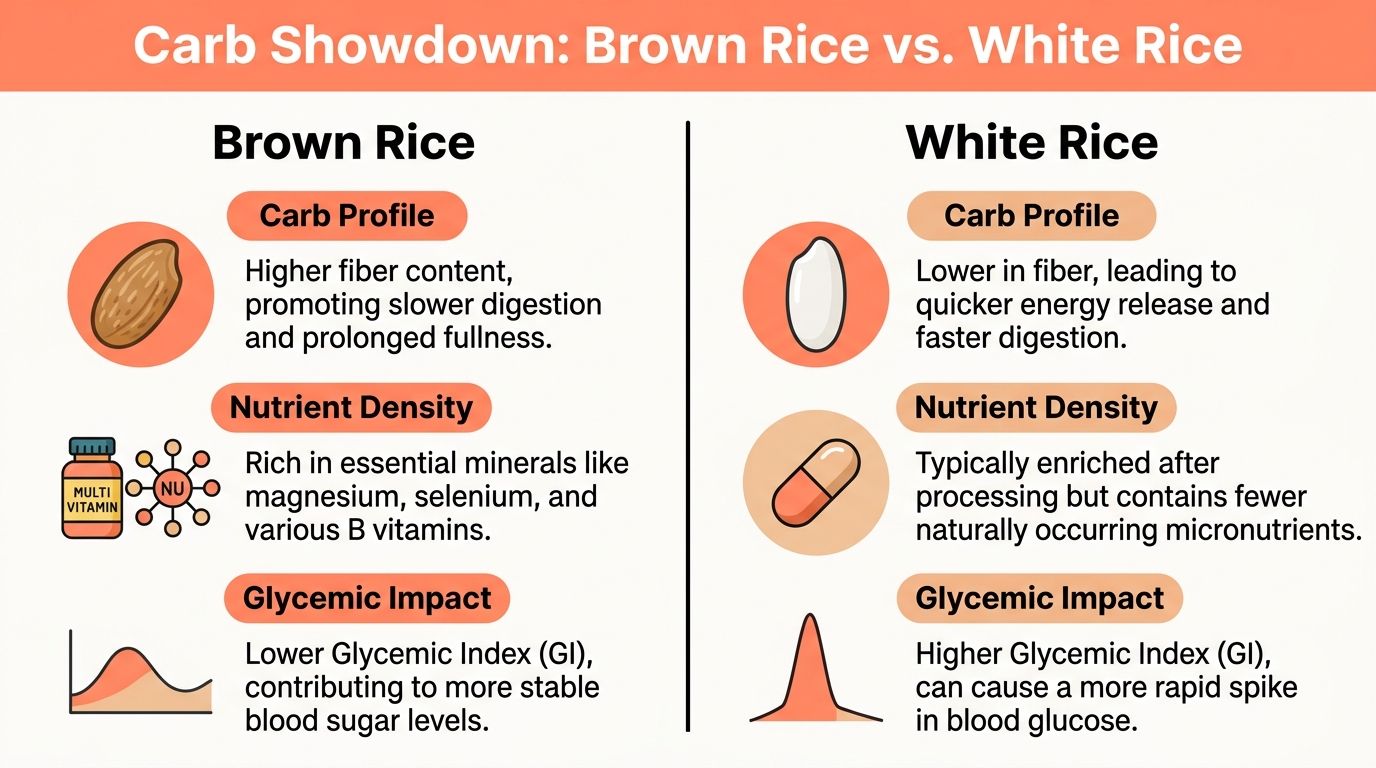
A 1-cup cooked serving of brown rice at 195 grams contains 44.4 grams of total carbs and 3.5 grams of fiber, while a similar serving of white rice usually gives you less fiber, about 0.2 to 0.56 grams, according to Carb Manager’s brown rice nutrition entry.
That difference matters because carb tracking is not only about the total number. It is also about how that carb arrives. Brown rice brings more fiber with it, so the same serving often feels steadier and more filling.
| Feature | Brown rice | White rice |
|---|---|---|
| Fiber | Higher | Much lower |
| Digestion speed | Slower for many people | Faster for many people |
| Fullness | Often more satisfying | Often less satisfying |
| Processing | Bran retained | Bran removed |
If you want help matching cooked rice entries to the portion on your plate, this guide to logging cooked rice accurately makes the comparison easier to apply in real meals.
Glycemic index in plain English
Glycemic index, or GI, describes how quickly a carb food tends to raise blood sugar in a standard test.
Brown rice still has a blood sugar impact, but the rise is often less abrupt for many people because the grain structure is less refined. White rice is usually digested faster, so the rise can be quicker.
That does not make GI a pass or fail score. A lower-GI food can still push your carb intake up if the serving gets large. For logging, the useful takeaway is simple. Brown rice and white rice may fit the same meal differently, even before you change the portion.
Why the difference matters day to day
Brown rice does not remove carbs. It changes the package those carbs come in.
That package can affect how manageable the meal feels. If you are trying to stay full between lunch and dinner, brown rice often gives you a little more help. If you are trying to turn a mixed plate into clean numbers in BiteKit, it also gives you a clearer reason to separate total carbs from fiber instead of treating all rice entries as interchangeable.
The same Carb Manager brown rice nutrition details note that whole grain intake, including foods like brown rice, is associated with lower long-term health risk in observational research. That point is useful background, but the day-to-day win is more practical. Brown rice can be easier to portion, easier to stay satisfied with, and easier to log consistently when your goal is steady carb control.
Useful perspective: White rice is not automatically a poor choice. Brown rice is often the easier choice when you want more fiber, steadier energy, and a grain that supports tighter tracking.
When white rice may still make sense
White rice still fits certain situations well.
- Pre-workout meals: Some people want a carb source that digests faster.
- Sensitive digestion: Brown rice’s fiber is not always comfortable before training or during stomach issues.
- Simple meal planning: Some people eat white rice more consistently, which can make portions and repeat logs easier to keep accurate.
How Carbs in Brown Rice Affect Your Goals
The same food can be helpful or unhelpful depending on what you want it to do.
If your goal is weight loss
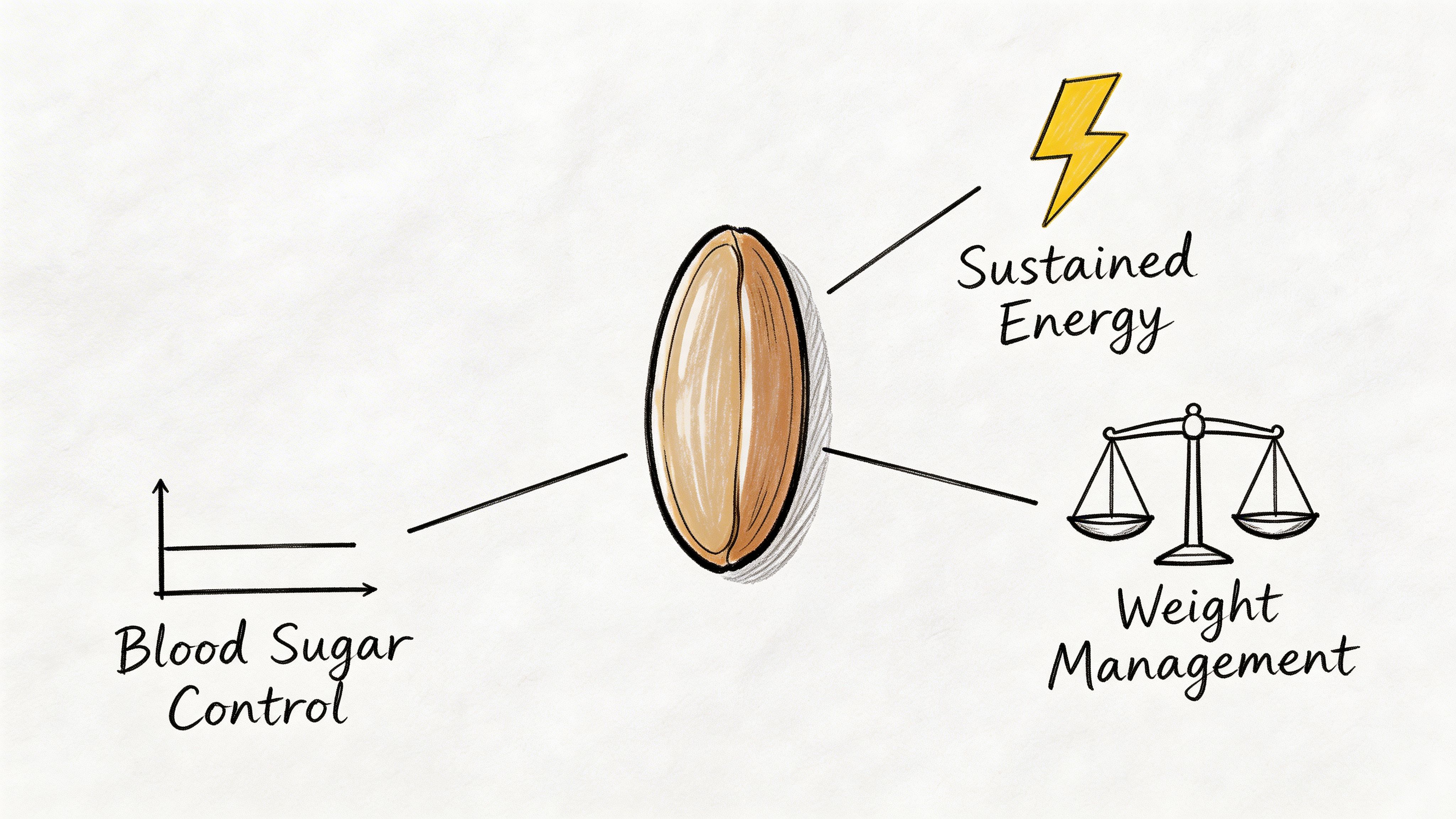
Brown rice is often easier to manage than more refined carbs because it brings fiber along for the ride.
According to Virta Health’s brown rice carb guide, the fiber in brown rice promotes gut motility and the production of SCFAs, which enhance GLP-1 secretion, a hormone that can curb appetite by 10 to 20 percent over 4 hours. The same source notes brown rice has a glycemic load of about 20 per cup, compared with white rice at 30+.
That does not mean one bowl of brown rice causes fat loss. It means brown rice may make it easier to eat in a controlled way because it can support fullness and more stable blood sugar.
If your goal is training energy
For exercise, carbs are fuel. Brown rice works well when you want a slower, steadier source instead of a fast hit.
A practical approach:
- A smaller portion with protein and vegetables can work on a lower-activity day.
- A larger portion can make sense after a tough session when you want to refill energy stores.
- Pairing it with lean protein often makes the meal easier to digest and easier to log.
If you like to think in terms of meal effect instead of carb fear, glycemic load is a useful concept. This calculator can help with that: https://bitekit.app/tools/glycemic-load-calculator
If your goal is general health
Brown rice is not a miracle food. It is a whole grain staple.
That matters because the package is different from a refined grain. You are not only getting starch. You are also getting fiber and a slower metabolic effect than many processed carb foods.
Coach’s rule: Choose brown rice when you want your carb source to do more than provide calories. It should also help with fullness, digestion, and consistency.
The mistake that changes outcomes
The problem is rarely “I ate brown rice.”
The problem is usually one of these:
- Portion drift: The serving gets bigger every week.
- Sauce blindness: People log the rice and ignore the sweet or oily toppings.
- Mixed-meal denial: A rice bowl is not “just rice.” It is rice plus everything layered on top.
Estimating Portions Without a Scale
Carb tracking often falls apart outside the kitchen.
At home, a scale is easy. At work, in a restaurant, or at someone else’s house, you need visual estimates that are good enough to repeat consistently.
Three visual cues that work
You do not need exactness. You need repeatability.
- A fist-sized mound: Often a helpful stand-in for about a cup of cooked rice.
- A cupped palm: A practical way to think about a smaller scoop.
- A side-dish scoop from a takeout bowl: Usually larger than people think, especially when rice is packed down.
The biggest error to avoid
Do not confuse the amount of dry rice you cooked with the amount of cooked rice you served yourself.
Rice expands when cooked. So if you prepared a batch for meal prep, the entry you use should match the amount on your plate now, not the dry amount you started with unless you are specifically dividing the recipe that way.
Tip: Restaurant rice often looks modest because it sits under the protein. Stir the bowl before estimating. Hidden rice is still logged rice.
A good walkthrough for hand portions and visual estimating is this guide on measuring food without a scale: https://bitekit.app/blog/how-to-measure-food-without-a-scale
A simple restaurant strategy
When you cannot measure:
- Look at the rice on its own before mixing.
- Compare it to your fist or cupped hand.
- Choose one estimate and use it consistently.
- Do not “correct” the log later based on guilt.
Consistency beats guessing wildly in both directions.
Logging Brown Rice in Seconds with BiteKit
Tracking carbs in brown rice is easy in theory and messy in practice.
You might have a bowl with brown rice, teriyaki salmon, avocado, shredded carrots, sesame seeds, and sauce. The challenge is not knowing that rice contains carbs. The challenge is turning that real plate into a usable log before motivation fades.
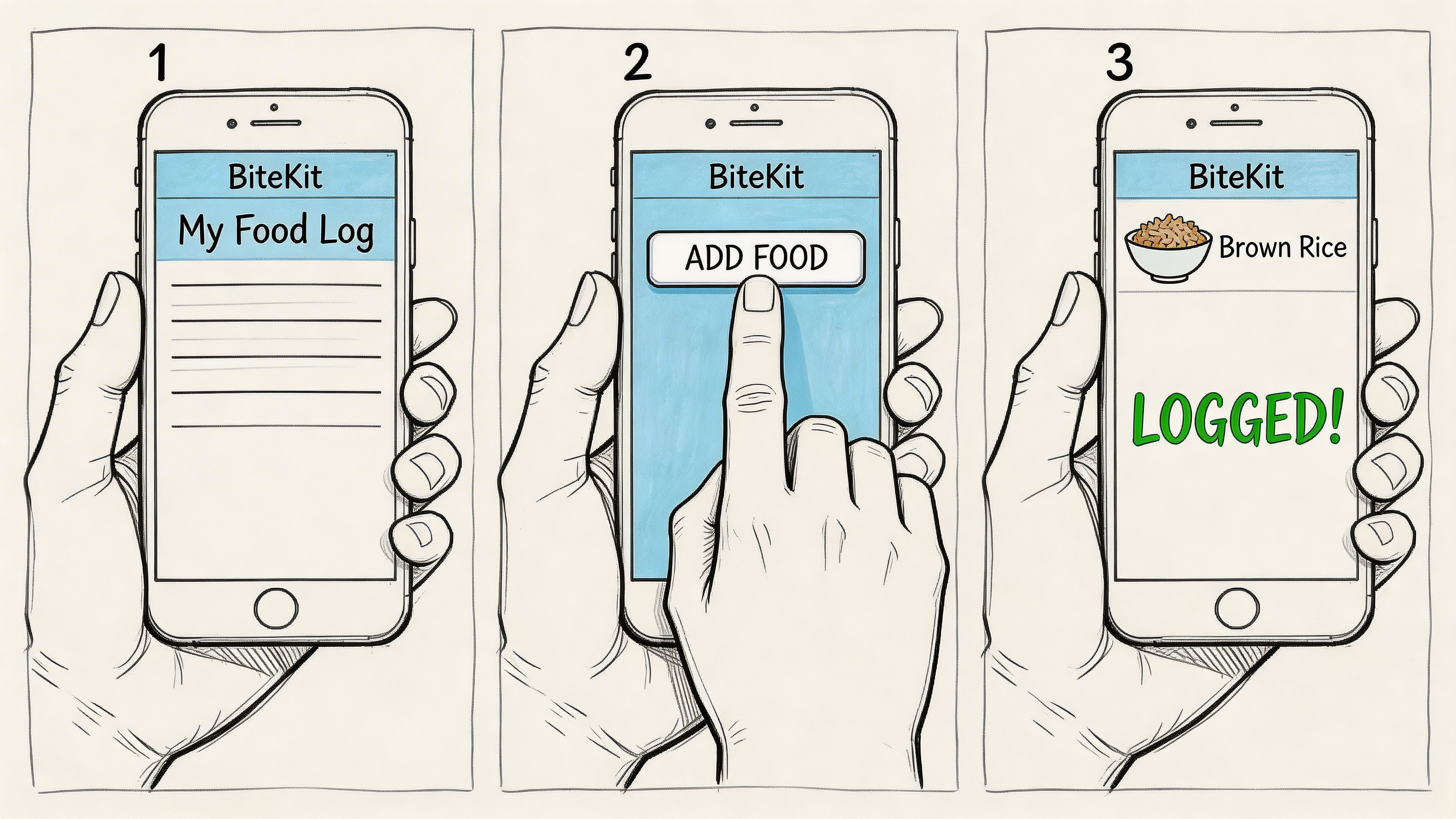
Photo logging for mixed meals
A photo works well when the meal is visually obvious.
You snap the bowl before eating. The app identifies the visible foods, estimates portions, and turns that image into a macro entry. That is especially useful when the rice is mixed with vegetables or spread under a protein.
This kind of logging reduces the usual mental friction. You are no longer searching a giant database for “brown rice, cooked, restaurant style, maybe one cup.”
Voice logging when your hands are full
Voice logging is practical when you are driving home, packing lunch, or eating between meetings.
You say something natural like, “large scoop of brown rice with chicken and broccoli,” and the app converts that into structured nutrition data. That matters because individuals do not quit tracking due to a lack of nutrition knowledge. They quit because logging interrupts life.
Text logging for clean entries
Text is fastest when you already know what you ate.
A simple entry like “1 cup brown rice” or “200g brown rice with salmon” gives you a direct log without scrolling through multiple similar foods.
BiteKit supports photo, voice, and natural language text logging, then updates calories and macros against your daily targets while keeping data stored locally on your device, according to the product information at https://bitekit.app.
When this matters most
This approach is most helpful in four common situations:
- Meal prep containers: You know the ingredients but not always the exact portion left in one container.
- Takeout bowls: Rice sits under toppings and is easy to underestimate.
- Family dinners: Nobody weighed anything, but you still want a useful record.
- Busy workdays: Fast logging keeps the habit alive.
Best use case: Log before the first bite. Estimation gets harder after the bowl is half gone and your memory fills in the gaps.
Advanced Tips for Carb Management
A bowl of brown rice can contain the same grams of carbohydrate on paper and still feel different in real life. One serving may leave you steady through the afternoon, while another makes you hungry again sooner. The difference often comes from preparation, temperature, and what you eat with it.
Stanford’s overview of brown rice, white rice, and glucose control notes that brown rice has a moderate glycemic effect, and that preparation can influence how your body handles its starch.
Why cooking method matters
Brown rice is mostly starch. Some of that starch is easy to break down quickly. Some becomes harder to access after cooking and cooling. That cooled portion is called resistant starch.
Resistant starch works more like a slow-to-reach part of the meal. It does not mean the rice becomes free carbs or that you stop counting it. It means the same food may hit your system a little more gradually, which is useful for blood sugar management, not just raw carb counting.
A simple way to picture it is this: freshly cooked hot rice is like dry kindling. Your body can use it fast. Cooked, cooled rice is more like thicker logs. The energy is still there, but access can be slower.
Practical ways to use that
If you meal prep, cooled brown rice in a lunch bowl may feel steadier than a large serving of freshly cooked rice eaten by itself.
Pairing also matters. Rice with chicken, tofu, eggs, beans, vegetables, or healthy fats usually creates a slower, more even meal than rice alone. The carb total stays relevant, but the overall response often changes because the meal digests at a different pace. Tracking becomes more useful than memorizing one number in this context. In BiteKit, you can log the rice portion and then note whether it was part of a mixed meal, a reheated leftover, or a post-workout bowl. Over time, that gives you a pattern you can use, not just a carb entry in isolation.
A smarter rule for advanced tracking
Count the carbs first. Then notice the context.
That context includes:
- whether the rice was freshly cooked or cooled first
- whether you ate it alone or with protein, fiber, and fat
- whether the meal was before training, after training, or during a sedentary part of the day
Those details help explain why the same 1 cup of brown rice may fit one goal well and another less well. For fat loss, context helps you stay full on fewer calories. For performance, it helps you place carbs where they support training. For blood sugar control, it helps you spot which meal setup feels more stable.
The goal is not to chase tiny food science tricks. The goal is to make your carb log match real life closely enough that your decisions get better week after week.
Frequently Asked Questions About Brown Rice Carbs
Is brown rice low carb
No. Brown rice is not a low-carb food in the strict sense.
It can fit a moderate-carb eating pattern, but it usually does not fit a strict ketogenic approach. If you are keeping carbs very low, even a normal serving of rice can take up a large share of your daily intake.
Is brown rice better for blood sugar than white rice
In general, it is often the steadier choice because of its fiber and lower glycemic impact.
That does not mean portion size stops mattering. A large serving of brown rice can still push your carb intake high. The better question is not “is it allowed?” It is “how much of it am I eating, and what is it paired with?”
Do long-grain and medium-grain brown rice have very different carb counts
For practical tracking, not enough to change your whole approach.
Different varieties can vary somewhat, but for everyday logging, the bigger issue is still serving size, cooked versus uncooked state, and whether you are logging the meal as eaten.
Should I worry about rinsing and preparation
It is reasonable to rinse rice before cooking. Many people do it for texture, cleaner grains, and general preparation habits.
If you have specific health concerns about rice intake, variety, or frequency, use basic food prep habits and talk with a qualified clinician for personalized guidance.
What is the simplest rule to remember
Treat brown rice like a useful carb source, not a free food and not a forbidden food.
If you can estimate the portion, log it in the right cooked or uncooked form, and keep an eye on the rest of the meal, you will handle carbs in brown rice much better than many individuals already.