Your Guide to Using a Free Macro Calculator
Unlock your fitness goals with our guide to using a free macro calculator. Learn to calculate and track macros for weight loss or muscle gain.
A free macro calculator is a powerful online tool that translates your fitness goals into a personalized daily plan for protein, carbs, and fats. By analyzing your unique biometrics and lifestyle, it provides a strategic roadmap for your nutrition. This shifts the focus from merely how much you eat to what you eat, giving you greater control over your body composition.
What Are Macros and Why Do They Matter
Calorie counting is a common starting point for weight management, but it only provides a partial view of nutrition. Scientific evidence consistently shows that the source of your calories is just as crucial as the quantity.
Think of your daily calorie allowance as a budget. You can spend it on nutrient-poor processed foods or on a balanced mix of lean protein, complex carbohydrates, and healthy fats. The physiological outcomes of these two approaches will be drastically different. This is where macronutrients—or "macros"—become essential.
The Three Key Macronutrients
Macronutrients are the primary nutrient groups your body requires in large quantities to function optimally. Each plays a distinct metabolic role, much like specialized fuels for a high-performance engine.
- Protein: Composed of amino acids, protein is the fundamental building block for bodily tissues. It's critical for muscle repair, immune function, and the synthesis of enzymes and hormones. Each gram of protein supplies 4 calories.
- Carbohydrates: These are the body's preferred source of energy, converted into glucose to fuel the brain and muscles. They are vital for both daily cognitive function and high-intensity physical activity. Each gram of carbohydrate also provides 4 calories.
- Fats: Essential fatty acids are crucial for cell structure, hormone production, and the absorption of fat-soluble vitamins (A, D, E, and K). As the most energy-dense macronutrient, fat provides 9 calories per gram.
Focusing solely on calories is a common pitfall. An 1,800-calorie diet derived from refined sugars and unhealthy fats will have profoundly different effects on body composition, metabolic health, and energy levels than an 1,800-calorie diet from whole-food sources.
By strategically balancing your intake of these three macros, you can precisely manage your body's resources. This evidence-based approach allows you to optimize for specific outcomes, whether that's reducing body fat, building lean muscle, or enhancing athletic performance.
Beyond Calories to Body Composition
This is precisely why tracking macros is a superior strategy for altering body composition—the ratio of fat mass to lean mass. For instance, numerous studies have demonstrated that higher protein intake promotes satiety and helps preserve muscle mass during a caloric deficit, leading to more sustainable weight loss. You can learn more about how to get started in our detailed guide on how to count macros for beginners.
A free macro calculator serves as the ideal starting point. It removes the guesswork from nutritional planning by converting your abstract goals into concrete, actionable daily targets for each macronutrient.
How a Free Macro Calculator Figures Out Your Needs
A free macro calculator doesn't use arbitrary numbers; it employs established physiological formulas to create your personalized nutrition plan. The calculation begins with your Basal Metabolic Rate (BMR), which is the energy your body expends at rest to maintain vital functions like breathing and circulation. Most reputable calculators use validated equations, such as the Mifflin-St Jeor formula, which incorporates your gender, age, height, and weight to establish this baseline.
From Your Baseline to Your Real-World Needs
Since you don't spend your day at complete rest, the next step is to account for your physical activity. The calculator multiplies your BMR by an activity factor that corresponds to your lifestyle—from sedentary (desk job) to highly active (manual labor plus daily exercise).
This calculation yields your Total Daily Energy Expenditure (TDEE), an estimate of the total calories you burn in a 24-hour period. This TDEE becomes the foundation upon which your macro targets are built. For a more in-depth look at this, you can use our dedicated TDEE calculator.
The technology underpinning these tools is part of a growing market. The global calculator technology sector was valued at $2.81 billion in 2026 and is projected to reach $4.14 billion by 2032, according to a detailed market report from Research and Markets. This growth reflects the demand for more precise and user-friendly digital health tools.
To get an accurate result, you'll need to provide some key information.
Understanding Your Macro Calculator Inputs
This table explains the essential data points and their physiological significance in the calculation.
| Data Input | Why It Matters for Your Calculation | Example |
|---|---|---|
| Age | Metabolic rate tends to decrease with age due to changes in muscle mass and hormonal profiles. | A 25-year-old will have a slightly higher BMR than a 55-year-old of the same size. |
| Gender | On average, males have a higher percentage of lean body mass, which results in a higher BMR. | A male and female of the same height and weight will get different BMR results. |
| Height & Weight | Body size is a primary determinant of energy expenditure; larger bodies require more energy. | A 6'2", 200 lb person needs more calories at rest than a 5'4", 130 lb person. |
| Activity Level | This multiplier adjusts your BMR to reflect your real-world energy demands from daily life and exercise. | "Lightly Active" (1-3 workouts/week) vs. "Very Active" (6-7 intense workouts/week). |
| Your Goal | This sets the energy balance: a calorie deficit for fat loss, a surplus for muscle gain, or maintenance. | "Lose weight" will subtract calories from your TDEE; "Gain muscle" will add to it. |
Providing accurate inputs is the first step toward creating a scientifically grounded and personalized nutrition plan.
Splitting Your Calories into Macros
With your TDEE established, the calculator's final step is to partition those calories into specific protein, carbohydrate, and fat ratios tailored to your goal. This is what transforms a simple calorie target into a strategic plan for body recomposition.
The macro split is adjusted based on physiological needs:
- For Muscle Gain: The protein ratio is increased to provide the necessary amino acids for muscle protein synthesis. Carbohydrate intake is also kept high to replenish glycogen stores and fuel intense resistance training.
- For Weight Loss: Protein remains elevated to preserve lean muscle mass and enhance satiety. The overall caloric target is reduced to create a deficit, with carbs and fats adjusted accordingly.
- For Maintenance: The macro split is typically more balanced to provide sustained energy and support your current body composition without promoting significant weight changes.
Each macronutrient has a unique metabolic pathway and function, making the ideal ratio highly individual.
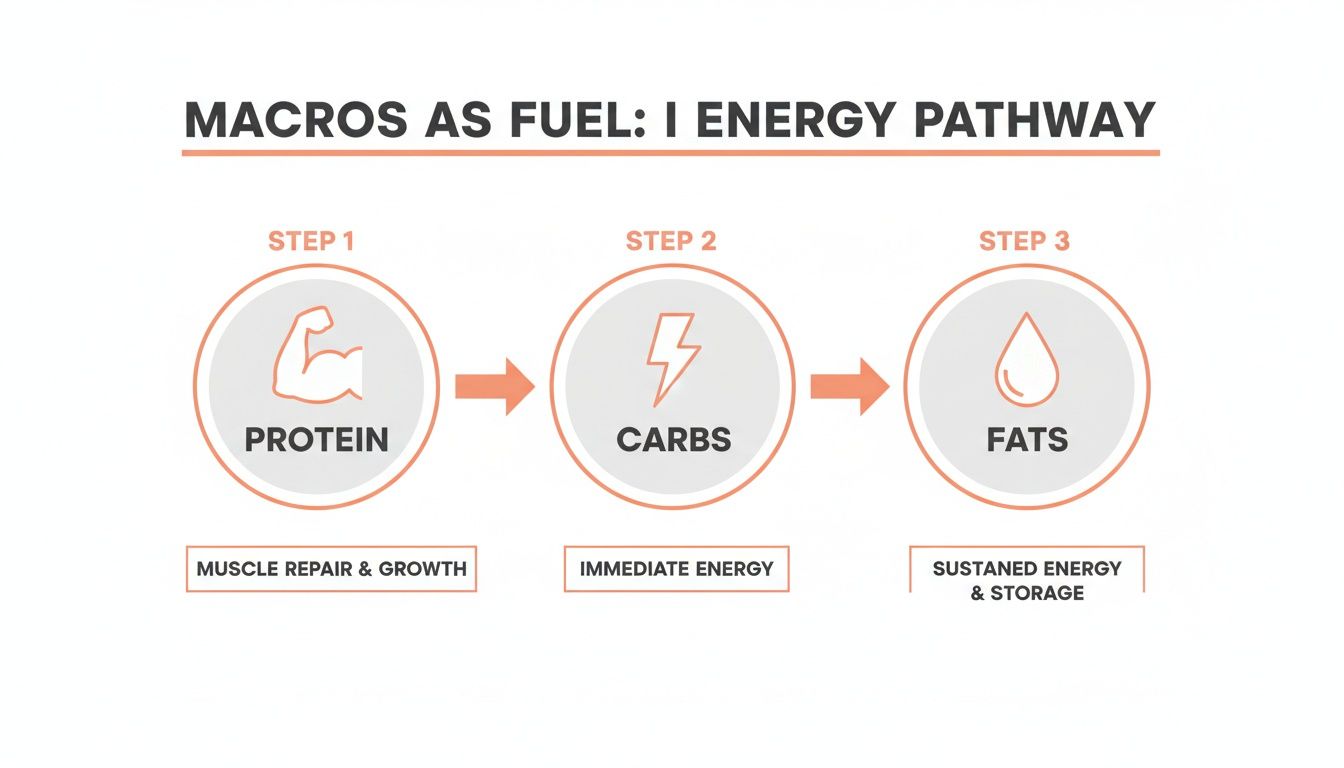
As the infographic shows, an athlete focused on muscle repair requires a different fuel blend than an endurance athlete who needs abundant, readily available energy from carbohydrates.
Putting the Calculator to Work with Real Examples
Theoretical knowledge is useful, but seeing a free macro calculator applied to real-world scenarios makes the concept tangible. Let's analyze two individuals with distinct goals to see how their inputs generate vastly different nutritional plans.
Sarah’s Goal: Sustainable Weight Loss
Sarah is a 30-year-old marketing professional, 5'6" tall, weighing 160 pounds. Her goal is to achieve sustainable fat loss of approximately one pound per week through nutrition and exercise.
She has a sedentary job but engages in moderate cardio and strength training 3-4 times per week, so we'll classify her as "Lightly Active."
Here are Sarah's inputs for a free macro calculator:
- Age: 30
- Gender: Female
- Height: 5'6"
- Weight: 160 lbs
- Activity Level: Lightly Active (exercises 3-4 days/week)
- Goal: Weight Loss (target of 1 lb/week)
The calculator will first determine her TDEE and then subtract approximately 500 calories to create the necessary energy deficit for her goal.
For successful weight loss, the primary objective is to maximize fat loss while minimizing the loss of lean muscle tissue. Scientific evidence strongly supports a higher protein intake to achieve this. Protein aids in muscle preservation and increases satiety, which is a significant benefit when managing a caloric deficit.
Sarah's resulting targets might be around 1,700 calories per day, with a macro split of 130g Protein, 160g Carbs, and 60g Fat. This provides a balanced framework for fat loss without extreme restriction.
David’s Goal: Building Lean Muscle
Next, consider David, a 25-year-old student who is 6'0" tall and weighs 175 pounds. His objective is to build lean muscle, targeting a slow gain of 0.5 pounds per week.
David is highly active, performing intense resistance training 5-6 times per week.
David's inputs for the calculator are:
- Age: 25
- Gender: Male
- Height: 6'0"
- Weight: 175 lbs
- Activity Level: Very Active (intense exercise 5-6 days/week)
- Goal: Muscle Gain (target of 0.5 lbs/week)
For muscle hypertrophy, the calculator will establish a modest caloric surplus. His macro distribution will be tailored to support muscle protein synthesis and fuel high-intensity workouts. A higher protein intake provides the necessary building blocks, while ample carbohydrates replenish glycogen stores and support performance.
His final targets might be approximately 3,100 calories per day, broken down into 195g Protein, 380g Carbs, and 90g Fat. These figures are designed to fuel both performance and recovery.
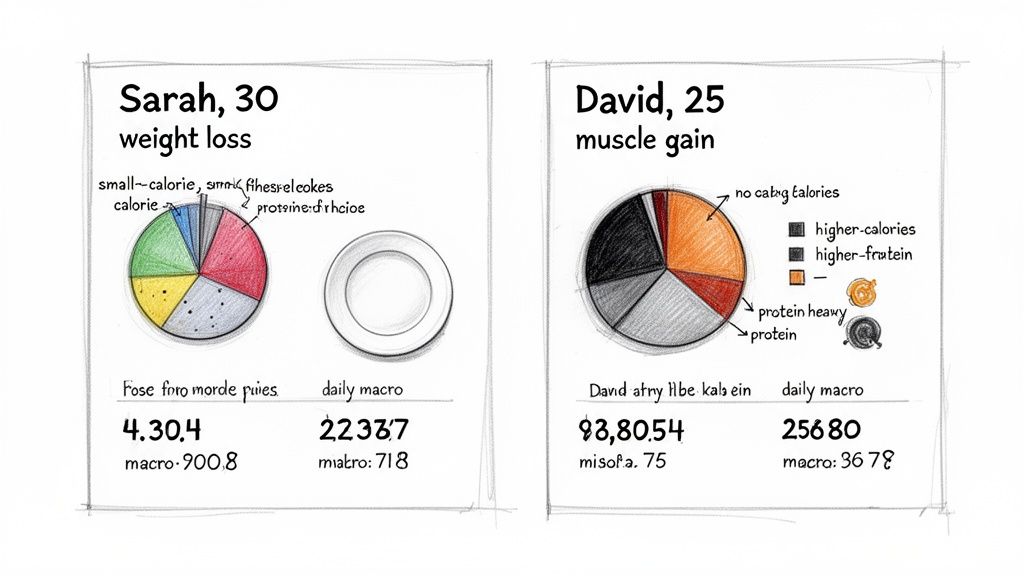
These examples clearly illustrate that your physiological goal dictates your nutritional strategy. A one-size-fits-all approach is ineffective because the macro-nutrient ratios required for fat loss versus muscle gain are fundamentally different.
The Hidden Struggle of Manual Macro Tracking
Obtaining personalized targets from a free macro calculator is an empowering first step. You have a clear, science-based nutritional plan. However, the initial motivation can quickly wane when faced with the daily reality of manual tracking. The process of weighing, measuring, and logging every food item can become a significant barrier to long-term adherence.
This is where theory meets practice, and many people discover that execution is far more challenging than planning.
The Problem with Most Tracking Apps
The constant demand for data entry is the primary reason for non-adherence. This tedious process can transform the act of eating from a source of nourishment and enjoyment into a chore, leading to what is often termed "tracking fatigue."
Most traditional tracking apps present three major challenges:
- Tedious Data Entry: Manually searching for or scanning every ingredient multiple times per day is time-consuming and mentally draining.
- Inaccurate Databases: Many apps rely on user-generated data, which can be riddled with errors, duplicates, and incomplete nutritional information, compromising the accuracy of your log.
- Logging Burnout: The obsessive nature of tracking every morsel can foster an unhealthy relationship with food, creating stress and anxiety around meals—the very opposite of the intended goal.
The core issue is the gap between knowledge and execution. A macro calculator provides the "what," but conventional tracking apps make the "how" a laborious and unsustainable process.
When Precision Becomes a Burden
The desire for accurate data is strong. The North American calculators market was valued at $510.04 million in 2019 and is projected to reach $646.07 million by 2033, as noted in the North American calculators market report. While this quest for precision is what draws people to macro tracking, the available tools often make it a burden.
This friction created by manual logging is a critical, often overlooked, factor in why many nutritional plans fail. The issue isn't a lack of willpower; it's a flaw in the tools. When the process of tracking becomes more arduous than the diet itself, abandonment is the likely outcome. The most scientifically sound plan is useless if it's too impractical to follow consistently.
BiteKit: An Effortless Alternative to Manual Logging
The daily grind of manual logging is the primary point of failure for many nutrition plans. A modern approach leverages technology to eliminate this friction. Imagine tracking a complex, home-cooked meal with the same ease as taking a photo. This technological shift is designed to combat tracking fatigue and make nutritional awareness sustainable.

The market reflects this demand for smarter solutions. The global calorie and macro tracking app industry, valued around $2 billion in 2025, is projected to surge to between $8 billion and $12 billion by 2033. This exponential growth underscores a collective search for more efficient and less burdensome methods of nutrition management.
A Smarter Way to Track Your Macros
BiteKit is engineered to solve the specific problems that make manual logging unsustainable. It utilizes AI to automate the data entry process, allowing you to log meals in seconds, not minutes.
You can use the most convenient input method for any situation:
- Log with a Photo: Simply take a picture of your meal. BiteKit's AI identifies the food items and estimates their quantities.
- Log with Your Voice: Describe your meal aloud, such as "a cup of Greek yogurt with a handful of blueberries," and the app transcribes and logs it.
- Log with Text: Use natural language to type your meal, like "a grilled chicken salad with vinaigrette," for instant logging.
This technology is particularly effective for homemade meals, which lack barcodes and are notoriously difficult to track accurately with traditional methods. It eliminates the friction, making consistent tracking achievable.
Privacy First: No Accounts Needed
In an era of data commoditization, BiteKit is built on a foundation of user privacy. It is not an afterthought but a core principle of its design.
A key differentiator for BiteKit is its absolute commitment to privacy. The app requires no account creation, no sign-ups, and no cloud storage. All your nutritional data remains exclusively on your device.
This means your dietary habits, biometrics, and progress are kept completely private. You benefit from advanced AI-driven analysis without compromising your personal information—a critical distinction for privacy-conscious users.
See how BiteKit's approach directly addresses the shortcomings of conventional macro tracking apps.
Comparing BiteKit with Traditional Macro Trackers
| Feature | Traditional Apps | BiteKit |
|---|---|---|
| Data Entry | Manual search, barcode scanning, tedious input | AI-powered photo, voice, and text logging in seconds |
| Homemade Meals | Difficult and time-consuming to log accurately | Effortlessly analyzed from a simple photo or description |
| Privacy | Requires account sign-up; data stored on company servers | No account needed; all data stays private on your device |
| Speed & Convenience | Can take several minutes to log a single complex meal | Logs most meals in under 30 seconds |
| User Experience | Often feels like a chore, leading to "tracking fatigue" | Designed to be intuitive, seamless, and sustainable |
BiteKit fundamentally redesigns the user experience, transforming nutritional tracking from a laborious task into a seamless, natural part of your daily routine.
From Tedious Logging to Effortless Awareness
Ultimately, sustainable results come from building consistent habits. A free macro calculator gives you the "what"—your nutritional targets. An effortless tool like BiteKit provides the "how"—a sustainable method for staying consistent.
By removing the friction of manual data entry, you can allocate your mental energy toward making mindful food choices and enjoying your meals. To see this integrated approach in action, you can explore the features of BiteKit and learn how it simplifies nutritional awareness, moving you from obsessive tracking to effortless insight.
Common Questions About Macro Tracking
After using a free macro calculator to get your initial targets, practical questions often arise as you begin to apply them. This section addresses some of the most common challenges and provides evidence-based guidance to help you navigate them effectively.
How Often Should I Recalculate My Macros?
Your body is a dynamic system that adapts to changes in diet and exercise. As your weight and body composition change, so do your energy requirements. Therefore, your macro targets should not be static.
As a general guideline, it's wise to recalculate your macros every 4 to 6 weeks, or following a significant change in body weight (e.g., 10-15 pounds). Another key indicator is a progress plateau; if your results stall for several weeks despite consistent adherence, it's likely time to adjust your targets.
Avoid the temptation to tweak your numbers daily. Consistency over time is the primary driver of results, not constant micro-adjustments.
Should I Prioritize My Protein or Calorie Goal?
This is a frequent dilemma in daily tracking. When you're at the end of the day and can meet one target but not the other, which should take precedence? The answer depends on your primary physiological goal.
-
For fat loss: Your protein goal is paramount. Prioritize hitting your protein target, even if it causes a slight deviation in your total calorie intake for the day. Adequate protein intake is scientifically proven to preserve lean muscle mass during a caloric deficit and enhance satiety, making the diet more sustainable.
-
For muscle gain: While the protein goal remains crucial for providing the amino acids needed for muscle protein synthesis, your total calorie goal gains equal importance. Muscle growth is an energetically expensive process that requires a calorie surplus. You cannot build new tissue without providing the requisite energy.
For most individuals, protein serves as the nutritional anchor for body composition goals. Think of total calories as your overall energy budget, but protein is the non-negotiable component that supports the preservation and growth of metabolically active tissue.
How Accurate Are Free Macro Calculators?
A free macro calculator is an excellent tool for establishing a scientifically-informed starting point. It uses validated predictive equations to estimate your needs. However, it's crucial to recognize that this is an estimate.
No algorithm can account for individual genetic variations, hormonal profiles, or unique metabolic responses. These calculators provide a highly educated starting point, but they are not definitive.
The most effective way to use them is to treat the initial numbers as a baseline. Adhere to them consistently for 2-3 weeks while tracking your progress (weight, measurements, performance, and biofeedback). Then, make small, logical adjustments based on your real-world results.
How Can I Track Macros When Eating Out?
Dining at restaurants can feel like a challenge to dietary adherence, but it doesn't have to derail your progress. Strategic planning can help you maintain consistency while enjoying a social life.
Here are a few practical tips:
-
Review the Menu Online: Many restaurants, especially chains, provide nutritional information on their websites. This allows you to plan your meal in advance and remove the guesswork.
-
Order Simple, Deconstructed Meals: Choose dishes with simple, distinct components, such as grilled protein (chicken, fish), a side of roasted vegetables, and a whole-food carbohydrate source (potatoes, rice). These are far easier to estimate than complex sauces, casseroles, or mixed dishes.
-
Use Your Hand for Portion Estimation: When precise information is unavailable, use your hand as a rough guide. The palm of your hand is approximately 3-4 ounces of protein, a cupped hand is about one cup of carbohydrates, and the tip of your thumb is roughly one tablespoon of fat.
-
Log Your Best Estimate: Use your tracking app to find a comparable entry and make an honest estimation. An imperfect entry is significantly better than no entry at all, as it maintains the habit of tracking and promotes continued nutritional awareness.