How to Count Macros for Beginners: A Science-Backed Guide
how to count macros for beginners: Learn simple steps to calculate your needs, track meals, and avoid common mistakes for lasting results.

So, you're ready to start counting macros. The first thing to understand is what they actually are: protein, carbohydrates, and fats. The entire process is about determining your daily calorie needs, breaking that down into specific targets for each macronutrient (in grams), and then tracking your food intake to meet those targets. It’s a strategic shift in focus—from just how much you eat to what you're eating.
Going Beyond a Simple Calorie Count
Most diets fixate on calories alone, but that’s an incomplete picture of nutrition. Not all calories are created equal, and their source has a profound impact on body composition, satiety, and metabolic health. This is where macronutrients provide a more nuanced and effective approach.
Counting macros offers a more intelligent way to manage your nutrition. You're focusing on the three key nutrient classes that fuel your body and drive physiological processes. A calorie budget is a good start, but a macro plan is the detailed blueprint for success. This method allows you to tailor your nutrition to specific goals, whether it's building lean muscle mass, reducing body fat, or optimizing athletic performance. It’s less about arbitrary restriction and more about making intentional, evidence-based food choices.
The Scientific Role of Each Macronutrient
Each of the three macronutrients has distinct and critical physiological functions. Achieving the right balance is what makes this nutritional strategy so effective.
-
Protein: Composed of amino acids, protein is the fundamental building block for the body's tissues. It is essential for muscle protein synthesis (the process of repairing and building muscle), especially following exercise. It also plays a crucial role in immune function, hormone production, and enzyme activity. Moreover, protein has the highest thermic effect of food (TEF), meaning your body burns more calories digesting it compared to carbs and fats, and it significantly increases satiety.
-
Carbohydrates: These are the body's preferred source of energy. When consumed, carbohydrates are broken down into glucose, which fuels the brain and provides the readily available energy needed for high-intensity physical activity. They are stored as glycogen in the muscles and liver, serving as a vital energy reserve.
-
Fats: Dietary fats are essential for long-term health and are not to be feared. They are critical for cell membrane structure, protecting organs, and absorbing fat-soluble vitamins (A, D, E, and K). Fats also play a massive role in regulating hormone production, including steroid hormones like testosterone.
Turning Calories into Grams
To effectively count macros, you must know the caloric value of each one. This basic bioenergetics math turns percentages and ratios into tangible, trackable numbers for your meals.
The conversion is based on established Atwater factors:
- 1 gram of protein = 4 calories
- 1 gram of carbohydrates = 4 calories
- 1 gram of fat = 9 calories
As you can see, fat is more than twice as energy-dense as protein and carbohydrates. Understanding these values is fundamental to designing a personalized nutrition plan. If you want to dive deeper into the basics, this beginner's guide to macros from TransparentLabs.com is a great resource.
To make this even clearer, here’s a quick reference table you can come back to.
Macronutrient Quick Reference Guide
This table breaks down the essentials for each macronutrient, giving you an at-a-glance summary of their roles, caloric values, and common food sources.
| Macronutrient | Primary Role in the Body | Calories Per Gram | Common Food Sources |
|---|---|---|---|
| Protein | Builds and repairs tissues, muscle, and organs; supports immune function. | 4 | Chicken, beef, fish, eggs, Greek yogurt, tofu, lentils, protein powder. |
| Carbohydrates | Primary source of energy for the brain and muscles. | 4 | Oats, rice, potatoes, bread, fruits, vegetables, quinoa. |
| Fat | Supports hormone production, absorbs vitamins, and protects organs. | 9 | Avocado, nuts, seeds, olive oil, fatty fish (like salmon), butter. |
Having this handy helps take the guesswork out of planning your meals.
By tracking macros, you ensure you're not just hitting a calorie number but also giving your body the right balance of fuel and building blocks it needs to thrive. This is why someone eating 2,000 calories high in protein will see different body composition results than someone eating 2,000 calories high in processed carbs.
How to Calculate Your Personal Macro Targets
You now understand the science of macronutrients. The next step is personalizing this knowledge by calculating your numbers. This is about creating a personalized nutritional blueprint that aligns with your physiology and goals.
The foundation of this calculation is your Total Daily Energy Expenditure (TDEE). TDEE represents the total number of calories you burn in a 24-hour period, encompassing your resting metabolism, the thermic effect of food, and physical activity.
Finding Your Calorie Starting Point
Before determining TDEE, you need to estimate your Resting Energy Expenditure (REE)—the calories your body burns at rest just to maintain vital functions. From there, we factor in your activity level.
A common method is to multiply your REE by an activity factor. For a sedentary individual (desk job, little exercise), the multiplier is 1.2. For light activity (exercise 1-3 days/week), it’s 1.375. For moderate activity (exercise 3-5 days/week), the factor is 1.55.
Let’s walk through a real-world example:
- Meet Alex: Alex is 30, weighs 150 lbs, and works a desk job but exercises 3 times a week. This places Alex in the "light activity" category.
- Estimate REE (The Quick Way): A rough estimate can be found by multiplying body weight by 10. So, 150 lbs x 10 = 1500 calories.
- Calculate TDEE: Now, we apply the activity multiplier. 1500 (REE) x 1.375 (Light Activity) = 2062.5 calories.
So, Alex’s maintenance TDEE—the caloric intake needed to maintain current weight—is approximately 2,063 calories per day.
If you'd rather skip the pen-and-paper math, you can get a quick estimate using our easy-to-use macro calculator.
Adjusting Calories for Your Goal
With your maintenance TDEE established, the next step is to adjust it based on your primary objective: fat loss, muscle gain, or maintenance.
- For Weight Loss: A caloric deficit is required. A sustainable and evidence-based starting point is a 15-20% reduction from your TDEE. For Alex, a 20% deficit is 412 calories (2063 x 0.20), resulting in a new daily target of 1651 calories.
- For Muscle Gain: A caloric surplus is necessary to fuel muscle protein synthesis. A 10-15% increase over TDEE is a good starting point to promote lean mass gain while minimizing fat accumulation. For Alex, a 10% surplus is 206 calories (2063 x 0.10), making the new target 2269 calories.
- For Maintenance: No adjustment is needed. Your TDEE is your target. This is ideal for focusing on performance improvements or body recomposition.
These are just starting points. The real magic happens when you pay attention to how your body responds. Track your progress for 2-4 weeks and don’t be afraid to tweak these numbers based on what you see.
Converting Calories into Macro Grams
The final step is to partition your total calorie target into specific grams for protein, carbs, and fat. This determines the composition of your diet.
While ratios can be highly individualized, a balanced 40% carbohydrate, 30% protein, and 30% fat split is an excellent starting point for most people.
Let's apply this to Alex's weight loss goal of 1651 calories:
- Protein (30%): 1651 x 0.30 = 495 calories. Since protein has 4 calories per gram, we divide by 4. (495 / 4 = 124g Protein)
- Fat (30%): 1651 x 0.30 = 495 calories. Fat has 9 calories per gram, so we divide by 9. (495 / 9 = 55g Fat)
- Carbohydrates (40%): 1651 x 0.40 = 660 calories. Carbs also have 4 calories per gram. (660 / 4 = 165g Carbs)
And there you have it. Alex's daily targets for weight loss are 124g Protein, 165g Carbs, and 55g Fat. These are the quantitative targets Alex will aim for when tracking meals.
This diagram offers a simple look at how your body puts each macronutrient to work.
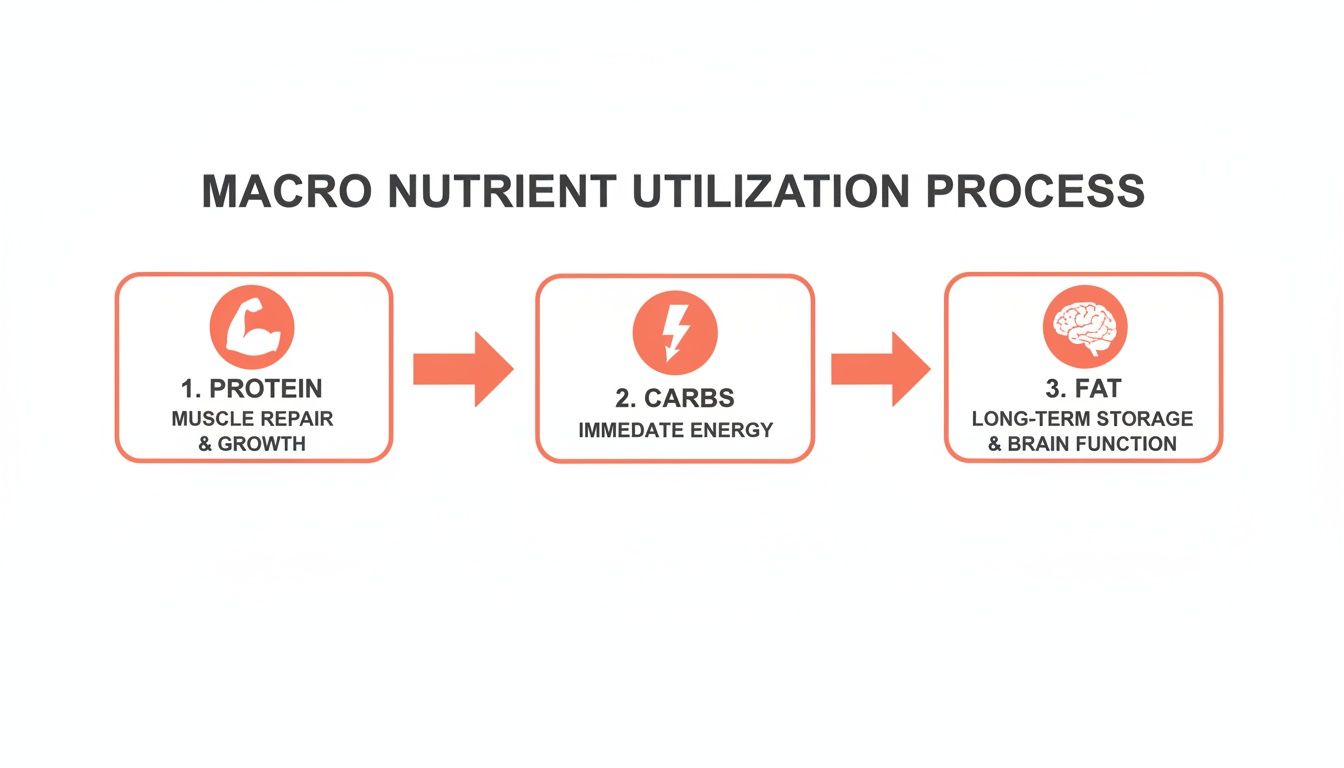
As you can see, protein serves as the building block for muscle, carbs provide the go-go-go fuel for energy, and fats are essential for things like brain function and hormone regulation. It’s all a team effort.
Bringing Your Macro Numbers to Life
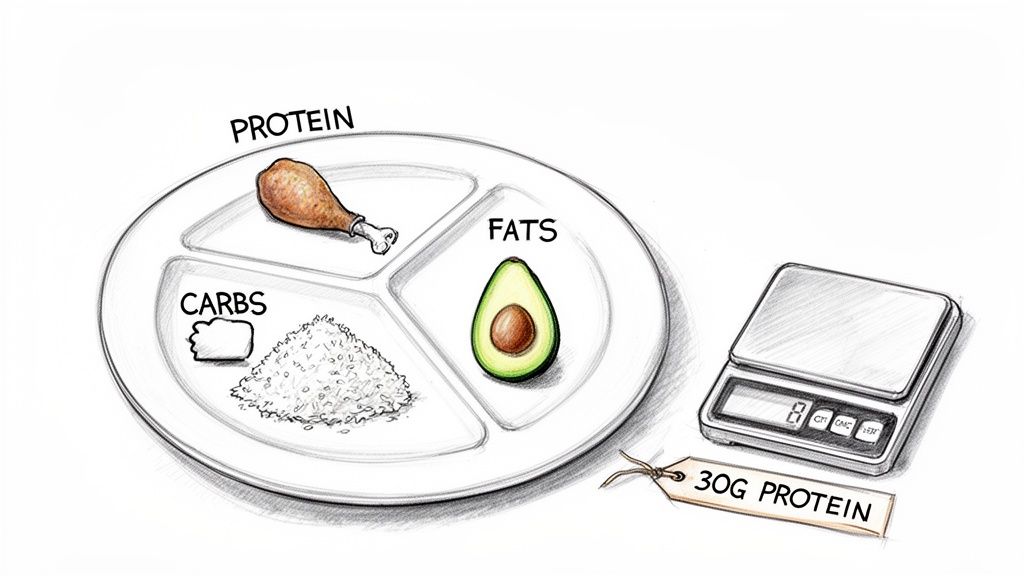
You’ve calculated your daily macro targets. Now it's time to translate those numbers into actual food. This is where theory meets practice, moving from a calculator to your kitchen.
It's less about being a math wizard and more about learning a few practical skills. Let's talk about the tools and techniques that bridge the gap between abstract grams and the satisfying meals on your plate.
The Power of Precision: A Food Scale
For anyone serious about accuracy, a digital food scale is the most critical tool. This isn't about fostering obsession; it's about education and data integrity. A scale eliminates guesswork and provides objective data on portion sizes.
Weighing your food for the first few weeks is an enlightening experience. You quickly learn what 150 grams of chicken or 30 grams of almonds actually looks like. This practice builds an instinctive understanding of portions that will serve you long after you stop using the scale daily.
Think of a food scale as your training wheels. Use it consistently for a few weeks, and you’ll develop an intuitive sense of portion sizes that makes tracking easier and more sustainable down the road.
Estimating Portions When You're Away From Home
Realistically, you won't always have a food scale available. For restaurants, social events, or family dinners, learning to estimate portions is a crucial skill. The "hand method" is a fantastic, discreet way to do this.
Here’s a quick guide to using your hand for on-the-go measurements:
- Protein: A portion of meat, fish, or tofu is roughly the size and thickness of your palm (about 3-4 ounces).
- Carbohydrates: A serving of rice, pasta, or potatoes is about the size of your cupped hand (around 1/2 cup).
- Fats: A serving of dense fats like nuts or cheese is about the size of your thumb (roughly one tablespoon).
Are these estimates perfect? No. But they provide a much better approximation than pure guesswork, helping you make informed choices and stay reasonably close to your targets in any setting.
Building Macro-Friendly Meals
Now, let's assemble a meal based on macro targets. A sound strategy is to build your plate around a protein source first, as this is often the most challenging macro to meet consistently.
Let's say your lunch goal is around 40g of protein, 50g of carbs, and 20g of fat. Here’s a simple way to construct that meal:
-
Start with Protein: A 6-ounce (170g) grilled chicken breast provides approximately 40-45g of protein. If you're unsure about your specific protein goals, this protein intake calculator can help you nail them down.
-
Add Your Carbs: Pair the chicken with a medium sweet potato (around 150g) and a large serving of broccoli. This combination yields roughly 35-40g of carbohydrates plus beneficial micronutrients and fiber.
-
Finish with Fats: Add a quarter of an avocado for about 7-8g of healthy fats. The cooking oil used for the chicken, plus trace fats in the other foods, will easily push you toward that 20g target.
This systematic approach shifts your perspective from staring at numbers to strategically constructing meals. You begin to view food as functional fuel, empowering you to build the body and energy levels you're after.
Building a Sustainable Macro Tracking Habit

You have your numbers and a strategy for building meals. However, the most significant challenge is adherence. The secret to long-term success isn't perfection; it's consistency. The goal is to establish a daily workflow that feels like a natural habit, not another chore.
Most people fall into one of two camps when it comes to tracking. Figuring out which one you are is a huge step toward making this habit last.
Finding Your Tracking Style
Some individuals are planners. They thrive on pre-planning meals for the day or week. This method, known as "pre-logging," has a major psychological advantage: it eliminates decision fatigue. You simply construct your day to meet your targets and then execute the plan.
Conversely, many people find this level of planning too rigid. They prefer the flexibility of logging meals as they consume them. This "as-you-go" style allows for more spontaneity but requires maintaining a mental tally of remaining macros. This can sometimes lead to challenging nutritional puzzles at the end of the day (e.g., needing to consume high protein with minimal fat).
There is no universally superior method. Experiment with both: pre-log for one week, then track as you go for the next. The best approach is the one that you can adhere to most consistently.
Making Technology Your Assistant
Let’s be honest: most people quit tracking because it's tedious. Manually searching for every ingredient, scanning barcodes, and guessing at portion sizes for every meal is a fast track to burnout. This is where the right tools can completely change the game for beginners.
Instead of getting stuck in the weeds of data entry, you can use technology to make logging almost effortless. For instance, apps like BiteKit were designed specifically to get rid of that friction. You can snap a photo of your food, use a voice command, or type a simple sentence, and the app does all the heavy lifting of figuring out the macros for you.
This is the key difference between tracking that feels like a burden and tracking that feels like a simple, two-second habit. It’s a complete game-changer.
Think about a real-world scenario. You've just finished a great dinner: grilled salmon with roasted asparagus and a scoop of quinoa. The old way involves opening an app, searching for "salmon," "asparagus," and "quinoa" individually, weighing each one, and logging them.
The new way? You just say, "I had 150 grams of salmon with quinoa and asparagus." The app instantly understands, estimates portions if you don't specify, and adds it all to your daily log. Done.
The clear progress bars for protein, carbs, and fat give you instant feedback, helping you make smarter choices for your next meal without having to obsess over spreadsheets. It makes the process feel more like a win and less like homework. If you want to dive deeper, exploring the features of a modern food diary app can show you just how simple this can be.
Ultimately, building a habit that sticks is all about removing friction. When logging is fast and intuitive, you're far more likely to stay on track and finally see the results you're working so hard for.
Common Macro Counting Pitfalls and How to Sidestep Them
Embarking on a macro counting journey is a significant step, but several common hurdles can derail even the most motivated beginners. Awareness of these potential pitfalls is key to navigating them successfully and ensuring steady progress.
One of the most frequent errors is an inaccurate estimation of one's own physical activity level. It's easy to complete a few strenuous workouts and classify yourself as "very active" in a TDEE calculator. This can significantly inflate your calorie and macro targets, leading to unintentional overconsumption.
The Activity Level Overestimation Trap
The feeling of accomplishment after a tough gym session is real, but the actual caloric expenditure may be lower than perceived. For most people with sedentary jobs, even five hours of exercise per week does not fully offset the other 163 hours spent with low physical activity.
A more prudent initial approach is to be conservative. Nutrition experts often advise beginners to select a lower activity multiplier to start. You can always adjust upwards after a few weeks if you observe unintended weight loss or low energy. For a deeper dive into setting and refining those initial numbers, the folks at Functional Bodybuilding have some great insights.
Forgetting the 'Hidden' Macros
You've meticulously weighed your chicken breast and portioned your rice, but what about the olive oil used for cooking or the dressing on your salad? These "hidden" macros can silently undermine your progress if unaccounted for.
Fats are particularly notable due to their high energy density. A single tablespoon of olive oil contains approximately 14 grams of fat and 120 calories. Consistently omitting such additions can easily negate a caloric deficit.
Be vigilant about tracking these common sources:
- Cooking Oils: Olive oil, coconut oil, butter, avocado oil.
- Sauces & Marinades: Many contain significant amounts of sugar (carbohydrates) or fat.
- Dressings & Condiments: These can add up quickly.
- Beverages: Cream and sugar in coffee, juices, and sodas all contain macros.
The solution is simple in principle but requires discipline: if it is consumed, it is logged. This rule ensures the accuracy of your data, making your efforts more effective.
The All-or-Nothing Mindset
Imagine you deviate from your plan and consume a meal high in fat and carbohydrates. A common cognitive distortion is to think, "I've already ruined today, so I might as well eat whatever I want and restart tomorrow."
This "all-or-nothing" thinking is the single biggest threat to long-term consistency. One off-track meal or day doesn't erase weeks of progress.
Instead of abandoning your plan, view the event as a single data point. Log the meal as accurately as possible and resume your normal plan with the very next meal. The goal is not perfection, but consistent effort over time. A single day of high caloric intake will not derail your progress, but abandoning your plan for a week in response to it certainly will. Treat it as a learning opportunity and move forward.
Common Questions (and Straightforward Answers) About Counting Macros
Even with a well-structured plan, questions will arise. Addressing these uncertainties is key to building the confidence needed for long-term adherence.
Here are evidence-based answers to the most common questions from beginners.
Do I Really Need to Hit My Macros Perfectly Every Day?
No. The pursuit of perfection is often a barrier to consistency. Your daily macro targets are guidelines, not rigid rules. A degree of flexibility is essential for sustainability.
A reasonable range to aim for is:
- Protein & Carbs: Within 5-10 grams of your target.
- Fat: Within 2-5 grams of your target, given its higher caloric density.
From a physiological standpoint, your weekly average intake is more significant than any single day's numbers. Daily fluctuations tend to balance out over the week. One "off" day is statistically insignificant in the long run; abandoning the process due to a perceived failure is what truly hinders progress.
This flexible, non-rigid approach fosters a sustainable habit rather than a short-term diet.
How Do I Handle Tracking When I Eat Out?
Dining at a restaurant does not have to derail your progress. Most large restaurant chains publish nutritional information online, which allows for precise logging.
For local establishments without published data, use an estimation strategy. Deconstruct the meal into its primary components:
- Protein: A piece of salmon the size of your palm is approximately 4-5 ounces. Log it as such.
- Carbs: A cupped handful of potatoes or rice is a reasonable estimate.
- Fats: This is a critical component often overlooked. Assume at least one tablespoon of cooking oil or butter was used in preparation and add it to your log.
It is always preferable to log an educated estimate than to log nothing. The act of estimation maintains mindfulness and reinforces the tracking habit.
Should I Bother Counting Macros from Vegetables?
Yes, all food and beverages consumed should be tracked to ensure data accuracy.
While non-starchy vegetables like spinach and broccoli are low in calories, the quantities can add up, particularly in large salads or multiple daily servings. Fruits are a significant source of carbohydrates; a single banana can contain 20-30 grams of carbs.
Omitting these from your log creates an incomplete and inaccurate data set, which undermines your ability to make informed adjustments to your plan.
How Often Should I Recalculate My Macros?
Avoid the common mistake of frequent adjustments. Your body requires time to adapt and respond to a new nutritional stimulus.
Adhere to your initial macro targets for a minimum of 3-4 weeks before considering any changes. This period provides sufficient data to assess progress and determine if you have reached a true plateau.
After this initial phase, review progress weekly. If weight loss has stalled for two consecutive weeks, a small, methodical adjustment may be warranted. For instance, reduce daily carbohydrate intake by 15-20 grams and assess the impact over the subsequent two weeks. This systematic approach allows you to identify what truly works for your individual physiology.