Unlocking Your Health Goals: A Guide to Using a Food Diary App
Discover how a food diary app helps you track calories, macros, and habits—empowering science-based nutrition decisions.
A food diary app is a digital tool for tracking your food and drink consumption. But it's far more than a simple journal. These applications analyze your meals to provide data on calories, macronutrients (protein, carbs, and fats), and other key metrics, offering a clear, scientific picture of how your diet impacts your health and fitness goals.
Why a Food Diary App Is Your Personal Nutrition Coach
Think of a food diary app as a detailed financial ledger for your health. It reveals exactly where your daily "calorie currency" is allocated and provides objective, data-driven feedback on your dietary habits. This awareness, grounded in self-monitoring, is a cornerstone of successful dietary change, as numerous studies on weight management have shown.
For many, the initial use of a food diary app is a revelation. You might discover the hidden sugars in your morning coffee, realize your lunches are deficient in protein for muscle synthesis, or find that late-night snacking contributes significantly more to your daily energy intake than you assumed.
From Awareness to Actionable Insights
The real power of a food diary app emerges when it translates raw data into actionable strategies for improving your diet, fitness, or weight loss journey. Consistent logging helps you identify patterns in your eating habits, allowing you to understand your body's specific responses to different foods and macronutrient ratios.
Here are a few key benefits supported by nutritional science:
- Pinpoint Problem Areas: Identify sources of excess calories, added sugars, or saturated fats that may be hindering your weight loss or fitness progress.
- Ensure Nutritional Balance: Verify that you are meeting targets for essential nutrients like protein for muscle repair, fiber for digestive health, and key vitamins and minerals.
- Build Accountability: The act of recording food intake, a principle known as self-monitoring, is a well-documented behavioral strategy that increases mindfulness and accountability.
A food diary creates a historical overview of your diet that empowers you and health professionals to make targeted, effective changes. It’s the difference between guessing what works and knowing what works for your body.
The methodology for tracking food intake has evolved significantly. What began with pen and paper has transformed into sophisticated, AI-powered tools that make logging both easier and more scientifically insightful.
How Food Diary Apps Have Evolved
| Feature | Traditional Logging (Pen & Paper) | Modern AI Food Diary App |
|---|---|---|
| Data Entry | Manual, time-consuming, requires looking up values. | Instant logging via photo, voice, or text search. |
| Nutrient Analysis | Basic calorie/macro counting, requires manual calculation. | Detailed breakdown of calories, macros, and micronutrients. |
| Personalization | Generic, one-size-fits-all approach. | AI-driven insights, personalized goals, and custom meal plans. |
| Feedback | Delayed; requires manual review and analysis. | Real-time feedback and progress tracking against goals. |
| Accessibility | Limited to wherever you carry your notebook. | Always available on your smartphone. |
This technological shift has democratized nutrition tracking, moving it from the realm of guesswork to data-driven wellness.
This evolution is a key driver of market growth. The AI-driven meal planning app sector, a close relative of food diary apps, is projected to grow from USD 972.1 million in 2024 to USD 11,566.5 million by 2034. Mobile apps are at the forefront, capturing 51.2% of the market as users demand on-the-go solutions for their fitness and diet needs.
Ultimately, a food diary app functions as a personal nutrition coach, providing the objective data necessary to stay on course with your health goals, whether they involve weight loss, muscle gain, or simply a healthier diet. You can learn more about the best way to track food intake in our detailed guide. It’s a tool for empowerment, designed to help you build a healthier and more mindful relationship with food.
Essential Features for Effective Nutrition Tracking
Not all food diary apps are created equal. The difference between a helpful scientific tool and a frustrating chore often comes down to a few core features. Choosing the right app is like selecting specialized equipment for a sport—the right gear enhances performance and makes the process more efficient.
The foundation of any credible app is a vast and accurate food database. An incomplete library means you'll spend more time on manual data entry than on analysis. A fast, reliable barcode scanner is indispensable here, allowing you to instantly capture verified nutritional information from packaged foods. This feature dramatically reduces the friction that often leads users to abandon their tracking efforts.
Personalizing Your Nutrition Blueprint
Logging what you eat is only the first step. A truly powerful food diary app must allow you to set customizable goals based on your unique physiology and objectives. Generic, one-size-fits-all targets for calories or macros fail to account for individual differences in metabolism, activity level, and body composition goals. The app should adapt to you, whether your goal is weight loss, muscle hypertrophy, or fueling endurance activities.
At a minimum, you should be able to set specific targets for:
- Calories: The fundamental metric for managing energy balance, which is the scientific basis for weight gain, loss, or maintenance.
- Macronutrients: The ability to fine-tune your protein, carbohydrate, and fat intake is critical for specific fitness and body composition goals. For example, a higher protein intake is scientifically shown to support muscle repair and satiety.
This level of personalization transforms the app from a simple log into a strategic partner in your health journey. You can even see how tools like an AI meal analyzer break down the macros in your real-world meals.
Turning Data into Actionable Insights
Finally, what is the value of data if it cannot be easily interpreted? A clean, intuitive dashboard with clear progress summaries is essential. You need to be able to understand your nutritional status at a glance. Simple visuals, like progress bars for daily macros or charts illustrating weekly trends in calorie intake, are incredibly effective for translating complex data into actionable information.
This flowchart visually represents how a primary goal is broken down into these key nutritional pillars.
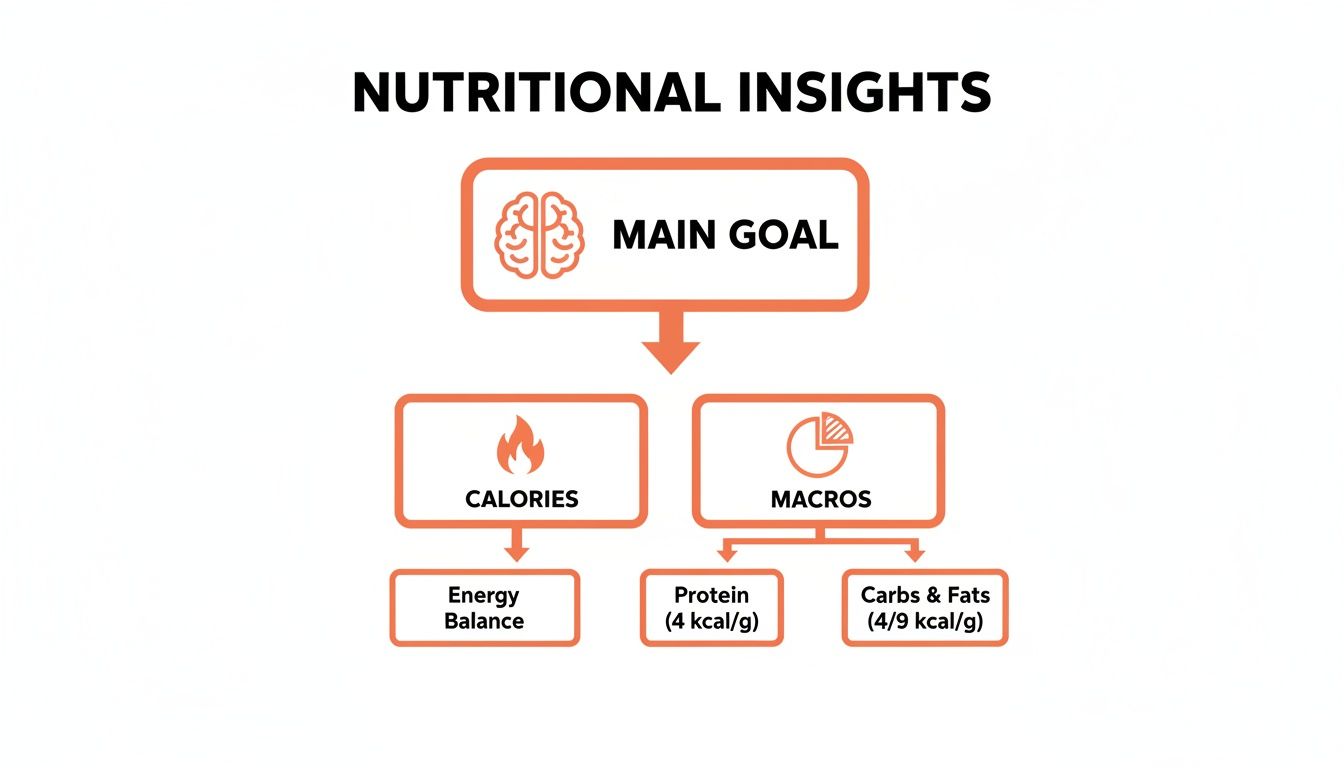
As shown, all nutritional strategies stem from your main objective. Managing calories is key for energy balance and weight control, while optimizing macronutrient ratios helps with body composition, athletic performance, and overall health.
This focus on user experience is what distinguishes apps that are used for a week from those that become long-term habits. It's no surprise that while traditional manual logging holds a 39.13% market share, faster methods like image-based logging are rapidly gaining traction. People demand tools that integrate seamlessly into their lives, and the best app is the one that makes consistency nearly effortless.
The Future of Food Logging Is Effortless
Let's be honest: the primary reason people abandon food diary apps is that manual logging is tedious. Searching for ingredients, estimating portion sizes, and entering data for every meal can feel like a part-time job. This is where AI is revolutionizing the experience, turning a chore into a quick, almost invisible habit.
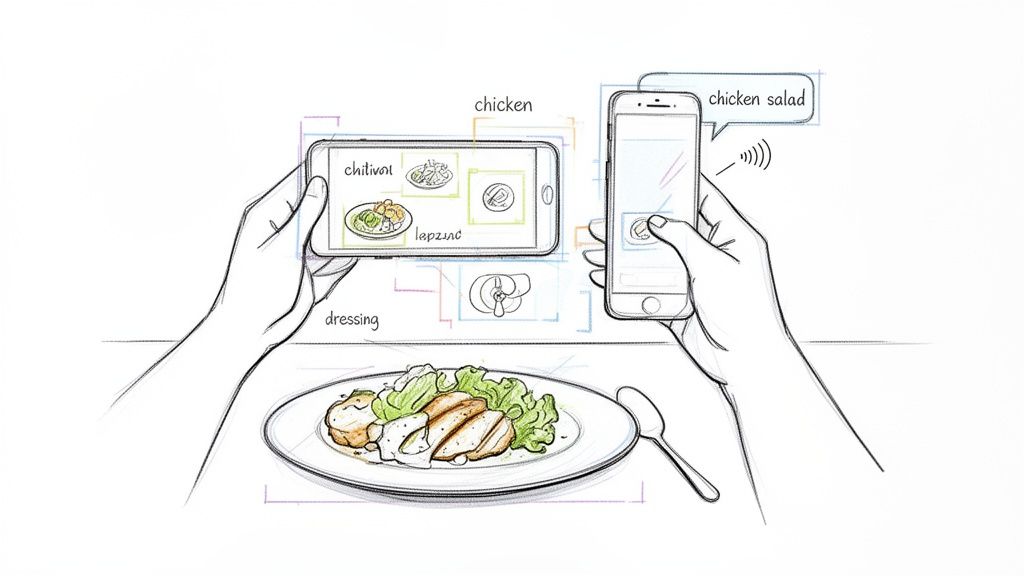
Imagine this: you snap a photo of your dinner. In seconds, the app's AI identifies the grilled chicken, avocado, and mixed greens, then instantly estimates portion sizes and calculates the nutritional information. This isn't a futuristic concept; it's the new standard for a modern food diary app, and it removes the friction that made traditional tracking so difficult to sustain.
New Ways to Log Your Meals
The goal is to make logging as natural as eating. Beyond image recognition, the best apps are integrating new, seamless methods that fit into your daily routine, which scientifically increases the likelihood of adherence.
Here are some of the most effective new methods:
- Voice Logging: You can simply say, "I had a protein shake with one scoop of whey and a banana." The app's AI parses this command and creates an accurate entry.
- Natural Language Input: Type or text the app as you would a friend: "For lunch I had a turkey sandwich on whole wheat." The AI understands the context and logs the individual components for you.
This shift toward intuitive logging does more than just save time. It directly addresses the primary obstacle to long-term success: the significant effort required for daily tracking.
By reducing the logging process to mere seconds, AI-powered tools make it exponentially more likely that users will adhere to the practice long enough to achieve meaningful results in their diet, fitness, and weight loss journeys.
Accuracy Meets Accessibility
When logging is this easy, the quality of the data improves as well. Capturing a meal in real-time eliminates the recall bias and inaccurate portion estimations that occur hours later. A powerful food diary app uses sophisticated AI models to analyze what it "sees," providing a more accurate nutritional breakdown than a rushed, manual guess.
To see this in action, you can explore how an AI photo analyzer works. This technology is engineered to handle complex, homemade meals that lack a barcode—a persistent weakness of older applications.
Ultimately, these new technologies are making accurate nutrition tracking accessible to everyone, regardless of their schedule. The future of understanding your diet is becoming as simple as taking a picture.
Building Sustainable Habits with Your Food Diary App
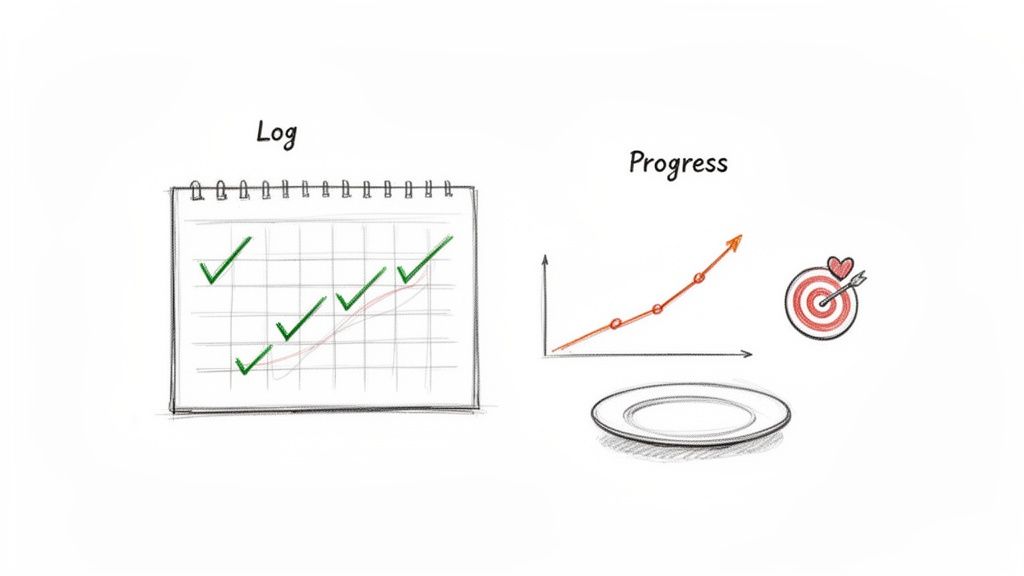
Let's be honest: the secret to deriving any benefit from a food diary app is consistent use. However, transforming daily tracking into a lasting habit requires more than good intentions. The science of behavior change shows that it's less about perfection and more about building a sustainable practice that provides useful data over the long term.
Think of it like strength training. Initial efforts may feel awkward, but with consistent practice, the movements become second nature. This guide will help you transform your food diary from a chore into a powerful tool for mindful eating and achieving your fitness goals.
Set Realistic and Achievable Goals
Setting impossibly high standards from day one is a common cause of burnout. Instead of vowing to hit perfect macronutrient targets every day, start with a smaller, more manageable goal. For example, your initial objective could be to simply log everything you eat for one week, without judgment.
Once that feels routine, introduce another layer. The following week, you might focus on meeting your protein target or staying within your calorie range on five out of seven days. This gradual, evidence-based approach builds momentum and helps you avoid the frustration that comes with attempting to overhaul your entire diet at once.
Log Consistently, Even on "Bad" Days
We've all experienced it. After a day of dietary indulgence, the last thing you want to do is record it. However, these are often the most valuable days to log. An "off" day can provide as much insight as a "perfect" one.
Consistent tracking reveals patterns that would otherwise go unnoticed. You might discover that certain moods, social situations, or even days of the week are triggers for deviating from your diet plan. This is not a failure; it is valuable data that you can use to prepare and adapt your strategy.
Remember, the purpose of a food diary app is to foster awareness, not to induce guilt. Numerous scientific studies confirm that self-monitoring is a cornerstone of sustainable behavior change. Every entry, regardless of its content, is simply another data point in your personal health puzzle.
Master the Art of Portion Estimation
While a food scale offers the highest accuracy at home, it's not always practical. Learning to estimate portion sizes is a crucial skill for maintaining tracking consistency, especially when eating out.
Here are some practical, science-backed visual cues using your hands:
- A clenched fist is approximately one cup (useful for cereals, pasta, or rice).
- The palm of your hand (excluding fingers) is a good proxy for a 3-4 ounce serving of protein like chicken or fish.
- A cupped hand holds about one ounce of nuts or seeds.
- Your thumb (from the tip to the first knuckle) is roughly one tablespoon (ideal for oils, peanut butter, or salad dressing).
These visual aids, while not perfectly precise, are a significant improvement over pure guesswork. With practice, you can become surprisingly adept at estimation, making on-the-go logging far less stressful.
Where Does Your Data Go? Privacy and Accuracy in Food Tracking
When you log a meal in a food diary app, you are sharing sensitive personal health information. This raises two critical questions: who has access to this data, and is the nutritional information you are relying on scientifically accurate?
Most popular tracking apps require you to create an account, syncing your eating habits, weight, and health goals to the cloud. While this offers the convenience of multi-device access, it also means your private health data is stored on a company's servers.
This practice introduces significant risks. Your information could be exposed in a data breach or used for targeted advertising in ways you did not consent to. This forces a difficult choice between convenience and privacy.
Can You Trust the Numbers?
Beyond data privacy, a more fundamental issue is the accuracy of the food database itself. A surprising number of food diary apps rely on user-submitted entries. This means the nutritional data for the food you just logged may have been entered by an unverified source, not a nutritionist or a verified database.
This crowdsourced model is prone to errors:
- Incorrect calorie counts for basic foods.
- Inaccurate macronutrient details (protein, carbs, and fat).
- Outdated information for products with reformulated recipes.
Relying on flawed data for your diet or fitness plan is like navigating with an incorrect map—it can silently undermine your progress. You may believe you are meeting a daily protein target for muscle growth, but if the app's data is inaccurate, you could be falling short.
When making health decisions based on data, the integrity of that data is paramount. Inaccurate entries in a food diary app can sabotage your weight loss and fitness efforts, making it crucial to use a tool with validated, trustworthy information.
This is precisely why some applications are adopting a different model. A privacy-first food diary app like BiteKit operates without user accounts. All of your information is stored locally on your device—and only your device. No data is sent to the cloud, ensuring your health information remains 100% private.
By combining this local-first approach with a database built on verified nutritional sources instead of user-generated content, you achieve both security and scientific accuracy. This gives you the confidence that your efforts are guided by information you can actually trust.
Common Food Tracking Pitfalls and How to Avoid Them
Even the most sophisticated food diary app is just a tool. It's easy to fall into common traps that can stall your progress or lead to frustration. Understanding these pitfalls is key to building a healthy, sustainable relationship with both your food and the data you collect on your diet and fitness journey.
A major mistake is becoming obsessed with achieving "perfect" numbers every single day. This all-or-nothing mindset creates immense psychological pressure. A single "imperfect" meal can lead to feelings of guilt, causing you to abandon your efforts for the rest of the day.
The scientific reality is that health and body composition are not determined by a single day's choices but by the cumulative effect of habits over weeks and months.
It's All About the Mindset
Your food diary should function as a flexible guide, not a rigid set of rules. One high-calorie day does not negate a week of goal-aligned eating. The real power of a food diary app lies in analyzing long-term trends, not reacting emotionally to daily fluctuations.
To maintain a balanced and sustainable approach to your diet, consider these evidence-based strategies:
- Focus on Weekly Averages: Instead of stressing over daily calorie targets, aim for a weekly average. This allows for flexibility in your diet, accommodating social events or special occasions without derailing your overall weight loss or fitness progress.
- Embrace the 80/20 Rule: Aim to consume nutrient-dense, goal-oriented foods approximately 80% of the time. The remaining 20% can be allocated to foods you enjoy for pleasure. This balanced approach is a cornerstone of long-term dietary adherence.
- Log Without Judgment: Record all food intake, whether it's a salad or three slices of pizza. The goal is not self-criticism but objective data collection. This information is crucial for identifying patterns and understanding your own habits, turning a "cheat meal" into a valuable learning opportunity.
A food diary is a tool for awareness, not a report card on your self-worth. It provides objective feedback to help you make more informed decisions about your diet and health, not to induce negative feelings.
Deviating from your plan is a natural part of forming new habits. If you miss logging a meal or an entire day, do not abandon the process. Simply resume tracking with your next meal. Consistency will always be more effective than perfection when using a food diary app to achieve lasting results in your fitness and weight loss goals.
Got Questions? Here Are Some Common Ones About Food Diary Apps
Even with a comprehensive guide, specific questions often arise. Here are answers to some of the most common queries to help you start your tracking journey with confidence.
How Long Should I Keep a Food Diary?
The optimal duration for using a food diary app depends on your individual goals. There is no single answer that applies to everyone.
For many individuals, a short-term period of four to twelve weeks is highly effective. This timeframe is sufficient to gain a deep understanding of your current dietary habits, learn to estimate portion sizes accurately, and identify areas for improvement in your diet. It serves as an excellent educational tool.
Conversely, for athletes fine-tuning their nutrition for performance or individuals managing a specific health condition, long-term tracking may be more beneficial. A balanced approach could be to engage in detailed tracking for a few months to establish a solid foundation, followed by periodic check-ins (e.g., one week every quarter) to ensure you remain on track with your fitness and weight loss goals.
Is Using a Food Diary App a Guaranteed Way to Lose Weight?
A food diary app should be viewed as a compass, not an autopilot system. It provides the necessary data and direction, but you must take the steps.
Numerous scientific studies have demonstrated a strong correlation between consistent food tracking and successful weight loss and maintenance. The awareness and accountability gained from self-monitoring are what enable the creation and maintenance of a calorie deficit—the fundamental principle of weight loss. However, the app is merely a tool. Your consistency and the dietary choices you make are the ultimate drivers of your results.
What if I Can't Find My Food in the App's Database?
This is a common challenge, particularly with complex, homemade meals. While most apps allow for manual entry of custom foods, this process is often slow, tedious, and relies on rough estimations, reducing the scientific accuracy of your log.
This is precisely where modern apps are making a significant impact. Advanced features, such as the AI photo recognition in BiteKit, can analyze an image of your meal and identify its individual components. This technology eliminates the guesswork, making the tracking of unique, homemade dishes as simple and accurate as scanning a barcode. It represents a major advancement in making daily logging a sustainable and scientifically valid habit.