How Many Calories in a Cornbread Muffin? A Scientific Breakdown
Uncover how many calories in a cornbread muffin you're really eating. Our guide breaks down calories by ingredient, size, and source for accurate tracking.

Pinpointing the exact number of calories in a cornbread muffin is complex. The caloric content is highly variable, influenced by recipe formulation, portion size, and preparation method. A single muffin can range from a modest 150 calories to over 600, a significant variance driven primarily by the quantities of fat and sugar.
A Calorie Guide to Cornbread Muffins
For individuals tracking their energy intake, understanding the caloric landscape of common foods is essential. Cornbread muffins serve as a prime example of this variability. A simple, homemade muffin might constitute a light accompaniment to a meal, whereas a commercially produced bakery version could have a caloric profile similar to a dessert.
This variability presents a challenge for accurate dietary logging. For instance, a small, 2.3 oz (66g) cornbread muffin typically contains around 201 calories. This represents approximately 10% of a 2,000-calorie daily diet, a reference value established by the FDA in 1993. This highlights how rapidly the caloric contribution of a single food item can accumulate. For those interested in precise nutritional science, government resources like the USDA's FoodData Central offer comprehensive data. You can explore more detailed nutritional data on foods like these to inform your dietary choices.
A Visual Calorie Comparison
The chart below illustrates the average caloric differences between muffins from various sources, providing a clearer understanding of these discrepancies.
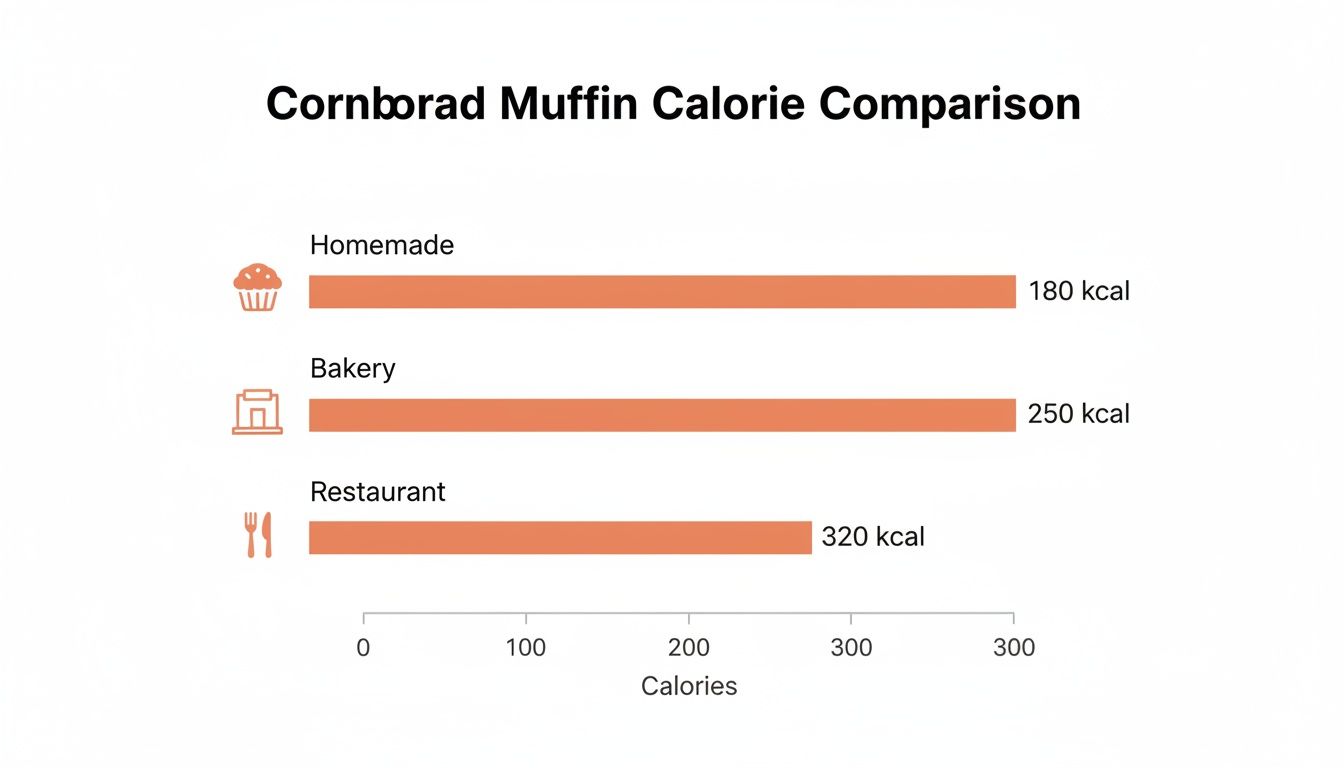
As depicted, restaurant and bakery muffins consistently exhibit higher calorie counts. This is attributable not only to larger portion sizes but also to the use of richer ingredients like additional butter and sugar, which enhance palatability and texture.
Key Takeaway: It is a misconception to assume all cornbread muffins are nutritionally equivalent. A muffin from a restaurant or commercial bakery is likely to have a significantly different caloric and macronutrient profile than one prepared at home or purchased from a grocery store multipack.
This guide provides a baseline for understanding muffin calories. Next, we will delve into the scientific reasons for this variance and how you can make more informed dietary decisions.
The Science Behind Muffin Calorie Inconsistency
The caloric content of a cornbread muffin is not arbitrary; it is a direct result of its recipe's chemical composition. The final calorie count is determined by the ratio of four key ingredients: cornmeal, flour, fat (such as butter or oil), and sugar.
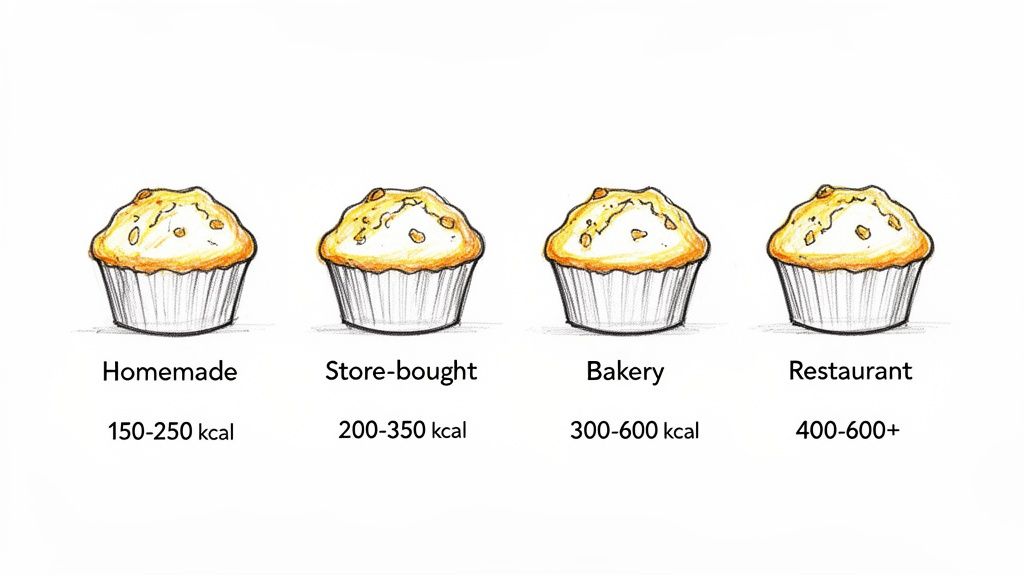
From a nutritional science perspective, a recipe that prioritizes cornmeal and minimizes sugar will yield a savory, less energy-dense muffin. Conversely, increasing the proportion of butter and sugar creates a richer, sweeter, and more calorie-dense product. Fat is the most energy-dense macronutrient, providing 9 calories per gram, while carbohydrates (from flour and sugar) provide 4 calories per gram.
The Impact of Recipe Choices
The type and quantity of fat used are critical variables. A recipe using a small amount of melted butter will have a vastly different caloric profile than one employing a larger volume of vegetable oil. Even seemingly minor details, such as greasing a muffin tin with cooking spray versus a generous layer of butter, contribute to the final calorie count.
The primary reason for the wide range in cornbread muffin calories lies in the formulation. Commercial mixes and bakery recipes are engineered for maximum palatability—a sweet flavor and tender crumb. This is achieved through higher concentrations of sugar and fat, the two most calorie-dense components.
Recipe origin also plays a significant role, reflecting a classic culinary divide that yields two distinct types of cornbread muffins:
- Northern-Style: This sweeter, cake-like variant typically contains more sugar and refined flour, resulting in a higher calorie count.
- Southern-Style: This traditional version is characteristically savory, with minimal or no sugar. Its distinct flavor and texture come from buttermilk and cornmeal, generally making it a lower-calorie option.
Understanding these fundamental differences is crucial for accurately estimating a muffin's nutritional value. To further develop your skills in this area, learning how to read nutrition labels is a valuable step.
A Calorie Comparison of Common Muffin Types
Understanding the ingredients is the first step, but the source of the muffin is equally important. The final calorie count varies significantly depending on whether it is from a grocery store, a local bakery, or your own kitchen.
Consider the pre-packaged muffins found in grocery stores. These products are formulated for extended shelf life and broad consumer appeal, typically falling within a consistent calorie range of 170-250 calories per muffin. This makes them a relatively predictable choice.
Where Muffin Calories Hide in Plain Sight
However, the caloric landscape shifts dramatically in a coffee shop or restaurant setting. These muffins are not designed for shelf stability but for immediate indulgence. This translates to more butter, more sugar, and often, a significantly larger portion size.
It is a common error to perceive a bakery muffin as merely a larger version of a homemade one. In reality, many are so laden with rich ingredients that they are calorically equivalent to a dessert, frequently exceeding 350-500 calories.
A notable example is the cornbread muffin from Cracker Barrel, a menu item since 1969. It contains 190 calories, which is surprisingly close to a standard homemade recipe; the USDA database lists a typical homemade version at approximately 174 calories. You can explore more data on popular restaurant muffins using resources like nutritional info from FatSecret. The key insight is that while some restaurant options are moderate, many employ richer formulations and larger portions that significantly elevate the calorie count.
This brings us to homemade muffins. Baking at home provides complete control over the ingredients. A standard recipe typically yields muffins in the 160-220 calorie range. The primary advantage is the ability to modify everything from sugar content to the type of fat, all while managing portion size to align with your nutritional goals.
How Size and Toppings Impact Your Muffin's Calories
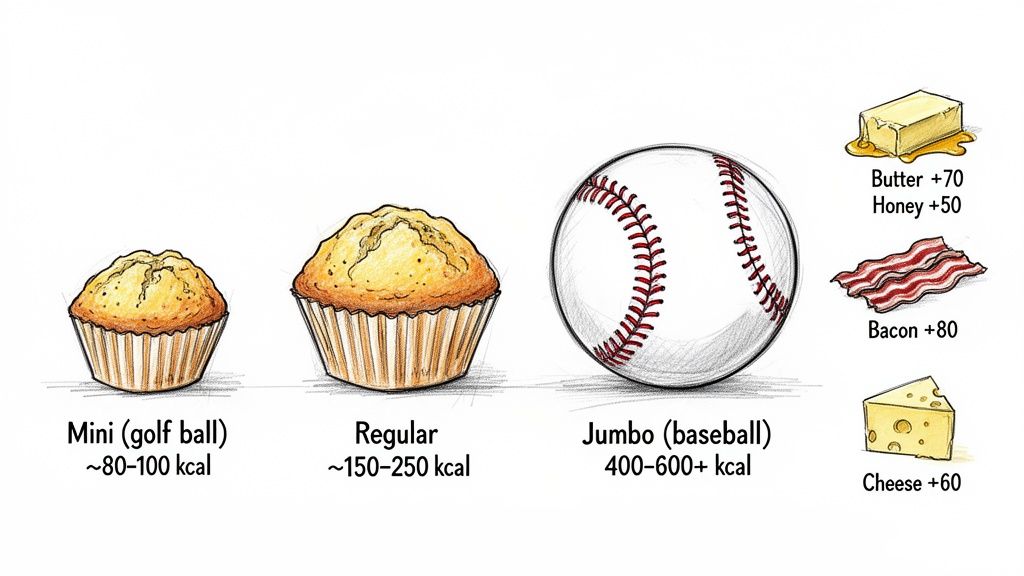
The wide caloric range of cornbread muffins is largely explained by "portion distortion." The difference between a mini muffin and a jumbo, bakery-style muffin is not marginal—it can represent the caloric equivalent of an entire meal.
A mini muffin, roughly the size of a golf ball, is a small snack. In contrast, a large cafe-style muffin can easily be the size of a baseball. This size differential is often the primary factor distinguishing a 100-calorie snack from a 600-calorie indulgence. The variability is substantial, with some plant-based recipes containing as few as 95 calories, while certain jumbo retail muffins exceed 610 calories.
From Plain to Packed: How Add-Ins Add Up
Beyond size, mix-ins and toppings can discreetly increase the calorie count. A plain cornbread muffin is a relatively simple food, but its caloric value can be significantly altered by additions.
The most significant calorie increases come from high-fat and high-sugar additions. A simple pat of butter or a drizzle of honey may seem innocuous, but these energy-dense items can easily add 50-100 calories or more.
Consider how these common additions affect the final count:
- Butter or Honey Butter: Just one tablespoon of butter contains approximately 100 calories. Honey butter, a mixture of fat and sugar, can have an even higher caloric value.
- Shredded Cheese: A quarter-cup of cheddar cheese, whether incorporated into the batter or melted on top, adds an extra 100-115 calories.
- Bacon or Sausage: Adding savory meats like crumbled bacon can increase the total by 80-150 calories per muffin, depending on the quantity.
- Sweet Glazes: A simple sugar glaze is a quick way to add 50-80 calories from refined sugar.
Understanding how these ingredients alter the energy value of food is fundamental to accurate dietary logging. A caloric density calculator can be a useful tool for visualizing how these choices impact the final numbers.
Making Healthier Homemade Cornbread Muffins
The primary benefit of baking your own cornbread muffins is having complete control over the ingredients. This allows you to create a lighter, healthier version that retains its flavor and texture.
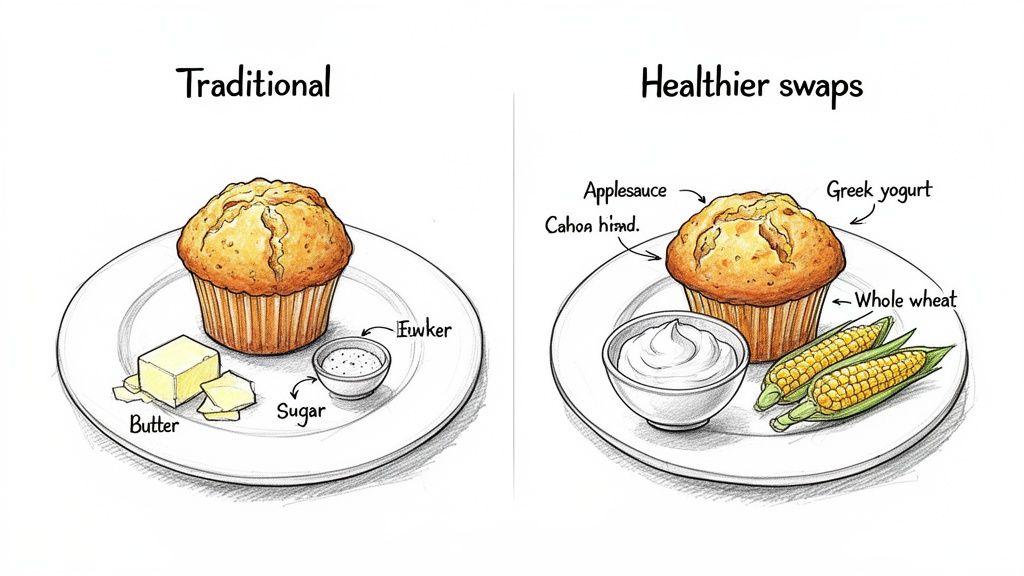
In most recipes, fat and sugar are the largest contributors to the calorie count. This is where you can make the most significant impact. For example, substituting up to half of the butter or oil with unsweetened applesauce or plain Greek yogurt is an effective technique to maintain moisture while reducing fat content.
Smart Swaps for Lighter Muffins
Sugar is another modifiable component. Many cornbread recipes remain palatable even with a one-third reduction in sugar. You can also replace some of the all-purpose flour with whole-wheat flour to increase dietary fiber, which promotes satiety.
The objective is not simply to remove ingredients, but to reformulate for a better nutritional profile. Thoughtful additions can enhance flavor, texture, and nutrient content.
Consider these nutrient-boosting additions:
- Whole Corn Kernels: A half-cup of thawed frozen corn adds texture, moisture, and natural sweetness.
- Diced Peppers: Finely diced bell peppers or jalapeños can introduce a savory flavor and contribute vitamins.
Of course, using quality bakeware promotes even cooking for optimal results. If you wish to determine the precise nutritional information for your modified recipe, our guide explains how to calculate calories in homemade food in detail.
Your Cornbread Muffin Questions, Answered
Let's address some common questions regarding the nutritional aspects of cornbread muffins. Clarifying these points can improve the accuracy of your food tracking.
Is a Cornbread Muffin Healthier Than a Blueberry Muffin?
This is a classic "it depends" scenario where the name is less important than the composition. A homemade cornbread muffin made with minimal sugar could be a nutritionally superior choice compared to a large, commercially produced blueberry muffin laden with sugary filling, which can easily exceed 400 calories.
Conversely, a cornbread muffin loaded with butter, sugar, and bacon can be equally high in calories. The "healthiest" muffin is determined by its ingredient profile—specifically, one made with more whole ingredients and less added fat and sugar, regardless of its flavor name.
The recipe—not the flavor—is the true determinant of nutritional value. A muffin's "healthiness" is a function of its ratio of flour, sugar, and fat.
How Can I Accurately Track My Homemade Muffin Calories?
For homemade baked goods, the gold standard for accuracy is a recipe calculator. This involves inputting each ingredient and its quantity, along with the total yield, to calculate a precise per-serving calorie count.
For a faster, more convenient method, an AI-powered nutrition tracker like BiteKit can provide a close estimate. By analyzing a photo, it can identify the muffin's size and likely ingredients, cross-referencing this information with a vast database to deliver a reliable calorie count in seconds.
How Many Carbs Are In a Typical Cornbread Muffin?
Given their primary ingredients of cornmeal and flour, carbohydrates are the main macronutrient in a cornbread muffin. A standard medium-sized muffin (approximately 70g) will typically contain between 25-35 grams of carbohydrates.
Be mindful of large, sweet bakery-style versions. A jumbo muffin from a cafe can easily contain 80-90 grams of carbohydrates, which may represent a substantial portion of an individual's daily carbohydrate target. This serves as another reminder that the calories in a cornbread muffin are intrinsically linked to its carbohydrate and fat content.