How to Read Nutrition Labels to Achieve Your Health Goals
Tired of confusing food labels? Learn how to read nutrition labels like a pro to make smarter choices for weight loss, muscle gain, and overall wellness.
Let's be real, decoding a nutrition label can feel like a chore, especially when you're in a hurry at the grocery store. But what if I told you there’s a simple trick that can help you make a smart choice in about five seconds? It's a quick mental checklist I use all the time, and it cuts right through the noise.
Once you get the hang of it, you'll be able to glance at a package and know almost instantly if it aligns with your health goals. It all comes down to focusing on just a few key numbers first.
The 5-Second Scan for Smarter Food Choices
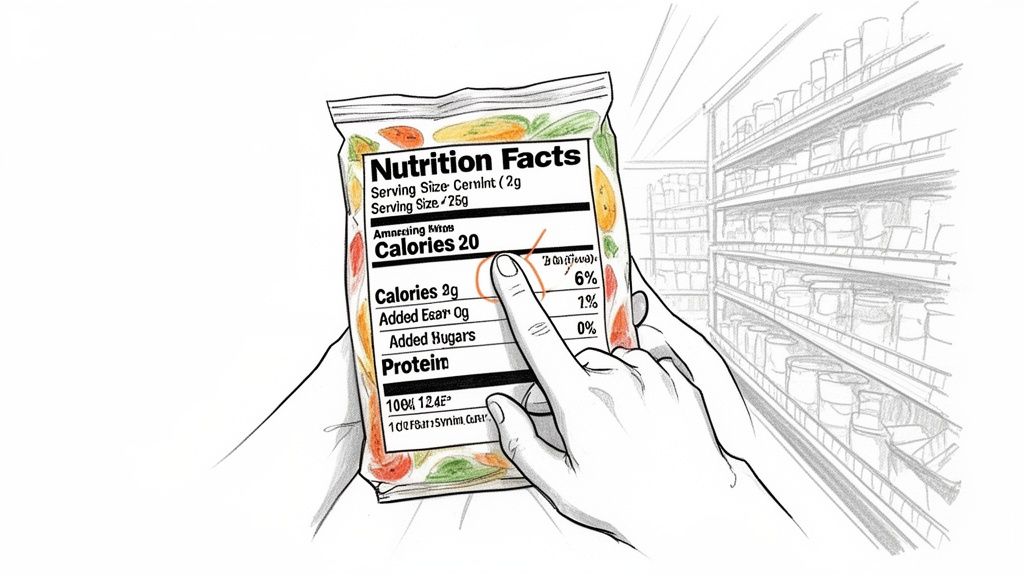
You don't need to analyze every single line item to make a good decision. The goal of this quick scan is to get a fast, reliable snapshot of a food's nutritional value. This technique gives you about 90% of the information you need to give a food a quick "yes" or "no" before deciding if you want to dig deeper.
The Four Pillars of the Quick Scan
When I pick up a new product, my eyes immediately jump to four specific things. This rapid assessment helps me filter out foods that are mostly hype without getting lost in the details.
-
Serving Size: This is the first place I look because it's where manufacturers can be a little sneaky. All the other numbers on the label are based on this amount, which is often way smaller than what you'd actually eat in one sitting.
-
Calories: Next, I check the energy punch. How many calories are you getting for that single, often tiny, serving? This helps you quickly gauge the energy density of the food.
-
Added Sugars: This number is a game-changer. It shows you how much sugar was put in during processing, completely separate from the sugars naturally found in milk or fruit. Your goal here is to find foods with as little of this as possible.
-
Protein: An absolute must for feeling full and supporting muscle growth or repair. A higher protein count usually means the food will keep you satisfied longer, which is a huge win for just about any fitness goal.
If you've started paying more attention to labels, you're in good company. A recent survey found that a whopping 83% of US consumers check food labels before buying something. Even more telling, 64% say they're more focused on it now than they were just five years ago. This data highlights a significant shift towards more health-conscious consumer behavior.
This habit of scanning labels is becoming a fundamental part of healthy eating for millions. While things like expiration dates are important, the nutritional data is where you can make real, lasting changes to your diet.
Key Nutrition Label Components at a Glance
To build on the 5-second scan, it helps to understand what each part of the label is telling you. This table breaks down the most critical components and explains why they matter for your specific goals.
| Label Section | What It Tells You | Why It Matters for Your Goals |
|---|---|---|
| Serving Size | The standard amount the nutrition facts are based on. | This is the multiplier for everything else! If you eat double the serving size, you must double all the other numbers. |
| Calories | The total energy provided by one serving of the food. | Essential for weight management. Your total daily calorie intake determines whether you lose, gain, or maintain weight. |
| Macronutrients | The amount of Fat, Carbohydrates, and Protein in one serving. | Crucial for body composition. High-protein is great for muscle gain, while balancing carbs and fats is key for sustained energy. |
| % Daily Value (%DV) | How much a nutrient in one serving contributes to a 2,000-calorie daily diet. | A quick guide to see if a food is high or low in a nutrient. 5% DV or less is low; 20% DV or more is high. |
| Added Sugars | Sugars added during processing (not naturally occurring sugars). | A key indicator of processed foods. Minimizing added sugar is vital for weight loss, stable energy, and overall health. |
| Dietary Fiber | A type of carbohydrate the body can't digest. | Promotes fullness, aids digestion, and helps stabilize blood sugar. Aim high for this number, especially for weight loss. |
| Ingredients List | Lists all ingredients by weight, from most to least. | Reveals what the food is actually made of. Look for whole-food ingredients at the top of the list. |
This quick-reference table is your cheat sheet for making sense of it all. As you get more comfortable, you'll be able to pull this information from a label in seconds.
And if you want to skip the manual work entirely, our AI food label analyzer can do the heavy lifting for you—just snap a photo, and it breaks everything down.
Don't Fall for the Serving Size Trap
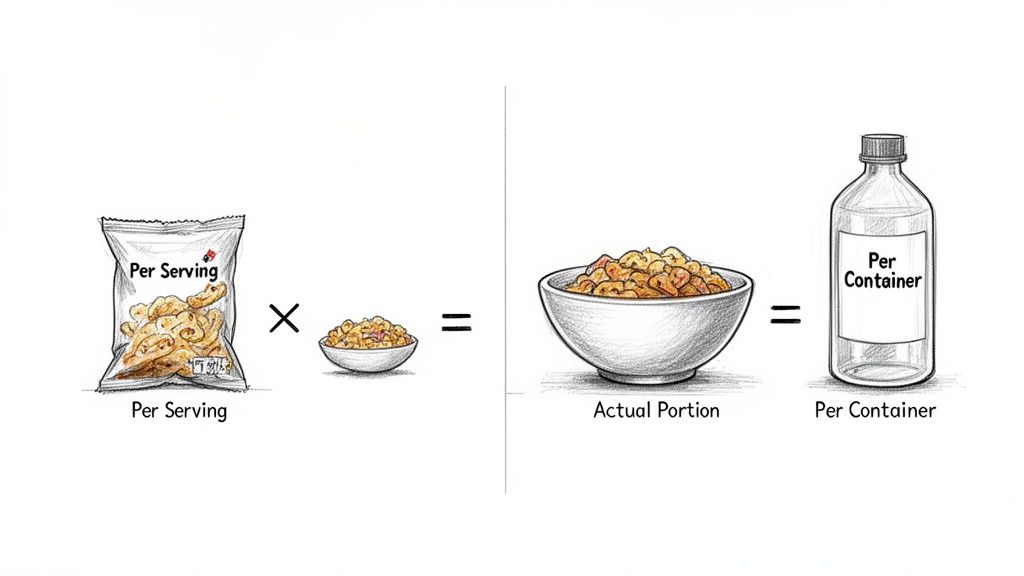
If there’s one place people get tripped up when reading a nutrition label, this is it. The serving size is the foundation for every other number on that panel, and it's often the most misleading part of the whole thing.
Food companies have a knack for choosing surprisingly small serving sizes that don't match how we actually eat. Think about that "personal" bag of chips you grab from the vending machine. You probably finish the whole thing, right? But if you check the label, you might see it lists 2.5 servings per bag. That means you have to multiply the calories, fat, and sugar by 2.5 to get the real story of what you just ate.
This isn’t just a random choice. Serving sizes are based on something called Reference Amounts Customarily Consumed (RACCs). While these are regulated standards, they can feel completely disconnected from reality. A bottle of iced tea that looks like a single drink might legally be two or even three servings.
The Simple Math That Changes Everything
Getting a handle on your real portion size is crucial for tracking your intake accurately. The good news is that it’s just simple multiplication.
Let's use a pint of "healthy" ice cream as a real-world example. It's a classic pitfall.
- The label says a serving is ⅔ cup for 120 calories.
- The container clearly states there are 3 servings.
- If you polish off the whole pint (and let's be honest, it happens), you didn't just have 120 calories. You had 360 calories (120 calories x 3 servings).
This math applies across the board. If your morning granola has 8g of sugar per ¼ cup serving and you pour yourself a heaping bowl that's closer to a full cup, you're actually starting your day with 32g of sugar. To nail this down, you can use measuring cups for a good estimate or a food scale for pinpoint accuracy. If you want to get a better feel for this, our guide on using a portion size calculator can help you see just how much these portions can differ.
A Win for Transparency: Dual-Column Labels
Thankfully, the FDA caught on to how confusing this was for people and introduced a fantastic update for certain packages: the dual-column label.
These updated labels are a game-changer. They show two columns side-by-side: one listing the nutrition facts "per serving" and a second showing the facts "per container." This format is now mandatory on food packages that are bigger than one serving but could realistically be eaten in a single go.
This change takes all the guesswork out of the equation for many common snacks. For that 20-ounce bottle of soda or king-size candy bar, you can now see the total nutritional damage at a glance. It gives you a much more honest picture, helping you make an informed choice without needing to pull out your phone's calculator in the middle of the grocery store.
Decoding Macros and Micros for Peak Performance
While calories tell you how much fuel you're getting, the macronutrients tell you what kind of fuel it is. This is where you graduate from basic calorie counting to actually optimizing your diet for specific goals, whether that’s building muscle, running your first 10K, or just feeling less hungry between meals.
Think of it like this: Calories are the amount of gas you put in your car, but the macros are the octane rating. You wouldn't put diesel in a regular engine, right? Your body is the same way—it uses different fuel types for different jobs.
The Big Three Macronutrients
The nutrition panel breaks down your food's fuel into three main categories: Fats, Carbohydrates, and Protein. Getting a handle on what these do is the key to making any label work for you.
-
Fats: These are not the enemy! Fats are critical for producing hormones and absorbing certain vitamins. You'll see "Total Fat" on the label, but the real story is in the breakdown. Keep an eye on Saturated Fat and Trans Fat, as limiting these is a smart move for your heart health.
-
Carbohydrates: This is your body’s go-to, high-efficiency energy source. The label splits this into Dietary Fiber and Total Sugars. Pay close attention to the line for Added Sugars—this is a big one. More fiber and less added sugar is pretty much a universal recipe for better health.
-
Protein: The undisputed king for building and repairing everything from muscle tissue to skin. If you’re trying to build strength, recover from workouts, or stay full longer, this is your number. A high protein-to-calorie ratio is a hallmark of a food that will support your fitness goals.
The FDA’s major label update in 2020 was designed to make this data clearer, with more realistic serving sizes and a bigger font for calories. According to USDA data, the number of people regularly reading nutrition labels shot up from 62% in 2005-2006 to 79% by 2017-2020, demonstrating a growing public engagement with nutritional information.
Using Percent Daily Value as Your Shortcut
That Percent Daily Value (%DV) column on the right might look like a bunch of random numbers, but it’s actually your best friend for making quick decisions. It shows you how much a nutrient in a single serving contributes to a standard 2,000-calorie diet.
Here’s a dead-simple rule of thumb that I use all the time:
The 5/20 Rule:
- 5% DV or less means a food is low in that nutrient. This is what you want to see for things you’re trying to limit, like Saturated Fat, Sodium, and especially Added Sugars.
- 20% DV or more means a food is high in that nutrient. Look for this when you want more of the good stuff, like Dietary Fiber, Vitamin D, Calcium, and Potassium.
Let's say you pick up a can of soup and see 40% DV for Sodium. You immediately know that just one serving wipes out nearly half your sodium budget for the entire day. That's powerful, instant context without needing a calculator.
This shortcut works just as well for micronutrients (vitamins and minerals). If you’re not sure if you're getting enough of the essentials, you can use our AI Micronutrient Gap Analyzer to pinpoint potential gaps in your diet. The label's %DV then becomes your guide to finding foods that can fill them.
Reading the Ingredient List Like a Pro
The Nutrition Facts panel gives you the numbers, but the ingredient list tells the real story. Think of it this way: the front of the box is pure marketing, but the back is where you find the evidence. Learning to decode this list is one of the most powerful skills you can develop for making genuinely healthy choices.
The first thing to know is that ingredients are always listed in descending order by weight. Whatever is listed first is the most prominent ingredient in that food. It's a simple rule, but it's incredibly revealing.
Let's say you pick up a "healthy" granola bar. If the very first ingredient is sugar, or maybe an "organic cane syrup," you know right away that it's more of a candy bar than a health food. On the flip side, seeing "whole wheat flour" or "rolled oats" at the top of the list for your bread or cereal is a great sign.
Uncovering Hidden Sugars and Sneaky Additives
This is where manufacturers get clever. They know people are looking for sugar in the top spot, so they often use several different types. This spreads the sugar out down the list, making the product look healthier than it actually is.
You have to become a sugar detective. When you're scanning the list, keep an eye out for anything ending in "-ose" and other common disguises like syrup or nectar.
- Common Sugar Aliases: Dextrose, fructose, maltose, sucrose, corn syrup, high-fructose corn syrup, rice syrup, barley malt, and fruit juice concentrate.
A short ingredient list full of things you recognize is almost always a better bet than one that reads like a chemistry textbook. Long, complicated lists are often a red flag for a highly processed product built for a long shelf life, not for your health.
My go-to advice is simple: stick with foods that have short ingredient lists and don't start with sugar. And if you see a long chemical name you don't recognize, don't just dismiss it. A quick search might reveal it's just a vitamin, like tocopherol (Vitamin E), which is often added as a natural preservative.
How to Spot the Top 9 Allergens
For anyone with a food allergy, the ingredient list is a critical safety tool. Thankfully, regulations require major allergens to be declared clearly.
In the U.S., the FDA has pinpointed nine major food allergens that companies have to call out. They do this in one of two ways:
- Including the allergen in parentheses right after the ingredient, like "lecithin (soy)."
- Adding a separate "Contains" statement right after the list, such as "Contains Wheat, Milk, and Soy."
This makes it much faster to scan for potential issues. The nine major allergens to watch for are:
- Milk
- Eggs
- Fish
- Crustacean shellfish (crab, lobster, shrimp)
- Tree nuts (almonds, walnuts, pecans)
- Peanuts
- Wheat
- Soybeans
- Sesame
Once you get comfortable scanning the ingredient list, you’ll start seeing past the flashy marketing. You'll be making choices based on what's really in your food, which is a total game-changer.
How to Read a Label for Your Specific Goal
A nutrition label isn't a one-size-fits-all document. The most important numbers on that panel completely change depending on what you're trying to accomplish. In fact, what makes a food a "good" choice for one person might make it a terrible choice for another.
It all comes down to context. Learning to read the label is the first step, but the real skill is learning to filter that information through the lens of your personal goals. Let's take a common food, like Greek yogurt, and see how different people would interpret its label.
How Different Goals Change Your View of a Yogurt Label
This table shows exactly how your priorities shift. We'll imagine two people looking at the same yogurt: one focused on weight management and the other on building muscle.
| Nutrition Fact | Value Per Serving | Focus for Weight Management | Focus for Muscle Building |
|---|---|---|---|
| Calories | 150 | Is this low enough to fit into my daily budget? A key number to watch. | Good. I need enough energy to fuel workouts and support muscle growth. |
| Total Fat | 5g | A bit high. I might look for a lower-fat version to save calories. | Okay. I'm not avoiding fat; it's useful fuel and helps with hormones. |
| Protein | 18g | Excellent! This will help me feel full and preserve muscle while in a deficit. | The most important number. This is a great amount for a post-workout snack. |
| Added Sugars | 8g | A red flag. I'd prefer a version with 0g to avoid empty calories. | Not ideal. I'd rather get my carbs from a more complex source pre-workout. |
As you can see, there’s no single "healthy" choice—only the right choice for your objective. Now let's break down the thought process for each goal.
If Your Goal Is Weight Management
When fat loss is the name of the game, you're playing a calorie-counting game. Your eyes should go straight to two things: calories and added sugars. The goal is to get the most satiety (the feeling of fullness) for the fewest calories.
A good yogurt for this goal is relatively low in calories but still packs a protein punch to keep hunger at bay. More importantly, you have to be a detective when it comes to added sugar. Many flavored yogurts are basically dessert, loaded with empty calories that can easily derail your progress. Always aim for as close to 0g of added sugar as possible.
If Your Goal Is Building Muscle
For anyone trying to pack on muscle, the label priorities flip. Calories are still important—you need a surplus to grow—but the undisputed king of the nutrition panel is protein. This is your number one priority.
You're hunting for the highest protein number you can find. A yogurt offering 15-20 grams of protein per serving is a fantastic choice for supporting muscle repair after a workout or just hitting your daily protein target. Carbs and fats become secondary; they're the fuel that supports your tough training sessions.
The "healthiness" of a food is totally relative. For a bodybuilder, the higher calorie count in a full-fat yogurt is a benefit. For someone managing their weight, those same calories are a liability.
If Your Goal Is Heart Health
Let's look at that same yogurt one last time, but now with heart health in mind. The focus shifts again, this time to saturated fat and sodium.
Major health organizations recommend keeping these two in check. When you scan the label, you're looking for a low Percent Daily Value (%DV). A good rule of thumb is that anything with 5% DV or less of saturated fat and sodium per serving is considered a strong choice for a heart-conscious diet.
Beyond the main numbers, the ingredient list offers another layer of insight, especially for spotting hidden sugars or unwanted additives.
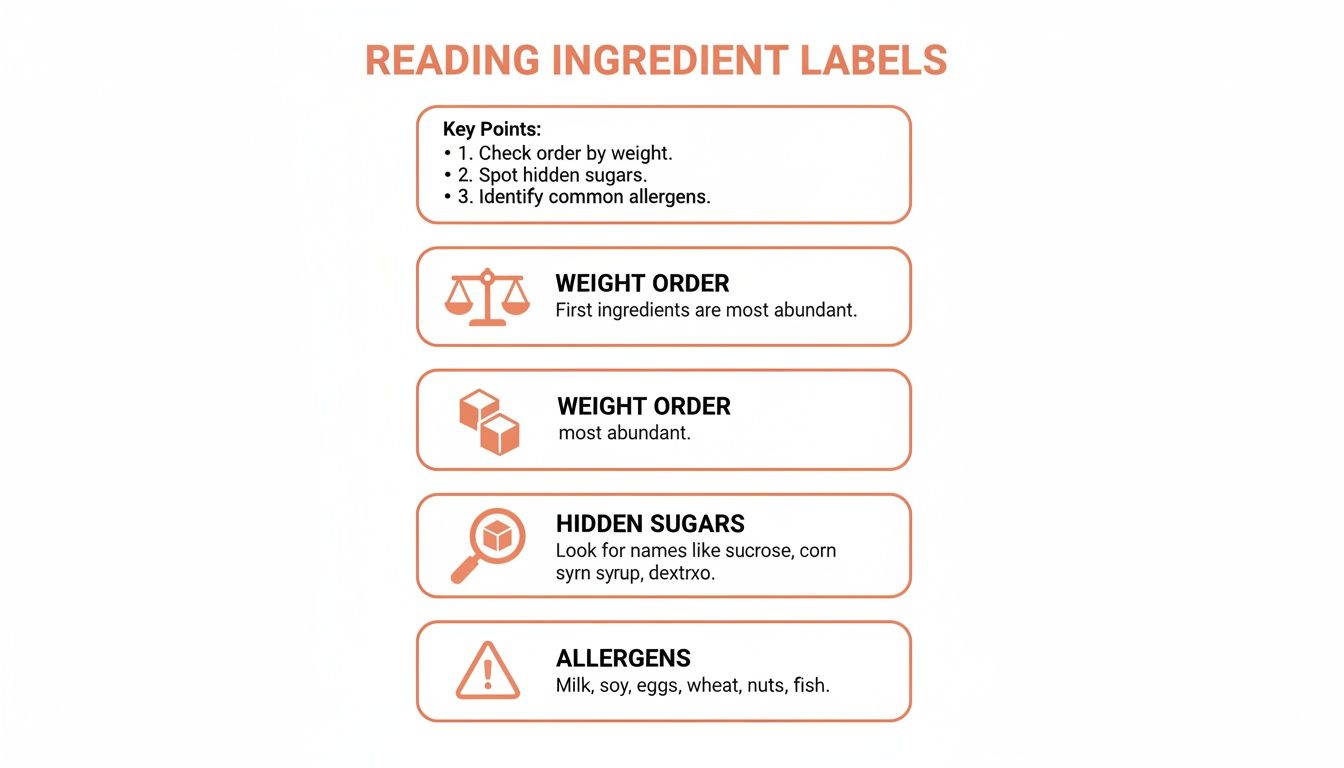
This quick visual guide reminds you to always check the ingredient order, be on the lookout for hidden sugars, and scan for common allergens. By tailoring your approach, you'll stop just reading labels and start using them as a strategic tool to get where you want to go.
Frequently Asked Questions About Food Labels
Okay, so you’ve got the basics of reading a nutrition label down. But what happens when you’re out in the real world? Inevitably, tricky questions and weird scenarios come up.
Let's walk through some of the most common ones I hear, so you can handle them with confidence.
What Are "Net Carbs" and Should I Focus on Them?
You’ve definitely seen "net carbs" plastered on the front of keto-friendly or low-carb snacks. The idea behind it is to subtract the fiber and certain sugar alcohols from the total carbohydrates, since they don't typically spike your blood sugar.
Here’s the thing, though: "net carbs" is a marketing term. It's not an official designation recognized by the FDA. While it might be a helpful shortcut for people on specific therapeutic diets, for most of us, it's much smarter to focus on the quality of your total carbs.
Why? Because the fiber you'd be subtracting is one of the best things about a carbohydrate! It's crucial for gut health, keeping you full, and providing steady, stable energy. Chasing a lower "net carb" number often means you're missing out on the most beneficial part of the food.
My advice for most people? Don't get caught up in net carb math. Focusing on high-fiber, whole-food carbohydrate sources will do far more for your long-term health than obsessing over a number on the front of a box.
How Trustworthy Are Health Claims on the Box?
Marketing claims on the front of a package—things like "low-fat," "light," or "made with whole grains"—can be incredibly misleading. Some of these are regulated by the FDA, but the regulations often don't paint the full picture.
For example, when a company removes fat to label a product "low-fat," where does the flavor go? They often pump it full of extra sugar and sodium to make it taste good again. That "multigrain" bread might sound healthy, but it could be made almost entirely of refined flour with just a few other grains sprinkled in.
And don't even get me started on unregulated words like "natural." That one has virtually no legal meaning.
Your best bet is to develop one simple habit: ignore the front of the package completely.
The only sources you can truly rely on are the Nutrition Facts panel and the ingredient list on the back. That's where the real story is, free from the marketing fluff.
What Do I Do When There Is No Nutrition Label?
This happens all the time. You're at the farmers' market, ordering from a local cafe, or just cooking a meal from scratch with fresh ingredients. How do you stay on track without a label?
First, if you're at a chain restaurant, check their website. Most major chains are required to post their nutrition information online.
For whole foods like fruits, vegetables, and plain cuts of meat, technology is your best friend. Modern nutrition apps, like our own BiteKit, are designed for exactly these situations.
- Snap a photo: Just take a picture of your plate. The app can identify the items and give you a surprisingly accurate estimate of the nutritional info.
- Use your voice: You can simply say, "a grilled chicken breast with a cup of broccoli," and it will do the math for you.
- Type it out: A quick entry like "salmon with quinoa" will generate an instant breakdown of calories and macros.
This makes it possible to get a reliable, data-backed estimate in seconds. Instead of throwing your hands up or making a wild guess, you can ensure that no meal has to be a complete mystery.