Calorie Clarity: How to Calculate Calories in Homemade Food
Discover how to calculate calories in homemade food with precision—learn weighing, logging, and cook-portion adjustments for confident eating.
Calculating the calories in your home-cooked meals hinges on one core, scientifically-grounded practice: weighing every raw ingredient. You’ll then log each item using a reliable nutrition database and determine your portion size based on the final cooked weight of the dish. This method isn't about guesswork; it's about applying a systematic approach to gain precise control over your nutrition.
Why Nailing Your Calorie Count Is a Game Changer
Before we dive into the "how," let's explore the "why." Understanding the scientific rationale for this meticulous process is key to long-term adherence. For many people, hitting a weight loss plateau or failing to see desired results from their fitness regimen often stems from one simple, frustrating truth: unaccounted-for calories in homemade meals.
Commercially prepared foods come with a nutrition label, but a homemade lasagna or hearty chili is a nutritional black box unless you perform the calculations yourself. This is where accurate tracking becomes a powerful tool for achieving your goals. It’s not about obsessive behavior; it’s about gaining objective clarity on your energy intake.
When you weigh your ingredients, you replace ambiguous estimates like "a splash of oil" or "a handful of cheese" with empirical data. For instance, a single tablespoon of olive oil contains approximately 120 calories. This seemingly minor detail is incredibly easy to overlook but can significantly alter your daily energy balance, impacting weight management efforts.
Laying the Groundwork for Real Nutritional Awareness
When you manually calculate the calories in your own cooking, you’re doing more than just crunching numbers. You’re building a deep, intuitive understanding of the energy density of food. This process empowers you to make evidence-based decisions that align with your health objectives, whether you're aiming for fat loss, muscle gain, or improved overall wellness.
- You're in the driver's seat. You know exactly what's in your food—no hidden sugars, trans fats, or excessive sodium.
- Portioning becomes foolproof. You can confidently serve yourself a portion knowing its precise calorie and macronutrient breakdown.
- You build sustainable instincts. Over time, this practice hones your ability to estimate portions and make healthier choices, even when you're not actively tracking.
The objective isn't about hitting your numbers with absolute perfection every single day. The critical factor is consistency. Consistent tracking provides the data you need to identify patterns, make informed adjustments, and ultimately achieve the long-term success you're after. Getting familiar with the best way to track food intake is the foundation for all of this.
To get started, you really only need a few essential tools. Having the right gear on hand turns what seems like a complicated chore into a simple, repeatable part of your cooking routine.
Essential Toolkit for Homemade Calorie Calculation
Here’s a quick rundown of the gear you'll need. Think of this as your personal nutrition lab setup—simple, effective, and crucial for getting accurate results.
| Tool | Primary Purpose | Pro Tip for Best Results |
|---|---|---|
| Digital Food Scale | To precisely measure the weight of each raw ingredient in grams. | Always use the 'tare' or 'zero' function. It lets you weigh multiple ingredients in the same bowl without having to do extra math. |
| Nutrition Tracking App | To look up and log the nutritional data for each ingredient. | Stick with an app that uses a verified food database. The accuracy of your entire calculation depends on the quality of this data. |
| Notebook or Digital Log | To record ingredient weights and calculate the recipe's total calories. | I recommend keeping a running list as you cook. It's the only way to make sure you don't forget small but calorie-dense additions like oil or butter. |
With these three items, you have everything you need to move from estimating to knowing. It’s a small investment that pays off big time in results.
The Foundation: Weighing and Logging Raw Ingredients
To obtain a truly accurate calorie count for your homemade meals, it all starts with one non-negotiable step: weighing every single ingredient before you cook it. This isn’t about guesstimating or getting "close enough." It’s about building a precise foundation. Without it, any final number you come up with will be based on a guess.
This is a significant hurdle for most people. In my experience, and what the research backs up, is that 70-80% of individuals attempting to count calories encounter difficulties with homemade meals. It's easy to scan a barcode, but what do you do with a pot of chili? The process—grabbing a food scale, listing out every ingredient with its exact weight, and finding it in a database—feels daunting.
But it doesn't have to be a chore. With the right tools and a smart workflow, you can make this a seamless part of your cooking routine.
The whole process is pretty straightforward when you break it down: weigh, log, and let your app do the math.
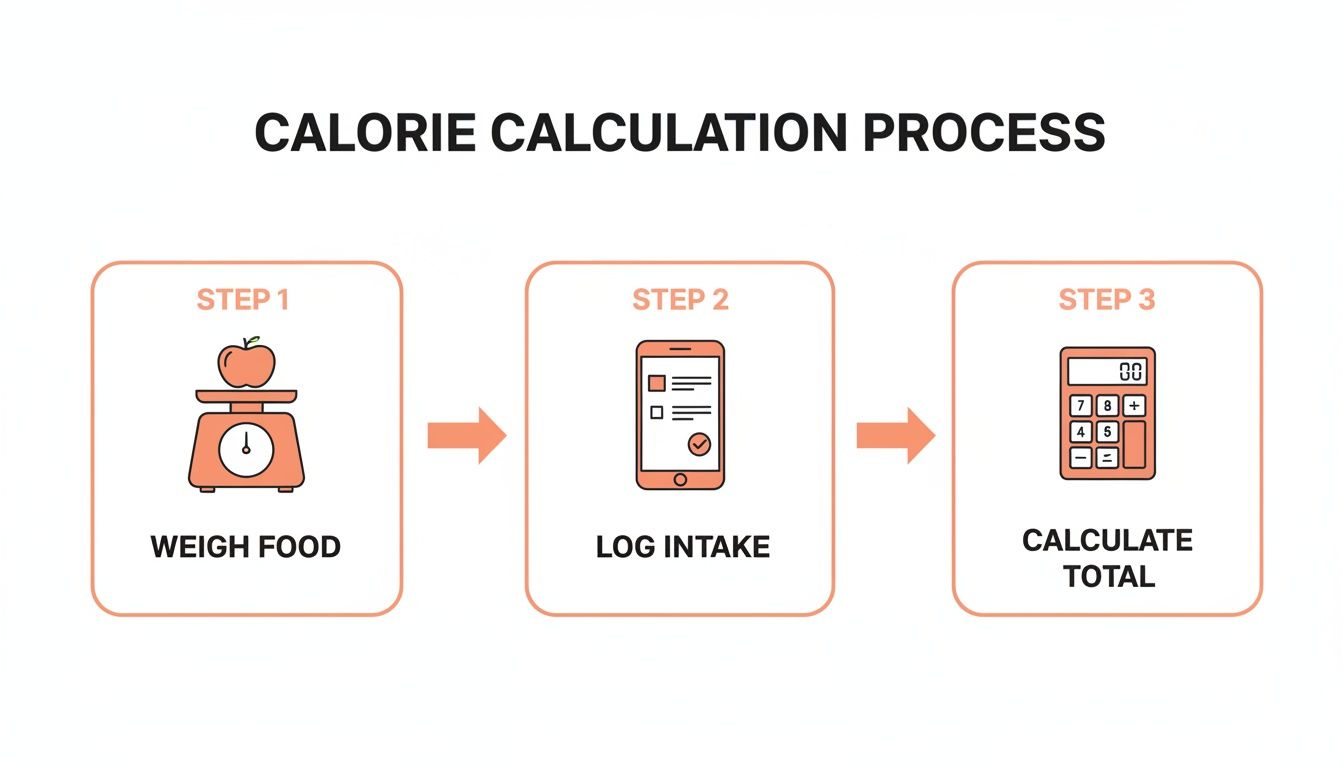
This visual really drives home the point: accuracy starts with the scale and flows directly into your digital log. That's the cornerstone of a reliable final count.
Mastering Your Food Scale for Efficiency
Your digital food scale is your most valuable tool in the kitchen for this purpose. The trick to using it without creating a mountain of dirty dishes is mastering the 'tare' function. This button zeroes out the scale, letting you weigh multiple ingredients in the same bowl or pot.
Here’s how it works in a real-world scenario, say for a simple pasta sauce:
- Pop your cooking pot on the scale and hit 'tare'. The display should read 0g.
- Pour your olive oil directly into the pot until it hits your target, maybe 15g.
- Hit 'tare' again. The scale goes back to 0g.
- Toss in your chopped onions until the scale shows the right weight, like 227g.
- Just keep repeating this 'tare and add' process for your garlic, canned tomatoes, spices—everything.
This little trick saves you from using a dozen measuring cups and bowls, which means cleanup is a breeze. You're building your recipe and your ingredient log at the same time.
Raw vs. Cooked: The Unbreakable Rule
Here’s where a lot of people get tripped up: do you weigh ingredients before or after cooking? The answer is simple and absolute: always weigh ingredients in their raw, uncooked state.
The reason is that nutritional databases—the engines that power apps like BiteKit—are built almost exclusively on raw food values. Cooking changes the weight of food, mainly by altering its water content.
- Foods that lose water: Meats like chicken breast and ground beef shrink as they cook, losing water and fat. They become lighter but more calorie-dense per gram.
- Foods that absorb water: Things like rice, oats, and pasta soak up water, getting much heavier but less calorie-dense per gram.
A classic example is pasta. 100g of raw pasta has a completely different nutritional profile than 100g of cooked pasta. By weighing everything raw, you're locking in the correct starting calories before cooking messes with the weights. This one habit is make-or-break for accurate tracking. If you're ever caught without your scale, our guide on how to measure food without a scale offers some good workarounds.
Streamlining the Logging Process
Weighing is just one half of the equation; logging is the other. Manually typing every item and its weight into an app can get old, fast. This is where finding the right tech can make all the difference.
The best tracking method is the one you can stick with. If the process is too cumbersome, you're more likely to abandon it. The key is to find a workflow that removes as much friction as possible.
Instead of pecking away at your phone's keyboard, look for tools that speed things up. Some apps, like BiteKit, let you use your voice or a photo to log your list. You can just say, "Log 454 grams of 80/20 ground beef, 227 grams of yellow onion, and 340 grams of fusilli pasta," and the app does the work for you.
This kind of feature turns logging from a slow, annoying task into a quick, hands-free action. By combining these smart habits—using the tare function, weighing everything raw, and using fast logging tools—you create an accurate and, more importantly, sustainable system for calculating the calories in anything you cook.
Accounting for Cooking Changes and Final Yield
So, you've meticulously weighed and logged every last raw ingredient. You have the grand total for the entire dish before it hits the heat. But here’s the thing—the cooking process itself fundamentally changes your food, and this is a step most people miss.
These changes, mostly coming down to water gain or loss, directly impact the calorie density of what you're about to eat.
Getting a handle on this concept, called yield, is what separates a decent calorie estimate from a truly accurate one. The yield is just the final, cooked weight of your recipe. Nailing this number lets you calculate the exact calories per gram, which is the ultimate goal here.
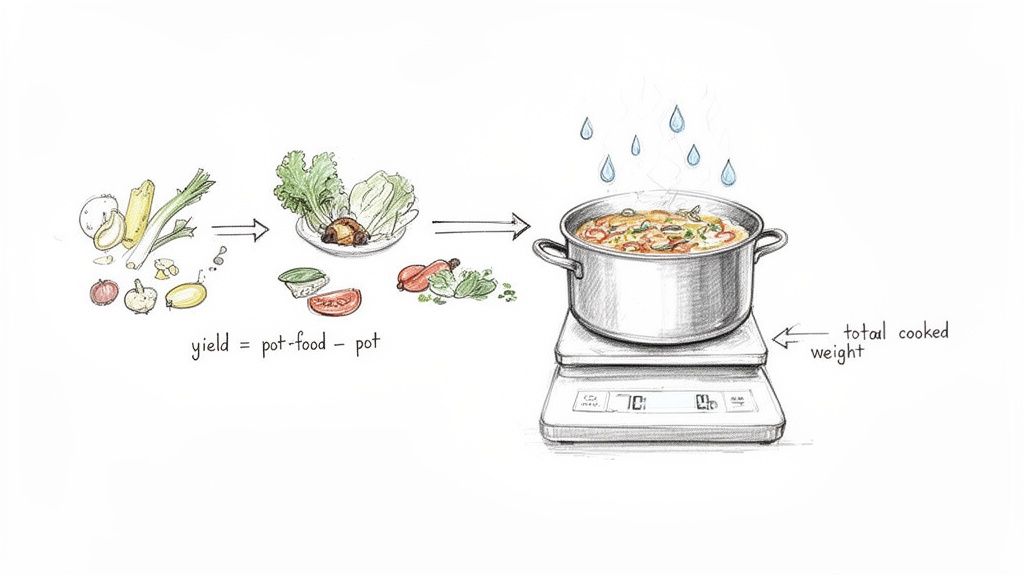
This simple step connects the dots between the raw stuff you started with and the finished meal you’re ready to serve. Without it, you're still just guessing at portion sizes.
Measuring Your Recipe's Final Yield
Figuring out the final weight of your meal sounds complicated, but it's not. It’s one quick, extra step with your food scale that becomes second nature after a few tries.
Here's how I do it every time:
- Before adding any food, pop your empty cooking pot, pan, or baking dish on the scale. Jot down its weight.
- Cook the recipe just like you always do.
- Once it's done, place the entire pot—with all the cooked food still inside—right back on the scale.
- Now, just subtract the empty pot's weight from this new, final number. That’s it. That's your yield.
Let's say your empty chili pot weighs 1,500g. After simmering for an hour, the pot full of finished chili weighs 4,000g. Your final yield is 2,500g (4,000g - 1,500g). This is the magic number for all your portioning.
Why Cooking Changes Calorie Density
Cooking is chemistry. It’s not just about heating things up; it's about changing their composition. For our purposes, the biggest change is the shift in water content.
And this is the key takeaway: the total calories in your recipe don't magically disappear or multiply during cooking. They just get more concentrated or more diluted.
- Roasting, Baking, & Sautéing: Think about what happens when you roast chicken or sauté vegetables. They shrink! That's water evaporating. This makes the food more calorie-dense because the same number of calories is now packed into a lighter final product.
- Boiling & Steaming: This is the opposite story. When you boil pasta or rice, it absorbs a ton of water and swells up, increasing its weight dramatically. The food becomes less calorie-dense because those original calories are now spread across a much heavier dish.
By measuring the final yield, you automatically account for all of this. It doesn't matter if your chicken lost 30% of its weight in the oven or your rice tripled in size. The math corrects for it, guaranteeing your "calories per gram" number is dead-on.
Putting It All Together: A Stir-Fry Example
Let's walk through a real-world scenario. You're making a big batch of chicken and veggie stir-fry.
First, you’ve weighed and logged all your raw ingredients, and your tracking app gives you these totals for the whole recipe:
- Total Calories: 2,100 kcal
- Total Protein: 180g
- Total Carbs: 150g
- Total Fat: 80g
After you finish cooking, you measure the yield. Your empty wok was 1,200g, and the finished stir-fry inside the wok weighs 2,950g. This means your total yield is 1,750g.
Now for the simple part. You can find the calories per gram with one quick division:
Total Calories / Final Yield (in grams) = Calories per Gram
2,100 kcal / 1,750g = 1.2 kcal/g
This little number—1.2 calories per gram—is everything. It gives you complete control. You can serve yourself any amount, and as long as you weigh that portion, you'll know its exact calorie count.
So, if you dish out a 350g serving for dinner, the math is easy:
350g x 1.2 kcal/g = 420 calories
This method completely eliminates the guesswork of trying to slice a casserole into "four equal servings." Whether you're starving one night or just want a small lunch the next day, the numbers always work.
For those who want to speed up the whole process of logging ingredients and crunching these numbers, checking out a tool like an AI recipe calculator can be a huge time-saver. It automates a lot of the manual entry and gets you precise figures fast.
Calculating Your Portion with Simple Math
Alright, you've done the hard part. You weighed your raw ingredients and got the final cooked weight of your masterpiece. Now for the payoff—turning those big recipe numbers into the exact calories on your plate.
This is where you take real control. Forget guessing what a "serving" is or slicing a lasagna into six "equal" pieces. With a little bit of simple math, you can dish out any amount you want, whether it's a massive post-workout refuel or a tiny snack, and know precisely what you're eating.
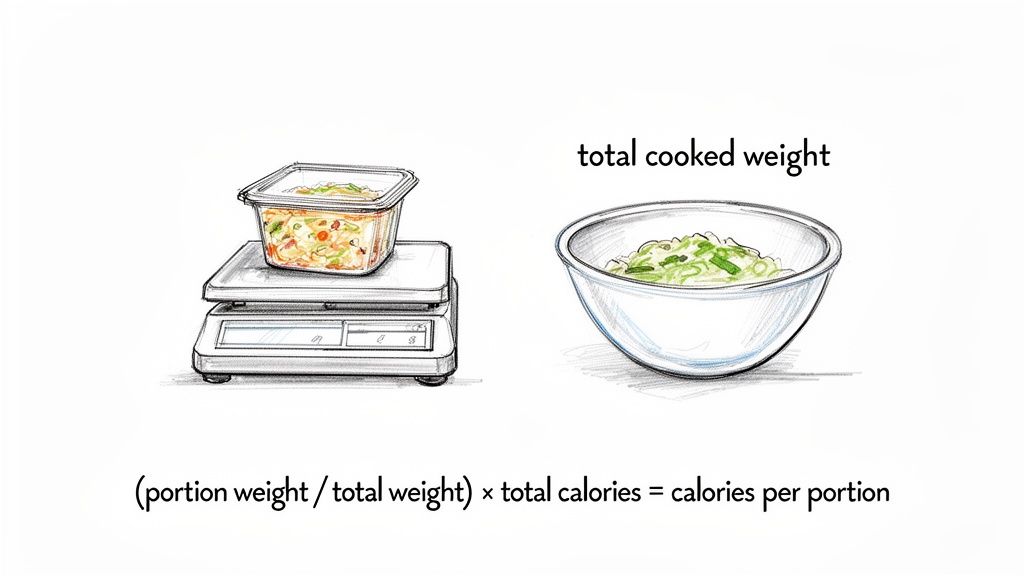
The calculation itself is incredibly straightforward, but it's the key to making this whole system work in the real world.
The Core Formula for Perfect Portioning
The magic here is just a simple ratio. You only need the three numbers you've already figured out: the total calories for the whole recipe, the total cooked weight (your yield), and the weight of the portion you're about to eat.
Here’s the formula that brings it all together:
(Your Portion Weight / Total Cooked Weight) x Total Recipe Calories = Calories in Your Serving
This little equation is your best friend. It works for everything from a thick stew to a light soup because it's based on a simple percentage. You're just figuring out what percentage of the total dish is on your plate and applying that same percentage to the total calories.
Let’s run through a quick example with that batch of chicken chili we talked about.
- Total Recipe Calories: 3,668 kcal (from all your logged ingredients)
- Total Cooked Weight (Yield): 2,886g
- Your Portion Weight: You scoop out a nice big bowl that weighs 350g.
Plug those numbers in:
(350g / 2,886g) x 3,668 kcal = 445 calories
And there you have it. Your bowl of chili is 445 calories. No guesswork, no ambiguity. This is how you get consistently accurate tracking.
Making Meal Prep Work for You
This method is an absolute game-changer for meal prep. Instead of just dividing a batch of food into five containers and hoping for the best, you can make every single meal consistent.
It's a simple workflow:
- Get Your Totals: Once your dish is cooked, you have the total calories and the final yield (total weight).
- Set Your Target: Decide what you want each meal to be. Maybe you’re aiming for 500-calorie lunches this week.
- Weigh and Pack: Put a container on the scale and hit tare. Spoon in your food until you hit the weight that corresponds to your target calorie amount. Label it.
- Repeat: Do this for all your meals, and you're set for the week.
By portioning and labeling everything upfront, you take all the thinking out of it. On a busy Tuesday, you just grab a container from the fridge, and you already know the numbers—no scale or calculator needed.
Integrating with Your Tracking App
Let's be real: you're not going to pull out a calculator every single time you eat. The final piece of the puzzle is getting this information into your tracking app so it’s easy to log later.
This is exactly what the "custom recipe" feature in apps like BiteKit is for. You do the work once—weighing ingredients, calculating the final yield—and save it all as "My Famous Chicken Chili."
The app does the math and stores the nutritional info per gram. The next time you have that chili, all you have to do is find your saved recipe, type in the weight of your portion, and hit log. A process that took a few minutes the first time becomes a ten-second task.
You're putting in the effort upfront to build an accurate entry. In return, you get lightning-fast, precise logging every time you eat that meal again.
Understanding the Science Behind Calorie Numbers
So, after all that meticulous weighing and logging, you might find yourself wondering just how "perfect" the final calorie count really is. It is crucial to understand that even with the most precise measurements, the calorie numbers on labels and in tracking apps are expert estimations, not absolute truths.
This fact does not invalidate your process; it reflects the reality of nutritional science. Understanding this helps you approach calorie tracking with a more balanced and less stressful mindset. The goal isn't impossible perfection—it's consistent, informed awareness. And the system we all rely on? It's surprisingly old, but it works.
The Atwater System: A Universal Standard
Whenever you log an ingredient, the calorie figure provided is almost certainly a product of the Atwater system. Developed by researcher Wilbur Atwater over a century ago, this method remains the gold standard for nutritional calculations worldwide.
It’s built on a simple set of averages that work incredibly well at a population level.
- Protein: About 4 calories per gram
- Carbohydrates: About 4 calories per gram
- Fat: About 9 calories per gram
- Alcohol: About 7 calories per gram
These values were derived by burning food in a bomb calorimeter and measuring the energy (heat) released. They are the foundation of nearly every nutrition label and food database you'll ever encounter. However, they come with an inherent margin of error, typically around 5-15%. This is because the system assumes all proteins, for example, are created equal, which isn't biochemically true. You can get a much deeper look into how these energy values are determined over at public-health.uq.edu.au.
Why Perfection Is an Illusion
The Atwater system is a phenomenal tool, but it's built on averages. And real food is anything but average. The exact calorie count of an apple can shift based on its variety, ripeness, or even the soil it grew in. One chicken breast will have a slightly different fat-to-protein ratio than the next.
This is the most important thing to remember: Your goal isn't to find the single "true" calorie number for your chili. It's to use a consistent and reliable system of estimation to guide your choices. Precision is great, but consistency is what truly drives results.
This natural variability is precisely why stressing over a few calories is a waste of energy. When you take the time to weigh and log your homemade meals, you are creating an incredibly accurate estimate based on the best science available. That estimate is light-years better than a wild guess and is more than powerful enough to help you nail any health or fitness goal.
So, when you learn how to calculate calories in homemade food, you're not trying to become a human lab machine. You're simply becoming a smart user of a proven scientific model. This realization should feel liberating. It frees you from the anxiety of getting it "perfect" and lets you focus on what really moves the needle: making informed choices, meal after meal.
Answering Your Top Questions About Tracking Homemade Meals
Even when you have a system down, a few tricky situations always seem to come up when you start logging homemade food. These are the little details that can trip you up. Let's walk through some of the most common questions I hear and how to handle them.
What’s the Best Way to Log Cooking Oils and Fats?
This is a big one. It's so easy to forget that quick glug of olive oil, but it can easily add 100-200 calories to your meal without you even thinking about it.
For dead-on accuracy, here's the best method: weigh your oil bottle on the food scale before you pour, and then weigh it again right after. The difference is exactly how much you used.
Let's say your bottle weighed 500g to start and 485g after you were done. You know you used precisely 15g of oil. That's what you log. If you use cooking spray, the calories are much lower but they still count. A quick one-second spray is usually around 5-10 calories.
How Do I Log a Recipe if I Don’t Eat It All at Once?
This is where the "calories per gram" method really proves its worth. It’s built for this exact scenario. Once you've figured out the total calories for the entire recipe and you have the final cooked weight (your yield), you can calculate the caloric density.
Maybe your finished chili comes out to 1.5 calories per gram.
From here, you can store the whole batch in one big container. When it's time to eat, just scoop out whatever portion you're in the mood for, weigh it, and do some simple math. If you serve yourself a 300g bowl of that chili, you'd log 450 calories (300g x 1.5 kcal/g). This gives you the freedom to have a small bowl one day and a huge one the next, with perfectly accurate tracking every time.
Do I Really Have to Weigh Low-Calorie Veggies and Spices?
Honestly, for the best results, yes. A few leaves of spinach or a sprinkle of paprika won't make or break your day, but those small amounts can start to add up, especially if you're making a big veggie-packed soup or a stir-fry.
The real win from weighing everything isn't just about the calories—it's about building an unbreakable habit. When you remove all the guesswork, you end up with incredibly reliable data, and that includes all the important stuff like fiber and micronutrients.
Think of it this way: getting into the rhythm of weighing everything makes the whole process automatic. It removes the mental load of deciding what "counts" and what doesn't.
What if I’m Cooking for My Family and Not Eating the Whole Thing?
This is a classic dilemma, but the solution is simple. The "calories per gram" approach works perfectly here, too. You'll still calculate the nutritional info for the entire batch of food you made—total calories divided by the total final weight.
Then, just weigh your own portion onto your plate before you sit down to eat. Log that specific amount. It doesn't matter what anyone else eats, because you know the exact stats for the portion on your plate. This lets you cook one big meal for everyone without sacrificing the accuracy of your own log.