How to Calculate Protein Intake: A Science-Backed Guide
Learn how to calculate protein intake for your specific goals. Our guide uses science-backed methods to help you find your ideal daily protein number.
Calculating your daily protein requirement is simpler than it sounds. The most scientifically reliable method bases intake on your body weight, multiplied by a factor corresponding to your specific health and fitness goals.
For most active individuals, a well-supported starting point is 1.2 to 2.2 grams of protein per kilogram of body weight. This calculation provides a concrete, evidence-based target that moves you from nutritional guesswork to a strategic plan.
Why Your Protein Target Matters
Protein is more than just a macronutrient for bodybuilders; it is the fundamental building block for countless physiological processes. It's essential for repairing muscle tissue post-exercise, synthesizing hormones, and maintaining a robust immune system. Achieving an optimal protein intake is critical whether your objective is to build strength, reduce body fat, or simply preserve your current physique.
Without a specific target, nutritional planning is arbitrary. Knowing your daily protein number transforms eating into a strategic tool, enabling you to make informed food choices that fuel your body for optimal recovery and growth.
Two Primary Methods for Calculating Protein Needs
There are two well-established methods for determining your daily protein goal.
- The Body Weight Method: This is the approach most frequently recommended by nutrition scientists and dietitians. It calculates your protein needs based on your weight, typically in grams per kilogram (g/kg). It’s precise, personalized, and easily adjustable.
- The Percentage of Calories Method: This approach is effective if you already track your total caloric intake. You simply allocate a specific portion of your daily calories—typically between 10-35%—to protein.
For a sedentary adult, the official Recommended Dietary Allowance (RDA) is 0.8 grams per kilogram of body weight. This amount is established to prevent protein deficiency. For example, a 70kg (154 lbs) individual would need approximately 56 grams daily to meet this baseline. This typically constitutes 10-15% of total energy intake, a standard further detailed in the official healthy diet guidelines from the World Health Organization.
However, for individuals with active lifestyles and specific fitness goals, the RDA represents the bare minimum, not an optimal target.
Key Takeaway: Establishing a clear, specific protein target is crucial. It removes ambiguity from your nutrition plan and simplifies the process of tracking progress.
Fortunately, modern tools can automate this process. Apps like BiteKit perform these calculations for you, allowing you to focus on achieving your goals.
Daily Protein Intake Recommendations at a Glance
For quick reference, this table provides scientifically supported starting points for daily protein intake based on your activity level and primary goal.
| Goal / Activity Level | Grams per Kilogram (g/kg) | Grams per Pound (g/lb) |
|---|---|---|
| Sedentary Adult (Baseline) | 0.8 g/kg | 0.36 g/lb |
| General Health & Maintenance | 1.2 - 1.6 g/kg | 0.54 - 0.72 g/lb |
| Weight Loss (Fat Loss) | 1.6 - 2.2 g/kg | 0.72 - 1.0 g/lb |
| Muscle Gain (Bulking) | 1.6 - 2.2 g/kg | 0.72 - 1.0 g/lb |
| Endurance Athlete | 1.2 - 1.4 g/kg | 0.54 - 0.63 g/lb |
| Strength/Power Athlete | 1.6 - 2.0 g/kg | 0.72 - 0.9 g/lb |
These figures are excellent starting points. Individual needs may require adjustments based on personal results, age, and physiological feedback.
How to Actually Calculate Your Protein Intake
Knowing you need more protein is one thing, but how do you arrive at a precise number? This isn't a guessing game; there are simple, reliable methods to determine your daily protein target. We'll walk through the most common approaches to help you find what works best.
The fundamental principle is straightforward: begin with your body weight, apply a multiplier based on your goal, and you'll have a clear target to aim for.
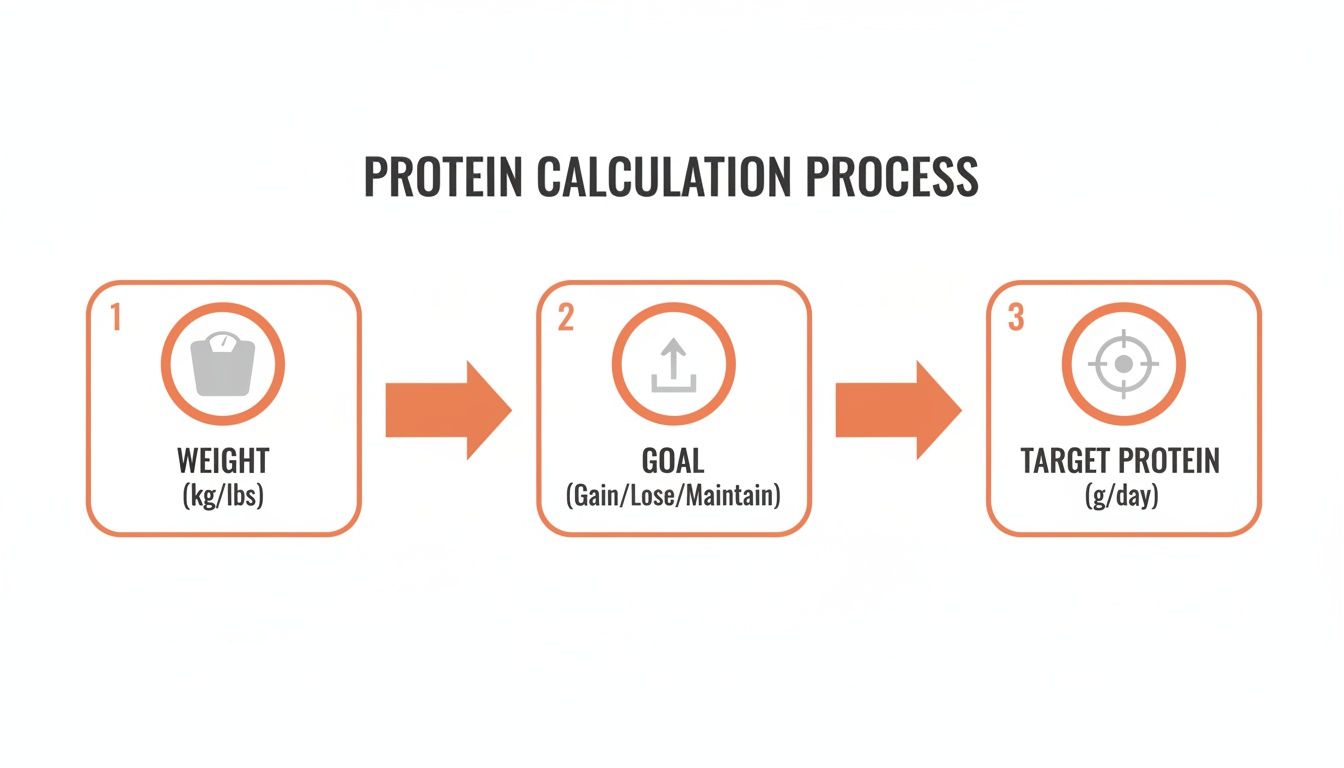
As illustrated, the calculation bridges your current state (your weight) with your desired outcome (your goal). Let's delve into the specifics.
The Kilogram Method (Grams Per kg of Body Weight)
By far, the most common and scientifically validated method for calculating protein needs is based on your body weight in kilograms. This personalized approach is direct and effective.
The formula is elegantly simple:
Your Weight in kg × Protein Multiplier = Your Daily Protein Target in Grams
Let’s apply this with a practical example. Consider a 40-year-old individual who weighs 85 kilograms (approximately 187 pounds). His primary goal is muscle hypertrophy, so he selects a protein multiplier of 1.8 grams per kilogram, which falls squarely within the recommended range for muscle gain (1.6-2.2 g/kg).
Here is the calculation:
- 85 kg × 1.8 g/kg = 153 grams of protein per day.
With this simple equation, he has a solid, actionable target to achieve daily.
The Pounds Method (Grams Per lb of Body Weight)
If you prefer using pounds, the process is identical; you just use a different set of multipliers.
The concept remains the same:
Your Weight in lbs × Protein Multiplier = Your Daily Protein Target in Grams
Using our same example, the individual weighs 187 pounds. To build muscle, he uses the corresponding multiplier of 0.82 grams per pound (the direct conversion of 1.8 g/kg).
The calculation yields the same result:
- 187 lbs × 0.82 g/lb = 153 grams of protein per day.
The outcome is identical, demonstrating that the choice of unit is purely a matter of preference.
The body-weight method is considered the gold standard because it directly ties your protein needs to your body mass—the primary driver of metabolic and muscular repair functions.
The Calorie Percentage Method
Another effective method, particularly useful if you're already tracking calories, is to set protein as a percentage of your total daily intake. This helps you visualize your macronutrient balance. Remember that protein provides 4 calories per gram.
Here's how this works for our 85kg individual:
- First, determine total calories. He estimates a daily need of 2,500 calories to fuel workouts and support muscle growth.
- Next, select a protein percentage. For muscle hypertrophy, a range of 20-30% of total calories from protein is effective. He aims for 25%.
- Then, calculate protein calories. 2,500 calories × 0.25 = 625 calories from protein.
- Finally, convert calories to grams. 625 calories ÷ 4 calories/gram = ~156 grams of protein per day.
This result closely aligns with the 153-gram target derived from the body-weight method, confirming he is on the right track.
If you prefer this top-down approach for managing all your macros, our guide on using a free macro calculator can be a valuable resource. Ultimately, the "best" method is the one you can adhere to most consistently.
How to Adjust Protein Intake for Your Fitness Goals
Your protein requirements are not static; they should adapt in tandem with your fitness objectives. While establishing a baseline is a great start, the real efficacy comes from tailoring that number to your specific goal. This elevates your approach from basic arithmetic to truly strategic nutrition.
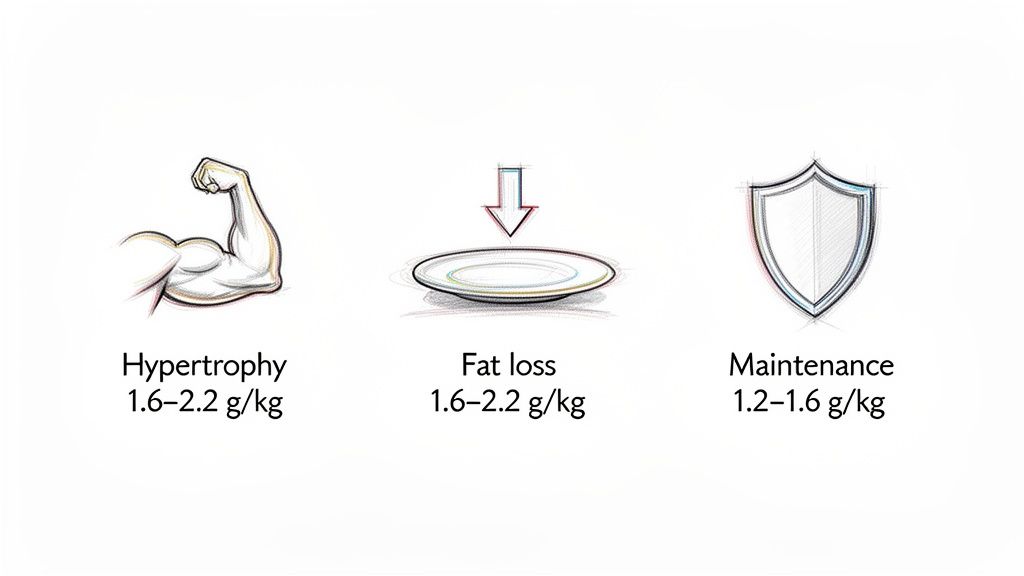
Whether you are aiming to increase muscle mass, reduce body fat, or maintain your current physique, your protein target will vary. Understanding the physiological reasons for these adjustments is key to making food choices that support your goals.
Fueling Muscle Growth (Hypertrophy)
When building muscle—a process known as hypertrophy—is your primary goal, protein is your most critical nutritional ally. Resistance training creates microscopic tears in muscle fibers. Protein supplies the amino acids necessary to repair this damage, rebuilding the fibers stronger and larger than before.
Insufficient protein intake stalls this recovery process, meaning your efforts in the gym will not translate into desired muscle gains.
To stimulate effective muscle protein synthesis, scientific consensus is clear: a higher protein intake is required.
- Optimal Range: Aim for 1.6 to 2.2 grams of protein per kilogram of body weight (approximately 0.72 to 1.0 g/lb).
- Mechanism of Action: This elevated intake promotes a positive nitrogen balance, a physiological state where the body has sufficient raw materials to build new tissue rather than catabolizing existing tissue for energy.
Consider your muscles a construction site and amino acids the building materials. A higher protein intake ensures a consistent and ample supply of these materials.
Preserving Muscle During Fat Loss
Effective weight loss focuses on losing body fat while preserving lean muscle mass. This is where protein's role becomes especially crucial.
During a caloric deficit, the body seeks alternative energy sources and may begin to break down muscle tissue for fuel. This counterproductive process can be mitigated by maintaining a high protein intake.
Furthermore, protein is the most satiating macronutrient. Increased protein consumption enhances feelings of fullness, which is a significant advantage when adhering to a lower-calorie diet, as it helps manage hunger and cravings.
A study published in the American Journal of Clinical Nutrition found that when overweight women increased their protein intake to 30% of their total calories, they spontaneously consumed approximately 441 fewer calories per day. Over 12 weeks, this led to an average weight loss of 11 pounds, primarily from fat.
For fat loss, protein recommendations are often as high as those for muscle gain, typically falling between 1.6 to 2.2 grams per kilogram of body weight. This level is optimal for protecting muscle and preventing hunger from derailing your progress.
Maintaining Your Hard-Earned Physique
Once you've reached your physique goal, the focus shifts from building or cutting to maintenance. In this phase, protein requirements are slightly lower than during a growth phase, but it's critical not to let intake drop too low. You still need adequate protein to support daily repair, immune function, and overall health.
A significant drop in protein can lead to a gradual loss of muscle mass. A solid maintenance intake keeps your body functioning optimally without the surplus required for new tissue growth.
- Maintenance Range: A target of 1.2 to 1.6 grams of protein per kilogram of body weight (0.54 to 0.72 g/lb) is ideal.
- The Goal: This provides ample amino acids to preserve existing muscle mass and support all of your body's essential functions.
For a more granular approach, you can apply an activity factor. A novice might use a multiplier of 1.0-1.2 g/kg, while an elite athlete could require as much as 2.2 g/kg. While general advice may suggest 50-75 grams per day, athletes regularly consume much higher amounts safely, provided they maintain adequate hydration. You can explore these protein consumption trends on Frontiersin.org for a deeper understanding of evolving recommendations.
Fine-Tuning Your Numbers for Age and Lifestyle
The protein targets we've discussed are excellent starting points, but they are not universally fixed. Your ideal protein intake is a dynamic variable influenced by your age, activity level, and dietary preferences. Understanding these nuances is what distinguishes a good nutritional plan from a great one.
Life is not static, and your nutrition should adapt accordingly. Factors like aging, endurance training, or adopting a plant-based diet all impact your protein requirements.
Adjusting Protein for Age
With age, the body's ability to process protein becomes less efficient. This phenomenon, known as anabolic resistance, can lead to a gradual loss of muscle mass and strength—a condition called sarcopenia.
To counteract this, older adults often need to increase their protein intake simply to maintain their existing muscle mass.
- Recommended Range for Older Adults: Experts frequently recommend 1.2 to 1.7 grams of protein per kilogram of body weight.
- Why It Matters: This higher intake provides the necessary amino acids to stimulate muscle protein synthesis effectively, helping to mitigate the age-related decline in muscle and bone density.
Think of it as providing extra materials to maintain an older structure—more resources are needed to keep it sound.
Protein Needs for Athletes and Active Jobs
Your daily activity level is a critical factor. The demands of endurance sports or a physically laborious job also influence protein needs.
An endurance athlete or a construction worker may not be focused on hypertrophy, but their bodies are under constant physical stress. This results in a continuous cycle of muscle breakdown and repair that requires a steady supply of protein.
For these individuals, consistently achieving a protein intake at the higher end of the maintenance range—around 1.4 to 1.7 g/kg—is crucial for preventing muscle catabolism, supporting recovery, and sustaining performance.
Considerations for Plant-Based Diets
Following a vegetarian or vegan diet requires a more strategic approach to protein consumption. It is entirely possible to meet protein needs with plant-based sources, but a few key considerations apply.
Plant proteins can have lower digestibility and may not contain a complete profile of all essential amino acids in a single source. The solution is dietary diversity. Combining complementary protein sources, such as rice and beans, creates a complete amino acid profile.
Due to these factors, individuals on plant-based diets may benefit from aiming for the higher end of their recommended protein range. This helps ensure sufficient absorption of all essential amino acids. If you are navigating a plant-based diet, our vegan protein calculator can provide personalized guidance.
Putting Your Protein Plan Into Practice
You've completed the calculations and have determined your daily protein target. This is a significant first step. However, the true test—and where you will see tangible results—is consistently hitting that number. This is where your plan on paper becomes a real-world habit.
Many people become enthusiastic about a new nutrition goal, only to be deterred by the tedious task of tracking their intake. Manually searching for food items, scanning barcodes, and estimating portion sizes is a common path to burnout.
The good news is that modern technology has made this process much easier.
Making Tracking Effortless
The key to long-term adherence to a nutrition plan is not willpower, but rather a system that makes success easy and sustainable. Instead of food logging being a chore, it can become a seamless part of your routine.
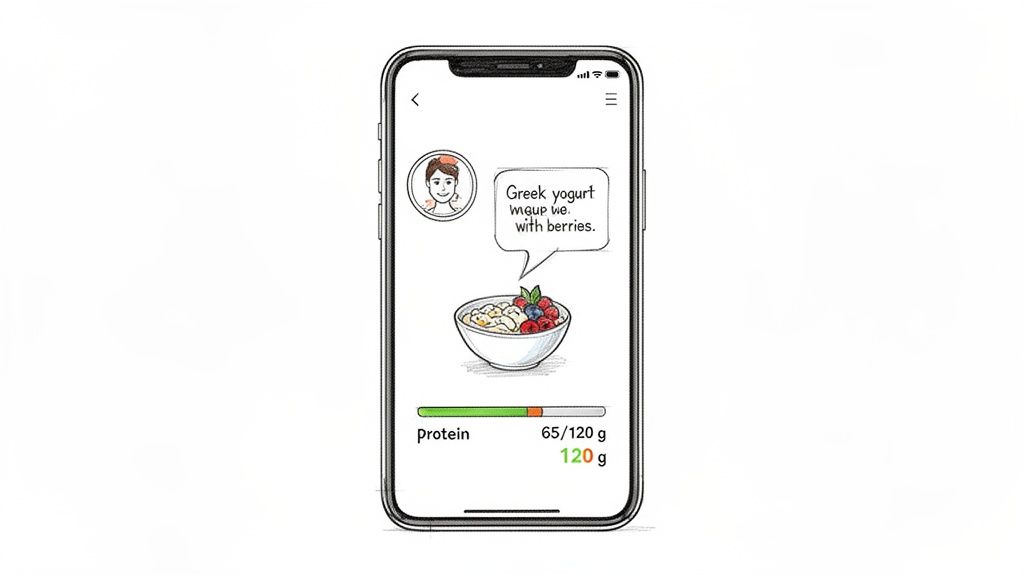
Imagine snapping a photo of your meal or simply stating, "I had Greek yogurt with berries and almonds," and watching your protein intake update instantly. This is the new reality of nutritional tracking.
From Manual Logging to Smart Automation
This shift from manual data entry to automated logging is a game-changer. It removes the most significant barrier to consistency: the time and mental effort required for accurate food logging. When tracking is as simple as sending a text, it ceases to be a burden and becomes a sustainable habit.
This is precisely the functionality an app like BiteKit provides:
- Photo Logging: Take a picture of your meal, and the app's AI identifies the food, estimates quantities, and logs the macronutrients.
- Voice Commands: Simply state what you ate, and it's added to your daily log in seconds.
- Natural Language Input: Type "a chicken salad sandwich," and the AI handles the detailed breakdown.
This provides immediate feedback on your progress toward your protein goal throughout the day. A quick glance can inform your food choices, helping you decide if you need a protein-rich snack or if your dinner will meet your target.
The Goal: To make tracking so simple that it feels like a natural part of your routine. When the process is effortless, consistency follows, and that’s what leads to meaningful, lasting results.
This automation eliminates the mental burden of constant calculation, allowing you to focus on what matters most—enjoying your food while achieving your goals.
If you're ready to start, our protein intake calculator can provide a personalized target in under a minute. Pairing a clear goal with an easy tracking method creates a powerful system for success.
Got Questions About Protein? Let's Clear Things Up
Once you have your daily protein target, other practical questions often arise. When is the best time to consume protein? Can you have too much in one sitting? Let's address some of the most common myths and uncertainties.
Clarifying these details will help you move from simply knowing your protein target to confidently achieving it every day.
Is There a Best Time to Eat Protein?
The concept of the "anabolic window"—a brief, 30-minute post-workout period for optimal protein absorption—has been largely overstated by scientific research.
While consuming protein after a workout is beneficial for initiating muscle repair, the overall daily intake is far more critical. Your primary focus should be on consistently hitting your total daily protein goal.
For optimal results, distribute your protein intake relatively evenly across your meals. Aiming for at least 20-40 grams of protein at breakfast, lunch, and dinner ensures a steady supply of amino acids for muscle protein synthesis throughout the day.
Key Insight: Prioritize total daily intake over nutrient timing. Consistency in meeting your daily protein target will have a much greater impact on your long-term progress and recovery than focusing on a narrow post-workout window.
Can Your Body Only Absorb 30 Grams of Protein at Once?
This is a persistent myth in fitness culture. The notion that any protein consumed beyond 30 grams in one meal is wasted is a gross oversimplification. The body is highly efficient and will digest and absorb virtually all the protein you eat, regardless of the meal size.
The relevant question is not about absorption but about utilization for muscle protein synthesis. While your body will absorb a 60-gram serving of protein, the rate of muscle building may not increase significantly beyond the 40-gram mark in a single feeding. The additional protein is not wasted; it is simply digested more slowly and used for other vital functions.
Therefore, while you can absorb a large protein meal, dividing it into smaller servings may be slightly more optimal for maximizing muscle growth. However, the number one priority remains meeting your total daily requirement.
Is Too Much Protein Bad for Your Kidneys?
This concern is common but largely unfounded for most individuals. The apprehension stems from the fact that the kidneys filter metabolic waste products from protein breakdown. A higher protein intake does increase their workload.
However, for individuals with healthy, functioning kidneys, this is not a problem. The kidneys adapt to handle the load, much like muscles adapt to resistance training. This concern is valid primarily for individuals with pre-existing kidney disease or renal impairment. For this population, a high-protein diet can be harmful.
For the vast majority of healthy adults, consuming protein within the widely recommended range of 1.6 to 2.2 g/kg is safe. It is also important to maintain adequate hydration, as water is essential for helping the kidneys perform their filtration duties efficiently.