How to Overcome a Weight Loss Plateau: A Science-Backed Guide
Feeling stuck? Learn how to overcome weight loss plateau with science-backed strategies for diet, exercise, and metabolism to restart progress.
So, you’ve hit a wall. After weeks of steady progress, the scale just won't budge. It’s one of the most maddening parts of any weight loss journey, but it’s not a sign you’ve failed. It’s a sign your body has adapted, and now it’s time for your strategy to adapt, too.
The key to breaking through is to make precise, evidence-based adjustments. It's about making specific changes to your calorie intake, introducing strategic modifications to your diet and workouts, and focusing on recovery. Let's dig into the science of why progress stalls and what you can do about it.
Here’s a quick overview of the strategies we'll be diving into. Think of this as your game plan for getting things moving again.
Quick Guide to Busting Your Plateau
Here's a summary of the key strategies you can use to break through a weight loss plateau, which we'll cover in detail throughout this guide.
| Strategy | Primary Goal | How It Works |
|---|---|---|
| Dietary Adjustments | Re-establish a calorie deficit | Fine-tuning calorie and macro targets to account for your new, lower body weight. |
| Refeeds & Diet Breaks | Reset hormones and psychology | Temporarily increasing calories to maintenance levels to lower stress, boost metabolism, and improve adherence. |
| Activity & NEAT | Increase energy expenditure | Adding more movement to your day, both through formal exercise and small, everyday activities. |
| Prioritize Recovery | Lower stress and improve hormonal balance | Focusing on sleep and stress management to combat cortisol and other hormones that hinder fat loss. |
| Tracking & Consistency | Eliminate hidden calories | Auditing your food log with a critical eye to catch "calorie creep" and ensure accuracy. |
Each of these plays a critical role, and understanding how they work together is what will ultimately get you past this hurdle.
Why Progress Stalls: The Science of a Weight Loss Plateau
It's a frustratingly common story. You're adhering to your plan—eating well, exercising—but the scale is stuck. This isn't your fault; it's a completely normal biological response from a body that is incredibly adept at survival.
Understanding the "why" is the first step. When you lose weight, your body doesn't just get smaller. It gets more efficient. This phenomenon is called metabolic adaptation, and it’s the primary reason you're stuck.
Your lighter body simply requires less energy (calories) to function than your heavier body did. Your body has adapted to its new state, burning fewer calories at rest and during workouts.
The Role of Metabolic Adaptation
Metabolic adaptation is the main culprit behind most plateaus. As you lose weight, your Basal Metabolic Rate (BMR)—the calories you burn just to live—drops. Research has shown this drop is often greater than what can be explained by just the loss of body mass. This disproportionate decrease is a phenomenon known as adaptive thermogenesis.
Your body actively resists further weight loss. It learns to perform the same amount of work with fewer calories, a powerful survival mechanism that can bring your progress to a screeching halt.
For example, a person who has lost 20 pounds might burn significantly fewer calories than someone who has always been at that same, lower weight. This metabolic slowdown is a very real hurdle. You can see this effect for yourself and get a better handle on your own body by checking out an adaptive thermogenesis calculator.
Unconscious Changes That Halt Progress
On top of your metabolism slowing down, other subtle factors are working against you, often without you even realizing it. These can create the perfect storm for a plateau.
- Hormonal Shifts: As body fat decreases, so do levels of leptin, the hormone that signals satiety to your brain. Meanwhile, ghrelin, the "hunger" hormone, can increase, making you feel hungrier. This hormonal one-two punch makes sticking to a calorie deficit feel like a constant battle.
- The NEAT Decrease: Non-Exercise Activity Thermogenesis (NEAT) is all the energy you burn from activities that aren't formal exercise—fidgeting, walking, typing, even standing. As you diet, your body instinctively conserves energy by reducing these small movements, which can easily add up to hundreds of calories you're no longer burning each day.
- Calorie Creep: After weeks of strict adherence, it's easy to become less precise. A slightly more generous pour of olive oil, a larger scoop of peanut butter, or a few extra nuts can add up fast. This "calorie creep" can quietly erase your deficit without you ever noticing.
A weight loss plateau isn't a sign of failure. It’s a signal that your body has adapted and it's time for you to make a few smart, strategic changes to get the scale moving again.
Time for a Personal Plateau Audit
So, the scale has stopped moving. The first reaction for most people is to panic—either by drastically cutting calories or by adding another hour of cardio. But before you do anything extreme, take a breath. It’s time to play detective.
A weight loss plateau isn't an overnight disaster. It’s the result of small, almost unnoticeable habits creeping in over time. The only way to figure out what’s really going on is to conduct an honest audit of your daily life. This means getting real with yourself, tracking with the same focus you had on day one.
More often than not, the issue isn't one huge mistake. It's a collection of tiny slips that have slowly erased your calorie deficit.
Where Are the Extra Calories Coming From?
The number one reason for a stalled scale is "calorie creep." It’s when your actual daily intake has quietly risen to match what your body is burning, even if you feel like you’re still in a deficit. To find the culprits, you have to track everything with precision for at least a few days.
- Portion Distortion: Are your portion sizes starting to look a little generous? That "tablespoon" of peanut butter might have doubled, and your "cup" of rice is now heaping. Get your measuring cups and food scale back out for a few days to recalibrate your eyes. It makes a huge difference.
- The Sneaky Extras: These are the forgotten calories, and they add up fast. We're talking about the splash of creamer in your coffee, the glug of oil in the pan, the sauce on your chicken, or that handful of almonds you grabbed while cooking. They all count.
- Weekend Wipeout: Many people are perfectly on track from Monday to Friday, but then the weekend hits. A couple of higher-calorie meals, a few drinks, and some mindless snacking can completely cancel out five days of solid effort.
This is where a good tracking tool is your best friend. Instead of spending ages looking up every little thing, an app like BiteKit lets you log quickly and honestly. You can just snap a photo of your meal or speak into your phone, and it figures out the calories and macros for you. This makes it so much easier to catch those sneaky items—like cooking oils and dressings—that are notorious for stalling progress.
When you log everything, you get the hard data you need to see exactly where those extra calories are sneaking in. It removes the guesswork.
Looking Beyond the Plate: Activity, Sleep, and Stress
Your diet is a huge piece of the puzzle, but it's not the only one. How you move, sleep, and manage stress can absolutely bring your progress to a halt. Be brutally honest with yourself as you think about these questions.
Have you started phoning it in at the gym? Your body is smart and adapts quickly. The workout that felt tough six weeks ago might be just a warm-up for it now. If your intensity has dropped, your calorie burn has, too.
What about your movement outside the gym? As you lose weight, your body naturally tries to conserve energy. This is called Non-Exercise Activity Thermogenesis (NEAT), and it can drop without you even realizing it. You might be fidgeting less, taking the elevator more, or just sitting more often. This alone can account for a few hundred fewer calories burned each day.
And then there's sleep. It's not optional. Research consistently shows that a lack of quality sleep interferes with appetite-regulating hormones and can slow your metabolism. If you're not getting a solid 7-8 hours a night, that could be a massive factor.
Finally, check your stress levels. Chronic stress increases cortisol, a hormone that does two things you don't want: it makes you hold onto water (which masks fat loss on the scale) and encourages fat storage right around your midsection.
A plateau is almost never about just one thing. It's usually a perfect storm of your metabolism adapting, your food tracking getting a little loose, and your daily movement decreasing.
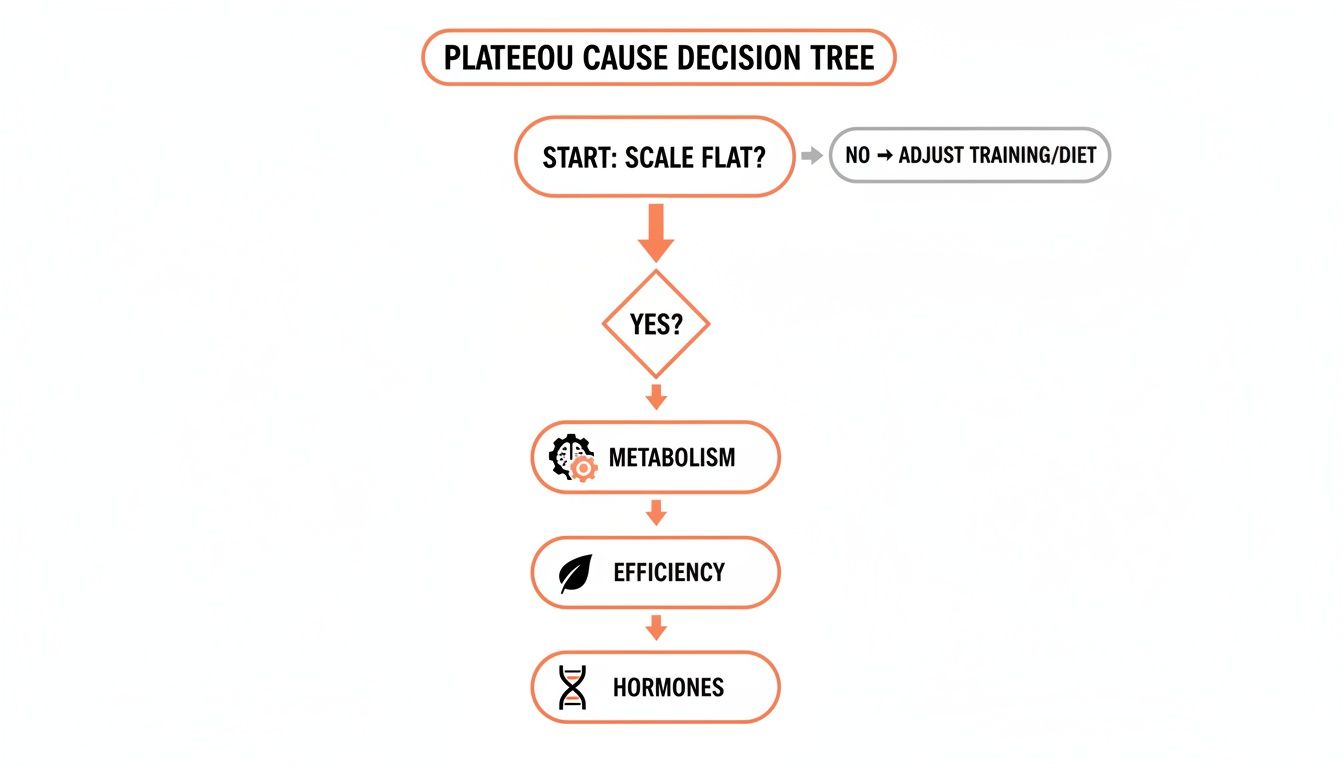
This decision tree gives you a great visual for troubleshooting the root cause.
As the chart shows, a stalled scale can come from metabolic, efficiency, or hormonal factors. That’s why a full audit is so important. And remember, the scale doesn't tell the whole story. You could be losing fat and gaining muscle, which is a win! Using a body measurement tracker helps you see progress that the scale misses.
Once you’ve gone through this audit, you'll have a much clearer picture of what's really happening, allowing you to make smart, targeted adjustments instead of just guessing.
Smart Dietary Shifts to Get the Scale Moving Again
After you’ve done some detective work and have a good idea of why the scale is stuck, it's time to make some changes. This isn't about doing anything drastic like cutting your calories in half or completely banning your favorite foods. The real key is to make smart, strategic adjustments that work with your body, not against it, to get fat loss going again.
So, let's move past the old "just eat less" advice. To break a plateau, you have to eat smarter. We'll focus on a few proven techniques that can help manage hunger, support your metabolism, and get you back on track.
Put Protein Front and Center
If you only do one thing, do this: prioritize protein. It's one of the most powerful levers you can pull to break through a stall. Protein works its magic in a couple of ways. First, it’s incredibly satiating. This helps manage hunger and cravings, making it easier to stick to your calorie goals without feeling deprived.
Second, protein has a high Thermic Effect of Food (TEF). This means your body burns more calories digesting it compared to other nutrients. In fact, you'll burn 20-30% of the calories from protein just through digestion, compared to only 5-10% for carbs and a measly 0-3% for fats. It's like a small, built-in metabolic boost with every meal.
A strong target to aim for is 1.6 to 2.2 grams of protein per kilogram of body weight. For someone who weighs 150 pounds (about 68kg), that comes out to about 110-150 grams of protein daily.
You can easily tweak this in the BiteKit app. Just head to your daily goals, tap on your macros, and slide the protein percentage up while nudging carbs or fats down to keep your total calories consistent. Then, just focus on adding a solid source of lean protein—like chicken, Greek yogurt, eggs, or lentils—to every meal and snack.
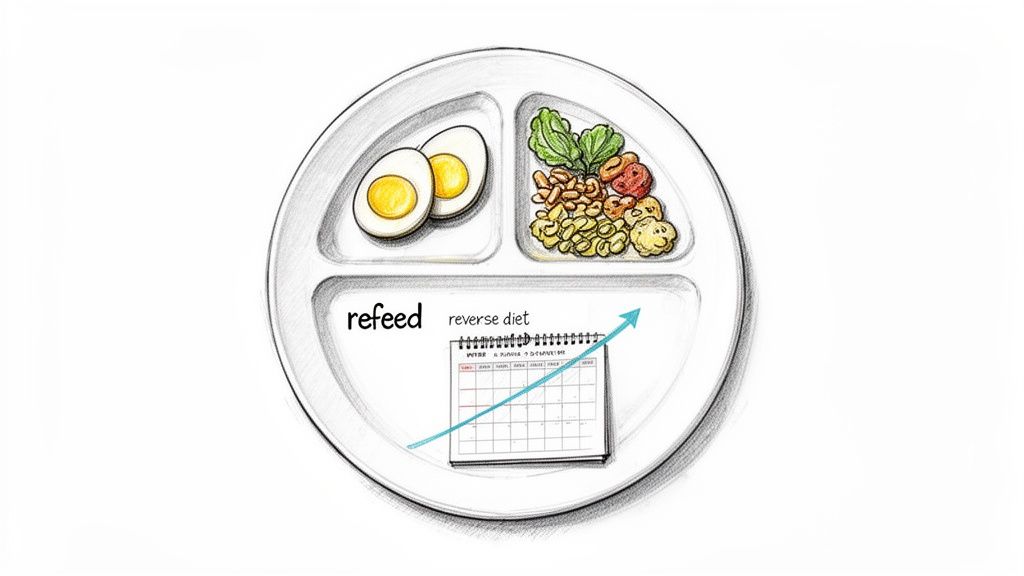
Try a Strategic Refeed Day
Prolonged dieting takes a toll. Your hormones, especially one called leptin, can really start to drop. Leptin signals satiety to your brain and helps keep your metabolism running. When it's low, you feel hungrier and your metabolism slows down. This is exactly where a planned "refeed day" can be effective.
This isn't a "cheat day" where anything goes. A refeed is a single, structured day where you intentionally bring your calories up to your maintenance level, with most of the extra calories coming from carbohydrates.
Think of a refeed as hitting a reset button for your metabolism. The influx of carbs refills your muscle energy stores and gives your leptin levels a much-needed boost, signaling to your body that it’s okay to start burning fat efficiently again.
Here’s a simple way to plan one:
- When to do it: Try a refeed once every 2-4 weeks when you feel you've hit a wall.
- How many calories: For just one day, eat at your estimated maintenance calorie level.
- What to eat: Keep your protein intake about the same and your fat intake low. Fill in the rest of your calories with carbs—think things like potatoes, rice, oats, and fruit, not high-fat foods.
This short break can also provide significant psychological relief. It gives you a light at the end of the tunnel and can make long-term adherence feel much more manageable.
Take a Full-Fledged Diet Break
If one refeed day doesn't quite do the trick, or if you're just feeling completely burned out from being in a deficit, a longer "diet break" might be what you need. This means taking 1-2 full weeks to eat at your maintenance calories.
It sounds counterintuitive to stop dieting to lose weight, but the science supports this strategy. A planned break can help reverse the metabolic slowdown and hormonal changes that caused the plateau in the first place.
During these 1-2 weeks, you're giving your body and mind a chance to recover. Your stress hormone (cortisol) levels can come down, leptin bounces back, and that mental fatigue just melts away. Many people come back from a diet break feeling refreshed and find that fat loss kicks right back in when they return to a small deficit.
If you want to get more comfortable with these macro-based strategies, you can learn more about how to track macros for weight loss in our detailed guide.
Explore Reverse Dieting
For anyone who's been dieting for a very long time, or has dieted their way down to a frustratingly low calorie intake, a "reverse diet" can be a total game-changer. This is a much slower, more methodical approach than a standard diet break.
The idea behind reverse dieting is to very slowly add calories back into your diet over several weeks or even months. We're talking small, controlled bumps of just 50-100 calories per week while keeping a close eye on your weight and body measurements.
This process essentially helps restore your metabolic rate, "teaching" your body to handle more food without piling on fat. It’s a powerful way to get out of a metabolic rut. By the end of a successful reverse diet, you could be maintaining your weight on hundreds more calories per day, putting you in a much stronger, healthier position for your next fat loss phase.
Revitalizing Your Workout to Boost Metabolism
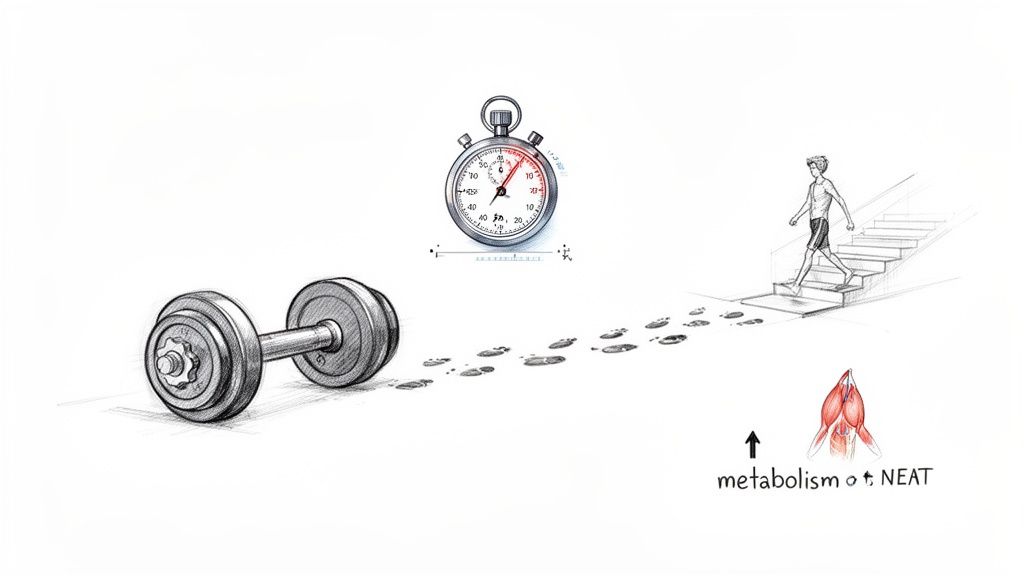
It’s a classic story: the workout that felt impossible two months ago now feels like a warm-up. That’s your body doing what it does best—adapting. It’s become so efficient at your routine that it’s simply burning fewer calories to get the job done. This efficiency is great for survival but terrible for breaking a plateau.
Shaking things up doesn't mean you have to suddenly start training for a marathon. It’s about making smart, strategic shifts to your activity to force your body to adapt all over again. The key is to challenge your system from three different angles: building muscle, adding intensity, and increasing your everyday movement.
Build Metabolically Active Muscle with Resistance Training
One of the sneakiest culprits behind a plateau is muscle loss. When you’re eating in a deficit, your body can sacrifice muscle tissue along with fat. Since muscle is metabolically active—meaning it burns calories even when you’re at rest—losing it can cause your metabolism to downshift.
Resistance training is your best defense. It sends a clear signal to your body to preserve, and even build, muscle. More muscle mass means a higher resting metabolic rate, which means you’re burning more calories 24/7. It’s the single most effective long-term strategy for turning your body into a more efficient fat-burning machine.
If you’re already lifting, it's time to introduce a new challenge. You can’t keep doing the same thing and expect new results. Try one of these:
- Increase the weight: The core of progressive overload. Aim to lift slightly heavier over time.
- Change your rep range: If you live in the 8-12 rep range, switch to a strength phase of 5-8 reps or an endurance phase of 15-20 reps.
- Try new exercises: Swap your usual barbell bench press for dumbbell presses or your leg press for front squats.
The idea is to keep your muscles guessing. This forces them to respond, which directly counteracts the metabolic slowdown that has you stuck.
Introduce High-Intensity Interval Training (HIIT)
Steady-state cardio has its place, but your body gets good at it—fast. To really jolt your metabolism, try adding High-Intensity Interval Training (HIIT) to your routine once or twice a week. HIIT is all about short bursts of maximum effort followed by brief recovery periods.
The magic of HIIT lies in what’s called Excess Post-exercise Oxygen Consumption (EPOC), or the "afterburn effect." After a gut-busting HIIT session, your metabolism stays elevated for hours as your body works to recover, burning a significant number of calories long after your workout is over.
A 20-minute HIIT workout can often torch more total calories over 24 hours than a 45-minute slog on the treadmill. It’s an incredibly efficient way to boost your daily energy expenditure without spending hours in the gym.
A simple HIIT session on a bike could be:
- Warm-up for 5 minutes.
- Go all-out for 30 seconds.
- Pedal slowly to recover for 60 seconds.
- Repeat this cycle 8-10 times.
- Cool down for 5 minutes.
You can apply this sprint-recover-repeat formula to almost anything—running, rowing, battle ropes, or even bodyweight circuits.
Boost Your Non-Exercise Activity Thermogenesis (NEAT)
This might be the most overlooked factor in any weight loss journey: Non-Exercise Activity Thermogenesis (NEAT). NEAT is all the calories you burn from activities that aren't structured exercise. We're talking about walking to your car, fidgeting at your desk, taking the stairs, and even doing chores.
When your body senses a prolonged calorie deficit, it often goes into energy-conservation mode by subconsciously dialing down your NEAT. You might find yourself sitting more and fidgeting less without even realizing it. This can quietly erase hundreds of calories from your daily burn—often enough to bring fat loss to a dead stop.
Making a conscious effort to increase your NEAT is a low-stress, high-impact way to get the scale moving again.
Here are a few simple ways to weave more movement into your day:
- Set a timer to stand up and walk around for five minutes every hour.
- Take the stairs. Always. No exceptions.
- Park in the farthest spot from the entrance.
- Pace around the room while you're on a phone call.
- Do some light stretching or foam rolling while you watch TV at night.
By combining resistance training to build your metabolic engine, HIIT to supercharge your calorie burn, and a focus on NEAT to keep your daily activity high, you’re creating a powerful, multi-pronged attack on that plateau.
Mastering Recovery: The Overlooked Plateau Breaker
Let's talk about the single biggest reason people get stuck. You can have the most meticulous diet and a killer workout plan, but if you're ignoring recovery, you’re essentially driving a car with the handbrake pulled.
Chronic stress and poor sleep are silent progress killers. They create a hostile hormonal environment that can grind fat loss to a halt, even when you're positive your calories and activity are on point.
When you're constantly frazzled or sleep-deprived, your body floods itself with cortisol. This stress hormone is a disaster for anyone trying to push past a plateau. For one, it signals your body to retain water, which easily masks real fat loss on the scale and leaves you feeling puffy and defeated.
Worse, elevated cortisol has been shown to encourage the storage of visceral fat—that's the dangerous stuff that wraps around your organs. So even in a calorie deficit, chronic stress can dictate where your body decides to store fat, often right where you want it least.
The Critical Role of Sleep in Fat Loss
Sleep isn't a luxury; it's a fundamental requirement for losing fat. Skimping on it throws the hormones that control your appetite completely out of balance. Ghrelin, your "I'm hungry" hormone, spikes, while leptin, the "I'm full" hormone, plummets.
This hormonal chaos creates a perfect storm. You feel hungrier all day, it’s harder to feel satisfied after a meal, and your brain starts demanding high-calorie, sugary foods. It’s not a lack of willpower; it’s your biology working against you. Research consistently shows that people who sleep poorly eat more calories the next day.
Beyond cravings, not getting enough quality sleep—and we're talking a solid 7-8 hours a night—can directly slow down your metabolism. Your body becomes less sensitive to insulin, making it more likely to shuttle calories into fat storage instead of burning them for fuel. If you want to break a plateau, you must get serious about your sleep.
Here are a few proven strategies to improve your sleep hygiene:
- Make Your Bedroom a Cave: It should be dark, quiet, and cool. Blackout curtains and an eye mask are game-changers. Your bedroom is for sleeping, period.
- Create a "Power-Down" Hour: An hour before bed, the screens go off. The blue light from your phone and TV actively suppresses melatonin. Read a real book, take a warm bath, or do some light stretching instead.
- Stick to a Schedule: Try to go to bed and wake up around the same time every single day—yes, even on weekends. This consistency is what sets your body's internal clock.
Practical Stress Management for a Busy Life
Managing stress is just as crucial. You can't just eliminate it from your life, but you can build a toolkit of techniques to keep it from derailing you. The goal is to shift your nervous system out of "fight or flight" and into "rest and digest."
A plateau often has a psychological component. Focusing only on the scale can create a cycle of stress and frustration, which raises cortisol and makes the plateau even worse. It's a self-fulfilling prophecy.
Finding healthy ways to unwind can break this cycle and help you finally move the needle. It doesn't have to be complicated or time-consuming.
- Take Mindful Moments: Just 5-10 minutes of a meditation app or simple deep breathing exercises can significantly lower cortisol.
- Get Outside: A gentle walk, especially somewhere with a bit of green, is a proven stress-buster.
- Do a Brain Dump: Spend a few minutes journaling. Getting your anxieties out of your head and onto paper can feel incredibly freeing.
Zoom Out to Protect Your Mindset
The mental grind of a plateau is real. Stepping on the scale every morning can become a source of major anxiety, often leading to rash decisions like slashing calories too low or giving up entirely.
This is where you need to force a perspective shift, moving your focus from the daily noise to the long-term trend.
This is also where a tool like BiteKit becomes a powerful ally for your mindset. Instead of obsessing over today's number, you can open the app and look at the "Trends" tab. See how your weekly average weight is still trending downward, even with the day-to-day bumps.
By focusing on these bigger patterns, you can emotionally detach from the discouraging daily weigh-ins. This helps you maintain the patient, consistent mindset that's absolutely required for lasting success and stops that stress-induced plateau in its tracks.
Your Plateau Questions, Answered
When you're doing everything right and the scale just won't budge, it's natural to have a ton of questions. Hitting a plateau can be frustrating, but it's a normal part of the process. Let's walk through some of the most common questions and get you moving in the right direction again.
How Long Does a Weight Loss Plateau Typically Last?
A true plateau isn't just a bad weigh-in or a slow week. It should only be considered a plateau if you've seen no change on the scale for at least three to four consecutive weeks, despite consistent adherence to your plan.
Anything shorter than that is usually just the normal ebb and flow of body weight. You could be holding onto a little extra water from a salty meal, dealing with hormonal shifts, or simply have more food in your system than usual.
Patience is absolutely crucial. Don't panic and make drastic changes to your plan after just one week of no progress. Give your body time to show you the real trend before deciding your strategy needs an overhaul.
Should I Try a 'Cheat Day' to Break My Plateau?
The old-school "cheat day" sounds fun, but a free-for-all can easily wipe out an entire week of your hard-earned deficit. A much better approach is a structured refeed day or even a planned diet break.
Think of it as a controlled, strategic move. Instead of an anything-goes binge, you'll deliberately increase your calories for a short period, focusing mainly on carbohydrates. This isn't just for your sanity; it sends a powerful signal to your body.
That influx of carbs and calories helps fire up key metabolic hormones like leptin. It essentially tells your metabolism, "Hey, the famine is over, it's safe to start burning energy at a normal rate again." It’s a targeted physiological reset.
Can I Overcome a Plateau Without Tracking Calories?
It is possible, but it’s like trying to navigate without a map. A plateau is, at its core, an energy balance problem—the calories you're eating now match the calories your body is burning. Without tracking, you’re just guessing what the problem is.
Even if you dislike tracking, committing to it for just one week can be a complete game-changer. The data you get is incredibly valuable.
You’ll quickly spot things you've been missing—the "calorie creep" from cooking oils and sauces, portion sizes that have gotten a little too generous, or weekend habits that are stealthily erasing your progress. This gives you the power to make precise fixes instead of just slashing calories blindly.
Is It Better to Cut More Calories or Increase Exercise?
My advice is almost always to do a little of both, but there’s a specific order I recommend. The first instinct for most people is to cut calories dramatically, but that can backfire by slowing your metabolism even more and leaving you feeling tired and hungry.
Try following this sequence instead:
- First, audit your food log. Get brutally honest with your tracking. Are you really accounting for everything? More often than not, this is where the solution lies.
- Next, add more activity. This doesn't have to mean hours at the gym. You could add a couple of strength training sessions to build muscle (which burns more calories at rest), or simply focus on getting more daily steps to boost your NEAT.
- Finally, adjust calories slightly. If you've tightened up your tracking and added more movement and you're still stuck, then it's time to consider a small calorie reduction. Dropping your intake by just 100-200 calories is often enough to get the scale moving again without triggering a major metabolic downshift.