How to Track Macros for Weight Loss: A Science-Backed Guide
Learn how to track macros for weight loss with this step-by-step guide. Master calculating, logging, and adjusting macros to achieve your fitness goals.
Tracking macros is a game-changer for weight loss, and it’s about so much more than just counting calories. Instead, you're setting specific daily targets for protein, carbs, and fats. This approach helps you fine-tune your body's response to a calorie deficit, making sure you're shedding fat while holding onto valuable muscle.
Why Macros Are Your Secret Weapon for Weight Loss
You’ve probably heard the old "calories in, calories out" mantra a million times. And yes, a calorie deficit is non-negotiable for losing weight, but it's really just the starting point. Where those calories come from—your macronutrients—is what truly dictates your body composition, energy levels, and whether you’ll succeed long-term.
Focusing only on the total calorie number can backfire. You might end up losing muscle along with fat, which can tank your metabolism and make it incredibly difficult to keep the weight off for good.
This is exactly why learning to track your macros is such a powerful tool. It’s not about being restrictive; it's about being smart and intentional with your nutrition. By balancing your protein, fats, and carbs, you’re giving your body the right kind of fuel to get the results you want.
More Than Just Calories: The Science of Macros
Think of your body as a high-performance engine. Calories are the fuel, sure, but your macros are the specific grades of fuel that do very different, very important jobs.
- Protein: These are the building blocks for your muscles. When you're losing weight, getting enough protein is absolutely critical to preserve that lean mass, which in turn keeps your metabolism humming along.
- Carbohydrates: This is your body's go-to energy source. Carbs fuel your brain and power you through workouts, keeping that dreaded diet fatigue at bay.
- Fats: Don't fear the fat! They are essential for producing hormones and absorbing certain vitamins. Plus, healthy fats play a huge role in helping you feel full and satisfied after a meal.
By managing this trio, you can directly influence how your body handles a diet. For example, a diet higher in protein helps you feel fuller for longer, which is a massive help in controlling your total calorie intake without feeling deprived. This focus on nutrient quality is what separates simple weight loss from sustainable fat loss. We actually dive deeper into this in our guide on the differences between weight loss vs fat loss.
The science is crystal clear: while a calorie deficit drives weight loss, your macro mix is a very close second. Blindly slashing calories often leads to muscle loss and a metabolic slowdown, with up to 80% of dieters eventually regaining the weight they lost.
This is precisely why tracking macros has become so popular—it works. A 2021 meta-analysis showed that diets with defined macronutrient targets resulted in an average body weight reduction of 5-10% over six months.
Even better, protecting your muscle by aiming for adequate protein (around 1.6-2.2g per kg of body weight) can boost your resting metabolism by 5-10%. That’s a significant edge on any weight loss journey. You can dig into the full research on diet programs if you want to see the data for yourself.
For busy professionals and women who need an effective strategy that fits a hectic life, this method offers a sense of control without overcomplicating things. Modern tools make it even easier. Apps like BiteKit take the tedious work out of manual logging and turn it into a simple, effortless daily habit.
Figuring Out Your Personal Macro Targets for Fat Loss
Before you can start tracking macros, you need a target. This isn't about grabbing some generic meal plan off the internet; it's about building a nutritional blueprint that’s actually designed for your body, your activity level, and your specific goals. It all boils down to a few simple calculations that turn a vague goal like "lose weight" into concrete, actionable numbers.
First things first, we need to estimate how many calories your body burns in a day. This is your Total Daily Energy Expenditure (TDEE), and it accounts for everything from your resting metabolism to your workouts. We'll use a reliable and widely used method—the Mifflin-St Jeor equation—to find your Basal Metabolic Rate (BMR) and then adjust it for activity.
Finding Your Starting Calorie Goal
To get your BMR, you'll need your weight, height, and age.
- For men: (10 x weight in kg) + (6.25 x height in cm) - (5 x age in years) + 5
- For women: (10 x weight in kg) + (6.25 x height in cm) - (5 x age in years) - 161
Once you have that number, you'll multiply it by an activity factor to get your TDEE, which is your daily maintenance calorie level.
- Sedentary (little to no exercise): BMR x 1.2
- Lightly Active (light exercise 1-3 days/week): BMR x 1.375
- Moderately Active (moderate exercise 3-5 days/week): BMR x 1.55
- Very Active (intense exercise 6-7 days/week): BMR x 1.725
For steady, sustainable fat loss, you need to be in a calorie deficit. A 15-20% reduction from your TDEE is the sweet spot. This approach helps you hold onto precious muscle and sidesteps the ravenous hunger that tanks most crash diets.
Let’s see this in action. Meet Sarah, a 35-year-old woman who is 168 cm tall, weighs 75 kg, and works out a few times a week.
- Her BMR is: (10 x 75) + (6.25 x 168) - (5 x 35) - 161 = 1464 calories.
- Her TDEE is: 1464 x 1.55 (moderately active) = 2269 calories.
- Her weight loss calorie goal (with a 20% deficit) is: 2269 x 0.80 = 1815 calories.
Boom. Sarah now has her starting point: 1815 calories per day. Now we can break that down into macros.
Setting Your Protein, Fat, and Carb Targets
With a calorie goal locked in, it's time to set your macros. I always tell my clients to start with protein. It’s absolutely essential for keeping you full and preserving muscle mass when you’re cutting calories, which is exactly what we want.
A solid, science-backed target for active people in a calorie deficit is 1.6 to 2.2 grams of protein per kilogram of body weight.
Let's stick with Sarah's example:
- Protein Target: We’ll aim for a middle-ground 1.8 g/kg. So, 75 kg x 1.8 g = 135 grams of protein.
- Protein Calories: Protein has 4 calories per gram, so her protein intake comes to 135 g x 4 cal/g = 540 calories.
Next up is fat. Healthy fats are non-negotiable for hormone production and overall well-being. A good rule of thumb is to dedicate 20-30% of your total daily calories to fat.
- Fat Calories: We’ll shoot for 30% of her 1815 calorie goal. That’s 1815 x 0.30 = 545 calories.
- Fat Target: Fat has 9 calories per gram, so 545 / 9 = 60 grams of fat.
Finally, carbohydrates get the rest of the calorie budget. Think of carbs as your body’s preferred fuel source, powering your brain and your workouts.
- Carb Calories: We subtract protein and fat from the total: 1815 - 540 (protein) - 545 (fat) = 730 calories.
- Carb Target: Carbs also have 4 calories per gram, so 730 / 4 = 182 grams of carbs.
This balanced macro approach is so effective because it tackles weight loss from multiple angles, as this flowchart shows.
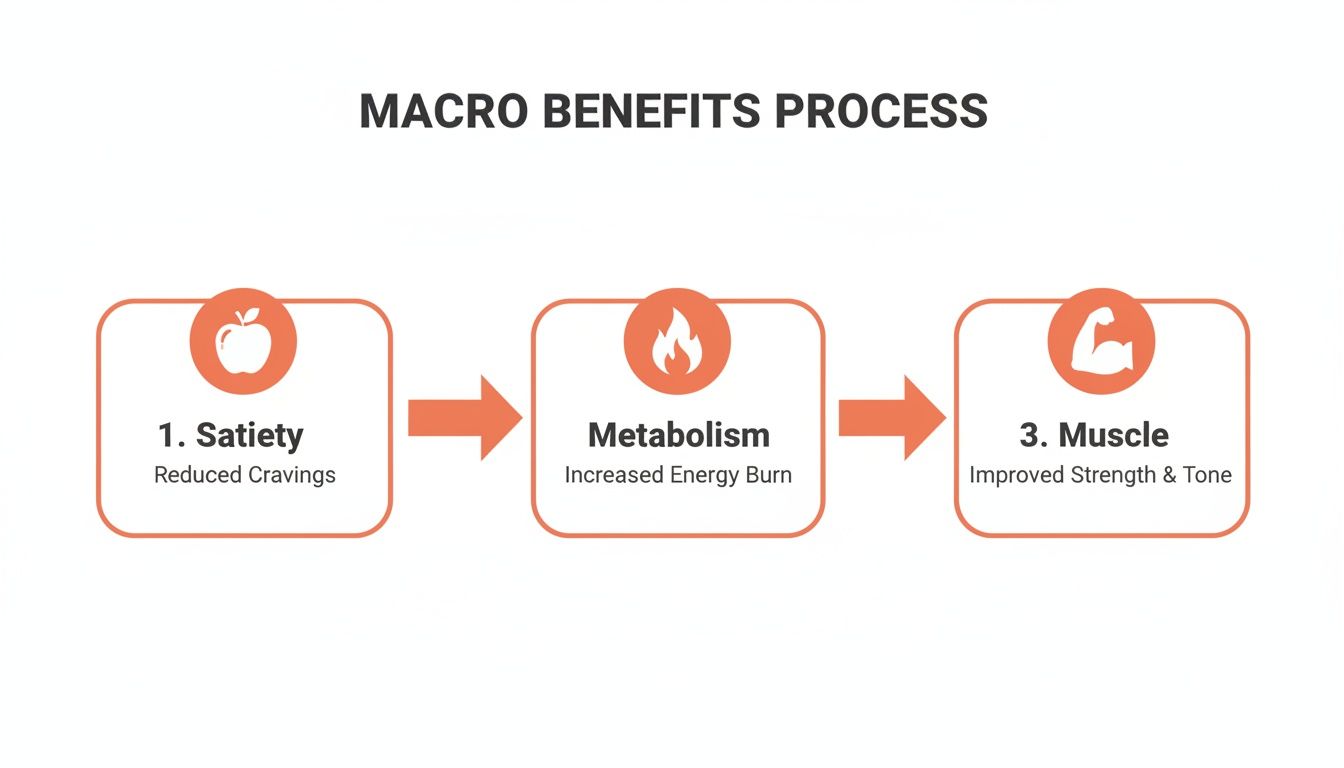
As you can see, hitting your macros helps you feel fuller, supports a healthy metabolism, and protects your lean muscle while you lose fat.
So, here are Sarah’s Starting Daily Macro Targets:
- Calories: 1815
- Protein: 135g
- Fat: 60g
- Carbohydrates: 182g
This works out to a ratio of roughly 30% protein, 30% fat, and 40% carbs—a fantastic and sustainable setup for fat loss. Some people prefer a higher protein split, like a 40P/30C/30F breakdown, to really double down on muscle preservation. That’s a great strategy, too.
To give you a better idea of what these numbers look like in practice, here are a few examples for different calorie goals.
Sample Daily Macro Targets for Weight Loss
| Calorie Goal | High-Protein Split (40P/30C/30F) | Balanced Split (30P/40C/30F) |
|---|---|---|
| 1600 | 160g Protein / 120g Carbs / 53g Fat | 120g Protein / 160g Carbs / 53g Fat |
| 1800 | 180g Protein / 135g Carbs / 60g Fat | 135g Protein / 180g Carbs / 60g Fat |
| 2000 | 200g Protein / 150g Carbs / 67g Fat | 150g Protein / 200g Carbs / 67g Fat |
| 2200 | 220g Protein / 165g Carbs / 73g Fat | 165g Protein / 220g Carbs / 73g Fat |
These targets give you a clear, quantitative goal to aim for each day instead of just vaguely "eating healthy."
And if you want to skip the manual math, you can use a tool to do the heavy lifting. Our guide shows you how to find a free macro calculator that uses these same proven principles.
The Modern Way to Log Meals Effortlessly
You’ve got your targets. Now comes the part where most people fall off the wagon: actually tracking what you eat, day in and day out. Let’s be real, the old-school way of logging food feels like a part-time job.
Who has the patience to scroll through endless database entries for "chicken breast, grilled, boneless, skinless" after every single meal? This friction is exactly why so many of us give up. The good news is, technology has finally caught up and offers a much smarter, faster way to keep track.
Beyond Barcodes and Manual Searches
Traditional tracking methods are fundamentally broken for how we actually eat. Think about it. What do you do with that amazing bowl of pho from your favorite local spot? Or a homemade stew with a dozen different ingredients? A barcode scanner is useless, and manually entering every component is a recipe for frustration and inaccuracy.
This is where AI-powered tools completely change the game. Instead of you doing all the heavy lifting, the technology handles it for you. This shift from manual labor to smart automation is what makes macro tracking a habit that can actually stick.
The biggest barrier to consistency isn't a lack of motivation; it's friction. When a task is too difficult or time-consuming, we're biologically wired to avoid it. The goal is to make logging so fast and simple that it becomes an effortless part of your routine.
Modern apps are built to crush this friction. They get that you eat real food, not just pre-packaged items with a convenient barcode. If you're looking for a tool that fits into a busy life, it's a critical piece of the puzzle. Curious about your options? You can see how different tools compare in our breakdown of the best free nutrition tracking apps.
How AI Simplifies Your Daily Logging
Imagine logging your entire lunch just by taking a picture of your plate. That’s not science fiction anymore—it's how modern tracking works.
Here’s how this plays out in the real world:
- Photo Logging: You’re at a cafe with a salmon salad. Instead of fumbling with a food scale or guessing portions, you snap a photo. An app like BiteKit analyzes the image, identifies the salmon, quinoa, and avocado, estimates the portion sizes, and instantly calculates the macros.
- Voice Commands: Just finished your morning oatmeal? You can simply say, "a bowl of oatmeal with blueberries and a scoop of protein powder," and the app logs it. It’s faster than typing and perfect for when your hands are full.
- Natural Language Text: For dinner, you had "200g salmon with roasted asparagus." Just type that simple phrase. The app understands exactly what you mean and breaks it down into accurate data without you ever touching a food database.
This is what it looks like in practice—a clean, simple interface where logging takes just a few seconds, whether you use text, voice, or a photo.
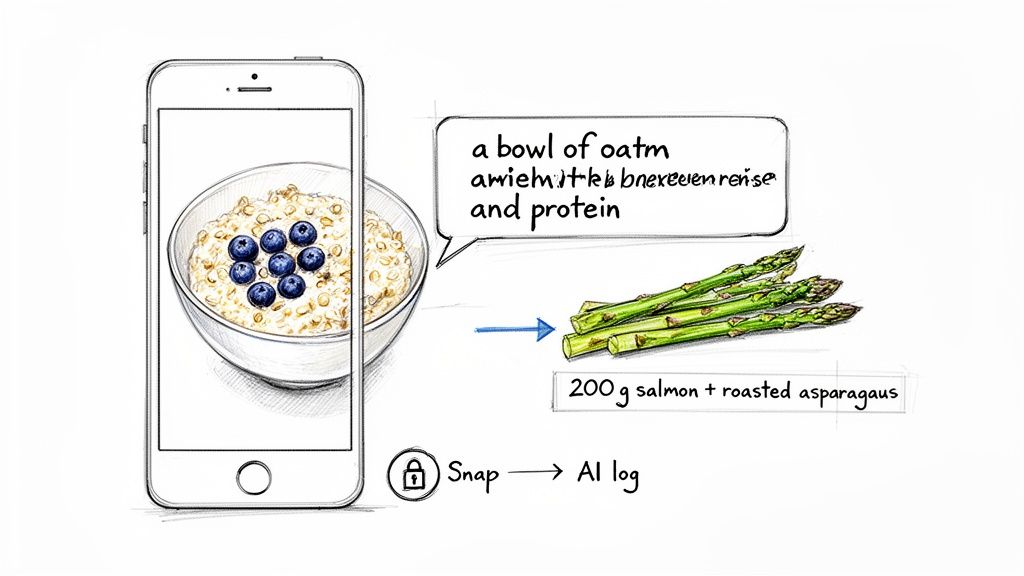
The point here is speed and simplicity. What used to take five minutes of tedious searching now takes five seconds.
Your Health Data Should Stay Private
In an age where our personal data is a hot commodity, what you eat should remain your business. Many popular health apps push you to create an account, syncing your sensitive information—what you eat, when you eat it, your weight—to their cloud servers. For many, that's a legitimate privacy concern.
A privacy-first approach makes a huge difference. BiteKit, for example, requires no account and stores all your data locally on your device. This means your meal history, weight, and personal goals are for your eyes only.
You get all the benefits of smart AI analysis without sacrificing your privacy. That peace of mind is invaluable as you work toward your health goals, making the entire process of tracking macros not just effective, but also secure.
Building Your Daily Macro Tracking Routine
Knowing your macro targets is like having a map. But a map doesn't do you any good if you never look at it. The real progress begins when you build a simple, sustainable routine around tracking your food, turning it from a chore into a habit that actually guides your choices.
The trick is to make logging so easy that it becomes second nature. This isn't about being a drill sergeant with your food or spending ages logging every last crumb. It's about creating small, repeatable actions that slot right into your day.
Weaving Tracking into Your Day
The most effective way to track is to stay one step ahead of your hunger. This means making proactive choices instead of reactive ones. By planning and logging a little bit in advance, you kill decision fatigue and make sure your meals fit your goals before you eat them. It’s a small shift in timing that makes a world of difference.
Here’s how to make it happen:
- Plan the Night Before: Seriously, just take five minutes before bed to map out what you’ll eat tomorrow. This simple act gets rid of the guesswork and stops you from grabbing something off-plan when you're busy or stressed.
- Log Your Staples Early: Do you eat the same breakfast and lunch most days? Log them first thing in the morning. You’ll instantly see a huge chunk of your day accounted for, which gives you a clear picture of what you have left for dinner and snacks.
- Use Your Downtime: Got a few minutes on your commute or while waiting for a meeting? Use that time to plan and log dinner. It’s a great way to use those little pockets of time that usually go to waste.
This proactive approach flips tracking on its head—it’s no longer a diary of what you’ve already eaten, but a blueprint for success. It puts you back in the driver's seat.
From Passive Logging to Active Decision-Making
Once you find your rhythm, you can start using that data in real-time to make smarter food choices on the fly. This is where tracking moves beyond just recording numbers and becomes a genuinely useful tool.
The people who succeed with tracking aren't aiming for perfection; they're aiming for awareness. They use their daily macro targets as a flexible guide, not a rigid rulebook, to inform their choices throughout the day.
This is exactly why features like the real-time progress bars in BiteKit are so helpful. They give you instant visual feedback on where you stand with your protein, carbs, and fats at any given moment.
Imagine you glance at your phone in the afternoon and see you’re nearing your fat and carb limits, but you're still way behind on protein. That one piece of information completely changes your dinner plans.
Instead of that cheesy casserole you were thinking about, you might pivot to grilled chicken breast and steamed veggies. You're still eating a great meal, but you’ve actively steered it toward hitting your protein goal without blowing your other macros. This is how you really learn to make tracking work for you—by making small, informed adjustments as you go.
Focus on Averages, Not Perfection
One of the biggest mental traps you can fall into is obsessing over hitting your numbers perfectly every single day. This "all-or-nothing" thinking is a fast track to burnout. Let's be real, life happens. There will be office parties, dinners out, and days you just don't have it in you.
Instead of stressing over daily perfection, shift your focus to your weekly averages. Went over on carbs Tuesday but were under on Wednesday? It all evens out. As long as your weekly calorie and protein averages are on track, you're winning. This mindset gives you the flexibility you need to stick with this for the long haul and protects your sanity, which is just as important as hitting your macros.
Adjusting Your Macros as You Lose Weight
Those initial macro numbers you calculated? Think of them as a launchpad, not a locked-in flight plan. Your body is a master of adaptation. As the pounds come off, your energy needs shrink, which means the macros that got you started won't be the same ones that get you across the finish line. Learning to tweak them is a crucial skill for making your results last.
Sticking to your original numbers when the scale stops moving is one of the most common reasons people get frustrated and give up. It’s like trying to follow your original GPS route after hitting an unexpected detour. You have to recalculate and adjust your course to keep moving forward.
When to Know It's Time for a Change
Your body is pretty good at telling you when it's time for a tune-up. The most glaring sign, of course, is a weight loss plateau. If you’ve been tracking honestly and the scale hasn’t budged for two to three weeks, it's a solid indicator that your metabolism has adapted to your new, lighter body. A smaller body simply burns fewer calories, both at rest and during your workouts.
But the scale isn't the only thing to watch. Keep an eye out for these other triggers:
- Your Activity Level Shifts: Did you just ramp up your training for a 5K? Or maybe you switched from a sedentary job to one that keeps you on your feet? More activity demands more fuel, and your macros need to reflect that.
- You're Constantly Tired or Hungry: Feeling wiped out, irritable, or perpetually hungry is a red flag. It could mean your calorie deficit is too steep or your carbs are too low to power you through the day.
- You Hit a Major Milestone: I always recommend my clients reassess after every 5-7kg of weight loss. It’s the perfect time to run the numbers again and set new targets that match your current body weight.
Making Smart Adjustments Based on Data
When you do need to make a change, the key is to be precise. Avoid the temptation to just slash a huge chunk of calories out of desperation. Small, methodical tweaks are always more sustainable and effective. Your number one priority is to protect the muscle you’ve worked so hard for—that’s what keeps your metabolism fired up.
This is where your protein intake becomes non-negotiable. It's shocking, but over 1 billion people globally don't get enough protein. When you're in a calorie deficit, this becomes even more critical. Aiming for 25-30% of your calories from protein helps protect your lean mass, which can otherwise decrease by 20-30% during weight loss and drag your metabolism down by up to 15%. In fact, a major scientific review found that people on high-protein diets lost significantly more weight (8-12kg vs. 5kg) over six months, largely because protein is so incredibly effective at keeping you full.
With that in mind, a smart adjustment strategy always keeps protein high while slightly trimming your energy macros: carbs and fats.
Pro Tip: Change one thing at a time. Try reducing your daily carbs or fats by just 10-15 grams. That's a tiny change—only a 40-135 calorie drop—but it's often all it takes to break through a stall without feeling deprived.
This is where consistent tracking really pays off. Using a tool like BiteKit makes this process incredibly simple. Its date-organized history lets you easily look back at your weekly stats, spot trends in your intake, and see exactly where you can make a small cut. Then you can just update your custom targets right in the app.
What About After You Hit Your Goal? A Quick Look at Reverse Dieting
Reaching your goal weight is a huge accomplishment, but the work isn't quite over. You can't just flip a switch and go back to eating the way you did before. That's a recipe for rebound weight gain.
Instead, you need a transition plan. This is where a strategy called reverse dieting comes into play. It involves slowly and systematically adding calories back into your diet over a period of weeks or even months. This process gives your metabolism time to adapt and recover from being in a deficit, ultimately allowing you to maintain your new weight while eating a lot more food. It’s the smartest way to move from "weight loss mode" to a sustainable, lifelong maintenance phase.
Common Macro Tracking Mistakes and How to Fix Them
Look, whenever you start something new, there's going to be a learning curve. Tracking your macros is no different. Even with the best intentions, a few common slip-ups can easily throw you off course. The good news? Once you know what they are, they're pretty easy to fix.
Guesstimating Portion Sizes
This is the big one. Eyeballing a cup of rice or a "serving" of chicken can be wildly inaccurate. I've seen clients accidentally eat double their intended calories just from misjudging portion sizes throughout the day. A small miscalculation at breakfast, another at lunch... it all adds up.
A food scale is your best friend for accuracy, but I get it—it's not always practical, especially when you're out and about.
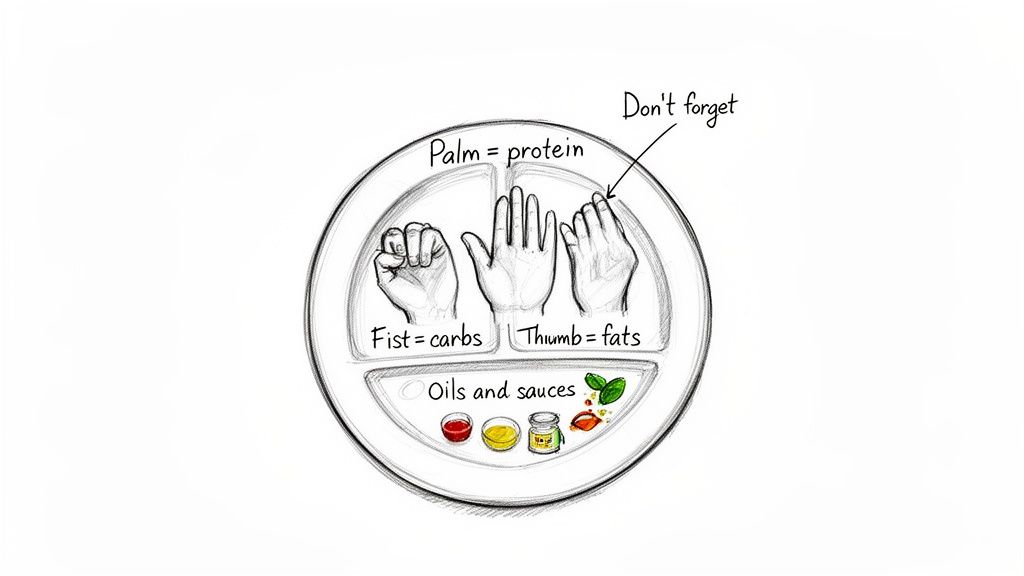
When you can't weigh your food, using your hand is a solid backup plan to stay consistent.
- Protein: A serving is about the size of your palm.
- Carbs: Think of a cupped hand for things like rice or pasta.
- Fats: A serving of dense fats like nuts or cheese is roughly the size of your thumb.
This method gives you a reliable baseline. From there, a tool like BiteKit can take it a step further. When you log meals with photos, its AI starts to recognize your typical portions, getting smarter and more accurate over time without you ever needing to pull out the scale.
Forgetting the "Extras"
Another classic mistake is forgetting all the little things that sneak into your day. That splash of creamer in your coffee, the olive oil you used to roast your veggies, the ketchup for your fries—it all has calories and macros. It's easy to dismiss them, but these "hidden" calories can easily pile up to hundreds of extra calories a day, completely stalling your progress.
The solution is simple but non-negotiable: log everything. Make it a habit to account for every oil, sauce, dressing, and drink. It might feel like a pain at first, but this is often the single change that breaks a weight-loss plateau.
Your goal should always be progress, not perfection. An 80% accurate log is infinitely better than an empty one. Don't let the fear of not being perfect stop you from tracking at all.
Chasing Perfect Numbers Daily
Finally, don't fall into the trap of thinking you need to hit your macro targets perfectly every single day. Life happens. Some days you'll be over on carbs, other days you'll be under on protein. It's okay.
Instead of stressing about the daily details, focus on your weekly average. If your numbers balance out over the course of seven days, you're on the right track. This flexible approach is what turns macro tracking from a rigid diet into a sustainable, long-term tool for reaching your goals.
Got Questions? We've Got Answers
Even with the best plan in hand, you're bound to have questions as you go. It's totally normal. Here are some of the most common things people ask when they start tracking macros for weight loss, along with some practical, real-world advice.
So, Do I Really Need a Food Scale?
Look, a food scale is the most accurate way to do this, no question. But is it absolutely necessary to get started and see results? Nope.
When you're just starting out, using measuring cups, spoons, or even just comparing portions to the size of your hand can work surprisingly well. The key isn't perfection from day one; it's consistency.
Apps like BiteKit have also gotten incredibly good at estimating portion sizes from a quick photo, which really helps close that gap. Just stick with whatever method you choose, and you’ll be able to track your progress and adjust things effectively.
What Happens When I Eat Out and Can't Track a Meal Perfectly?
This is a big one, and it trips a lot of people up. My advice? Don't sweat it. One meal isn't going to derail your entire week of progress.
When you’re at a restaurant or a friend's place, just do your best to make an educated guess. Mentally break down the plate—okay, that looks like a piece of salmon, about a cup of rice, and some broccoli. Log those items individually.
You can search for a similar dish in your app's database or, even easier, use a tool like BiteKit to analyze a photo and give you a solid estimate.
Remember, the goal is consistency, not perfection. The occasional estimated meal has a tiny impact in the grand scheme of things. Focus on nailing the meals you can control, and you'll stay on track without the stress.
Learning to handle these real-life situations is a huge part of making this a sustainable habit.
How Long Am I Supposed to Do This For?
That really comes down to you and your goals. Most people track closely until they hit their target weight, which might be a few weeks or several months. But think of this initial period as more than just logging food—it's an education. You're learning what proper portion sizes look like and how different foods affect your body and energy levels.
After a while, you'll start to internalize all of this. Many people find they can ease off and eat more intuitively because they've built such a strong foundation. You might switch to tracking just a few days a week to stay sharp, or you might be one of those people who loves the data and decides to keep tracking long-term to maintain your hard-earned results. There's no single right answer.