Weight loss vs fat loss: The scientific approach to preserving muscle
Weight loss vs fat loss: Discover weight loss vs fat loss strategies to shed fat and preserve muscle for lasting results.
It’s a common mix-up, but understanding the distinction is a game-changer: weight loss is just a drop in your total body weight, while fat loss is a specific reduction in stored body fat. Grasping this difference is the first step toward getting results that actually last. If you only ever chase the number on the scale, you might be setting yourself up for a frustrating ride.
Understanding The Core Difference
When you step on a scale, that number reflects the sum of everything—muscle, bone, water, organs, and yes, fat. Weight loss simply means the total has gone down. But what did you actually lose? The scale doesn't tell you. It could be water weight from a hard workout, a loss of precious muscle from a crash diet, or what you were actually hoping for—a drop in body fat.
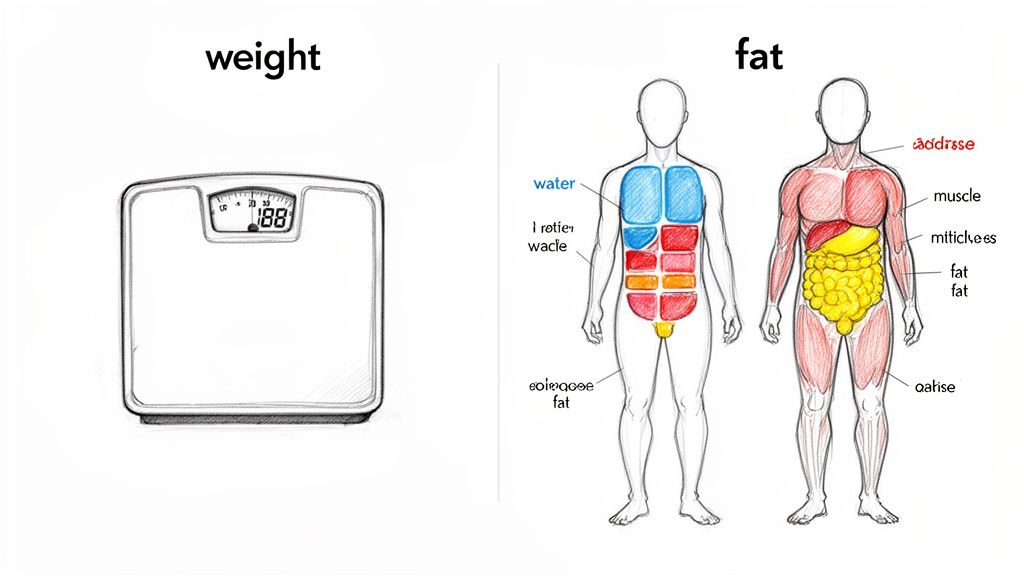
Fat loss, on the other hand, is all about reducing adipose tissue. This is what most of us really mean when we say we want to lose weight. The true goal is to shed fat while holding onto as much lean muscle as possible. This is how you improve your body composition, boost your metabolic health, and achieve that toned, athletic appearance.
The scale is a terrible storyteller. It's perfectly normal to see daily fluctuations of 2-5 pounds from things like hydration, salt intake, or when you last ate. Real progress is measured in how your clothes fit and how your body composition changes, not just in pounds.
Why Prioritizing Fat Loss Matters
Holding onto your muscle is non-negotiable. Why? Because muscle is metabolically active, meaning it burns calories even when you're just sitting on the couch. The more muscle you have, the higher your resting metabolic rate (RMR).
When people go for aggressive, rapid weight loss, they almost always lose a significant amount of muscle along with fat. This can absolutely wreck your metabolism, making it incredibly difficult to keep the weight off long-term. One study showed that people who lost weight more gradually were better at preserving their RMR because they didn’t sacrifice as much fat-free mass. Get the full scoop on how muscle impacts metabolism over at inbodyusa.com.
A key part of this strategy is eating enough protein. If you’re not sure where to start, our guide explains how to calculate your protein intake for your goals.
Key Differences At a Glance
To make this crystal clear, let's break down the two approaches side-by-side. Seeing the differences laid out like this can really help you set smarter, more effective goals.
| Metric | General Weight Loss | Targeted Fat Loss |
|---|---|---|
| Primary Goal | Decrease the number on the scale. | Reduce body fat percentage while preserving muscle. |
| What Is Lost | A mix of fat, muscle, and water. | Primarily adipose tissue (body fat). |
| Typical Method | Often involves aggressive calorie restriction. | Balanced nutrition with high protein and resistance training. |
| Metabolic Impact | Can lower metabolism due to muscle loss. | Helps maintain or even increase metabolic rate. |
| Appearance | May result in a "skinny fat" look. | Leads to a leaner, more toned physique. |
Ultimately, choosing to focus on fat loss isn't just about semantics; it's about adopting a smarter strategy for sustainable health and a physique you can be proud of.
The Hidden Price Tag of Rapid Weight Loss
It’s tempting to chase a fast drop on the scale. Seeing those numbers go down quickly feels like a win, but that short-term victory often carries a steep, long-term price. When you lose weight too fast, your body doesn't just pull from fat stores for energy; it starts breaking down valuable, metabolically active muscle tissue.
This sets off a chain reaction that can sabotage your efforts down the road.
Your body interprets aggressive dieting as a famine, triggering a survival mechanism called metabolic adaptation. To conserve energy, it slows down its internal engine—your resting metabolic rate (RMR). The more muscle you lose, the more your RMR tanks, making it harder and harder to lose fat in the future and making weight regain almost a certainty.
Why Losing Muscle Is a Deal-Breaker
Losing muscle isn't just about looks; it's a metabolic disaster. The famous "Biggest Loser" study is a sobering real-world example of what happens when you prioritize speed over quality. The contestants lost huge amounts of weight in a very short time, but a significant chunk of it was lean body mass.
Fast forward a few years, and most had regained the weight. What's worse, their metabolisms had slowed so dramatically that they were burning hundreds of calories less per day than you'd expect for someone their size. Their bodies were actively fighting to put the weight back on—a direct result of sacrificing muscle for a lower number on the scale.
The Sobering "Quarter FFM Rule"
This isn't a fluke; it's how our bodies are wired. There's a well-documented principle in nutrition science called the 'Quarter FFM Rule,' and it highlights just how much muscle is on the chopping block during a typical diet. Research consistently shows that in many weight loss plans, about 25% of the total weight you drop comes from fat-free mass (FFM), which is mostly your precious muscle.
A meta-analysis published in the journal Obesity Reviews drove this point home, finding that muscle accounted for 25-28% of the weight lost in adults. Think about that. If the scale drops by 10 kilograms, you might have lost up to 2.8 kilograms of muscle. That single change could slow your metabolism by over 100 calories a day. You can dig into more data on how body composition changes during weight loss on bodyspec.com.
This is the fundamental trap in the whole weight loss vs fat loss debate. When you only watch the scale, you have no idea what you're actually losing.
An extreme diet without enough protein and zero resistance training is the perfect recipe for becoming 'skinny fat.' You end up at a lower body weight, sure, but with a high body fat percentage. You've lost the very muscle that gives your body shape and strength, leaving you with a softer, less-defined look.
The Vicious Cycle of Crash Dieting
You’ve probably seen this cycle play out. You go on an aggressive diet, the pounds fly off (muscle included), and your metabolism grinds to a halt. The diet is miserable and unsustainable, so you eventually go back to your old eating habits—only now, you're doing it with a slower metabolism.
The result? The weight comes roaring back, and a higher percentage of it is stored as fat this time. Each round of crash dieting can leave you with less muscle and a slower metabolism than when you started, making every future attempt to get lean even more difficult. The real key is to get off this hamster wheel and shift your focus from losing weight to losing fat, all while protecting the muscle that keeps your metabolism fired up.
If you want to understand the real difference between losing weight and losing fat, you have to look beyond the bathroom scale. The scale gives you a single, often misleading, number. Measuring your body composition, on the other hand, tells the whole story—revealing how your fat, muscle, and water levels are actually changing.
This distinction is critical. Why? Because successful fat loss can sometimes mean the scale barely moves, especially if you’re building muscle at the same time. Using a few different tools to track your progress helps you see what's really happening and keeps you from getting discouraged.
This flowchart lays out the crucial choice between a slow, sustainable fat-loss plan and a rapid weight-loss crash diet that often sacrifices valuable muscle.
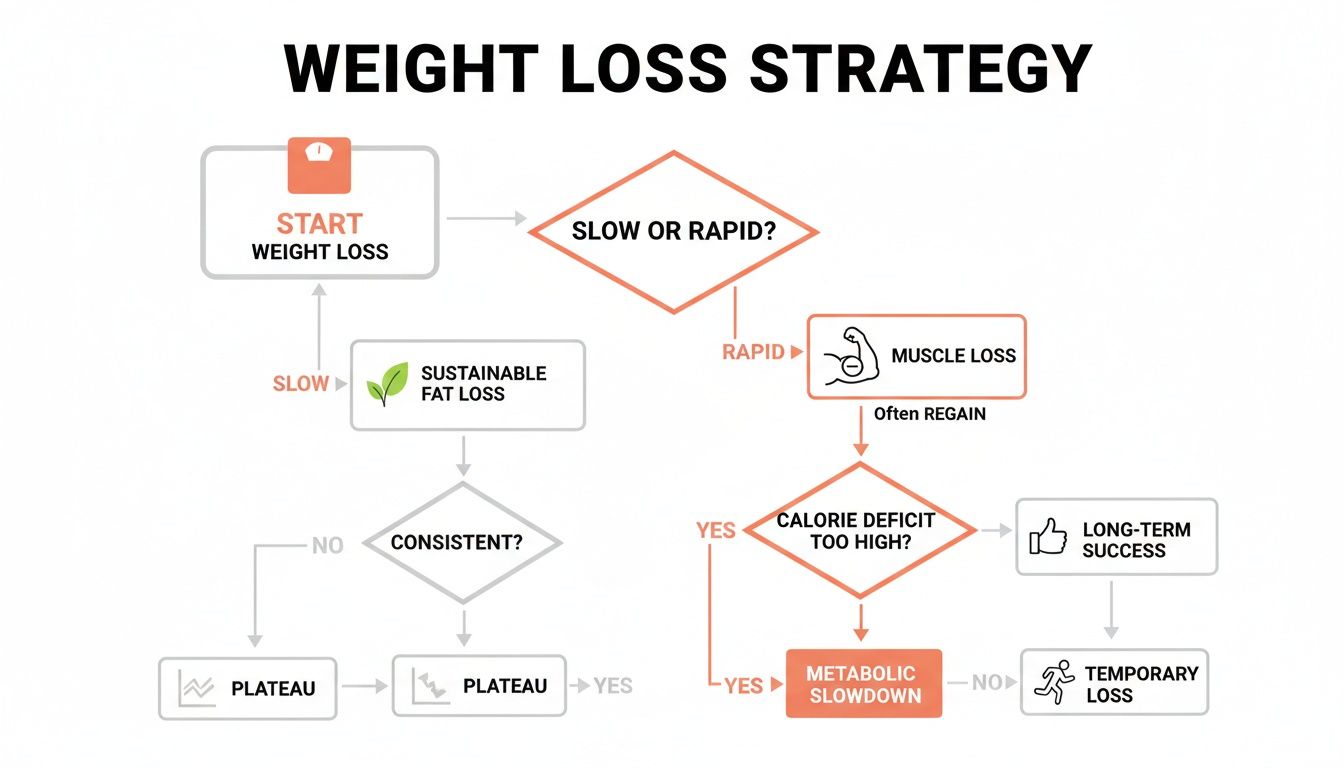
The path you take from the start has a huge impact on your long-term metabolic health and the physique you end up with.
Simple and Effective At-Home Methods
You don't need a lab coat or expensive gear to get started. These straightforward methods give you tangible, valuable feedback right from home.
- The Humble Measuring Tape: A flexible measuring tape might just be the most powerful tool you own. Tracking the circumferences of your waist, hips, thighs, and arms gives you direct proof of fat loss. If your waist is getting smaller while the scale is stuck, you’re winning.
- Progress Photos: The camera doesn't lie. Snap photos from the front, side, and back every four weeks or so, using the same lighting and pose. You'll be amazed at the visual changes you see that a daily weigh-in would completely miss.
- The Fit of Your Clothes: This one's a classic for a reason. When your jeans start feeling a little looser or that favorite shirt fits better across your shoulders, it's an undeniable sign you're making real progress, no matter what the scale says.
More Advanced Measurement Tools
For those who crave more precision, a few advanced tools can offer a deeper dive into your body fat percentage and lean mass. These options range from consumer gadgets to clinical-grade assessments.
Don’t get hung up on chasing a single, perfect number. The best strategy is to look at the trends from multiple sources over time. A shrinking waistline paired with improving progress photos tells a much more compelling story than any one body fat reading.
To help you decide which tool is right for you, let's break down the most common options.
Comparing Body Composition Measurement Methods
This table evaluates different methods for tracking body composition, helping you choose the best options for your budget and goals.
| Method | Accuracy | Accessibility and Cost | Best For |
|---|---|---|---|
| Tape Measure & Photos | Low (Qualitative) | High (Free to Low-Cost) | Everyone. It's a fantastic, low-cost way to track visual and dimensional changes that scales miss. |
| BIA Scales | Variable | High (Affordable) | Getting a general day-to-day trend line. Great for home use if you understand its limitations. |
| Skinfold Calipers | User-Dependent | Medium (Low-Cost, but needs practice) | People who want a more hands-on, quantitative measure without spending a lot, especially if the same person does the measuring. |
| DEXA Scan | Very High | Low (Expensive, requires a clinic) | Anyone needing a precise baseline or tracking for athletic competition. It's the gold standard for a reason. |
Ultimately, combining a simple at-home method like the measuring tape with occasional, more precise measurements gives you the most complete picture of your progress.
Bioelectrical Impedance Analysis (BIA)
Many modern smart scales use bioelectrical impedance analysis (BIA). These devices send a tiny, harmless electrical current up through your body.
Because muscle, fat, and water all conduct electricity differently, the scale uses the signal's speed to estimate your body composition. They're incredibly convenient, but be warned: their accuracy can swing wildly based on your hydration levels, when you last ate, or if you just worked out.
Skinfold Calipers
This is a more hands-on approach. Skinfold calipers are used to pinch and measure the thickness of your subcutaneous fat at several key spots on your body (like your abs, triceps, and thigh).
Those numbers are then plugged into a formula to estimate your overall body fat percentage. While the tool itself is cheap, the accuracy is all about the skill of the person doing the measuring. For a digital alternative that uses similar inputs, you can try our online body fat calculator.
DEXA Scans: The Gold Standard
A Dual-Energy X-ray Absorptiometry (DEXA) scan is widely considered the gold standard for body composition analysis. It gives you an incredibly detailed and accurate breakdown of your body.
Using two low-dose X-ray beams, a DEXA scan precisely differentiates between your bone mass, fat mass, and lean tissue. It provides an exact body fat percentage and even reveals how fat is distributed across your body. While it's the most accurate method available, it's also the priciest and least convenient, usually requiring an appointment at a medical or specialized facility.
A Smart Plan for Losing Fat, Not Just Weight
If you want to lose fat for good, you have to think beyond just dropping pounds on the scale. The real goal is to burn body fat while holding onto the muscle you have—that’s what creates a strong, lean, and healthy physique. Chasing a lower number on the scale at all costs often leads to losing both fat and muscle, which is a recipe for a slower metabolism and rebound weight gain.
A smarter strategy is built on three core principles that work together: smart nutrition, effective resistance training, and solid recovery.
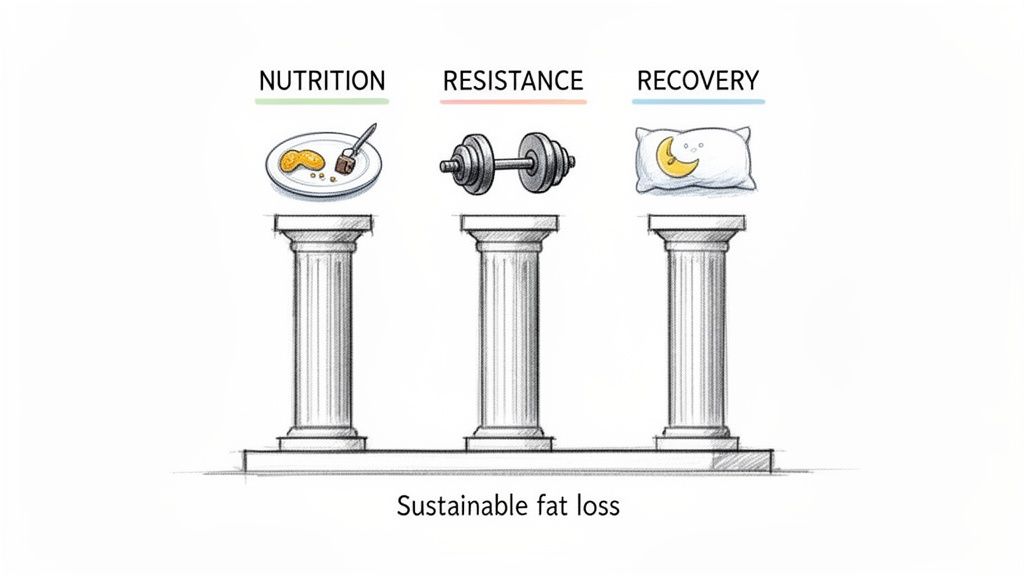
Nail one or two of these, and you'll see some results. But when you dial in all three, you create a powerful system that truly transforms your body composition for the long haul.
Pillar 1: Smart Nutrition
Nutrition is the engine of fat loss, and it all starts with a moderate calorie deficit. This just means eating slightly fewer calories than your body burns each day. Going too aggressive with calorie cutting might make the scale drop faster, but you’ll be losing a ton of muscle along with the fat.
The sweet spot is a slow, steady pace—aim to lose about 0.5% to 1% of your body weight per week. This rate is sustainable and far better for preserving that hard-earned muscle.
Research consistently backs this up. A study published in the International Journal of Sport Nutrition and Exercise Metabolism compared rapid and slow weight loss in athletes. The slow loss group lost significantly more fat mass and even gained a small amount of lean mass, while the rapid loss group lost muscle. You can dive into the findings on how a slower pace preserves muscle yourself.
Just as critical is getting enough protein. Aiming for 1.6 to 2.2 grams of protein per kilogram of body weight gives your muscles the raw materials they need to recover from training. Plus, protein keeps you feeling full, which makes sticking to your calorie goal a whole lot easier. You can figure out your personal targets with a good calorie deficit calculator.
Pillar 2: Effective Resistance Training
Your diet creates the calorie deficit, but strength training is what tells your body what to burn. When you're eating less, your body needs a reason to keep its muscle tissue, which is metabolically "expensive" to maintain. Lifting weights is the most powerful signal you can send to preserve it.
Resistance training is a non-negotiable signal to your body. Lifting weights tells your muscles, "We need you," forcing your body to pull energy from fat stores for fuel instead of breaking down precious lean tissue.
The key here is progressive overload. You have to consistently give your muscles a reason to adapt. That means gradually increasing the challenge over time by lifting heavier, doing more reps, or adding sets. If your workouts aren't getting harder, your body has no incentive to change. Focus on big, compound movements like squats, deadlifts, and bench presses—they give you the most bang for your buck.
Pillar 3: Solid Recovery
The final piece of the puzzle, and the one most people ignore, is recovery. This is when all your hard work in the kitchen and the gym actually pays off. Skimping on sleep or living in a constant state of stress can completely sabotage your fat loss efforts by messing with your hormones.
Here’s why recovery is so important:
- Sleep: Getting less than 7-8 hours of quality sleep can spike your cortisol levels. Cortisol is a stress hormone that encourages fat storage, especially around your belly. Poor sleep also messes with the hormones that control your appetite, making you hungrier and less satisfied by the food you eat.
- Stress Management: Chronic stress does the same thing—it keeps cortisol high, which can break down muscle and crank up your cravings for junk food. Finding healthy ways to unwind, whether it's through meditation, taking a walk, or just making time for a hobby, is essential for keeping your body in a fat-burning state.
When you nail these three pillars—a moderate calorie deficit with high protein, consistent resistance training, and dedicated recovery—you're not just losing weight. You're building a system for lasting change.
How BiteKit Can Help You Get It Done
Knowing the theory behind fat loss is a great start, but putting it into practice day after day is where the real work happens. Let's be honest: tracking calories, hitting a high protein target, and staying consistent can feel like a full-time job. This is exactly where a good tool can make all the difference, turning a chore into a simple habit.
BiteKit was built to take the headache out of tracking your food. It’s designed to help you follow your fat loss plan without the usual grind of scanning barcodes or searching endless food databases. By making the logging process fast and almost effortless, it helps you build the consistency that’s absolutely essential for seeing real results.
Logging That Fits Into a Busy Life
Life gets hectic. Your nutrition tool shouldn't add to the chaos; it should fit right in. BiteKit gives you a few different ways to log your meals in seconds, so you can stay on track whether you're at your desk or on the go. That kind of flexibility is a game-changer when you're juggling a career, family, and your fitness goals.
Picture this: you're out for lunch with a client or having dinner with friends. Instead of mentally guessing the calories—or just giving up on tracking for the day—you can just snap a quick photo of your plate. BiteKit's AI gets to work, identifying the food, estimating the portion sizes, and calculating the calories and macros for you almost instantly.
The biggest reason people fall off the wagon with nutrition is that daily logging just takes too much time and effort. When you can shrink that process down to a few seconds, you’re far more likely to build a habit that directly supports your long-term goals.
This simple act removes the guesswork and the stress, letting you enjoy your social life while still making smart choices that align with your plan.
Stay on Track with Instant Feedback
A solid fat loss plan is built on daily accountability. BiteKit delivers this with clean, simple progress bars that show you exactly where you stand with your daily calorie and macro goals. This immediate feedback is incredibly powerful for making better decisions throughout your day.
For example, you might glance at the app mid-afternoon and see you're doing great on calories but are still 40 grams of protein short of your goal. That little nudge is all you need to reach for a high-protein snack like Greek yogurt or a protein shake instead of something that's just empty calories.
This daily guidance is what helps you consistently hit the nutritional targets that are crucial for holding onto muscle while you're in a deficit.
- Custom Macro Goals: You can set your own targets for protein, carbs, and fat to keep you full and preserve muscle.
- Instant Updates: Every time you log a meal, your daily totals update immediately, so you always know where you are.
- Visual Accountability: The progress bars make it easy to see what you need at a glance, helping you plan your next meal or snack.
Smart Features Built for Speed and Privacy
BiteKit is more than just a food logger; it's a tool that works with your lifestyle while respecting your privacy. The whole thing is designed to be fast and efficient, so your focus stays on your results, not on messing around with an app.
One of the best features is voice logging. When you're rushing out the door in the morning or just finished a workout, you can simply say, "200g chicken breast and a cup of rice," and BiteKit logs it for you. This kind of hands-free convenience is perfect for busy parents or professionals who need to track on the move.
On top of that, BiteKit was built with a privacy-first design. You don't create an account or sync to the cloud. All of your nutrition data stays securely on your device, giving you total control. In a world where everyone seems to want your data, this offers some real peace of mind.
By combining smart AI with a design that puts you first, BiteKit changes the entire dynamic of calorie counting. It provides the structure and feedback you need to turn your knowledge about weight loss vs fat loss into real, sustainable action. When your tools make consistency this easy, you can finally focus on what really matters—reaching your goals.
Common Questions About Fat Loss
When you're trying to improve your body composition, not just lose weight, a lot of questions come up. It's easy to get lost in the sea of fitness myths, so getting straight answers is key to building a plan that actually works and setting realistic expectations.
Let's cut through the noise and tackle some of the most common questions people have on their fat loss journey.
Can You Lose Fat and Build Muscle Simultaneously?
Absolutely. It's a process called body recomposition, and it's the holy grail of changing your physique. You're essentially swapping fat for muscle, which is why your body can look dramatically different even if the scale barely moves.
This is most common for beginners or people getting back into lifting after a long break. Their bodies are so primed for change that they can respond to both muscle-building and fat-burning signals at the same time.
To pull it off, you need a smart, balanced approach. You have to maintain a small calorie deficit (or even eat at maintenance) while hitting a high protein target, usually around 1.6 to 2.2 grams per kilogram of body weight. Paired with a consistent, challenging strength training program, your body gets the signal to build muscle while using stored fat for energy. It's slower than traditional "bulking" and "cutting," but the payoff is a leaner, stronger physique without the extreme swings.
How Much Cardio Is Necessary for Fat Loss?
Think of cardio as a tool to help you burn more calories, not the main driver of fat loss. Your top priority should always be resistance training, as that's what tells your body to hold onto precious muscle while you're in a deficit. The classic mistake is spending hours on the treadmill while neglecting the weights, which is a fast track to losing both fat and muscle.
A solid, balanced routine usually looks something like this:
- 2-4 resistance training sessions per week: This is non-negotiable. It's the foundation of your entire plan.
- 2-3 moderate-intensity cardio sessions per week: Think brisk walking, cycling, or the elliptical. These are great for boosting your weekly calorie burn without leaving you too wiped out for your next lifting session.
Use cardio strategically. Once your nutrition and strength training are locked in, add cardio to widen your calorie deficit. It should support your goal, not sabotage your strength.
Why Is the Scale Not Moving but My Clothes Fit Better?
This is one of the best signs you could ask for! It's a textbook case of successful body recomposition and the perfect example of why the scale can be such a terrible way to measure progress.
Here’s the deal: muscle is much denser than fat. A pound of muscle takes up significantly less space than a pound of fat.
So, if you lose a pound of fat and gain a pound of muscle in the same week, the number on the scale won't budge. But you will look and feel leaner, your waist will be smaller, and your clothes will fit completely differently. This is exactly why taking progress photos and body measurements is so much more meaningful. It gives you the real story of your transformation.
Do I Need to Eliminate Carbs to Lose Fat?
Nope. This is one of the biggest and most stubborn myths out there. You absolutely do not need to cut out carbs to lose fat. In fact, for most people, that's a terrible idea.
Carbohydrates are your body's primary fuel source. They power your workouts, help you recover, and support muscle growth. Trying to lift heavy without adequate carbs is like trying to drive a car with no gas in the tank.
The only thing that truly matters for fat loss is being in a consistent calorie deficit. A balanced diet that includes quality carbs from fruits, vegetables, and whole grains is almost always more sustainable and enjoyable. Overly restrictive diets lead to burnout, but a flexible approach you can stick with is what gets you lasting results.