Golf Calorie Calculator
Calculate calories burned playing golf from your body weight, the holes you played, and how you get around the course — carrying your clubs, pulling a trolley, or riding a cart.
Is Golf Actually Exercise?
If you walk it, yes — and not marginally. Public health guidelines define moderate-intensity activity as 3.0 to 5.9 METs. Walking a golf course comes in at 4.3-4.5 METs, right in the middle of that band and about the same intensity as walking at 3.5 mph. The catch is that golf hides this behind a four-hour round with a lot of standing around, so it rarely feels like a workout.
What makes golf unusual is duration. Most moderate cardio is over in 30-45 minutes. A walked 18-hole round keeps you moving for four hours or more across roughly 4-5 miles of ground, which is why the calorie total lands somewhere near a long training run despite the modest intensity. The World Health Organization recommends 150-300 minutes of moderate activity per week; one walked round can cover most of that on its own.
4.3
METs walking the course
solidly moderate-intensity activity
4-5
Miles walked per 18 holes
plus the walking between shots
4h+
Typical round length
duration is what drives the total
Walking vs. Riding a Cart: The Real Story
This is the single biggest decision you make for calorie burn on a golf course, and it is worth being precise about why. There are two separate effects stacked on top of each other.
Effect 1: Intensity
Riding a cart is 3.5 METs versus 4.3 METs walking with clubs. Hour for hour, that is about 19% fewer calories. Note that a cart round is not zero effort — you still walk the tees, greens, and the last stretch to every ball, which is why 3.5 METs is still moderate activity rather than something close to sitting.
Effect 2: Duration
Cart rounds also tend to finish faster. Less time on the course means fewer active minutes, which compounds the lower intensity. Stack both effects and a realistic cart round comes in roughly 25-30% below the same round walked.
Worked example (165 lb / 75 kg golfer): walking 18 holes carrying clubs for 4h15m burns ~1,368 calories (4.3 × 74.8 × 4.25). The same 4h15m riding a cart burns ~1,113 calories (3.5 × 74.8 × 4.25) — a 255-calorie gap. If the cart round also finishes 30 minutes sooner, it drops to about 982 calories, and the gap widens to nearly 390 calories.
The practical takeaway: if you golf regularly and want it to count as training, walking is the lever that matters — far more than anything you do with your clubs or your swing. And because the calculator is time-based, entering your real time on the course under Custom Duration will always beat our default round length.
How Golf Calories Are Calculated
This calculator uses the MET (Metabolic Equivalent of Task) method, the scientific standard for estimating exercise calorie burn. MET compares the energy cost of an activity to sitting at rest (1 MET = resting metabolic rate).
The Formula
Calories = MET × Body Weight (kg) × Duration (hours)
For example: a 165 lb (74.8 kg) golfer walking 18 holes and carrying clubs (MET 4.3) for 4.25 hours burns approximately 4.3 × 74.8 × 4.25 = 1,368 calories.
Every golf MET below is a published value from the 2024 Adult Compendium of Physical Activities — none are estimated or interpolated. The 2024 edition is the current one, and it revised both the golf values and their codes from the 2011 edition, so older calculators citing 4.8 METs for golf are out of date.
| Activity (2024 Compendium code) | MET Value | Cal/hr (165 lbs) |
|---|---|---|
| Golf, walking, pulling clubs (15285) | 4.5 | ~337 |
| Golf, general (15255) | 4.5 | ~337 |
| Golf, walking, carrying clubs (15265) | 4.3 | ~322 |
| Golf, using power cart (15290) | 3.5 | ~262 |
| Golf, miniature / driving range (15270) | 3.5 | ~262 |
Source: Herrmann SD, Willis EA, Ainsworth BE, et al. 2024 Adult Compendium of Physical Activities: A third update of the energy costs of human activities. J Sport Health Sci. 2024;13(1):6-12. Round-length defaults (18 holes ≈ 4h15m, 9 holes ≈ half that) are our own assumption, not Compendium data — pace of play varies too much for a single number, so override the duration when you know it.
Why is carrying (4.3) lower than pulling (4.5)?
It looks backwards, and we get asked about it. The honest answer is that this is simply what the Compendium reports, and the two values differ by 0.2 METs — well inside the measurement noise of the studies behind them. We are not going to invent a tidy explanation for a gap that small. The useful reading is that walking the course costs about 4.3-4.5 METs regardless of how you move your clubs, and that the real decision is walking versus riding, which is a much bigger and much better-supported difference.
How to Burn More Calories on the Course
Walk the Round
Nothing else comes close. Leaving the cart behind is worth roughly 250-400 calories over 18 holes, which is more than every other tip on this list combined. If your course requires carts, ask whether walking is allowed outside peak hours.
Play 18 Instead of 9
Because the MET method is time-based, doubling your holes roughly doubles your burn. Nine extra holes walked is worth around 690 calories for a 165 lb golfer — a bigger swing than any intensity tweak.
Carry or Pull — Either Is Fine
The published values are 4.3 vs 4.5 METs, a difference small enough to ignore. Pick whichever lets you comfortably walk the whole round, because finishing on foot matters far more than the 0.2 MET. If a heavy bag over 18 holes is what pushes you into a cart, use the trolley.
Do Not Rush the Round
This is the counterintuitive one. Since calories scale with time at a roughly fixed intensity, a leisurely four-and-a-half hour walked round burns more than a brisk three-and-a-half hour one. Golf is a volume activity, not an intensity one.
Walk the Range Too
A 45-minute range session is about 3.5 METs, or roughly 195 calories for a 165 lb golfer. It is not much next to a round, but it is real, and it is more than the zero most people assume.
Golf for Different Fitness Goals
Weight Loss
Two walked rounds a week is roughly 2,700 calories of activity — meaningful, but only if you do not give it back at the turn. A beer and a hot dog can erase a third of a round. Track what you eat on the course, not just the round itself.
General Health
One walked 18-hole round delivers ~255 minutes of moderate activity, near the top of the WHO's 150-300 minute weekly recommendation on its own. For most golfers, walking the course is the single highest-leverage health habit available.
Cardio Fitness
Golf is steady low-end cardio, so it builds an aerobic base but will not raise VO2 max much on its own. Treat it as your long, slow volume and add one or two harder sessions — intervals, hills, or stairs — during the week.
Frequently Asked Questions
How many calories do you burn playing 18 holes of golf?
Walking 18 holes carrying your clubs burns roughly 1,350-1,400 calories for a 165 lb (75 kg) golfer over a typical 4h15m round. Riding a cart for the same round drops it to about 1,100. Your number scales directly with body weight and time on the course.
How many calories does 9 holes of golf burn?
About half an 18-hole round: roughly 690 calories walking and carrying for a 165 lb golfer, or about 560 with a cart. Since the method is time-based, how long you were out there matters more than the hole count.
Does golf count as exercise?
If you walk it, yes. At 4.3-4.5 METs it is genuinely moderate-intensity activity — the same band as walking 3.5 mph — sustained over four hours and 4-5 miles. Riding a cart drops it to 3.5 METs, still moderate but at the bottom of the range.
Do you burn more calories walking or using a golf cart?
Walking, by a lot. Hour for hour a cart is ~19% fewer calories (3.5 vs 4.3 METs), and because cart rounds usually finish faster the real-world gap is commonly 25-30% — around 250-400 calories per round.
Why does carrying clubs burn fewer calories than pulling a trolley?
Because that is what the 2024 Compendium measured: 4.3 METs carrying (15265) vs 4.5 pulling (15285). The 0.2 MET gap is within measurement noise, so read it as "walking the course costs ~4.3-4.5 METs either way" rather than as proof a trolley is harder. We report the published values as-is.
What MET values does this golf calculator use?
All published values from the 2024 Adult Compendium of Physical Activities, category 15: golf general 4.5 (15255), carrying clubs 4.3 (15265), pulling clubs 4.5 (15285), power cart 3.5 (15290), and miniature golf / driving range 3.5 (15270). None are estimated.
iPhone app · 3-day free trial
You're likely eating 500 calories more than you think
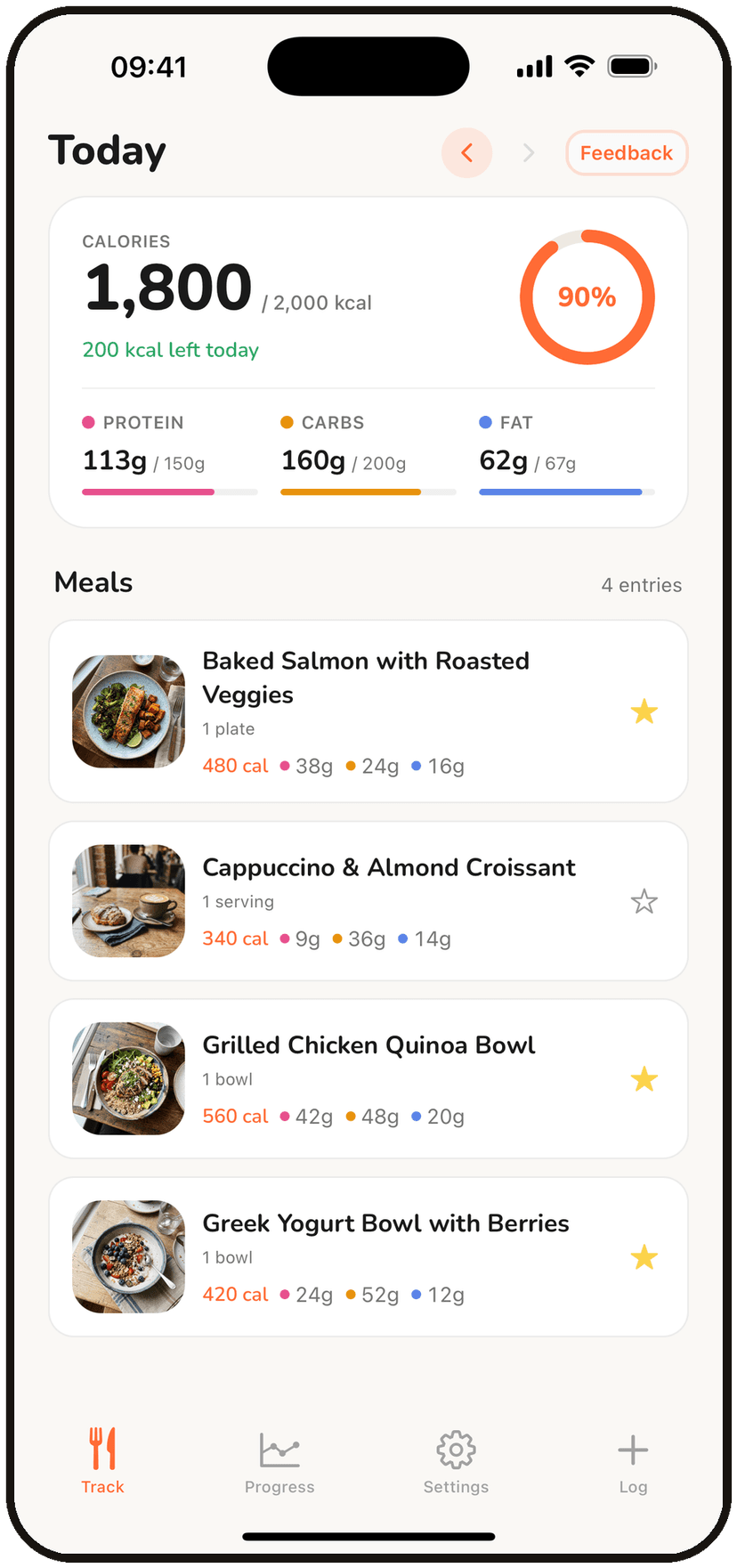
Portion guesses add up fast. BiteKit's AI estimates what's actually on your plate — oils, sides and all — so your log stays close to what you really ate.
- Log meals by photo, voice, or text
- Calories & macros estimated in seconds
- Syncs with Apple Health and Apple Watch
Free download · 3-day free trial, cancel anytime.
Scan with your iPhone camera