Rebounding Calorie Calculator
Estimate the calories you burn rebounding on a mini trampoline from your body weight, bounce intensity, and time — using an honest, MET-based method with the sources spelled out.
Why Rebounding is Low-Impact Yet Great Cardio
Rebounding — bouncing on a small, springy mini trampoline (a “rebounder”) — is one of the few cardio workouts that raises your heart rate meaningfully while sparing your joints. The mat absorbs most of the landing force, so instead of the hard, repetitive impact of running on pavement, your knees, hips, and ankles get a soft, elastic deceleration on every bounce.
That softness is why rebounding is popular with people who find running painful, are returning from injury, or simply want a joint-friendly way to move. Yet the calorie burn is real: a moderate session sits at roughly 6.3 METs — in the same ballpark as a brisk jog — because you are constantly working against gravity and stabilizing through your core, calves, and glutes.
~80%
Less joint impact
the mat absorbs most landing force
6.3
METs, moderate bounce
near a brisk jog
~8
Cal / min (165 lb)
at a moderate pace
Where These Numbers Come From (An Honest Note)
Most rebounding calorie tools quietly invent a number. We would rather be transparent. The scientific standard for exercise calorie estimates is the 2024 Adult Compendium of Physical Activities, but it has no dedicated “rebounding” or “mini-trampoline” entry. The closest published codes are for a full-size trampoline:
- Trampoline, recreational — 6.3 METs (Compendium code 15700, published). We use this as the anchor for our moderate tier.
- Trampoline, competitive — 10.3 METs (code 15702, published). An upper bound for very athletic bouncing.
So the moderate (6.3) tier is a published value; the gentle (4.5) and high-intensity (7.5) tiers are honestly estimated from those trampoline entries and from a 2016 ACE (American Council on Exercise) study. In that study, Dr. John Porcari's team measured a mini-trampoline cardio routine and found participants burning about 11.0 cal/min (men) and 8.3 cal/min (women) including warm-up and cool-down — landing on the “cusp of moderate to vigorous intensity,” which implies roughly 8 METs. We are deliberate about this: we do not attach a made-up Compendium code to the estimated tiers.
How Rebounding Calories Are Calculated
This calculator uses the MET (Metabolic Equivalent of Task) method, the scientific standard for estimating exercise calorie burn. One MET is your resting metabolic rate; an activity of 6.3 METs burns about 6.3 times as many calories as sitting still.
The Formula
Calories = MET × Body Weight (kg) × Duration (hours)
For example: A 165 lb (75 kg) person doing 30 minutes (0.5 hours) of moderate rebounding (MET 6.3) burns approximately 6.3 × 74.8 × 0.5 ≈ 236 calories.
| Intensity | MET Value | Cal/min (165 lb) | Basis |
|---|---|---|---|
| Gentle (health bounce) | 4.5 | ~5.6 | Estimated (below recreational trampoline) |
| Moderate (typical session) | 6.3 | ~7.9 | Published — trampoline, recreational (code 15700) |
| High-intensity (rebounder class) | 7.5 | ~9.4 | Estimated (trampoline codes + 2016 ACE study) |
| Trampoline, competitive (reference) | 10.3 | ~12.9 | Published — code 15702 (upper bound) |
Rebounding vs. Running: How They Compare
Running burns more calories minute-for-minute, but rebounding wins decisively on joint impact — and for many people that means they actually stick with it.
Rebounding
- Moderate ~6.3 METs, hard ~7.5 METs (estimated)
- Mat absorbs most landing force — very low joint impact
- Great for injury recovery and heavier beginners
- Trains balance, calves, core, and ankle stability
- Can be done indoors in a small space, any weather
Running (6 mph)
- About 9.8 METs — higher calorie burn per minute
- Repetitive high-impact loading on knees and hips
- Builds running-specific endurance and bone density
- Needs no equipment, but weather and terrain dependent
- Higher overuse-injury risk for many people
Minute for minute, a rebounding session burns roughly 65-80% of the calories of running at 6 mph. But because it is so much gentler, many people rebound longer and more often than they could run — closing much of that gap over a week.
The NASA and “Lymphatic Detox” Claims
Rebounding marketing loves two claims: that NASA proved it is “68% more efficient than running,” and that bouncing “flushes your lymphatic system” to detox the body. Here is the honest version.
The NASA study
A real 1980 NASA-funded study (Bhattacharya et al.) did compare rebounding and running and found rebounding to be an efficient exercise. But the popular “68% more efficient” soundbite overstates it. The fair takeaway: rebounding is a legitimate, effective cardio workout — not a shortcut that beats running for calorie burn.
Lymphatic “detox”
The up-and-down motion does move your body and can help circulation, and any exercise supports healthy lymph flow. But your liver and kidneys handle “detox” — no amount of bouncing detoxes you in the marketing sense. Enjoy rebounding for the cardio and the fun, not for a cleanse.
Tips to Burn More Calories Rebounding
Add Arm and Knee Drives
High knees, jumping jacks, and pumping your arms recruit more muscle and push you toward the high-intensity tier, raising calories per minute.
Use Intervals
Alternate 30-60 seconds of hard bouncing with a minute of easy health-bounce recovery. Intervals keep your average intensity — and calorie burn — higher than a steady jog on the mat.
Bounce Higher, Land Softly
A bigger amplitude works your legs and core harder. Keep knees soft and controlled so you stay joint-friendly while still increasing effort.
Hold Light Hand Weights
1-2 lb dumbbells for arm movements add a little load. Keep it light — form and rhythm matter more than weight on an unstable surface.
Rebounding for Different Goals
Weight Loss
Aim for 20-30 minutes at a moderate to high intensity, 4-5 days a week. Paired with a calorie deficit, that can add 700-1,500 exercise calories to your weekly total — but track your food, since diet drives most of the result.
Joint-Friendly Cardio
If running hurts, rebounding is a superb substitute. Start with 10-15 minute gentle sessions and build up — you get real cardiovascular benefit with a fraction of the impact.
Balance & Everyday Fitness
The unstable mat constantly challenges your ankles, calves, and core. A few short daily sessions improve balance and coordination while keeping you active.
Frequently Asked Questions
How many calories does rebounding burn?
A 165 lb (75 kg) person burns roughly 235 calories in 30 minutes of moderate rebounding (MET 6.3), about 8 calories per minute. A gentle health bounce burns closer to 170 in 30 minutes; a high-intensity class (estimated MET 7.5) around 280. Heavier bodies and higher bouncing burn more.
Is rebounding good for weight loss?
Yes — it burns a meaningful number of calories while being gentle on the joints, so it is easy to stick with. A daily 20-30 minute session burns roughly 150-300 calories. It works best inside an overall calorie deficit, where diet still does most of the heavy lifting.
Does rebounding burn as many calories as running?
Not quite, minute for minute. Running at 6 mph is about 9.8 METs versus 6.3 for moderate rebounding, so a session burns roughly 65-80% of the calories of the same time running. The upside is far less joint impact.
What MET value is used for rebounding, and is it accurate?
The 2024 Compendium has no dedicated rebounding code, so we anchor the moderate tier to the published “trampoline, recreational” value of 6.3 METs (code 15700). The gentle (4.5) and high-intensity (7.5) tiers are estimated from the trampoline entries and a 2016 ACE rebounding study — we label them as estimates, not published codes.
Did NASA really study rebounding?
A 1980 NASA-funded study did compare rebounding to running and found it efficient, but the popular “68% more efficient than running” claim overstates it. Rebounding is a legitimate low-impact cardio workout — not a magic fat-burner or a “detox.”
How long should I rebound to burn 300 calories?
For a 165 lb (75 kg) person, about 38 minutes of moderate rebounding (MET 6.3) or roughly 32 minutes of high-intensity bouncing (estimated MET 7.5). Use the calculator above with your own weight for an exact time.
iPhone app · 3-day free trial
You're likely eating 500 calories more than you think
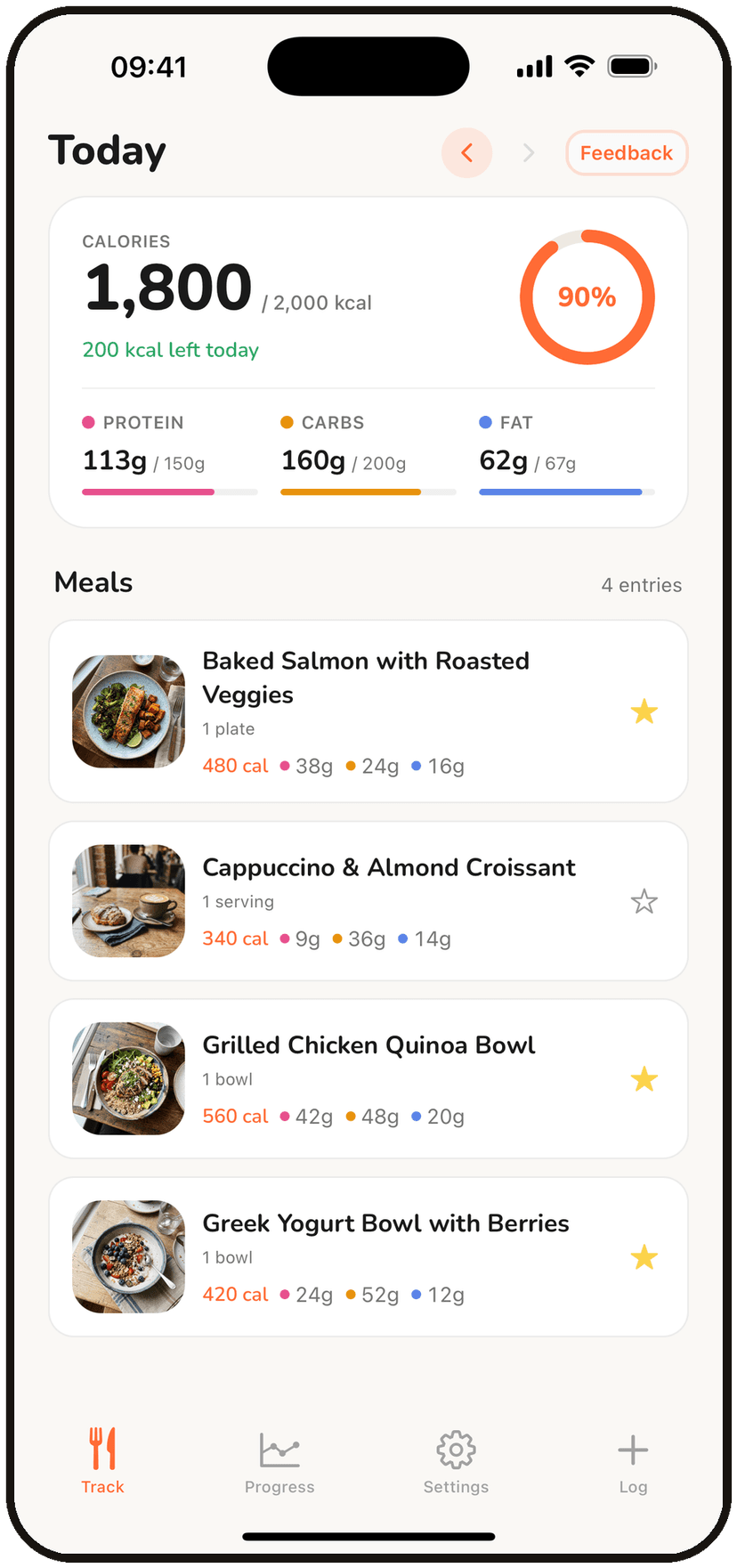
Portion guesses add up fast. BiteKit's AI estimates what's actually on your plate — oils, sides and all — so your log stays close to what you really ate.
- Log meals by photo, voice, or text
- Calories & macros estimated in seconds
- Syncs with Apple Health and Apple Watch
Free download · 3-day free trial, cancel anytime.
Scan with your iPhone camera