Skiing Calorie Calculator
Estimate calories burned downhill skiing, snowboarding, or cross-country skiing — with an honest active-time model that doesn't pretend you're skiing every minute you're on the mountain.
Why a Full Ski Day Burns Far Less Than Most Calculators Claim
Here is the single most important thing to understand about skiing calories, and the reason this calculator gives you a smaller (and more honest) number than most: the published MET values for downhill skiing are labeled “active time only.” They describe the energy cost of the minutes you are actually descending — not the lift rides, not the lift lines, not the mid-run breather while you wait for your friends, and not the lodge lunch.
A typical resort day is mostly not skiing. On many days only about 20-35% of your time on the mountain is spent going downhill — the rest is riding lifts and standing around. Yet most online calculators take the skiing MET and multiply it across your entire six-hour day, producing wild overestimates like 3,000+ calories. That's like calculating your driving calories as if you sprinted the whole commute.
The honest math
This tool asks for your total time on the mountain and an active-skiing percentage, then applies the skiing MET only to the active share and counts the lift-and-break remainder at a low idle rate (about 1.5 METs). So a 5-hour day at moderate effort with 30% active time burns roughly 1,000 calories, not 3,000.
How Skiing Calories Are Calculated
This calculator uses the MET (Metabolic Equivalent of Task) method, the scientific standard for estimating exercise calorie burn. MET compares an activity's energy cost to sitting at rest (1 MET = resting metabolic rate). Every skiing value here comes straight from the 2024 Adult Compendium of Physical Activities, the current edition.
The Formula
Calories = MET × Body Weight (kg) × Duration (hours)
For downhill and snowboard we split your day: active minutes at the skiing MET plus idle minutes at a low idle MET. Example — a 165 lb (75 kg) skier, moderate effort (MET 6.3), 5 hours on the mountain, 30% active: 90 active min at 6.3 METs + 210 idle min at 1.5 METs ≈ 710 + 395 = about 1,100 calories.
| Activity | MET | Code | Notes |
|---|---|---|---|
| Downhill / snowboard — light | 4.3 | 19150 | Active time only |
| Downhill / snowboard — moderate | 6.3 | 19160 | Active time only |
| Downhill / snowboard — vigorous | 8.0 | 19170 | Active time only |
| Skiing, slalom | 9.3 | 19146 | Racing effort |
| Snowboarding, recreational | 7.5 | 19201 | Moderate pace, mountain |
| Skiing, general | 7.0 | 19075 | Nordic, general |
| Cross-country — light (2.5 mph) | 6.8 | 19080 | Ski walking |
| Cross-country — moderate (4-4.9 mph) | 8.5 | 19090 | Steady pace |
| Cross-country — vigorous (5-7.9 mph) | 11.3 | 19100 | Brisk |
| Cross-country — racing / elite | 14.0 | 19110 | Among highest in the Compendium |
Source: 2024 Adult Compendium of Physical Activities (Herrmann SD, Willis EA, Ainsworth BE, et al. J Sport Health Sci. 2024;13(1):6-12), category 19 “winter activities.” All values above are published, not estimated. The 20-50% active-skiing shares and the 1.5-MET idle rate are our modelling assumptions, not Compendium values.
Downhill vs. Cross-Country: A Huge Difference
If your goal is calorie burn, the discipline you choose matters more than almost anything else.
Downhill & Snowboard
- Moderate effort is 6.3 METs — but only while descending
- Most of the day is lift rides and breaks (low burn)
- Gravity does much of the work between turns
- Great for legs, balance, and fun; modest for total calories
- A full day nets roughly 1,000-1,500 calories for most people
Cross-Country (Nordic)
- One of the highest-MET activities in the entire Compendium
- Brisk pace is 11.3 METs; elite racing hits 14.0 METs
- Continuous full-body effort — arms, legs, and core
- Almost no idle time, so nearly every minute counts
- Can burn 700-900+ calories per hour of actual skiing
Because it powers you along flat and uphill terrain using your whole body, cross-country skiing routinely burns two to three times as many calories per active hour as downhill — and there's far less idle time diluting the total.
Snowboarding vs. Skiing: Do They Differ?
Not by much. The Compendium files downhill skiing and snowboarding under the same active-time codes (4.3 / 6.3 / 8.0 METs for light / moderate / vigorous), with an additional snowboard-specific recreational value of 7.5 METs. Snowboarders often spend more time strapping in and sitting on the snow between runs, which can lower total active time, while skiers may take more but shorter runs. In practice the difference for a full day comes down mostly to how many minutes you spend actually moving — which is exactly what the active-time model captures.
Does Cold Weather Boost Calorie Burn?
A little — but honestly, less than the internet suggests. Cold exposure and shivering can nudge your energy expenditure up, and your body does spend some extra energy staying warm. But modern ski clothing is designed specifically to keep you comfortable, which minimizes the effect. We don't add a large cold-weather multiplier because the published MET values already reflect real outdoor skiing. Altitude can also raise your resting metabolism slightly for a few days, but it's a minor factor next to how much you actually ski.
Tips to Burn More Calories on the Mountain
Ski More, Ride Less
Since only active descending burns real calories, take shorter lifts, ski top-to-bottom without long stops, and lap runs efficiently. Raising your active share from 20% to 40% roughly doubles the skiing portion of your burn.
Choose Harder Terrain
Bumps, steeps, and off-piste demand constant muscular effort, pushing you toward the vigorous MET (8.0) instead of cruising greens (4.3) — nearly double the burn per active minute.
Add a Cross-Country Session
If calorie burn is the goal, an hour of cross-country can out-burn a whole downhill day. Many resorts have Nordic trails right next door.
Skip the Lift, Skin Uphill
Ski touring or splitboarding uphill turns idle lift time into high-MET climbing, dramatically raising your active percentage and total burn.
Skiing for Different Goals
Weight Loss
Ski aggressively and minimize lift downtime, or add cross-country. Pair the honest calorie number with a modest food deficit rather than assuming a ski day gives you a 3,000-calorie license to eat.
Endurance
Cross-country skiing is elite-level cardio — brisk to racing paces (11.3-14.0 METs) rival running and build serious aerobic capacity with low joint impact.
Fueling Right
Cold, altitude, and long days make it easy to under- or over-eat. Track what you actually eat against an honest burn to stay energized without wiping out the deficit.
Frequently Asked Questions
How many calories does skiing burn per day?
Far less than most calculators claim, because the downhill MET only applies while you're actually descending — not on lifts or breaks. A 165 lb person skiing moderately for 5 hours with ~30% active time burns roughly 1,000-1,100 calories, not 3,000+.
How many calories does skiing burn per hour?
Per hour of active skiing, moderate downhill (MET 6.3) burns about 470 calories for a 165 lb person, and brisk cross-country (MET 11.3) about 850. Remember an hour on the mountain is not an hour of skiing — only 20-50% of resort time is spent descending.
Does downhill or cross-country skiing burn more calories?
Cross-country, by a wide margin. It's one of the highest-MET activities in the whole Compendium (11.3 brisk, 14.0 racing) versus 4.3-8.0 for downhill, and it's continuous with almost no idle time.
How many calories does snowboarding burn?
Snowboarding shares downhill's active-time METs (4.3 / 6.3 / 8.0) plus a snowboard-specific recreational value of 7.5. A typical 5-hour day at moderate effort with 30% active time burns around 1,000-1,100 calories for a 165 lb rider.
Why is my ski calorie burn lower here than elsewhere?
Because we don't multiply the skiing MET across your entire day. The published downhill values are “active time only,” so we apply them only to your active-skiing share and count lift and break time at a low idle rate — a much more honest estimate.
Does skiing in the cold burn more calories?
Only slightly. Cold and shivering can raise expenditure a little, but good ski clothing minimizes it, and the MET values already reflect real skiing. How many minutes you actively ski matters far more than the temperature.
iPhone app · 3-day free trial
You're likely eating 500 calories more than you think
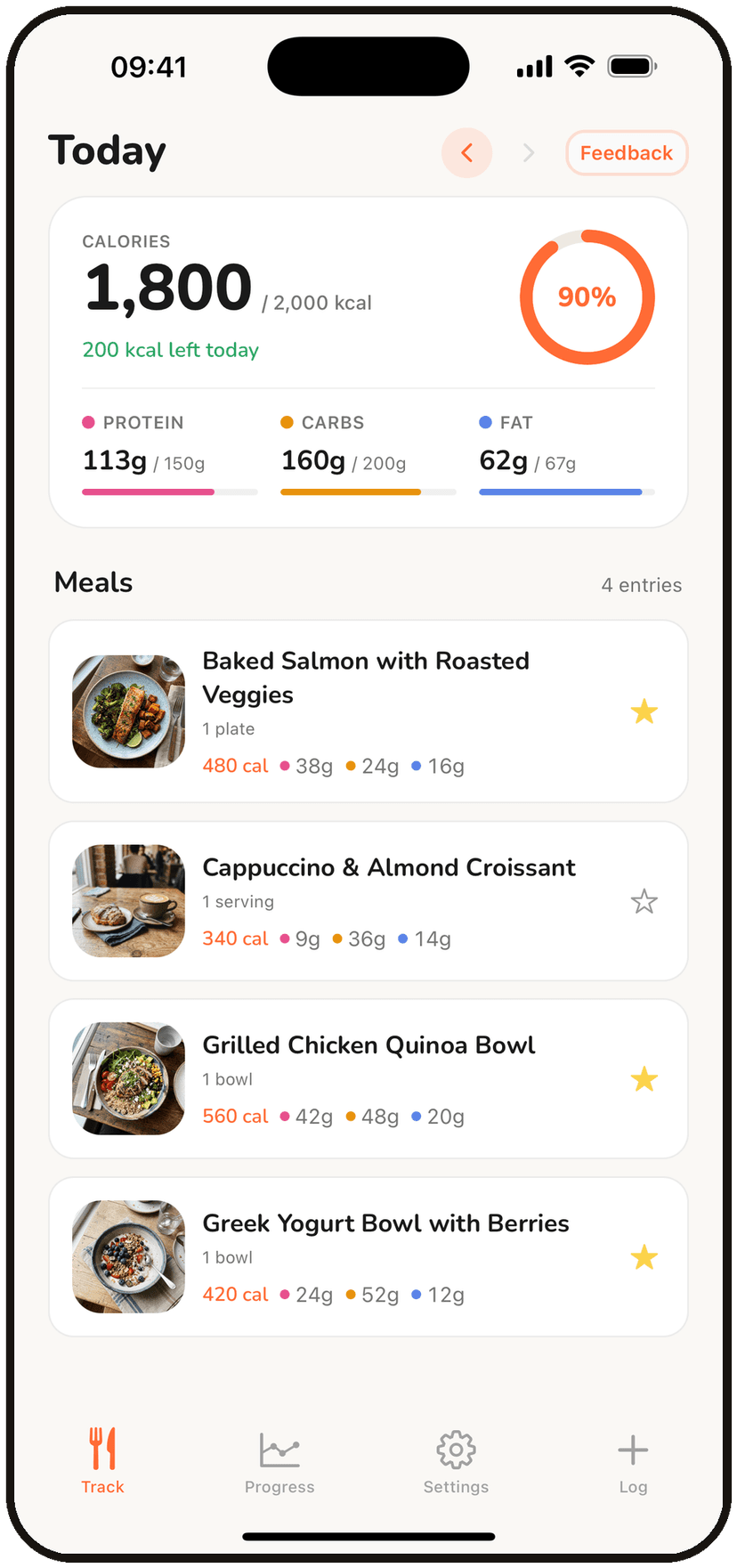
Portion guesses add up fast. BiteKit's AI estimates what's actually on your plate — oils, sides and all — so your log stays close to what you really ate.
- Log meals by photo, voice, or text
- Calories & macros estimated in seconds
- Syncs with Apple Health and Apple Watch
Free download · 3-day free trial, cancel anytime.
Scan with your iPhone camera