Squats Calorie Calculator
Estimate calories burned doing squats — by reps or by time, bodyweight or weighted — with an honest per-squat number that doesn't pretend 100 squats burns 500 calories.
The Honest Truth: One Squat Burns Well Under a Calorie
If you searched “calories burned doing 100 squats” expecting a big number, here is the reality most calculators quietly hide: a single bodyweight squat burns only about 0.2-0.5 calories for most people. Do 100 of them and you are looking at roughly 18-25 calories, not 500. That is because calorie math is based on time, and each squat only takes a few seconds.
This does not mean squats are a waste of time — far from it. It means the calorie you burn during the set is the smallest part of the story. The real payoff is the muscle squats build in your legs and glutes, and muscle burns calories around the clock, quietly raising your resting metabolism for the other 23 hours of the day.
Why the number is smaller here
We convert your reps into real active work time (about 3 seconds per bodyweight squat, 4 seconds weighted), apply the published MET only to that active time, and count any rest between sets at a low resting rate. No inflated durations, no padded MET values — just an estimate you can actually trust.
How Squat Calories Are Calculated
This calculator uses the MET (Metabolic Equivalent of Task) method, the scientific standard for estimating exercise calorie burn. MET compares an activity's energy cost to sitting at rest (1 MET = resting metabolic rate). Every squat value here comes straight from the 2024 Adult Compendium of Physical Activities, the current edition.
The Formula
Calories = MET × Body Weight (kg) × Duration (hours)
Because you think in reps but MET needs time, we convert: active time = reps × seconds per rep. Example — a 165 lb (75 kg) person doing 100 general bodyweight squats (MET 3.0) at 3 s each = 300 seconds = 0.083 hours: 3.0 × 75 × 0.083 ≈ 19 calories, or about 0.19 calories per squat.
| Squat Type | MET | Code | Notes |
|---|---|---|---|
| Bodyweight — general | 3.0 | 02056 | Squat, lunge, push-up, crunch |
| Bodyweight — high intensity | 6.5 | 02057 | Fast, minimal rest |
| Weighted — squats / deadlift | 5.0 | 02052 | Slow or explosive effort |
Source: 2024 Adult Compendium of Physical Activities (Herrmann SD, Willis EA, Ainsworth BE, et al. J Sport Health Sci. 2024;13(1):6-12), category 02 “conditioning exercise.” All three MET values above are published, not estimated. The 3-4 seconds-per-rep tempo and the low-rate rest between sets are our modelling assumptions, not Compendium values.
Bodyweight vs. Weighted Squats
Both build strength, but they burn calories differently — and the difference matters more over months than it does in a single set.
Bodyweight Squats
- General pace is 3.0 METs; high-intensity sets reach 6.5 METs
- No equipment — do them anywhere, any time
- Best for high reps, conditioning, and endurance
- Modest calorie burn per rep, but they add up over volume
- Great warm-up and finisher
Weighted Squats
- 5.0 METs (slow or explosive effort) per the Compendium
- Build more muscle — the biggest long-term metabolic win
- Fewer reps, more load, longer per-rep tempo
- Muscle raises resting burn 24/7, outside the gym
- Best for strength and body composition
The honest takeaway: during the set, high-intensity bodyweight circuits can out-burn slow heavy squats per minute. But heavy squats build more muscle, and that muscle is what keeps burning calories long after you have racked the bar. For fat loss, use both — and let your food intake do the heavy lifting.
Why We Ask for Reps or Time
MET-based calorie burn is fundamentally a function of time, not reps. To answer a question like “how many calories did my 100 squats burn?” we have to convert those reps into the number of minutes you were actually working. A controlled bodyweight squat — lowering down and standing back up — takes roughly 3 seconds; a deliberate weighted squat is closer to 4 seconds. Those are our documented assumptions; your real tempo may be faster or slower.
If you already know how long you squatted, use the duration mode instead — it is more direct. If you did your squats in multiple sets with rest between, add your set count and we will count that rest at a low resting rate rather than the full squat MET, because you are not burning squat-level energy while standing between sets.
Tips to Get More Out of Your Squats
Add Load Over Time
Progressive overload — gradually adding weight — is what drives muscle growth, and muscle is the metabolic engine that raises your resting calorie burn. A goblet or barbell squat beats endless bodyweight reps for body composition.
Slow the Tempo
A 3-4 second descent increases time under tension, boosts the strength stimulus, and extends the active work time — which nudges your in-session calorie burn up too.
Superset for Conditioning
Pairing squats with lunges, push-ups, or jumps and minimizing rest pushes you toward the high-intensity MET (6.5) and keeps your heart rate up, burning more per minute.
Prioritize Depth and Form
Full-depth squats recruit more muscle than shallow ones. More muscle worked means more total energy used and a better strength result from the same rep count.
Squats for Different Goals
Fat Loss
Use squats to build and preserve muscle, but drive the actual fat loss with a modest calorie deficit. The squats themselves burn relatively little; what you eat decides the outcome.
Strength & Muscle
Go weighted, keep reps in the 5-12 range, and add load over time. This maximizes muscle growth and the long-term rise in resting metabolism.
Conditioning
High-rep bodyweight squats at a fast pace with minimal rest reach the 6.5 MET range and double as cardio — a great no-equipment finisher.
Frequently Asked Questions
How many calories does one squat burn?
Roughly 0.2-0.5 calories for most people — well under 1 calorie. For a 165 lb person doing general bodyweight squats at ~3 seconds each, each squat is about 0.19 calories. Weighted or high-intensity squats burn a bit more, but the per-squat number is always small.
How many calories do 100 squats burn?
About 18-25 calories for a 165 lb person doing general bodyweight squats — not the hundreds some sites claim. High-intensity sets push it closer to 40, and weighted squats land in between. It is a great strength stimulus, but a modest calorie burn on its own.
Do bodyweight or weighted squats burn more calories?
Per active minute, weighted squats (MET 5.0) beat general bodyweight squats (MET 3.0) but not high-intensity bodyweight sets (MET 6.5). Weighted squats also build more muscle, so their biggest calorie effect shows up later, as a higher resting metabolism.
Do squats burn belly fat?
Not directly — you cannot spot-reduce fat. Squats build muscle and burn some calories, and paired with an overall calorie deficit the fat comes off your whole body, midsection included. The deficit, driven by what you eat, is what actually removes the fat.
Why does this calculator show fewer calories than others?
Because it is honest about time. We convert reps to real active work time at ~3-4 seconds per squat, apply the published MET only to that time, and count rest between sets at a low resting rate. Many rivals inflate the number with padded durations or MET values.
What MET values does this calculator use?
From the 2024 Compendium, category 02: bodyweight resistance general 3.0 (code 02056), high intensity 6.5 (code 02057), and weighted squats/deadlift 5.0 (code 02052). The 3-4 second per-rep tempo is our assumption, not a Compendium value.
iPhone app · 3-day free trial
You're likely eating 500 calories more than you think
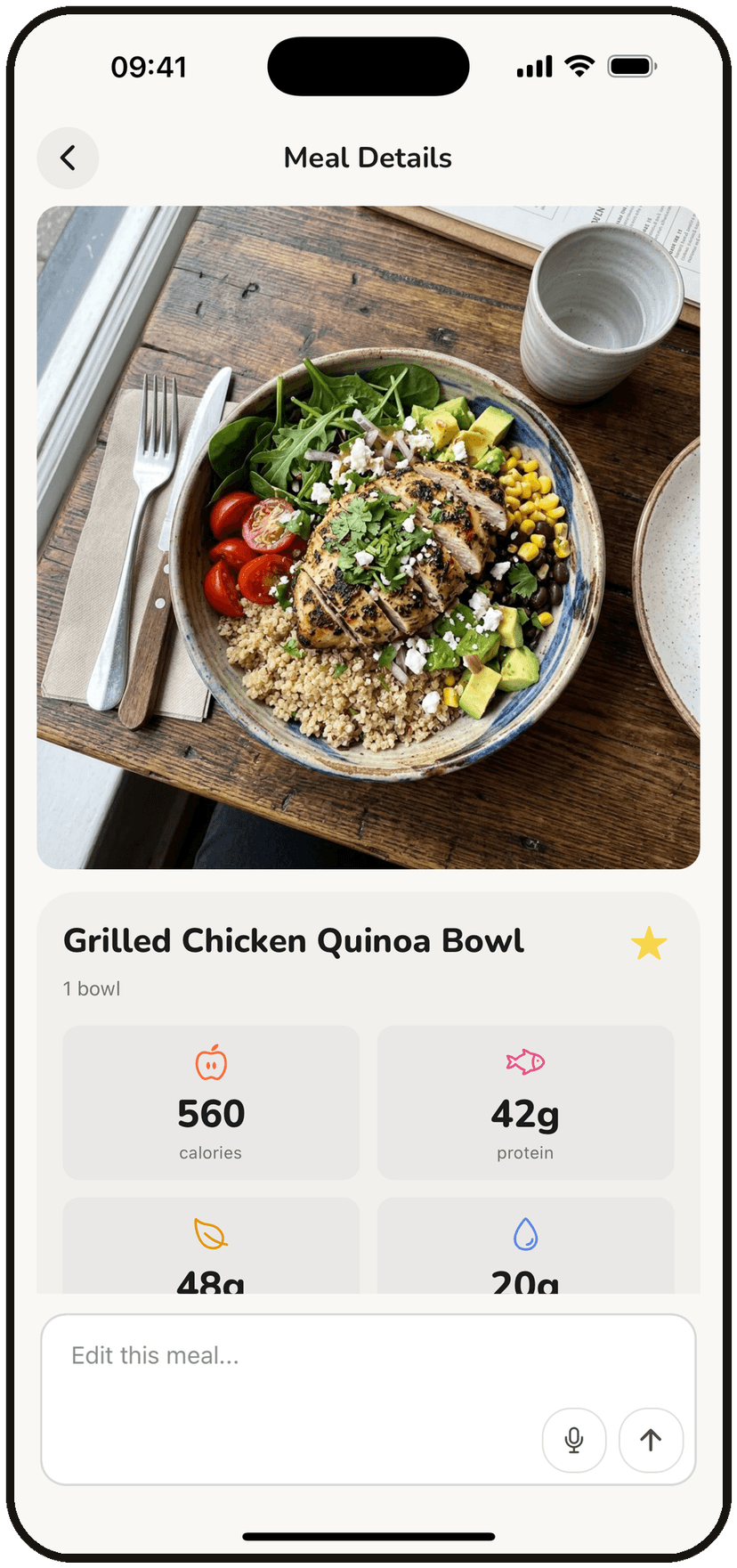
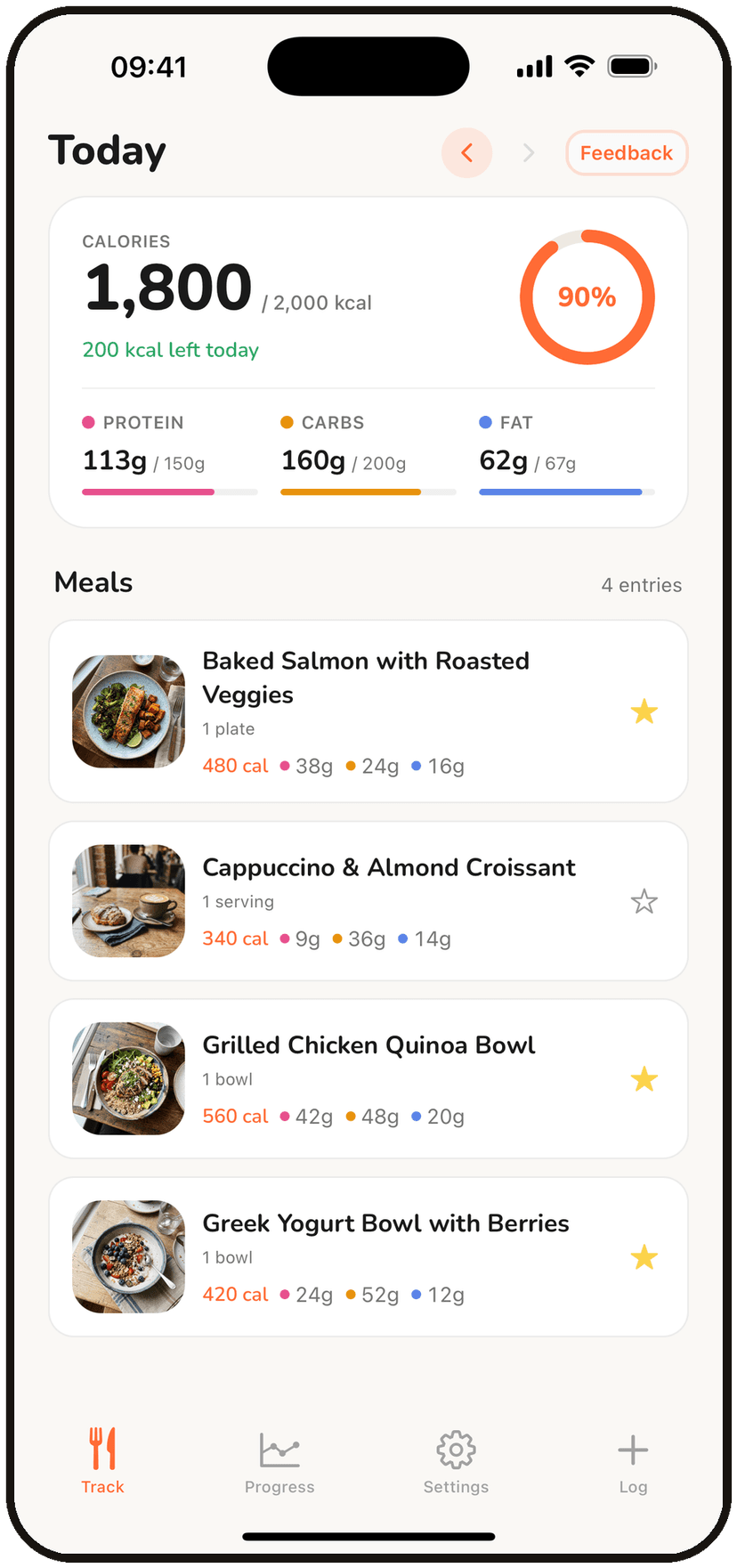
Portion guesses add up fast. BiteKit's AI estimates what's actually on your plate — oils, sides and all — so your log stays close to what you really ate.
- Log meals by photo, voice, or text
- Calories & macros estimated in seconds
- Syncs with Apple Health and Apple Watch
Free download · 3-day free trial, cancel anytime.
Scan with your iPhone camera