Is 2500 Calories a Day Right for Your Health Goals?
Discover if eating 2500 calories a day is the right fit for your body and goals. Learn to calculate your needs, see sample meal plans, and track macros.
A 2,500-calorie-a-day diet is a common benchmark in fitness and nutrition discussions. But is it the magic number for you? For some, it represents the ideal intake for maintaining their current physique. For others, it's a strategic target for building muscle or a structured plan for losing fat.
It’s crucial to understand that this is not a universal solution. For a moderately active man, this caloric intake might perfectly match his energy expenditure. For a sedentary woman, however, the same 2,500 calories could lead to weight gain. The outcome is dictated by individual physiology and lifestyle.
What a 2,500-Calorie Diet Actually Looks Like
Let's clarify one thing: a calorie target is context-dependent. Consuming 2,500 calories can be transformative, but whether it facilitates weight gain, loss, or maintenance is governed by the first law of thermodynamics: energy balance.
This principle is a simple equation of energy in (calories consumed) versus energy out (calories burned). If you consume more energy than your body expends, you are in a caloric surplus and will gain weight over time. Conversely, if you burn more calories than you eat, you create a caloric deficit, which leads to weight loss.
Therefore, a 2,500-calorie plan is only effective when it aligns with your specific goals and your body's unique energy requirements.
Who Is This Calorie Target For?
So, who is a 2,500-calorie diet really for? This intake level is often a suitable starting point for active individuals who require substantial fuel for performance, recovery, and overall well-being.
From a global perspective, it's interesting to note where this figure lands. In some countries, 2,500 calories is near the national daily average. However, it stands in stark contrast to the average 3,420 kcal consumed in many developed nations, highlighting the variability of "normal" dietary patterns based on geography and lifestyle.
If your goal is muscle hypertrophy, starting around 2,500 calories can provide the slight surplus needed for anabolism without promoting excessive fat storage. Our guide on bodybuilding for beginners delves into pairing your nutrition with appropriate training and recovery protocols.
To provide a clearer picture, here’s how this calorie target might impact different individuals.
Quick Guide to a 2500 Calorie Target
This table illustrates how a 2,500-calorie intake typically functions for various individuals based on their goals and activity levels.
| Individual Profile | Potential Goal for 2500 Calories/Day |
|---|---|
| Active Man (31-50 years, exercises 3-5 days/week) | Weight Maintenance |
| Sedentary Woman (31-50 years, little to no exercise) | Weight Gain or Significant Surplus |
| Active Woman (19-30 years, exercises 6-7 days/week) | Weight Maintenance or Slight Deficit |
| Man (19-30 years, moderately active) | Lean Muscle Gain (Slight Surplus) |
| Woman (50+ years, active) | Weight Loss (Moderate Deficit) |
As demonstrated, the same 2,500 calories a day can yield entirely different results. It all comes down to your age, sex, and activity level. Context is everything.
Calculate Your Personal Daily Calorie Needs
So we've seen how a 2,500 calorie a day plan can look different depending on the goal. But the real magic happens when you stop guessing and determine how that number relates to your unique physiology. This starts with understanding your Total Daily Energy Expenditure (TDEE).
Your body's energy expenditure can be broken down into several components. The energy required to maintain basic life-sustaining functions at rest—like breathing and circulation—is your Basal Metabolic Rate (BMR). This is your body's metabolic "idle" speed. However, any physical activity, from intense exercise to simply walking, increases your energy demands.
Your TDEE is the sum of your BMR and all the calories you burn from physical activity and the thermic effect of food.
Finding Your Total Daily Energy Expenditure (TDEE)
Your TDEE represents the total number of calories your body burns in a 24-hour period. It's the most critical metric for understanding what 2,500 calories will do for you. It's calculated using two key factors:
- Basal Metabolic Rate (BMR): The baseline energy needed for vital functions, determined by your sex, age, height, and weight.
- Activity Multiplier: This accounts for all other energy expenditures, including your occupation, workouts, and non-exercise activity thermogenesis (NEAT). The more you move, the higher your multiplier.
This calculation is rooted in the fundamental principle of energy balance. It’s not just about what you eat; it's about how your intake compares to your output.
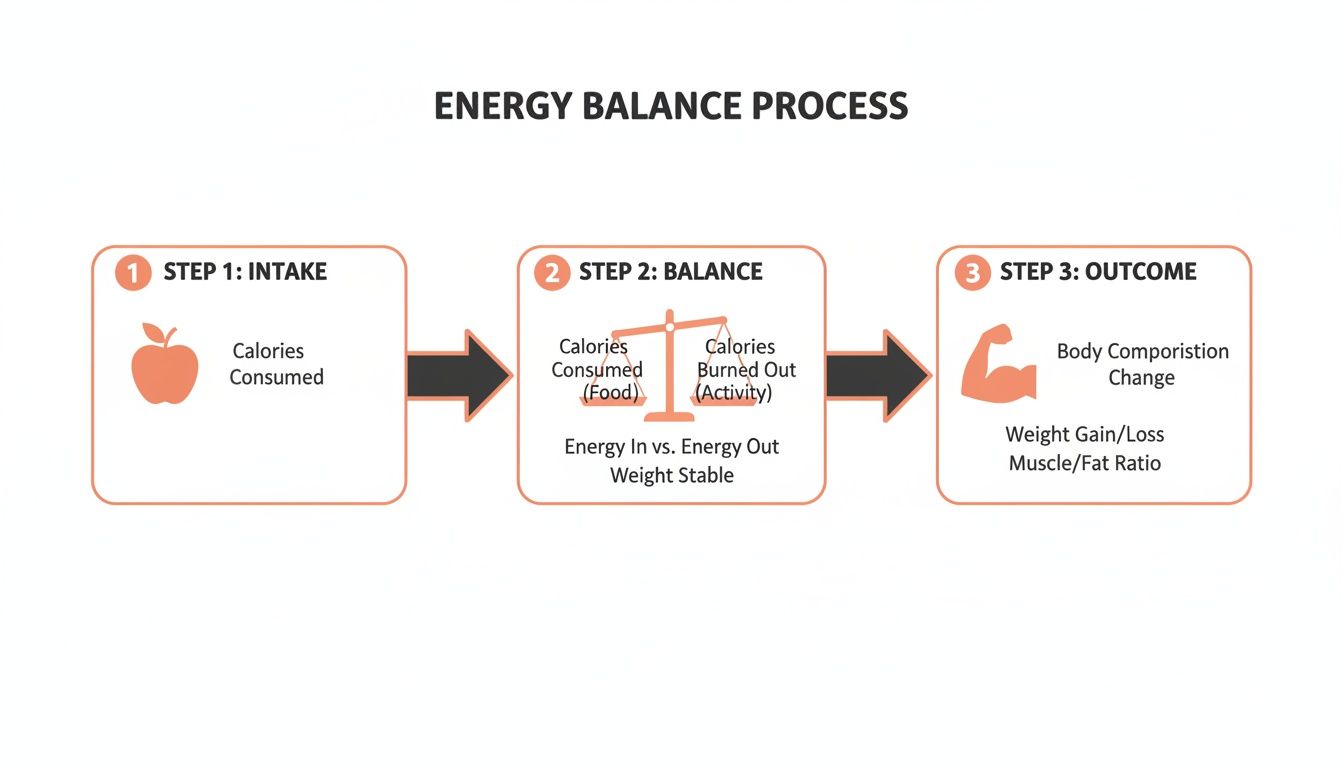
As this illustrates, the outcome—whether you build muscle or lose fat—is dictated by whether you are in a caloric surplus, deficit, or at maintenance.
Putting Your TDEE to Use
Once you know your TDEE, the 2,500 calories a day target becomes a meaningful, data-driven strategy.
For instance, if your TDEE is 3,000 calories, a 2,500-calorie diet places you in a 500-calorie deficit, which is the scientifically supported rate for losing approximately one pound per week. Conversely, if your TDEE is 2,200 calories, the same diet creates a 300-calorie surplus—ideal for fueling muscle growth. For a deeper dive into the science, the guide on Cracking the Calorie Code is an excellent resource.
Your TDEE transforms a generic number into a precise tool for achieving your specific body composition goals.
Ready to find out your personal number? Instead of wrestling with formulas, you can get a solid estimate in seconds. Head over to our free TDEE calculator to get the data you need to start building a plan that actually works.
How to Structure Your Macros on a 2500 Calorie Diet
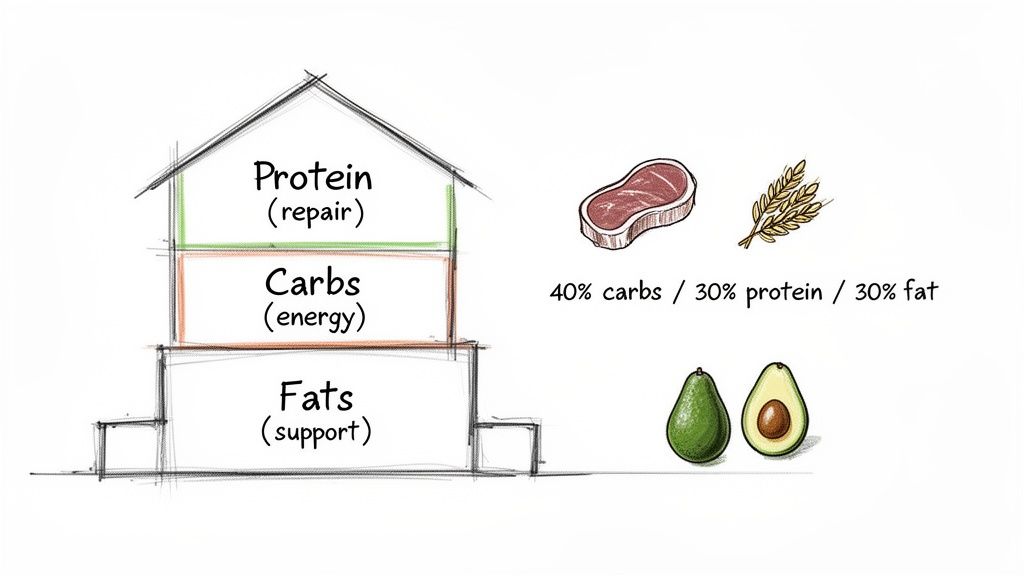
Hitting a calorie target is a great start, but it's only half the equation. The composition of those calories is equally important. This is where macronutrients—protein, carbohydrates, and fats—come into play.
Consider your 2,500-calorie budget as the raw materials for building your ideal physique. Protein provides the amino acids necessary for muscle repair and synthesis. Carbohydrates are the primary energy source, fueling workouts and cognitive function. Healthy fats are essential for hormone production and overall physiological health.
Simply put, 2,500 calories from nutrient-poor foods will yield vastly different results than a balanced, macro-focused plan. Each macronutrient serves a distinct purpose, and optimizing their ratios is what translates effort into tangible progress.
Turning Calories into Grams
To apply this, you must convert your calorie goals into grams. This requires knowing the energy density of each macronutrient:
- Protein: 4 calories per gram
- Carbohydrates: 4 calories per gram
- Fat: 9 calories per gram
Notice that fat contains more than twice the calories per gram as protein or carbohydrates. This is a critical detail for accurate tracking, as high-fat foods contribute significantly to your daily total.
The 2,500-calorie mark is an interesting benchmark. It’s a common target for active men and aligns with some international health guidelines. But it stands in sharp contrast to the average 3,540 kcal consumed daily in the United States in 2021, where energy-dense, processed foods are prevalent.
Finding Your Macro Split for a 2500 Calorie Diet
So, how should you allocate those 2,500 calories? Your ideal macronutrient split depends on your primary goal, whether it’s muscle gain, fat loss, or general health maintenance.
Let's examine two evidence-based approaches.
1. The Balanced Approach (40/30/30) This is a versatile split that promotes general health and steady body composition changes. It's an excellent starting point for many individuals.
- Carbohydrates (40%): 1000 calories = 250g
- Protein (30%): 750 calories = 188g
- Fat (30%): 750 calories = 83g
2. The High-Protein Muscle-Building Split (30/40/30) If your main objective is resistance training and muscle hypertrophy, this split is optimal. It increases protein intake to provide ample resources for muscle protein synthesis.
- Carbohydrates (30%): 750 calories = 188g
- Protein (40%): 1000 calories = 250g
- Fat (30%): 750 calories = 83g
These figures provide a clear nutritional roadmap. Instead of vaguely aiming for 2,500 calories, you now have specific targets for protein, carbs, and fat. This precision grants you greater control and ensures your dietary efforts directly support your goals.
If you’re not sure which split is best for you, our online macro calculator can create a personalized plan based on your unique stats and goals.
Sample 2500 Calorie Meal Plans You Can Start Today
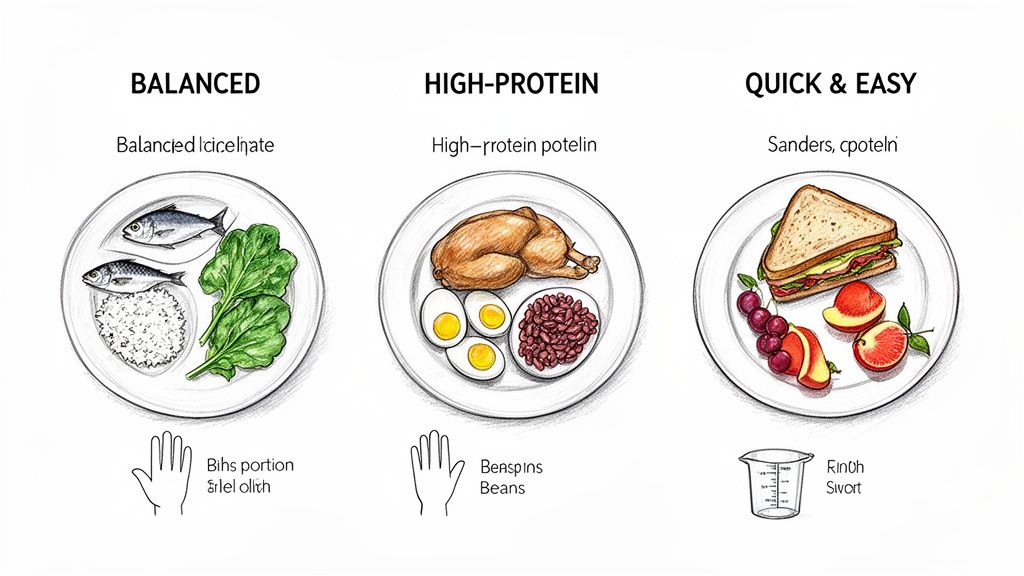
Alright, you know your calorie and macro targets. Now for the practical application—turning those numbers into delicious, satisfying meals. This is where theory meets reality, and it can feel like a puzzle at first.
To demonstrate how manageable and enjoyable eating 2500 calories a day can be, I've created three distinct sample plans. Use these as flexible templates, not rigid prescriptions. Feel free to swap foods or adjust portions to suit your preferences.
The Balanced Plan for Overall Health
This plan is designed for general wellness and is built on the classic 40/30/30 (Carbs/Protein/Fat) macro split. It's ideal for maintaining consistent energy levels without feeling overly restricted, emphasizing whole, nutrient-dense foods.
- Breakfast (~550 calories): 1 cup of cooked oatmeal provides complex carbs. Mix in 1 scoop (30g) of whey protein powder, and top with 1 medium sliced banana and 1 ounce (approx. 23) of almonds for healthy fats.
- Lunch (~650 calories): A large salad with a 4-cup base of mixed greens, 6 oz of grilled chicken breast, ½ cup of chickpeas, 1/4 of a sliced avocado, cherry tomatoes, cucumber, and 2 tbsp of olive oil vinaigrette.
- Dinner (~700 calories): A classic nutrient-dense meal: 6 oz of baked salmon, 1 cup of cooked quinoa, and 2 cups of steamed broccoli, finished with a squeeze of fresh lemon.
- Snack (~600 calories): To bridge the gap, have 1 cup of Greek yogurt (2% fat) with 1 cup of mixed berries. A protein bar (around 200 calories) can also help meet your targets.
This approach provides a steady supply of energy from complex carbs, ample protein for muscle support, and essential fats for optimal bodily function.
The High-Protein Plan for Fitness Goals
If your focus is on building muscle or preserving it during a fat loss phase, protein intake is paramount. This plan utilizes a 30/40/30 split, providing the necessary building blocks for anabolism and recovery post-training.
A key finding in nutrition science is that protein intake and total calories are the primary drivers of body composition change. As long as those two factors align with your goals, there is significant flexibility with your carbohydrate and fat intake.
Here’s a sample day designed to maximize protein intake. For anyone serious about their fitness, this structure is a game-changer. If you desire more variety, an AI meal plan generator can create numerous new meal ideas based on your specific macro targets.
This table breaks down a day of eating designed to maximize protein intake.
Example High-Protein 2500 Calorie Meal Plan
| Meal | Food Items & Portions | Estimated Calories |
|---|---|---|
| Breakfast | 4 large scrambled eggs, 2 slices whole-wheat toast with 1 tbsp peanut butter | ~600 |
| Lunch | 8 oz grilled chicken breast, 1.5 cups brown rice, 1 cup green beans | ~750 |
| Dinner | 7 oz lean ground turkey (93/7) sautéed with bell peppers and onions, served with a large spinach salad | ~650 |
| Snack | 2 scoops whey protein shake (mixed with water), 1 large apple | ~500 |
As you can see, every meal is structured to deliver a significant dose of high-quality protein.
The Quick and Easy Plan for Busy Schedules
Realistically, time for meal preparation is often limited. This plan is designed for individuals who need to hit 2500 calories a day using fast, convenient options that require minimal cooking.
- Breakfast (10 mins): A smoothie is an efficient choice. Blend 2 scoops of protein powder, 1 cup of almond milk, 1/2 cup of frozen berries, and 2 tablespoons of almond butter for a complete, portable meal.
- Lunch (5 mins): Use a large whole-wheat tortilla filled with 6 oz of pre-cooked chicken strips, a large handful of spinach, and 2 tablespoons of hummus for a quick wrap.
- Dinner (15 mins): Combine one 5 oz can of tuna with 1/4 cup of Greek yogurt (a healthier alternative to mayonnaise). Serve with whole-grain crackers and a side of baby carrots.
- Snacks (Grab-and-Go): Keep these items on hand: a quality protein bar, a handful of mixed nuts, a piece of fruit like an apple or banana, and a ready-to-drink protein shake for emergencies.
Don't Let These Common Pitfalls Sneak Up On You
You've got your target—2,500 calories a day—and you're ready to go. But success often hinges on avoiding the subtle mistakes that can quietly derail your progress.
Let's address the most common errors and how to strategically avoid them.
The first area to monitor is "invisible" calories. These are calories that hide in plain sight. For example, a generous pour of olive oil for sautéing vegetables can easily add ~240 calories. The splash of heavy cream in your morning coffee is another common offender.
These additions seem negligible individually, but their cumulative effect can be substantial, potentially turning a planned deficit into an unintended surplus.
Liquid calories are another major pitfall. It's easy to overlook the caloric content of beverages. A single can of soda or a sugary sports drink can contribute 150-200 calories, while specialty coffee drinks can contain even more. Crucially, these liquids provide minimal satiety, meaning you consume calories without alleviating hunger.
The "All-or-Nothing" Trap
Of all the psychological barriers, the all-or-nothing mindset is perhaps the most destructive. It’s the internal narrative that declares, "Well, I already blew it with that slice of cake, so the whole day is a write-off." A single dietary deviation is perceived as a total failure, leading to abandonment of the plan.
The secret to long-term success is not perfection—it's consistency. One high-calorie day does not negate a week of adherence. This is about building a sustainable lifestyle, not following a rigid diet that fosters resentment.
Progress is cumulative over weeks and months, not defined by a single day. Instead of striving for flawlessness, plan for reality. If you have a social event on Saturday, you can create a small caloric buffer by slightly reducing your intake on Friday. This allows for flexibility without derailing your goals.
Practical Fixes to Keep You on Track
Navigating these challenges is about developing smarter habits, not being perfect. Here are some simple, effective strategies:
- Measure Your Fats: For one week, use measuring spoons for oils, dressings, and nut butters. This will calibrate your eye to what a true serving size looks like, making future estimations more accurate.
- Log Drinks Immediately: Form the habit of tracking all beverages—juice, soda, lattes—as you consume them. Witnessing the immediate impact on your daily calorie budget is a powerful behavioral modifier.
- Use Your Hand as a Guide: When dining out or unable to weigh food, your hand serves as a reliable portioning tool. A palm-sized portion of protein, a cupped hand of carbs, and a thumb-sized portion of fats provide a great starting point.
- Plan Your "Fun" Foods: Instead of banning favorite treats, incorporate them into your plan. Intentionally fitting a cookie, a scoop of ice cream, or a glass of wine into your weekly calorie goal prevents feelings of deprivation that can lead to bingeing. This makes the process more enjoyable and, therefore, more sustainable.
Frequently Asked Questions About a 2500 Calorie Diet
Jumping into a new eating plan always brings up a few questions. Let's tackle some of the most common ones about a 2,500-calorie diet so you can get started on the right foot.
Can I Lose Weight Eating 2500 Calories a Day?
This is the critical question. The scientific answer is: it depends entirely on your Total Daily Energy Expenditure (TDEE). If your body burns more than 2,500 calories a day, then yes, you will be in a calorie deficit and you will lose weight.
For many individuals, particularly active men, this intake level is an excellent target for steady, sustainable fat loss. However, for a smaller or less active person, it might represent maintenance calories or even cause weight gain. The only way to know for sure is to calculate your personal TDEE first.
What Are the Best Foods for This Diet?
To truly thrive on 2,500 calories a day, the objective is not just to hit a number but to maximize the nutritional quality of those calories. Focus on nutrient-dense foods that offer the most vitamins, minerals, and fiber.
Prioritize these core food groups:
- Lean Proteins: Chicken breast, fish, lean beef, eggs, lentils, and Greek yogurt are all excellent choices for muscle repair and satiety.
- Complex Carbohydrates: Fuel your body with oats, quinoa, brown rice, sweet potatoes, and whole-wheat bread for sustained energy.
- Healthy Fats: Incorporate avocado, nuts, seeds, and high-quality olive oil for hormonal health and nutrient absorption.
- Fruits and Vegetables: Aim to "eat the rainbow" by consuming a wide variety of colorful produce to ensure a full spectrum of micronutrients.
Focusing on whole, unprocessed foods will leave you feeling much more satisfied and energized. Scientific evidence shows that diets high in protein and fiber increase satiety, making it significantly easier to adhere to a calorie goal without experiencing persistent hunger.
How Long Should I Follow This Plan Before Adjusting?
Patience is a crucial, yet often underrated, component of any nutritional strategy. You must allow your body sufficient time to adapt. Adhere to your 2,500-calorie target for at least 2-4 weeks before considering any adjustments. This duration is necessary to observe a genuine trend amidst daily weight fluctuations.
Track metrics beyond the scale, such as energy levels, workout performance, and how your clothes fit. If after several weeks of consistent adherence, you are not achieving your desired results, it's time to adjust. A small modification of 200-300 calories up or down is typically sufficient. Then, maintain consistency and reassess.