The Easiest Way to Count Calories: A Beginner's Scientific Guide
Discover the truly easy way to count calories. This guide breaks down modern AI methods that make calorie tracking effortless and sustainable for any lifestyle.
The easiest way to count calories isn't about more willpower—it's about less work. Using a modern AI tool to log meals from a photo, voice command, or a quick text message is the secret. This evidence-based approach sidesteps the tedious manual data entry that derails most people, turning a draining chore into a fast, sustainable habit.
Why Traditional Calorie Counting Fails
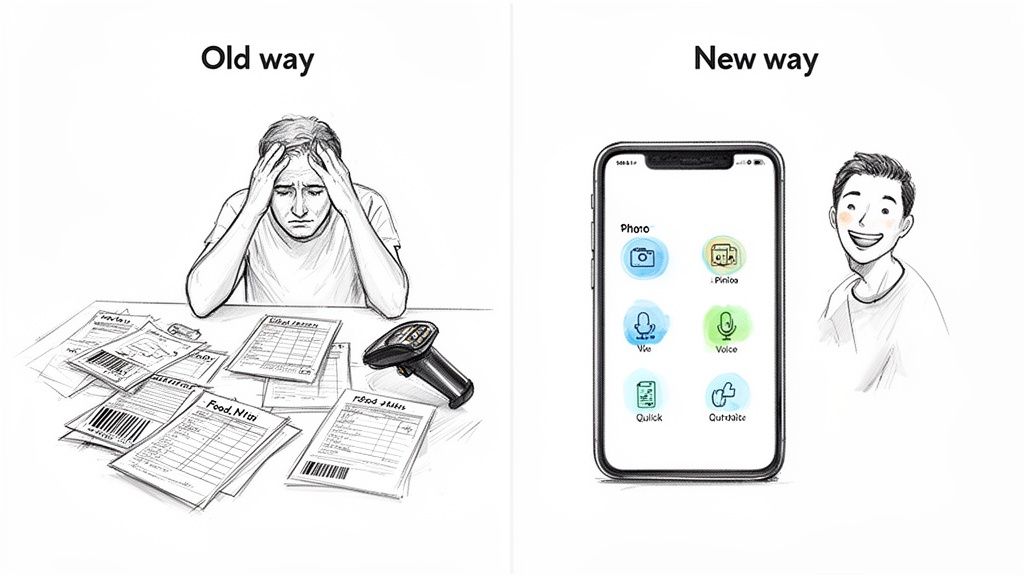
If you’ve ever tried counting calories the old-school way, you know the grind. Manually searching for every single ingredient, scanning barcodes, and guesstimating portion sizes is exhausting. That friction is exactly why most people quit, often blaming themselves when the real problem was the method.
Calorie tracking is a scientifically proven strategy for managing weight, but the method you choose makes all the difference. While a 2023 survey found that 12% of Americans actively track their calories, the dropout rate for manual logging apps remains sky-high. Life is just too busy to spend that much time fighting with a food database. You can find more data on dietary habits from the CDC.
This is where a smarter approach completely changes the game. Instead of you doing all the heavy lifting, AI does it for you.
The Tedium of Manual Logging
Think about logging a simple homemade salad. With a traditional app, your workflow would look something like this:
- Individually search for "romaine lettuce" and guess the amount.
- Look up "grilled chicken breast" and try to estimate its weight in ounces.
- Separately add "cherry tomatoes," "cucumber," and "balsamic vinaigrette."
Just one meal can turn into a five-minute data entry project. It’s no surprise that by the end of the day, logging that late-night snack feels like an impossible task.
This old way of doing things just isn't built for the long haul. Here’s a quick comparison to see how much of a difference an AI-powered workflow can make.
Calorie Counting Methods Compared
The table below breaks down the core differences between wrestling with a traditional app and using a modern, AI-assisted logger.
| Feature | Traditional Apps | AI-Powered Logging |
|---|---|---|
| Logging Speed | 3-5 minutes per meal | ~60 seconds per meal |
| Effort Required | High (manual search, entry) | Low (photo, voice, text) |
| Consistency | Difficult to maintain | Easy to build a habit |
| Accuracy | Relies on user guesswork | AI estimates and verifies |
The takeaway is clear: shifting from manual work to intelligent automation is what makes tracking finally stick.
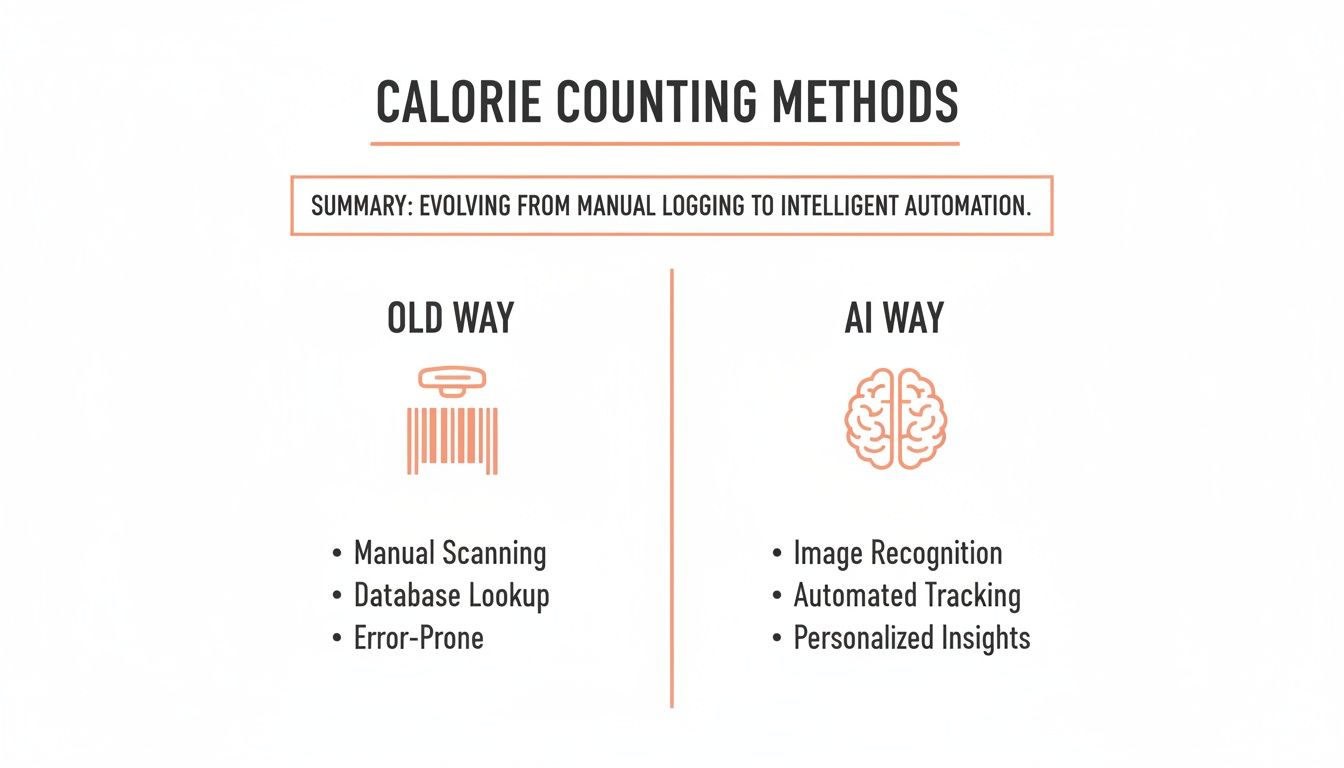
It’s all about working smarter, not harder. The goal isn't just to get the numbers right; it's to build a sustainable habit that gives you insight without causing burnout.
The best tracking method is the one you’ll actually stick with. Effortless tools remove the friction, which is the single biggest barrier to long-term success.
Methods like photo and voice logging aren't just novelties—they fundamentally change the task. They make tracking feel like a natural part of your day, not another chore on your to-do list.
How to Log Any Meal in Seconds with AI
Let's be real—the secret to sticking with calorie tracking is making it so easy you barely notice you're doing it. If it’s a chore, you’ll drop it. The good news is that modern AI tools have completely changed the game, turning a tedious task into something you can do in just a few moments.
This isn't about spending ten minutes searching a database for every last ingredient. It’s about using smarter, faster methods to get an instant nutritional breakdown of your meal.
Log with a Quick Photo
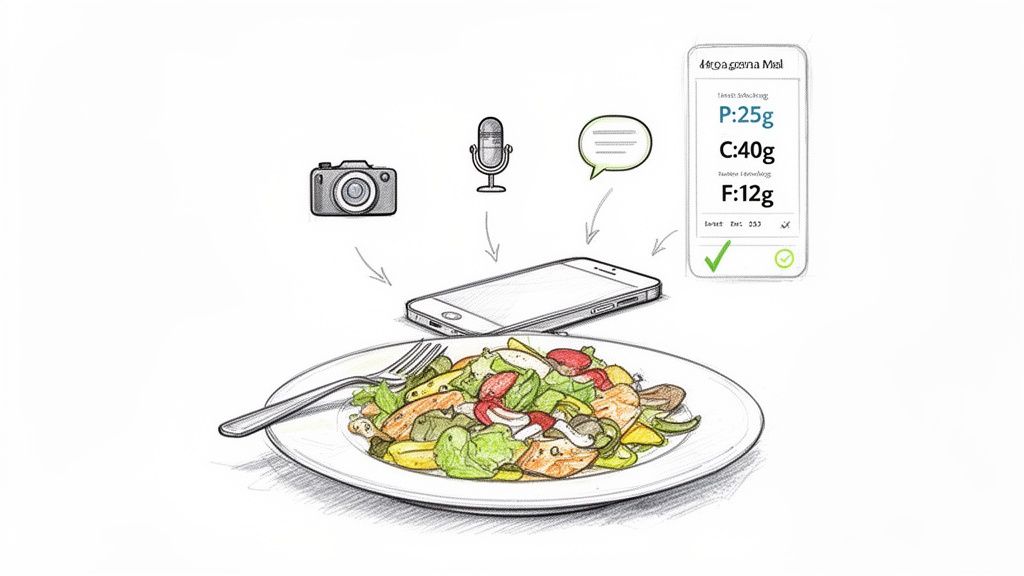
This is the one that feels like magic. Just snap a photo of your plate, and you're pretty much done. It doesn't matter if it's a complicated homemade recipe or a dish from your favorite restaurant; AI can analyze the image, identify the foods, and estimate the portions for you.
Think about logging a bowl of pasta with meatballs the old way. Nightmare, right? Now, you just take a picture. The AI sees the pasta, the sauce, and the meat and gives you a full calorie and macro summary. It gets you about 90% of the way there in seconds, without you typing a single word.
Here’s what that looks like inside the BiteKit app.
As you can see, the app breaks everything down into its core parts, giving you a clear snapshot of the calories, protein, carbs, and fat on your plate.
Use Your Voice to Log
When you're rushing around or just grabbed a quick snack, voice logging is even faster. You literally just say what you ate.
Just say something like, “I had a medium apple and a handful of almonds for a snack.” That's it. The app’s natural language processing gets it, converts your words into the right food items and portions, and boom—it's in your log.
This is my go-to for simple meals or single-item snacks when pulling out the camera feels like overkill.
Type It Out Naturally
Finally, there’s the text-entry method, which is way faster than you might think. It combines the precision of typing with the speed of AI.
Instead of searching for "bread," then "chicken," then "lettuce," you just type "chicken salad sandwich on whole wheat bread." The AI does the heavy lifting, parsing your phrase and building the meal for you. You can see this in action by playing around with BiteKit's AI meal analyzer tool.
Each of these workflows gives you a full macronutrient breakdown—protein, carbs, and fat—so you can instantly see how you’re doing against your daily targets. When logging is this seamless, consistency stops being a struggle. You’re no longer just counting calories; you’re building genuine awareness with a tool that actually fits into your life.
It might sound simple, but just knowing what’s in your food is one of the most effective things you can do for your health. This isn't just a hunch—it's a principle so powerful it has shaped national health policy.
Think about the calorie counts you see on menus at big chain restaurants. That’s the result of a 2018 federal law requiring food establishments to display that information. Giving people this single piece of data has had a staggering effect on public health.
A study of this policy found that between 2018 and 2023, making calorie information available at over 300,000 restaurants helped prevent an estimated 14,698 new cases of cardiovascular disease and 21,522 new diagnoses of type 2 diabetes.
That’s not all. By helping people make slightly lower-calorie choices, this simple change is projected to save an estimated $12.71 billion in net healthcare costs. You can discover the full economic and health findings in the original research, and it’s truly eye-opening.
Bringing That Power to Your Plate
So, what does this massive public health win have to do with you? Everything. It proves a simple truth: when you have the right information at the right time, you make better decisions. Menu labeling works because the data is right there when you’re about to order.
Tools like BiteKit take that same proven principle and put it directly in your hands. Instead of only getting that insight at a chain restaurant, you get it for every single thing you eat—your morning coffee, a home-cooked dinner, or a snack from a local food truck.
Every time you snap a photo of your meal or log it with your voice, you're tapping into that same power of awareness. You’re turning a simple daily habit into a series of small, informed decisions that add up to major health wins over time.
Navigating Your Diet in a Complex World
We live in a world of dietary extremes. It’s a strange reality where the biggest health challenges often come from having either far too little or far too much to eat.
On one side, you have an overwhelming abundance of calorie-dense, nutrient-poor foods that are cheap and easy to find. On the other, a huge part of the world’s population is fighting a daily battle just to get enough food.
The Global Food Imbalance
The numbers are staggering. In 2023, an estimated 733 million people faced hunger, and 2.33 billion experienced food insecurity. The Global Hunger Index shows that progress in fighting hunger has basically stalled since 2015. You can dig into the global hunger statistics to see the full picture.
Meanwhile, in many developed countries, the bigger issue is navigating a surplus of calories. The convenience of processed foods has created a food environment that makes it incredibly easy to overeat.
In this world of dietary extremes, having an easy way to count calories becomes a powerful tool for finding your personal balance.
It helps you cut through the noise. When you can effortlessly track what you're eating, you can start making conscious choices that actually align with your own health goals.
Take Control of Your Nutrition
Once you have a clear picture of what you’re consuming, you can start making smarter decisions for both your health and your wallet. The first step is figuring out your own energy needs. A great place to start is our guide on how to calculate your daily calorie needs.
This simple awareness is a game-changer. It gives you a reliable framework for building a diet that works for you, no matter what external pressures or confusing food environments you're dealing with.
Turning Your Data into Lasting Habits
So, you've started logging your meals. That’s the hard part, right? Well, not exactly. The real magic isn't just in the tracking; it's in what you do with that information. Fast and easy logging is great, but it’s the clear, immediate feedback that helps you build habits that actually stick.
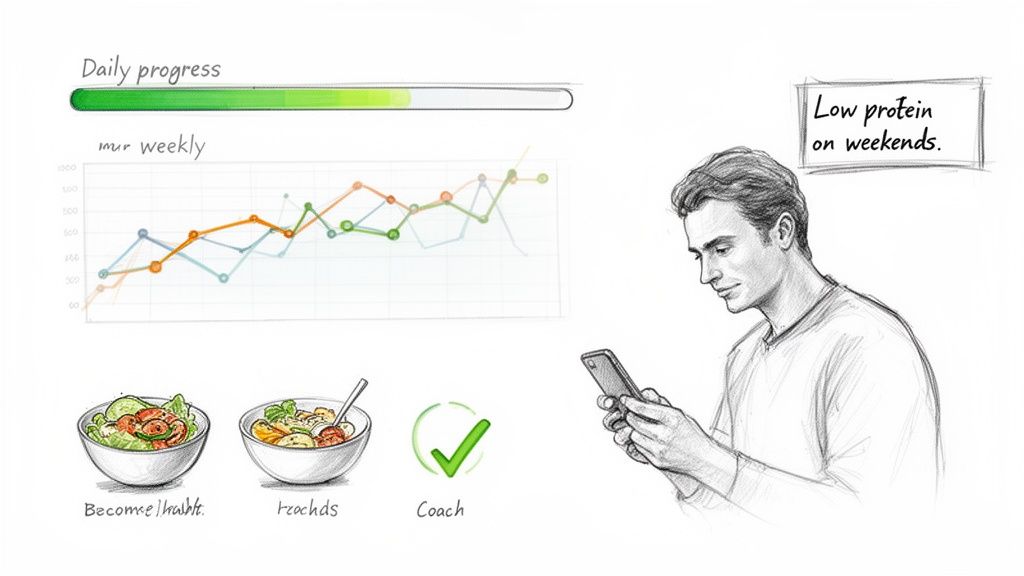
Think of your daily log as a mirror reflecting your eating patterns. When an app gives you real-time progress bars, a full meal history, and weekly summaries, it’s not just throwing numbers at you. It’s showing you the story of your day, helping you connect the dots between what you eat and how you feel.
From Information to Insight
Let's be honest, nobody wants to sift through a spreadsheet to figure out if they ate too many carbs. For this data to be useful, you need to be able to understand it at a glance. That's where clean, visual feedback makes all the difference.
A quick look should tell you if you're on track with your protein or if that second donut pushed you over your sugar goal. This instant feedback is what reinforces good choices and helps you catch yourself before you drift too far off course. Ever hit that 3 PM wall? A glance at your log might show you skipped the protein at lunch, giving you a clear reason for the slump.
The goal isn't to obsess over every single calorie. It's to build what I call "calorie awareness." You start to get a real feel for the energy in your food and how it fits into your day, all without the stress.
This awareness is a skill. Over time, it helps you get back in tune with your body’s actual hunger and fullness signals, which is the cornerstone of managing your weight for good.
Making Small, Smart Adjustments
Your weekly summaries are where the bigger picture comes into focus. This is often where you'll spot trends you had no idea existed, like a consistent dip in protein on the weekends or a habit of carb-loading after 8 PM.
Once you see a pattern, you can make a small, intentional change.
- Scenario: You notice your late-night snack is almost always cookies or a bag of chips.
- Adjustment: Try swapping that for something rich in protein, like a bowl of Greek yogurt or a handful of almonds. You'll feel more satisfied and stay within your macro targets.
These are the tiny course corrections that lead to massive, sustainable results. It’s not about overhauling your entire diet overnight. It's about using your own data to make smarter choices, one meal at a time. And for those meals where you're just guessing, our guide on how to measure food without a scale can help you get much more accurate.
Frequently Asked Questions About AI Calorie Counting
Whenever I show someone this new way of tracking food, the same few questions always pop up. It's natural to be skeptical, so let's tackle the most common concerns right now.
How Accurate Is Calorie Counting From a Photo?
It’s a fair question, and the short answer is: surprisingly good. For most common foods, an AI calorie counter is far more consistent and reliable than just winging it with a guess.
The AI has been trained on millions of food images, so it's gotten incredibly good at recognizing what’s on your plate and estimating portion sizes. While it's not the same as a lab analysis, it's a huge step up from pure guesswork. Just remember to take clear, well-lit photos and you can always make a quick manual tweak if needed.
Is Counting Calories the Right Approach for Everyone?
Calorie counting is a powerful tool because it works on the basic principle of energy balance. It brings awareness to what you're consuming. That said, it's important to remember that food quality—getting enough protein, fiber, and micronutrients—is just as crucial as the numbers themselves.
For individuals with a history of eating disorders, a fixation on numbers can be harmful. In these cases, working with a healthcare professional or registered dietitian is the best path forward.
Do I Need an Internet Connection to Log Meals?
You’ll need to be online for the split second it takes to log your meal, as the AI needs to connect to its brain to analyze your photo or voice note. But that's it.
After that, everything is stored securely right on your phone. Privacy-first apps like BiteKit don't require cloud accounts or constant syncing. This means your entire meal history and personal data are always available for you to review, even when you're offline.