How to Calculate Daily Calorie Needs: A Science-Backed Guide
Discover how to calculate daily calorie needs with simple formulas and personalized tips to reach your weight and fitness goals.

Forget the generic advice to eat 2,000 calories a day. While it’s a convenient round number, scientific evidence shows it rarely reflects what your specific body actually needs. A successful nutrition plan for losing weight, building muscle, or maintaining your current physique starts with a personalized number grounded in your unique physiology.
To find that number, we need to calculate your Total Daily Energy Expenditure (TDEE).
Finding Your Personal Calorie Starting Point
Think of your TDEE as your body's total daily energy budget—it's the sum of all the calories you burn in a 24-hour period. It’s a much more accurate starting point than any one-size-fits-all recommendation because it's based on your body and lifestyle.
This budget is primarily made up of two key components:
- Basal Metabolic Rate (BMR): This is the baseline. It’s the energy your body needs just to maintain vital functions—powering your brain, heart, and other organs while you’re completely at rest. BMR is the single largest piece of your energy puzzle, typically accounting for 60-70% of the calories you burn each day.
- Activity and Lifestyle: This includes all energy expended through movement. It covers planned workouts (Exercise Activity Thermogenesis, or EAT), the energy used to digest food (Thermic Effect of Food, or TEF), and even fidgeting at your desk (Non-Exercise Activity Thermogenesis, or NEAT).
Putting these components together gives you a scientifically-informed picture of your daily calorie needs.
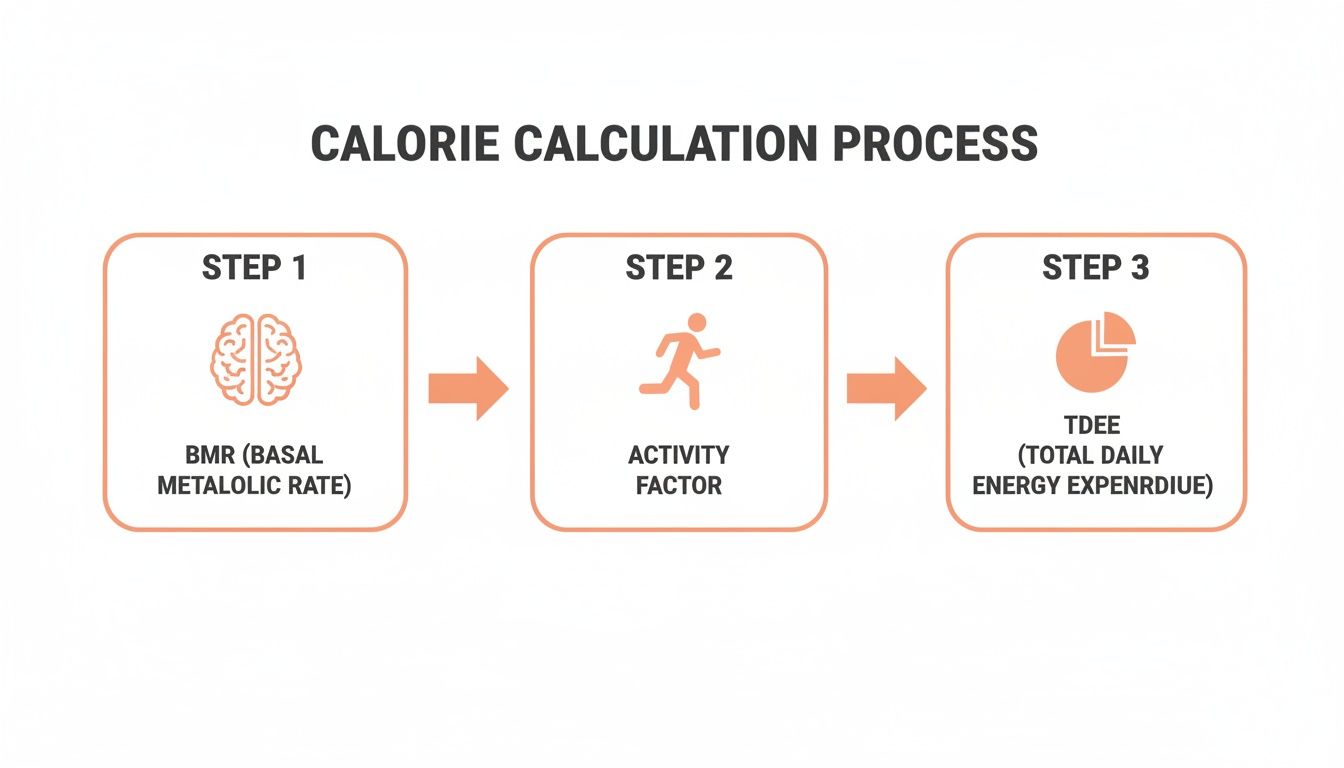
As you can see, your BMR is the foundation. Your activity level is the variable that turns that baseline into a real-world calorie target—your TDEE.
Key Takeaway: The most effective nutrition plans are built on a personalized TDEE calculation. Without a reliable, evidence-based starting number, you’re essentially guessing, which often leads to frustration and stalled progress.
To get started, we first need to estimate your BMR using a scientifically validated formula. While several exist, two have stood the test of time and are widely accepted for their accuracy in clinical and research settings.
Comparing Popular Calorie Calculation Formulas
Here’s a quick rundown of the two most common formulas we’ll be using. They both provide reliable estimates, but one may be a slightly better fit for you based on current research.
| Formula | Best For | Key Consideration |
|---|---|---|
| Mifflin-St Jeor | The general population. Multiple studies have validated it as the modern standard for accuracy in most adults. | It is often considered more reliable than older formulas for a wider range of body compositions. |
| Harris-Benedict | A long-standing, reliable alternative that has been a cornerstone of clinical nutrition for decades. | Originally developed in 1919 and revised in 1984, it's a trusted classic but may slightly overestimate calorie needs in some individuals. |
Both are excellent tools, and the difference between them is often small. The most important thing is to pick one, get your starting number, and be ready to adjust based on your real-world results.
Calculating Your Basal Metabolic Rate (BMR)
Before you can determine your total daily calorie needs, you must start with your baseline. This is your Basal Metabolic Rate, or BMR.
Think of your BMR as your body's "idle speed"—the minimum number of calories you burn just to sustain life. It’s the energy needed for essential, involuntary functions like breathing, circulating blood, and cellular repair. This number is the scientific foundation of your entire nutrition plan.
The most reliable way to get this number is with a proven scientific formula. While several exist, the Mifflin-St Jeor equation is what most experts and dietitians consider the gold standard today, as research has shown it to be the most accurate predictive equation for a wide range of people.
The Mifflin-St Jeor Formula
Developed in 1990, this formula has been rigorously tested. A key study published in the Journal of the American Dietetic Association found it to be more accurate than the Harris-Benedict formula, making it the preferred choice for modern lifestyles. It uses your sex, weight, height, and age to give a solid estimate of your resting energy needs.
The calculation is slightly different for men and women:
- For men: BMR = (10 × weight in kg) + (6.25 × height in cm) – (5 × age in years) + 5
- For women: BMR = (10 × weight in kg) + (6.25 × height in cm) – (5 × age in years) – 161
Don't worry if the math looks intense. It's just simple arithmetic, and you only need to calculate it once to establish your starting point.
Calculating BMR in Action
Let's put this into practice with a real-world example.
Meet Sarah, a 30-year-old woman.
- Weight: 143 lbs (which is 65 kg)
- Height: 5'5" (which is 165 cm)
Plugging her stats into the Mifflin-St Jeor formula for women gives us: BMR = (10 × 65) + (6.25 × 165) – (5 × 30) – 161 BMR = 650 + 1031.25 – 150 – 161 Sarah's BMR ≈ 1,370 calories per day
So, Sarah's body burns approximately 1,370 calories every day just to perform its basic functions—even if she were to remain in a state of complete rest. This is her metabolic floor. All other activities (walking, working, exercising) burn calories on top of this.
A Classic Alternative: The Harris-Benedict Formula
Another scientifically valid option is the Revised Harris-Benedict formula. It has been a trusted tool for decades and often gives a BMR estimate very close to Mifflin-St Jeor's.
Here are the formulas:
- Men: BMR = (13.397 × weight in kg) + (4.799 × height in cm) – (5.677 × age in years) + 88.362
- Women: BMR = (9.247 × weight in kg) + (3.098 × height in cm) – (4.330 × age in years) + 447.593
As you can see, the math is slightly more complex, which is one reason why Mifflin-St Jeor has become more popular for practical estimations. But it remains a reliable choice.
The key takeaway is not to get bogged down choosing the "perfect" formula. Both will provide an excellent starting estimate. The important part is to pick one, calculate your BMR, and move on to the next step.
It’s also fascinating to see how these calculated needs compare to what people think they eat. Research, including studies on self-reported food intake, consistently shows that people can underestimate their true consumption by as much as 20-50%. This phenomenon, known as "under-reporting," is precisely why starting with a calculated BMR is so critical—it grounds your plan in objective science, not subjective guesswork.
Factoring In Your Real-World Activity
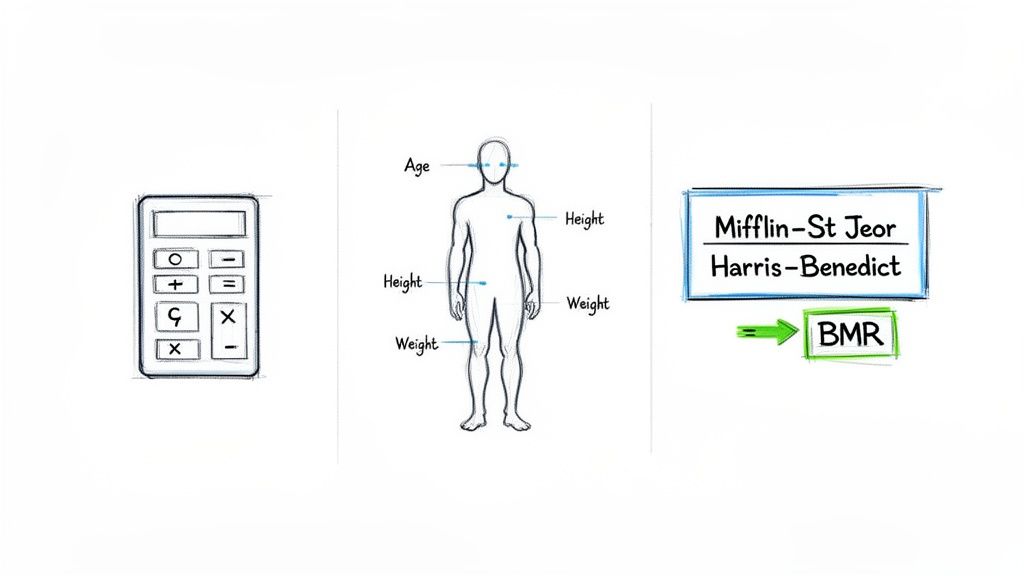
So you have your BMR number. Think of that as your "coma calories"—what your body would burn if you did absolutely nothing all day. But life involves movement. To get a useful number for your actual life, we need to account for all that activity.
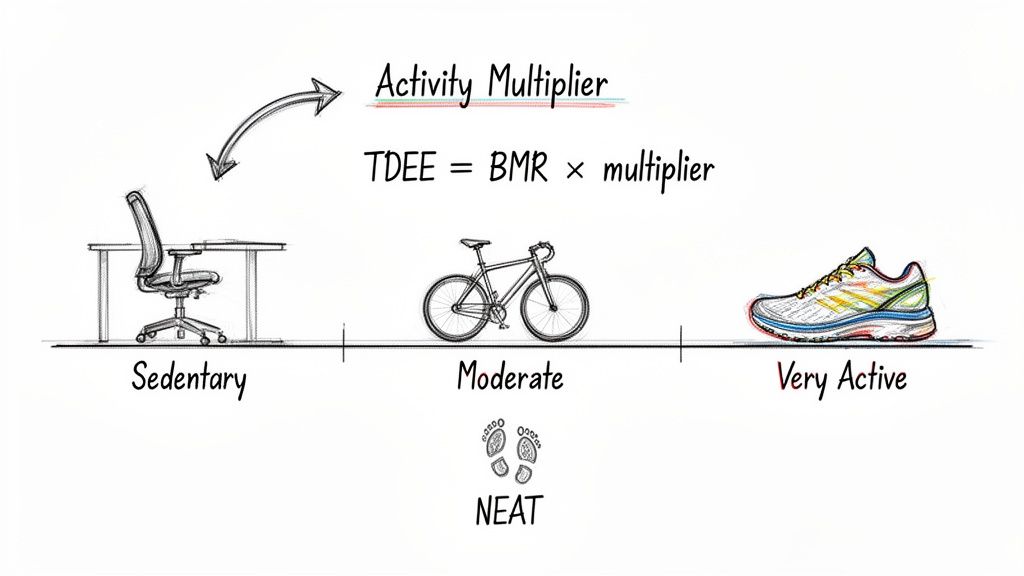
This next step brings us to your Total Daily Energy Expenditure (TDEE). It’s a much more complete picture, representing your BMR plus all the calories you burn from daily activities. To calculate your TDEE, we simply multiply your BMR by an "activity multiplier."
Choosing Your Activity Multiplier
This is where honest self-assessment is crucial. It's incredibly common for people to overestimate their activity level, a primary reason calorie targets sometimes fail. When you select your multiplier, be realistic about a typical week, not your most active day.
- Sedentary: Desk job with little to no formal exercise. (Multiplier: 1.2)
- Lightly Active: Light exercise or sports 1-3 days a week. (Multiplier: 1.375)
- Moderately Active: Moderate exercise or sports 3-5 days a week. (Multiplier: 1.55)
- Very Active: Hard exercise or sports 6-7 days a week. (Multiplier: 1.725)
- Extra Active: Physical job, twice-a-day training, or both. (Multiplier: 1.9)
Let’s see how this works. Using the Harris-Benedict formula, a 37-year-old man who is 5'10" and 170 pounds has a BMR of roughly 1,783 calories. If he’s moderately active (exercising 3-5 times a week), we use the 1.55 multiplier. His TDEE becomes 2,766 calories per day. This is his maintenance level—the amount he can eat without gaining or losing weight. With over 1.9 billion adults globally classified as overweight by the World Health Organization, understanding this basic metabolic math is a powerful first step toward health management.
Don't Forget About NEAT
There’s a hidden variable in your energy expenditure that many people miss: Non-Exercise Activity Thermogenesis (NEAT). This is the energy you burn from all activities that are not formal exercise.
We're talking about:
- Walking to your car or the bus stop
- Tapping your feet under your desk
- Doing household chores
- Even fidgeting
It might not seem like much, but research from the Mayo Clinic shows these small movements can account for a difference of hundreds of calories burned per day. Someone who is always on their feet will have a significantly higher NEAT than a person who remains seated most of the day.
If you work a desk job but you’re constantly fidgeting or you make a point to walk around every hour, your true activity multiplier might be slightly higher than the "sedentary" label suggests. You can get a clearer picture of your own patterns if you estimate your NEAT calorie burn.
This is why two people with the same weight, workout schedule, and BMR can have different calorie needs. The person with higher NEAT has a higher TDEE. It’s another piece of the puzzle that makes your final calorie target a truly personal number.
Fine-Tuning Your Calories for Your Specific Goal
Now that you have your TDEE, you've found your "maintenance" number. This is your body's energy budget to stay exactly where you are. It’s the crucial baseline from which we'll make small, calculated adjustments to achieve your goal.
Whether you're aiming to lose fat, build muscle, or simply maintain your current physique, it all comes down to manipulating your energy balance. This isn't about drastic diets; it's about being strategic and scientific.
Creating a Deficit for Fat Loss
The first law of thermodynamics dictates that for fat loss to occur, you must be in a consistent calorie deficit. This simply means you are consuming less energy (food) than your body is expending (your TDEE).
However, a bigger deficit is not always better. Aggressively slashing calories can be counterproductive, leading to muscle loss, metabolic adaptation (your metabolism slowing down), and overwhelming hunger.
For most people, a healthy and sustainable rate of fat loss is 0.5% to 1% of body weight per week. This typically corresponds to a modest deficit of 300-500 calories below your TDEE. For example, if your maintenance is 2,400 calories, setting a daily goal of 1,900–2,100 calories is an effective starting point.
This gentle deficit is key. It encourages your body to use fat stores for energy while preserving lean muscle mass and maintaining energy levels, making the plan sustainable long-term.
Building a Surplus for Muscle Gain
Building new muscle (hypertrophy) is an energy-intensive process that requires extra fuel for both workouts and the subsequent repair and growth. To facilitate this, you need to be in a calorie surplus, meaning you eat more than your TDEE.
A common mistake is the "dirty bulk," where individuals eat excessively, leading to significant fat gain alongside muscle. A more effective strategy is a small, controlled surplus.
Aiming for an extra 250-500 calories above your TDEE provides the necessary resources for muscle synthesis without promoting excessive fat storage. So, if your maintenance is 2,800 calories, a target of 3,050–3,300 calories per day will support lean mass gain.
A Quick Word on Body Recomposition
Is it possible to lose fat and build muscle simultaneously? Yes, this process is known as body recomposition. Scientific literature suggests it is most effective for specific populations:
- Novice lifters who are new to resistance training.
- Individuals returning to training after a significant break.
- People with a higher initial body fat percentage.
Body recomposition is most successful when eating at or very close to maintenance calories (your TDEE). The strategy must be paired with a high-protein diet and a structured, progressive resistance training program. This allows your body to use energy from its fat stores to fuel muscle growth, with protein providing the building blocks.
Translating Calories Into Daily Macros
Having a daily calorie target is a great start, but it's just a number. To make it actionable, you must convert that number into macronutrients—the protein, carbohydrates, and fats that make up your meals. This transforms a calorie goal into a practical eating plan.
Each macronutrient provides energy and serves distinct physiological functions:
- Protein: At 4 calories per gram, it's the building block for muscle repair and growth. It also has the highest thermic effect of food and promotes satiety.
- Carbohydrates: Also 4 calories per gram, carbs are the body’s preferred fuel source for high-intensity exercise and brain function.
- Fat: The most energy-dense macro at 9 calories per gram, fat is crucial for hormone production, cellular structure, and absorbing fat-soluble vitamins.
When setting up your macros, protein intake should be prioritized. Its role in preserving lean muscle, especially during a calorie deficit, makes it the non-negotiable foundation of an effective nutrition plan.
Setting Your Protein Target
An evidence-based recommendation for active individuals is to consume 1.6 to 2.2 grams of protein per kilogram of body weight (about 0.7 to 1.0 grams per pound). This range is supported by meta-analyses from organizations like the International Society of Sports Nutrition.
If you’re in a calorie deficit for fat loss, aiming for the higher end of that range helps protect against muscle breakdown. For muscle building, a higher intake ensures a positive nitrogen balance and provides ample raw materials for growth.
Once you’ve set your protein goal, the calories from carbohydrates and fats fill out the rest of your daily budget.
A Practical Example of Dividing Macros
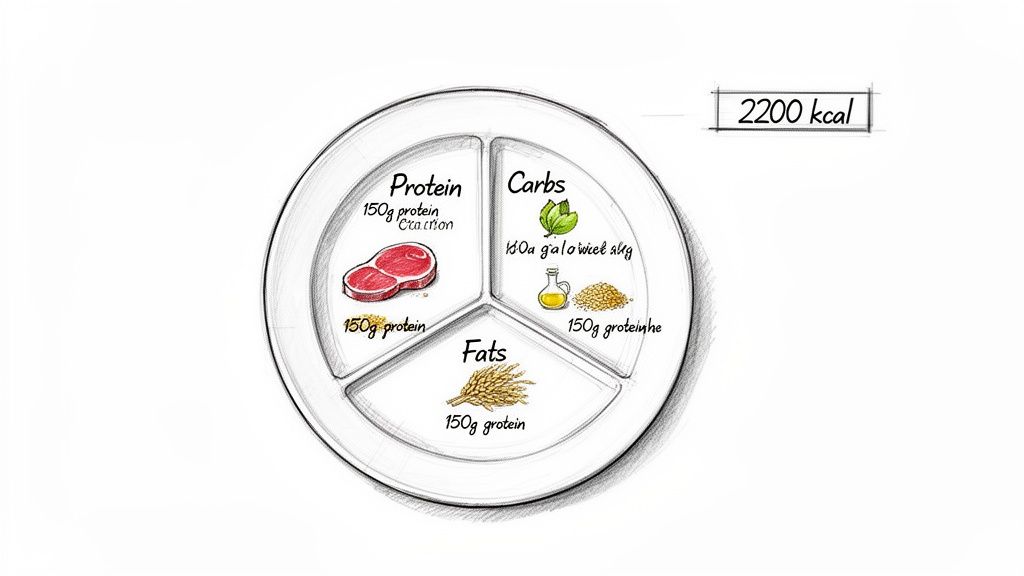
Let's walk through a real-world application. Imagine our target is 2,200 calories per day for an individual weighing 175 lbs (roughly 80 kg).
-
Calculate Protein First: We'll aim for 1.8g of protein per kilogram of body weight.
- 80 kg × 1.8 g/kg = 144 grams of protein
- 144g × 4 calories/g = 576 calories from protein
-
Calculate Remaining Calories: Subtract the protein calories from the total daily budget.
- 2,200 total calories – 576 protein calories = 1,624 calories remaining
-
Divide Carbs and Fats: This is where you have flexibility. A balanced 50/50 split of the remaining calories is a great starting point.
- Carbohydrates: 1,624 × 0.50 = 812 calories → 812 / 4 = 203 grams of carbs
- Fats: 1,624 × 0.50 = 812 calories → 812 / 9 = 90 grams of fat
So, for a 2,200-calorie plan, our daily targets become: Protein: 144g Carbohydrates: 203g Fat: 90g
This process gives you a clear, actionable roadmap. However, studies show that adherence to manual tracking can be low due to its tedious nature.
This is where modern apps like BiteKit are a game-changer. They leverage AI to allow meal logging via natural language (e.g., "200g chicken breast and two apples") or by analyzing a photo. The app then instantly calculates calories and macros against your goals. This effortless precision can significantly increase tracking adherence, which is a key determinant of long-term success.
Common Questions About Calorie Calculation
Once you start calculating and tracking calories, questions will inevitably arise. Understanding these nuances separates a short-term diet from sustainable, long-term success. Let's tackle some common hurdles with evidence-based advice.
How Often Should I Recalculate My Calorie Needs?
You don't need to recalculate daily, but it's crucial to do so when key variables change. A significant shift in body weight, such as losing or gaining 5-10% of your total weight, is a prime time to run the numbers again. As your mass changes, so does your BMR.
The other trigger is a major, sustained change in your activity level. Starting a physically demanding job or committing to a new training program that alters your weekly energy expenditure warrants a recalculation. For gradual weight changes, reassessing your numbers every 2-3 months is a good practice to keep your targets accurate.
Can I Trust Calorie Estimates from Fitness Trackers?
Fitness trackers are excellent for monitoring activity trends like daily steps and sleep patterns. However, their "calories burned" estimates should be viewed with skepticism.
Multiple independent studies, including research from Stanford University, have found that consumer wearables can significantly overestimate energy expenditure, with error margins sometimes exceeding 20-30%.
Your best practice is to establish your baseline TDEE using a validated formula like Mifflin-St Jeor. Use your tracker's data as a motivational tool and a gauge of relative activity, not as an absolute measure of calories burned.
Why Am I Not Losing Weight on a Calorie Deficit?
This is one of the most common and frustrating plateaus. If you've done the math but the scale isn't moving, let's troubleshoot with science.
First, critically evaluate your tracking accuracy. Unaccounted-for calories from cooking oils, sauces, dressings, and liquid calories can easily negate a planned deficit. This is often the primary culprit.
Next, be brutally honest about your activity multiplier. As noted earlier, overestimation is common. Try dropping to a lower multiplier level to see if it realigns your intake with your actual expenditure.
Finally, consider metabolic adaptation. If you've been in a prolonged deficit, your body may have adapted by reducing its energy expenditure. Research suggests that a "diet break"—a period of 1-2 weeks eating at your new maintenance calories—can help normalize hormone levels (like leptin and ghrelin) and up-regulate metabolic rate before resuming the deficit.
Is It Better to Use an App or Calculate Manually?
Calculating your TDEE manually at least once is an invaluable educational experience. It demystifies the science behind your body's energy needs. However, for the day-to-day task of tracking meals, an app is superior for ensuring long-term consistency.
Modern apps like BiteKit are designed to minimize the friction of logging. By using AI to interpret photos or voice notes, they remove the tedious data entry that causes many people to abandon tracking. By making the process seamless, you're far more likely to maintain the consistency that is ultimately the most critical factor for achieving your health and fitness goals.