AI food photos, tested against the scale
Against weighed food, top AI models missed a photo's calories by 23–36% on average. Adding ingredients with amounts cut one model's miss from 123 to 53 kcal.
·5 min read
On this page
You photograph your dinner and an AI says 640 calories. How close is that to what is on the plate? Researchers now test this directly: they weigh the food, work out its true calories, photograph it, and ask models such as ChatGPT, Claude and Gemini to estimate it.
From a photo alone, the leading models in three 2025 tests missed by 23% to 36% of a meal's calories on average, and the miss tended to grow with the size of the plate. In one study, adding a list of ingredients with amounts cut the error by more than half. BiteKit is an AI calorie tracker itself; none of these studies tested it. How we got these numbers is in the methodology.
Key findings
- 135.8% average error from a photo alone. ChatGPT-4o and Claude 3.5 Sonnet both missed energy by a mean 35.8% on 52 weighed photos, and Gemini 1.5 Pro by 64.2%, in a 2025 study in Current Developments in Nutrition. The models were 2024 releases.
- 223–34% for four models on 806 phone photos. With a plain prompt, GPT-4.1, Claude 3.7 Sonnet, GPT-4o and Gemini 2.5 Pro missed by 23.29% to 34.11% against weighed, dietitian-verified meals, according to a 2025 benchmark preprint that has not been fully peer reviewed.
- 3Ingredients with amounts cut the miss from 123 to 53 kcal. ChatGPT-5's average error on 195 dishes fell from 123.03 kcal (30.51%) with the photo alone to 53.33 kcal (13.92%) with an ingredient list added, in a 2025 Nutrients study. On the 25 dishes weighed by nutritionists it fell from 75.14 to 28.82 kcal.
- 4Large meals were estimated a third too light. ChatGPT-4 put large meals at 529.5 g on average against an actual 798.1 g, and underestimated weight in 87 of 114 photos, in a 2025 Nutrients study. Small meals were close.
- 5Dietitians had the smaller average miss. On 15 weighed hospital meals, 10 registered dietitians missed energy by 22.4 kcal on average and ChatGPT-4o by 38.5 kcal, in a 2026 Nutrients study. The study did not test whether that gap is significant. The same AI models overestimated fat.
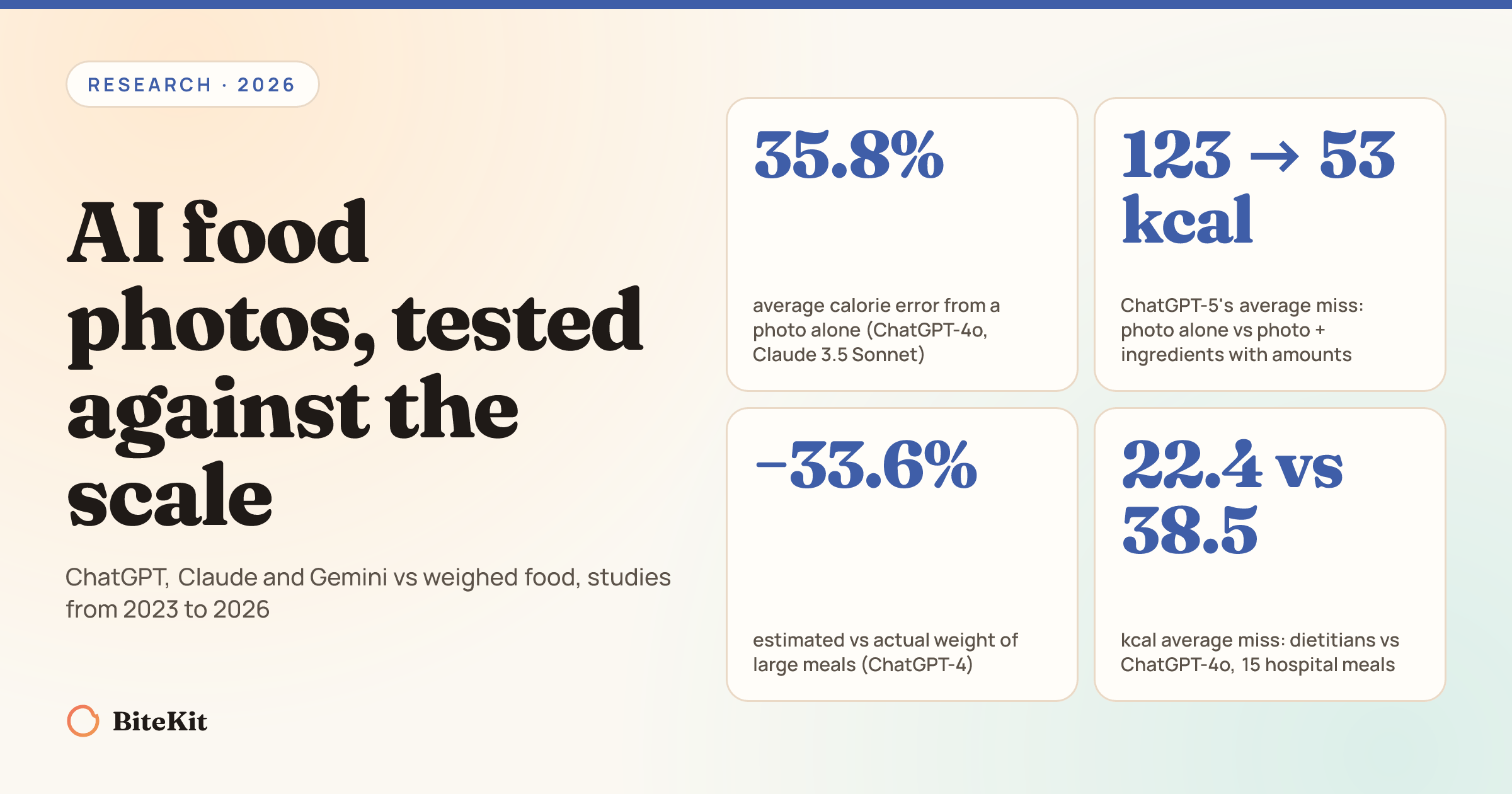
35.8%
Average calorie error from a photo alone, ChatGPT-4o and Claude 3.5 Sonnet (52 weighed photos)
Source: Fridolfsson et al., 2025
123 → 53 kcal
ChatGPT-5's average miss, photo alone vs photo plus ingredients with amounts (195 dishes)
Source: Rodríguez-Jiménez et al., 2025
−33.6%
Estimated vs actual weight of large meals, ChatGPT-4 (38 meals, group means)
Source: O'Hara et al., 2025
22.4 vs 38.5
Average calorie miss in kcal, dietitians vs ChatGPT-4o (15 hospital meals)
Source: Isobe et al., 2026
How big the error is from a photo alone#
A 2025 Swedish study by Fridolfsson and colleagues weighed dishes at three portion sizes, took one iPhone photo of each plate with cutlery for scale, and gave the same 52 photos and prompt to three models.
Calorie error from a photo alone, three models
Mean absolute percentage error of energy vs weighed food, 52 photos, models released 2024, paper 2025
| Label | Value |
|---|---|
| ChatGPT-4o | 35.8% (95% CI 27.3–45.1) |
| Claude 3.5 Sonnet | 35.8% (95% CI 27.9–44.7) |
| Gemini 1.5 Pro | 64.2% (95% CI 45.0–86.9) |
The average bias was small: ChatGPT-4o came out 10.0 kcal under the reference and Claude 3.5 Sonnet 18.9 kcal under. Overestimates and underestimates cancel in an average; single meals can still be well off.
A larger set gave smaller errors, including for GPT-4o, so the two studies' photos and meals are not directly comparable. The ACETADA benchmark, a 2025 preprint, used 806 phone photos from a feeding study of 152 adults in Perth, with food weighed to 0.1 g.
Mean absolute percentage error of energy with a plain prompt, weighed and dietitian-verified meals, preprint 2025
| Label | Value |
|---|---|
| GPT-4.1 | 23.29% (MAE 170.02 kcal) |
| Claude 3.7 Sonnet | 23.88% (MAE 181.68 kcal) |
| GPT-4o | 24.48% (MAE 165.77 kcal) |
| Gemini 2.5 Pro | 34.11% (MAE 211.04 kcal) |
Bigger plates, bigger misses#
All three models in the Swedish study showed systematic underestimation that grew with portion size. ChatGPT estimated one large lentil curry at 255 g; it weighed 480 g. A 2025 Irish study by O'Hara and colleagues shows the same pattern with ChatGPT-4 across 38 meals, each photographed at three sizes.
Actual vs ChatGPT-4-estimated meal weight in grams, 114 photos of 38 meals, 2025
Source: O'Hara et al., Nutrients 2025
Recognition was not the weak point: ChatGPT-4 named the foods with 93.0% precision and 84.6% recall. Quantity was. The authors note that some foods were hidden by others, in soups, sandwiches and salads, and the ChatGPT-5 study found its largest outliers in dishes served in bowls, which the authors link to judging depth from a photo.
Underestimation is not the whole story, though. In the 2026 hospital-meal study, every AI model tested overestimated fat. A single wrong identification can also swing the numbers: in the Swedish study, Claude read scrambled eggs as a pasta dish and overestimated that meal's carbohydrate by 1,788%.
Adding words to the photo#
The 2025 ChatGPT-5 study gave the model the same 195 dishes four ways: the photo alone, the photo plus details a camera cannot see (type and amount of fat and sweetener, dairy fat, type of meat), the photo plus an ingredient list with amounts, and the ingredient list with no photo.
Add the ingredients and the error falls by more than half
ChatGPT-5 average calorie miss (MAE, kcal) by input, 195 dishes, 95% CI, 2025
| Label | Value |
|---|---|
| Photo only | 123.03 kcal (MAPE 30.51% · CI 108.61–138.78) |
| Photo + fat, sweetener and meat details | 92.04 kcal (MAPE 24.35% · CI 80.99–103.63) |
| Photo + ingredients with amounts | 53.33 kcal (MAPE 13.92% · CI 45.08–62.27) |
| Ingredients with amounts, no photo | 66.51 kcal (MAPE 18.05% · CI 56.06–77.45) |
Source: Rodríguez-Jiménez et al., Nutrients 2025, Tables 2–5
One caveat: for 96 of the dishes the reference calories came from the recipe, the same ingredient list the model was given, which likely flatters the text inputs (our reading). The 25 weighed home-prepared dishes avoid that and show the same pattern: photo plus ingredients with amounts did best and the photo alone worst.
Amounts appear to be what does the work. A 2026 Scientific Reports study of 40 vision-language models gave them a list of the foods without quantities, and error improved only slightly (0.548 to 0.516 on its log-scale metric). Photos from more angles did not help. In the ACETADA benchmark, adding context such as meal type, venue and the foods present lowered calorie error in all eight models, by about 76 kcal on average (with the best combination picked per model).
Compared with dietitians#
In a 2026 Japanese study, 10 registered dietitians and 10 AI tools estimated 15 weighed hospital meals of about 605 kcal each.
Dietitians vs AI on 15 hospital meals
Average calorie miss (MAE, kcal) vs weighed meals of 605.2 ± 26.5 kcal, standardised photos, 2026
| Label | Value |
|---|---|
| Registered dietitians (mean of 10) | 22.4 kcal (86.7% of meals within ±10%) |
| ChatGPT-4o | 38.5 kcal (73.3% within ±10%) |
| Gemini 1.5 Pro | 42.1 kcal (60.0% within ±10%) |
An earlier test of GPT-4V by Lo and colleagues (arXiv 2023) found a similar gap on portion weight: 54.6 g average error for the model and 43.6 g for dietitians, across 32 food items. Neither study shows AI matching or beating dietitians. The models are in the same range as trained eyes, and both are estimates, not a scale.
What this means for you#
- Treat a photo-only number as a rough estimate. In these studies the leading models missed by 23% to 36% of a meal's calories on average.
- Add what the camera cannot see. In the ChatGPT-5 study, an ingredient list with amounts gave the largest gain, and details such as the type and amount of fat and sweetener also helped.
- Be most careful with big plates and bowls. Large portions were underestimated the most, and bowls produced the largest outliers.
- Check the food names. Recognition is usually right, but one wrong identification can move a meal's numbers a lot.
- Look at the trend over days. Random misses partly cancel across meals; a consistent one, such as underestimating large dinners, does not.
BiteKit lets you add a description to a meal photo, so you can include amounts, oils and sauces the camera can't see. BiteKit has not been tested against weighed food in a published study, so treat its numbers, like any AI estimate, as a starting point you can correct.
Methodology#
Sources. Five peer-reviewed studies that compared AI estimates from food photos with weighed food (Fridolfsson 2025, Rodríguez-Jiménez 2025, O'Hara 2025, Isobe 2026, Vedovelli 2026), plus two arXiv papers: the ACETADA preprint (2025) and Lo et al. (2023; we used the arXiv figures, not the later IEEE JBHI version). Each is linked where it is cited. We re-checked every key finding against its paper on 23 November 2026. App vendors' own accuracy claims were left out.
Definitions. MAPE is the average of each miss as a share of the true value, whether over or under. MAE is the average miss in kcal or grams. Bias is the signed average: negative means the estimate was too low. The truth is weighed food with nutrients from a food composition database, except where noted.
Limits. These are small studies of specific model versions, and models change every few months.
- The models tested are 2023–2025 releases (GPT-4V, GPT-4o, GPT-4.1, ChatGPT-5, Claude 3.5 and 3.7 Sonnet, Gemini 1.5 and 2.5 Pro). Newer ones may do better or worse.
- Each study scores one photo of one plate. None of the peer-reviewed studies tests a full day's total.
- Photos were taken under good conditions, often with a scale reference or fixed lighting. Everyday photos may be harder.
- In the ChatGPT-5 study, 96 of 195 reference values came from recipes rather than weighing.
- BiteKit uses AI models of this kind, but no study here tested BiteKit, and we have no weighed benchmark of our own.
FAQ#
How accurate is AI calorie counting from a photo?#
In studies published in 2025, leading general-purpose models missed a meal's calories by 23% to 36% on average when given only a photo, measured against weighed food. Gemini 1.5 Pro missed by 64.2% in one 52-photo study.
Does adding a description to a food photo help?#
Yes, when the description includes amounts. In a 2025 study of 195 dishes, ChatGPT-5's average miss fell from 123.03 kcal with the photo alone to 53.33 kcal with an ingredient list and amounts added. A food list without quantities helped only slightly in a 2026 study of 40 models.
Is AI as accurate as a dietitian at estimating calories from a photo?#
Not quite, but it is in the same range. On 15 weighed hospital meals in a 2026 study, dietitians missed by 22.4 kcal on average and ChatGPT-4o by 38.5 kcal; in a 2023 study, portion-weight errors were 43.6 g for dietitians and 54.6 g for GPT-4V.
Does AI always underestimate calories?#
No. ChatGPT-4 underestimated large meals by 33.6% of their weight in a 2025 study, while its small-meal estimates were not significantly different from the actual weight. In a 2026 hospital-meal study, every AI model tested overestimated fat.