How many calories should a woman eat: How Many Calories Shou
Wondering how many calories should a woman eat? This 2026 guide calculates unique needs for weight loss, maintenance, or gain using science-backed methods.

The most repeated answer to how many calories should a woman eat is also the least helpful: “about 2,000 calories a day.”
That number is easy to remember. It is also too broad to guide real decisions about fat loss, maintenance, muscle gain, energy, hunger, or long-term health.
A woman in her twenties who lifts weights several days a week does not have the same calorie needs as a woman in her sixties with a desk job. A shorter woman does not need the same intake as a taller woman. A woman trying to maintain weight should not use the same target as someone trying to lose it. Even the same person may need a different calorie target at different points in life.
The better question is not “what’s the one right number?” It is “what number fits my body, my activity, and my goal right now?”
That shift matters. It turns calorie guidance from a rigid rule into a skill. Once you understand how to estimate your needs, track what is happening, and adjust based on real feedback, nutrition gets much less confusing.
Why 2000 Calories a Day Is a Myth
Here is the contrarian truth. The famous 2,000-calorie number is not a personal target for women. It is a label reference that became so familiar that many people mistake it for advice.
That mix-up causes real confusion. A woman can eat 2,000 calories and feel energized, maintain her weight, and recover well from training. Another can eat the same amount and wonder why fat loss has stalled. Neither body is broken. They are running on different energy budgets.
Why one number breaks down in real life
Calorie needs shift with your body, your routine, and your goal. Height matters. Muscle mass matters. Daily movement matters. Hormonal changes, training volume, stress, and sleep can all change how much food feels appropriate and how your body responds over time.
A helpful way to view calories is like a thermostat setting, not a permanent identity. You do not set it once and never touch it again. You choose a starting point, watch how your body responds, and adjust.
That is why two women can both eat well, train consistently, and still need different calorie intakes.
What the 2,000-calorie myth gets wrong
The myth creates two common mistakes.
Some women eat around 2,000 calories and assume they are overeating because that number sounds high. For an active woman, it may be right around maintenance.
Others treat 2,000 as a built-in fat-loss target. If their body maintains weight on less than that, 2,000 calories may feel moderate on paper but function more like maintenance in practice.
The bigger issue is mindset. A fixed number encourages all-or-nothing thinking. A personal calorie target works better as a working estimate, something you test against hunger, energy, performance, body changes, and consistency.
Key takeaway: The best calorie target is not the most popular number. It is the number that fits your body right now, then gets adjusted as your body and goals change.
This context-dependent view also helps explain why higher calorie totals are not automatically good or bad. They only make sense in relation to the person eating them, as shown in this discussion of whether 2500 calories a day makes sense in different situations.
A modern tracker such as BiteKit makes that process much easier. Instead of chasing a perfect number from day one, you can log intake, notice patterns, and refine your target based on real feedback. That is how calorie guidance becomes practical. It turns from a rule you obey into a skill you build.
Your Body's Energy Budget BMR and TDEE
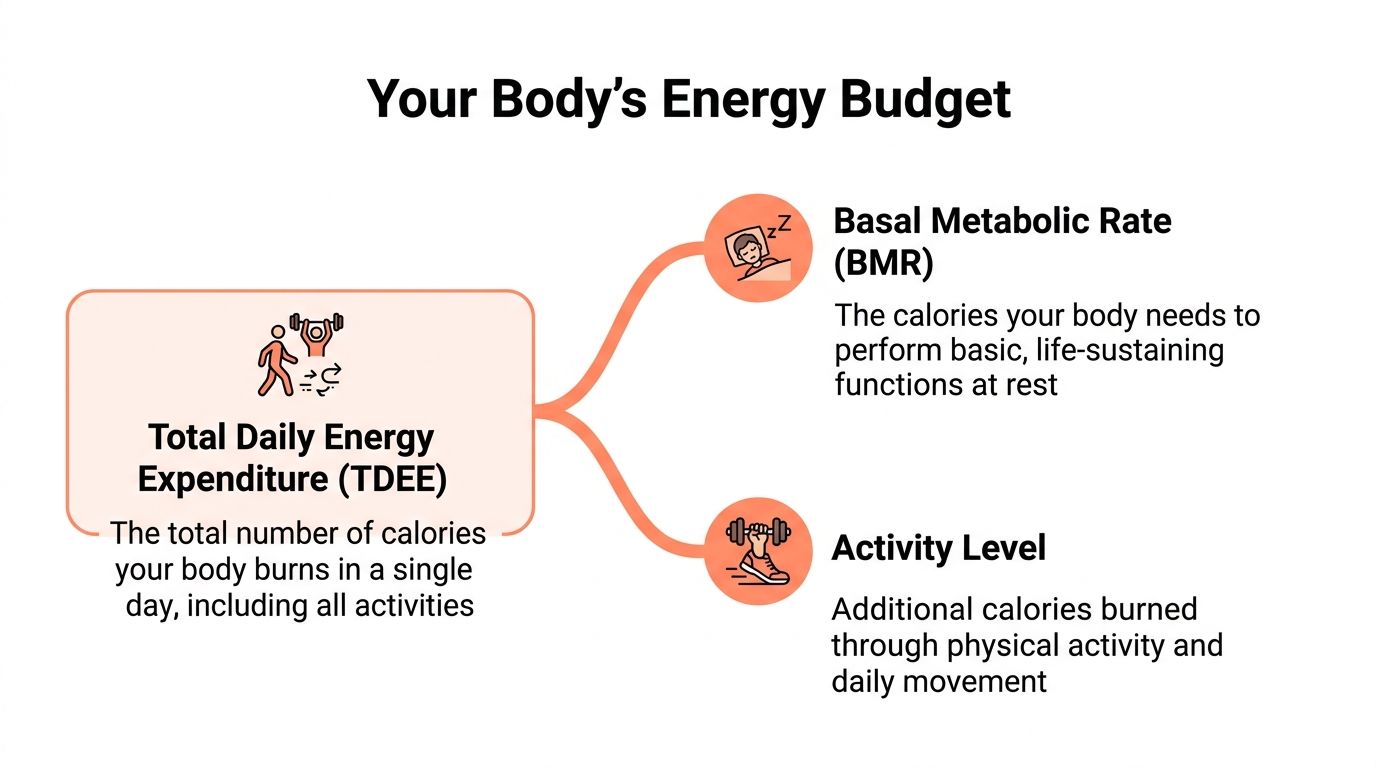
Your body's energy needs can be broken down into a simple budget.
At the base is the energy required to keep you alive. On top of that comes the energy you use living your actual life, walking, working, training, cooking, parenting, commuting, and even digesting food. Those two layers are called BMR and TDEE.
What BMR means
Basal metabolic rate, or BMR, is the amount of energy your body uses at complete rest.
This is your body's baseline operating cost. It covers breathing, circulation, temperature control, organ function, and the constant behind-the-scenes work that keeps you alive. Even on a day when you barely move, your body still uses a meaningful amount of energy.
That point matters because many women assume calories are only "burned" through exercise. Exercise adds to the total, but it is not the foundation. Your body already has a base cost before a workout, step count, or chore enters the picture.
What TDEE adds on top
Total daily energy expenditure, or TDEE, is your full daily calorie burn.
If BMR is the cost of keeping the lights on, TDEE is the full household bill after you add everything else. It includes your BMR plus structured exercise, daily movement, and the energy used to process food.
TDEE usually changes more than people expect. A hard training week, a vacation with lots of walking, a desk-heavy work stretch, or a season of poor sleep can all shift your real-world calorie needs. That is why a single number from a calculator should be treated as a starting estimate, not a permanent identity.
TDEE is shaped by a few main factors:
- Exercise activity: lifting, cardio, classes, sports
- Non-exercise movement: walking, standing, errands, housework, commuting
- Digestion: your body uses energy to break down and absorb food
Why this clears up so much confusion
Two women can have similar body sizes and very different maintenance calories.
One may train three times a week, walk often, and stay on her feet most of the day. Another may do the same workouts but sit for long stretches outside the gym. On paper they look similar. In practice, their calorie budgets can differ enough to change whether a meal plan feels satisfying, maintainable, and effective.
This is why comparing your intake to a friend, coworker, or fitness creator often backfires. The missing variable is usually expenditure, not discipline.
A higher TDEE means you can often eat more while maintaining weight. A lower TDEE means your maintenance intake may be lower. Neither number is morally better. It is your current energy budget.
A more useful mental model
Use BMR and TDEE like this:
- BMR is your baseline
- Movement and digestion raise the total
- Your calorie target should be based on TDEE, then adjusted for your goal
- That target may need updates as your routine, body weight, training, or life changes
That last point is the one many articles skip.
Your calorie number is not something you discover once and keep forever. It works more like a thermostat. You set an initial level, watch the feedback, then turn it up or down based on what your body is telling you through hunger, energy, performance, and weight trend over time.
Practical tip: If you only remember one number, remember your estimated maintenance calories, not your BMR. BMR helps you understand the baseline. TDEE is the number that helps you plan real meals in real life.
If you want a quick starting estimate, use this TDEE calculator for women and daily calorie needs. Then treat the result as version one. Tools like BiteKit make the next step easier because you can track your intake, compare it with your results, and adjust your target based on what is happening in your own body, not what worked for someone else.
How to Calculate Your Daily Calorie Needs
You do not need a perfect number. You need a strong starting estimate.
The most practical way to find that estimate is to calculate your BMR first, then convert it into TDEE with an activity multiplier. The formula commonly used for this is the Mifflin-St Jeor equation.
Step 1. Estimate your BMR
For women, the equation is:
BMR = 10 × weight in kg + 6.25 × height in cm - 5 × age in years - 161
This gives you an estimate of how many calories your body burns at rest.
Example:
A woman weighs 70 kg, is 165 cm tall, and is 35 years old.
- 10 × 70 = 700
- 6.25 × 165 = 1031.25
- 5 × 35 = 175
Now plug it in:
BMR = 700 + 1031.25 - 175 - 161 = 1395.25
So her estimated BMR is about 1395 calories per day.
That is not her maintenance level. It is her resting baseline.
Step 2. Multiply by activity level
Once you have BMR, multiply it by an activity factor to estimate TDEE.
Here is a practical table you can use.
| Activity Level | Description | Multiplier |
|---|---|---|
| Sedentary | Little or no planned exercise, mostly sitting | 1.2 |
| Lightly active | Light exercise or light movement on some days | 1.375 |
| Moderately active | Moderate exercise on several days each week | 1.55 |
| Very active | Hard training or very physically demanding days | 1.725 |
| Extra active | Very hard training, physical labor, or both | 1.9 |
If the example woman is moderately active:
1395 × 1.55 = 2162.25
Her estimated maintenance intake is about 2162 calories per day.
Step 3. Accurately choose the right activity category
This step is where people most often miscalculate.
If you train for an hour but sit the rest of the day, you may not be as active overall as you think. On the other hand, if you walk a lot for work, take stairs, carry groceries, and stay on your feet, your total expenditure may be higher than your formal workouts suggest.
A good rule is to classify your full day, not just your gym habits.
- Sedentary fits many desk jobs with little movement outside exercise
- Lightly active often fits women who walk some and exercise casually
- Moderately active is common for women who train regularly and move a fair amount
- Very active usually means demanding workouts, active jobs, or both
Step 4. Treat the result as a draft, not a verdict
Your calculator result is an estimate.
Real life can shift it. Sleep, stress, appetite, training volume, body composition, and routine changes all matter. That is why the best method is estimate first, then observe what happens over the next few weeks.
If your weight and measurements stay stable, your estimate is probably close to maintenance. If they trend down, you may be below maintenance. If they trend up, you may be above it.
Tip: Calculators are useful because they remove guesswork at the start. You can use BiteKit’s TDEE calculator to get that initial estimate quickly, then refine it based on your own results.
What women often get wrong
The biggest mistake is treating one day of eating as proof.
Calorie needs show up in patterns, not isolated meals. A high-sodium dinner, a harder training week, poor sleep, or the menstrual cycle can all change appetite and scale weight temporarily. Look for trends.
The second mistake is copying someone else’s calories. Even if your friend’s plan works for her, it tells you very little about what your body needs.
Setting Calorie Targets for Your Health Goals
A calorie target is not a rule you pick once and follow forever. It works more like a budget that needs occasional updates as your goal, routine, training, and appetite change.
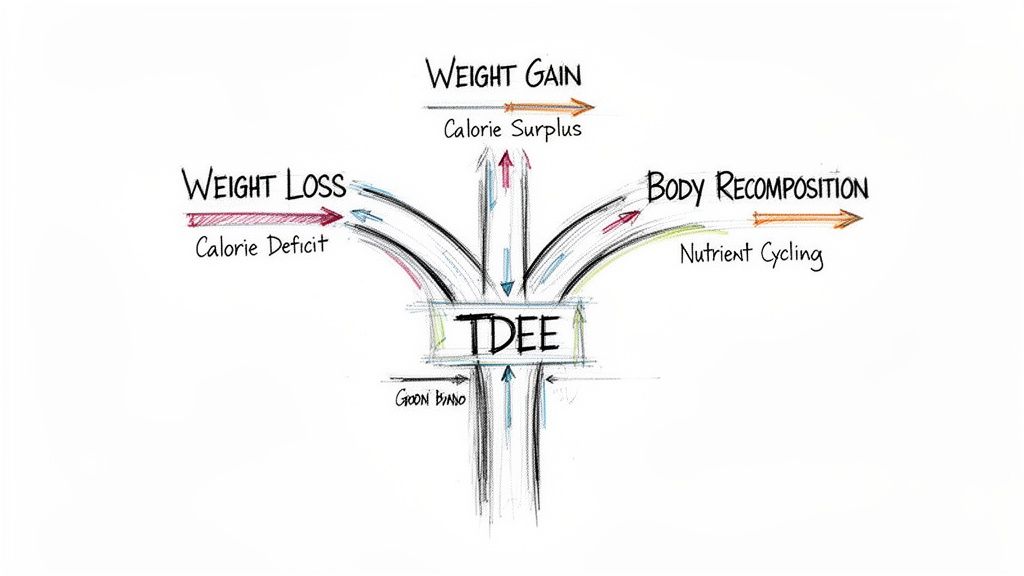
Once you have an estimated maintenance intake, you can set a starting target for fat loss, maintenance, or muscle gain. The key word is starting. Your first number should be close enough to test, then adjusted based on what your body does over the next few weeks.
If your goal is weight loss
Weight loss requires a calorie deficit, but a useful deficit is one you can live with.
A common starting point is to reduce calories moderately from maintenance. For some women, that may be around 300 to 500 calories below maintenance. If your estimated maintenance is 2,100 calories, a rough fat-loss target might land near 1,600 to 1,800. If your maintenance is already on the lower side, a smaller reduction often makes more sense. Aggressive cuts can backfire; energy drops, training quality suffers, hunger gets louder, and adherence usually breaks before the plan has time to work.
Many women also do better when they pair a moderate deficit with higher-protein meals. If that is your goal, this guide to protein intake for women trying to lose weight can help you build meals that feel more satisfying.
If your goal is maintenance
Maintenance is a skill.
It means eating enough to keep your weight fairly stable while supporting work, workouts, mood, sleep, and everyday life. For a lot of women, this is the best phase to practice regular meals, consistent portions, and honest tracking before trying to lose or gain.
Maintenance also helps after a long diet, during stressful seasons, or when your main goal is to feel normal around food again.
If your goal is muscle gain or body recomposition
Muscle gain usually works best with a small calorie surplus or an intake close to maintenance, especially when strength training is consistent.
Body recomposition is slightly different. Some women can lose fat and improve muscle definition while eating near maintenance, particularly if they are new to lifting, returning after time away, or finally getting consistent with training and protein intake.
The main pattern is simple: if your goal includes building muscle, eating too little for too long makes that harder.
Age can shift the range
Calorie needs often change across adulthood, which is one reason your target should be reviewed from time to time. The Cleveland Clinic calorie guide for women by age and activity level gives a useful range. Active women ages 19 to 30 may need 2,000 to 2,400 calories per day, women ages 31 to 60 may need 1,800 to 2,200, and women 61 and older may need 1,600 to 2,000.
Those are ranges, not assignments. Two women of the same age can still need different intakes because body size, muscle mass, movement, and training habits all change the picture.
Three practical examples
- Fat loss example: A woman estimates maintenance at about 2,000 calories. She starts with a moderate reduction, tracks intake consistently, and checks for trends in weight, hunger, energy, and workout quality before making another change.
- Maintenance example: Another woman finishes a dieting phase and returns to estimated maintenance. Her goal is stability, so she watches for steady body weight, more predictable hunger, and better training recovery.
- Muscle-focused example: A woman who lifts regularly adds a small amount above maintenance. She pays attention to performance in the gym, recovery between sessions, appetite, and whether her body measurements change over time. A tool can make the process practical here. Instead of guessing whether your target is working, BiteKit helps you log intake, spot patterns, and adjust based on real data from your own routine. That turns calorie planning from a one-time calculation into an ongoing feedback loop.
A short visual can help connect the goal to the calorie direction.
Key takeaway: The best calorie target is personal, goal-specific, and flexible enough to change as your body and routine change.
Thinking Beyond Calories A Primer on Macronutrients
Calories matter. They are not the whole story.
Two diets can contain the same number of calories and still leave you feeling very different. One may keep you full, energized, and satisfied. The other may leave you hungry an hour later.
That difference often comes down to macronutrients, the three main nutrients that provide energy: protein, carbohydrates, and fat.
Protein helps with repair and fullness
Protein supports muscle repair, recovery, and satiety.
If a woman is trying to lose fat, protein often helps make lower-calorie eating more manageable because meals built around protein tend to feel more satisfying. If she is strength training, protein also supports the recovery process that helps training pay off.
Good everyday options include Greek yogurt, eggs, fish, chicken, tofu, beans, lentils, cottage cheese, and lean cuts of meat.
Carbohydrates fuel activity
Carbs are your body’s easiest source of quick energy.
They are especially useful for training, higher-output days, and mental focus. Women often get confused here because carbs are frequently blamed for weight gain, but carbs themselves are not the problem. Total intake, meal quality, and context matter far more.
Fruit, oats, rice, potatoes, beans, and whole grains usually make carbs easier to build around because they bring fiber and staying power.
Fat supports hormones and satisfaction
Dietary fat helps meals feel satisfying and supports normal hormone-related functions.
Avocado, nuts, seeds, olive oil, full-fat dairy if tolerated, and fatty fish are common examples. Fat is not something to fear. It is something to portion sensibly.
Why 100 calories is not always the same experience
From a pure energy standpoint, 100 calories is 100 calories.
From a real-life nutrition standpoint, those calories can behave very differently. A small pastry may disappear quickly and leave you wanting more. A serving of yogurt or chicken may help you stay full much longer. A piece of fruit may come with volume and fiber that changes your hunger curve for the afternoon.
That is why a balanced plate works so well.
A simple balanced-plate approach
Try building meals around this pattern:
- Start with protein: chicken, fish, tofu, eggs, Greek yogurt, beans
- Add a smart carb: rice, potatoes, oats, fruit, whole grains
- Include fat: olive oil, nuts, seeds, avocado, cheese
- Finish with produce: vegetables, fruit, salad, cooked greens
You do not need perfect macro ratios to eat well.
You need meals that support your calorie goal, keep hunger manageable, and fit your routine. If protein feels confusing, this guide on protein intake for women weight loss is a practical next read.
Track and Adjust Targets Effortlessly with BiteKit
Knowing your calorie target is one job. Following it consistently is another.
Many women do not struggle because they are unwilling to learn. They struggle because manual logging is tedious. Searching food databases, guessing portions, and typing every ingredient can wear down motivation fast.
Why friction matters
The harder tracking feels, the less likely you are to do it accurately.
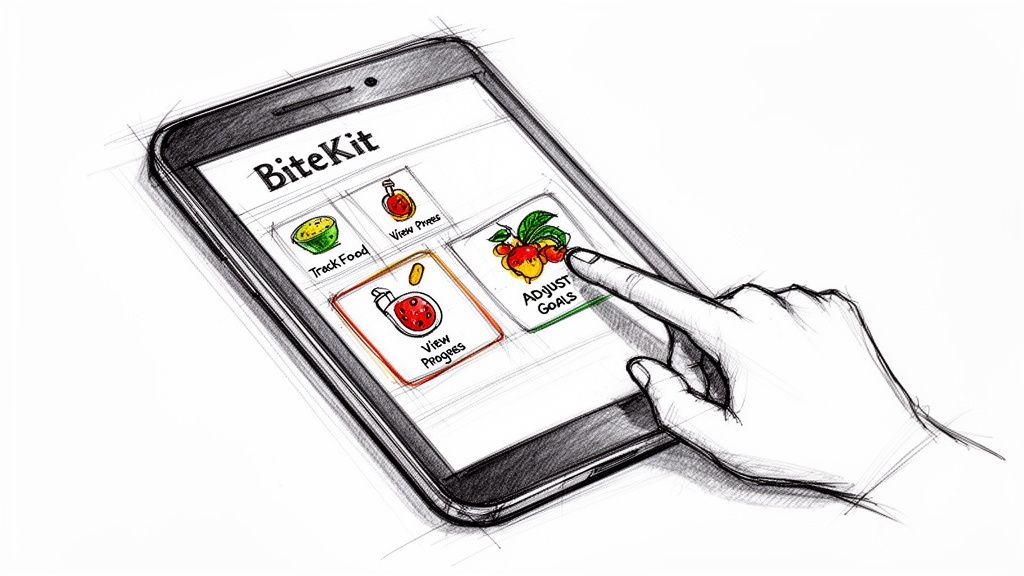
That is where a tool like BiteKit stands out. Instead of forcing you into barcode scans and endless database searches, it lets you log meals with photos, voice, or natural language text. You can snap a picture of a meal, say what you ate, or type it in plain English.
That matters in real life because meals are often messy. Think stir-fries, salads, restaurant plates, or leftovers. Few individuals want to dissect every bite manually.
What makes it practical
BiteKit works well for women who want less admin and more clarity.
A few examples:
- Photo logging: useful for mixed meals where typing every component feels annoying
- Voice logging: helpful when you are busy, commuting, or putting away groceries
- Natural-language entry: practical for meals like “grilled salmon with quinoa and vegetables”
The app then updates calories and macros against your daily targets. That lets you see whether breakfast was light, lunch was protein-poor, or dinner pushed you well past plan.
Better tracking leads to better adjustments
The most valuable part of tracking is not perfection. It is feedback.
If your hunger is high every afternoon, your log may show that breakfast lacks protein or lunch is too small. If your weight is not changing, your history may reveal that weekend intake is very different from weekday intake. If training feels flat, your meals may be too light on carbs.
Practical tip: The best tracking app is the one you can stick with. Consistency beats highly detailed logging that you abandon after a week.
BiteKit also keeps a date-organized history and shows progress in a clean way, which makes trend spotting much easier. For women trying to figure out how many calories should a woman eat for her own body, that loop of estimate, log, review, and adjust is what makes nutrition feel manageable instead of rigid.
Troubleshooting Common Calorie Tracking Hurdles
Even a solid calorie target can stop feeling effective.
That does not automatically mean your metabolism is broken or that calorie tracking “doesn’t work.” Usually, one of a few common issues is interfering with the process.
When weight loss stalls
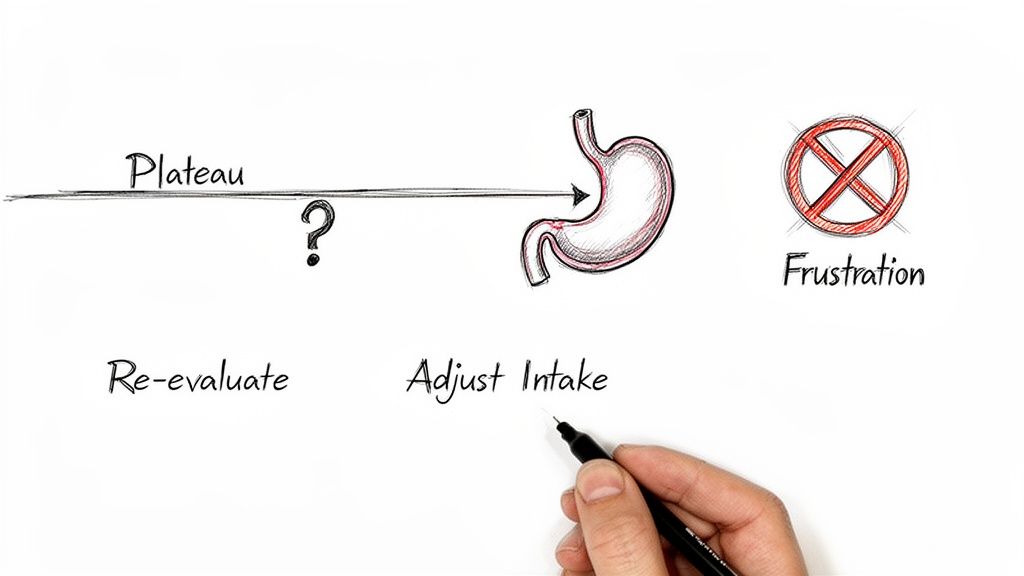
A plateau can happen for several reasons.
Sometimes intake has drifted upward through small extras that are easy to overlook. Sometimes daily movement has dropped because dieting reduces spontaneous activity. Sometimes body weight is temporarily masked by fluid shifts, digestion, soreness, or the menstrual cycle.
Before changing calories, check these basics:
- Review logging accuracy: oils, dressings, drinks, bites, and weekend meals often go undercounted
- Check consistency: a strong Monday through Friday pattern can be undone by untracked evenings
- Look beyond the scale: fit of clothes, measurements, and training performance add useful context
If your trend has flattened for a meaningful stretch, a small adjustment may help. But make one change at a time.
When you feel hungry all the time
Persistent hunger is a signal worth listening to.
It can show up when calories are set too low, when meals are low in protein or fiber, or when food timing is not working for your day. It can also happen when someone tries to “save calories” all day and then feels out of control at night.
Try these fixes:
- Build meals around protein first
- Increase food volume with produce, beans, soups, and higher-fiber carbs
- Spread intake more evenly across the day
- Choose meals that require chewing and feel substantial
Helpful reminder: Hunger is not a moral failure. It is information. Use it to improve your plan.
When exercise makes the numbers confusing
Many women ask whether they should eat back exercise calories.
The answer is: sometimes, but carefully. If your calorie target already assumed your usual training, you may not need to add anything extra for every workout. If you do a particularly hard or long session, especially repeatedly, more food may help recovery and adherence.
The key is to avoid turning exercise into a reward system where every session “earns” loose, inaccurate eating.
When your target worked before but not now
Bodies change.
Training volume changes. Jobs change. Sleep changes. Stress changes. Age changes. A calorie target that worked last year may not fit your current reality.
This is especially important for women over time. As noted earlier, calorie needs can decline with age, so maintenance is not a fixed lifelong number.
A good troubleshooting order
If results are off, use this sequence:
- Check adherence first
- Check meal quality and hunger patterns
- Check activity level and routine changes
- Adjust calories only after the first three are accurate and consistent
That order prevents over-correcting. Many women cut calories too fast when the underlying issue is inconsistent tracking or a meal pattern that drives overeating later.
Frequently Asked Questions About Female Calorie Needs
Questions about calories usually get more specific once you start applying the basics. These are the issues I hear most often from women trying to make their targets work in daily life.
Should I eat back exercise calories
Usually, not automatically.
If your calorie target was built from your average activity level, then your workouts are already part of the estimate. Adding all exercise calories back on top can easily overshoot. A better approach is to monitor recovery, hunger, and trend data. If training volume rises a lot and energy drops, then increasing intake may make sense.
Do I need different calories on rest days and workout days
Not always.
Some women do well with the same intake each day because it keeps things simple. Others prefer a little more food on harder training days and a little less on easier days. Either approach can work if your weekly pattern matches your goal.
Simplicity matters. If day-to-day cycling makes you obsessive or inconsistent, use one steady target.
How does the menstrual cycle affect appetite
Many women notice changes in hunger, cravings, and energy across the month.
That does not mean your plan is failing. It means your body is not a machine. During higher-hunger days, it often helps to lean harder on protein, fiber-rich carbs, regular meals, and enough sleep. A temporary increase in scale weight during some phases of the cycle also does not necessarily reflect fat gain.
Is it bad to eat the same number every day
No. For many women, it is easier.
A fixed daily target reduces decision fatigue. The downside is that it may not match hunger or training demand as precisely. If a fixed target feels calm and sustainable, keep it. If you constantly feel under-fueled on training days, add flexibility.
What about alcohol
Alcohol counts toward total intake, and it can also affect appetite and food choices.
The most practical approach is to plan for it instead of pretending it does not matter. If you know you are having drinks with dinner, keep the rest of the day balanced and avoid arriving overly hungry.
How low is too low
If a plan leaves you tired, preoccupied with food, unable to recover, or struggling to function socially and physically, it is too aggressive for your current situation.
More restriction is not always more effective. Sustainable progress usually comes from a moderate target you can repeat, not a severe one you abandon.
What if I do everything right and still feel unsure
That is normal.
Calorie targets are estimates refined by experience. If you are tracking accurately, eating balanced meals, and reviewing trends over time, you are already using the right method. The answer often comes from patient adjustment, not a brand-new formula.
The most useful way to think about how many calories should a woman eat is this: start with a reasonable estimate, match it to your goal, and then let your body’s feedback help you fine-tune it.
If you want an easier way to put this into practice, BiteKit can help you log meals by photo, voice, or simple text and compare your intake against your calorie and macro targets without the usual friction. You can learn more at BiteKit.