Finding the Best Low Carbohydrate Yogurt Brands for 2026
Explore the best low carbohydrate yogurt brands to meet your goals. Learn to read labels and find the perfect keto-friendly yogurt for a healthy lifestyle.

Walking through the yogurt aisle can feel like a pop quiz on nutrition labels, especially when you’re trying to keep carbs low. Between the "low sugar" claims and "high protein" banners, finding a yogurt that actually fits your macros can be a real headache.
Thankfully, the explosion of low-carb and keto diets since 2018 has completely changed the game. Brands have finally caught on, and now there are some genuinely fantastic options that deliver that creamy, tangy goodness without the sugar crash.
Your Quick Guide to Top Low Carb Yogurts
You don't have to guess anymore. A few standout brands consistently deliver on the low-carb promise, making them staples for anyone who tracks their macros seriously.
Leading Low Carb Yogurt Contenders
If you're looking for reliable go-to options, start with Two Good and Chobani Zero Sugar. These aren't just "healthier" yogurts; they are specifically designed for a low-carb lifestyle.
A perfect example is the Two Good Greek Lowfat Yogurt. Their Strawberry flavor clocks in at just 2 grams of net carbs in a standard 5.3-ounce cup. For anyone trying to stay under that daily 20-50 gram carb limit, that’s a huge win. Right alongside it, Chobani Zero Sugar Strawberry is another powerhouse, offering 3-4 grams of carbs, 60 calories, and absolutely zero added sugar.
So, how do they pull this off? The secret is a two-part process:
- Intensive Straining: They use a special straining method that removes most of the liquid whey. This is key because whey is where you find lactose, which is basically milk sugar. Less whey means fewer carbs and a higher concentration of protein.
- Smarter Sweeteners: Instead of refined sugar, they rely on natural, zero-calorie sweeteners. You'll typically see stevia or monk fruit on the ingredient list, which provide sweetness without spiking your blood sugar.
The best low-carb yogurts aren't about compromise. They nail the texture and flavor you crave while keeping the net carbs and sugar impressively low.
To help you see the differences at a glance, we've put together a quick comparison of the top players in the low-carb yogurt space for 2026.
Comparing the Best Low Carbohydrate Yogurt Brands of 2026
This table offers a side-by-side comparison of leading low-carb yogurt brands, focusing on key nutritional information per serving to help you quickly identify the best choice for your diet.
| Brand & Flavor | Serving Size | Net Carbs (g) | Protein (g) | Total Sugar (g) | Calories |
|---|---|---|---|---|---|
| Two Good Strawberry | 5.3 oz | 2 | 12 | 2 | 80 |
| Chobani Zero Sugar Strawberry | 5.3 oz | 4 | 11 | 0 | 60 |
| Ratio Keto Friendly Strawberry | 5.3 oz | 2 | 15 | 1 | 170 |
| Oikos Triple Zero Blended Greek | 5.3 oz | 7 | 15 | 5 | 90 |
| Fage Total 0% Milkfat Plain | 5.3 oz | 5 | 16 | 5 | 80 |
As you can see, the numbers vary, even among "healthy" options. A brand like Ratio Keto really doubles down on protein and fat, while a plain Greek yogurt like Fage gives you a blank canvas with minimal ingredients.
Ultimately, picking the right one comes down to your personal taste and specific macro goals. Stocking your fridge with these reliable options makes hitting your targets so much easier.
For more ideas on what to grab at the grocery store, be sure to check out our complete keto shopping list.
How to See Past the Hype and Find Hidden Carbs on the Label
Don't let the big "low-carb" or "keto-friendly" banner on the front of the cup fool you. That’s just marketing. The real story is always on the back, tucked away in the nutrition facts panel. After years of navigating the yogurt aisle, I can tell you that learning to read that label is the single most important skill for finding a yogurt that won't sabotage your goals.
Your eyes should immediately go to the Total Carbohydrates line. But that number is just a starting point. If you’re following a low-carb diet, the number that truly matters is net carbs—the carbs your body actually digests and uses for energy.
The Quick Math for Finding Net Carbs
Calculating net carbs is surprisingly simple. You just need to subtract the indigestible components from the total.
Here's the formula I use every time:
Total Carbohydrates - Dietary Fiber - Sugar Alcohols = Net Carbs
So, if you pick up a yogurt with 10g of total carbs, 3g of fiber, and 5g of erythritol (a very common sugar alcohol that doesn't impact blood sugar), you're only looking at 2g of net carbs. That small bit of math makes a world of difference in fitting yogurt into your daily macros.
This guide gives you a quick visual for how to approach it in the store.
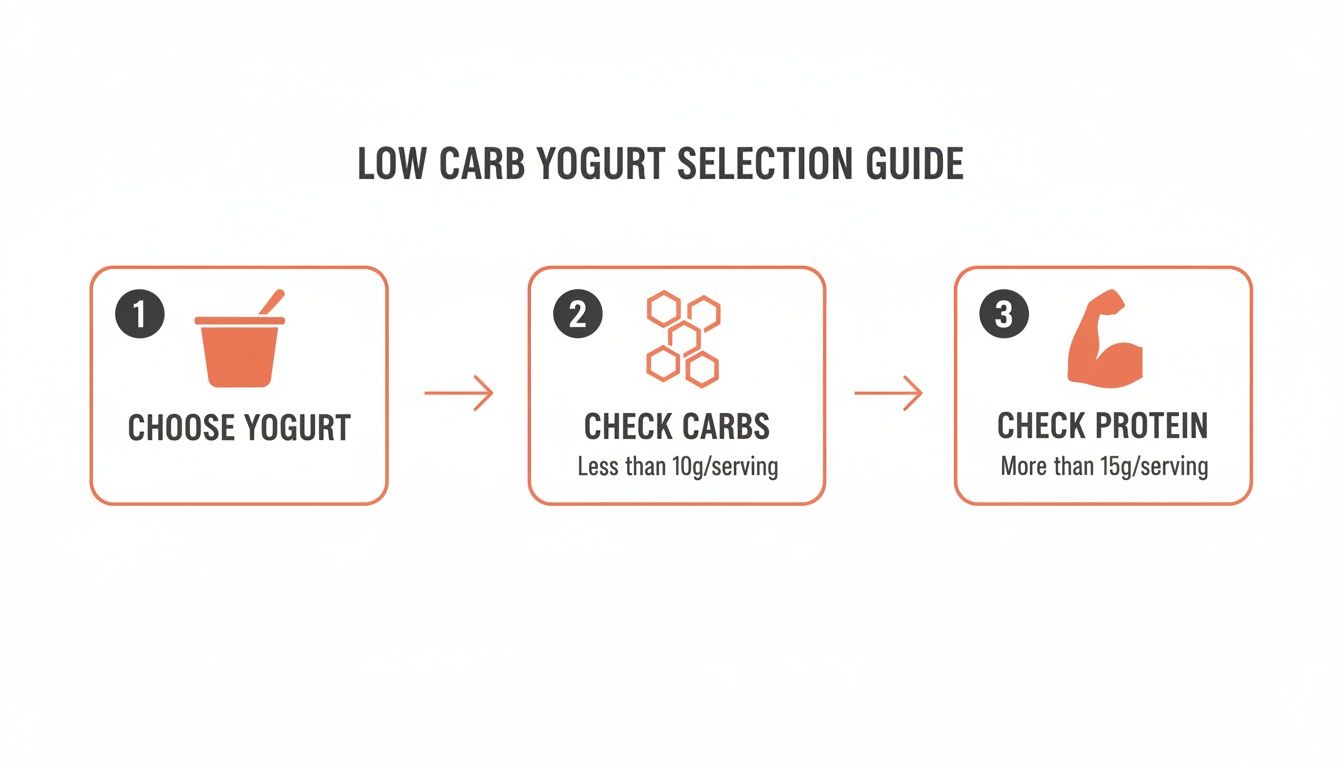
It’s a simple three-step mental checklist: grab a promising option, flip it over to check the carbs, and then weigh that against the protein content. This ensures you're getting a nutritious, filling option, not just a low-carb snack.
Spotting Sneaky Sugars and Carb-Heavy Fillers
Once you've got the net carb count, the next step is a quick scan of the ingredients list. This is where you’ll find the hidden culprits that manufacturers use to add flavor and texture, often at the cost of adding unnecessary carbs.
Keep an eye out for these common offenders:
- Fruit Purees or Concentrates: They sound healthy, but "strawberry puree" is basically a concentrated sugar bomb that can easily add 5-10g of carbs.
- Modified Corn Starch or Tapioca Starch: These are just cheap thickeners. They add a creamy texture, but they’re pure starch—and pure carbs.
- Agave Nectar, Honey, or Cane Sugar: It doesn't matter how "natural" they sound on the packaging. Sugar is sugar, and these will all increase the carb count.
A yogurt can proudly state "no added sugar" on the label and still pack a high-carb punch from the fruit or milk base itself. Your net carb calculation is the only number you can truly trust.
I've seen two vanilla yogurts sitting side-by-side on the shelf look nearly identical, but one will have 6g of carbs while the other has 15g. The difference almost always comes down to those sneaky starches and sweeteners. Getting good at spotting them is a game-changer, and you can get an even more detailed breakdown in our guide on how to read nutrition labels.
By running that quick net carb calculation and giving the ingredients a once-over, you’ll be able to walk out of the store with a yogurt that’s genuinely low-carb and delicious.
Greek vs. Skyr vs. Regular: What's the Difference?

When you're trying to find a good low-carb yogurt, you’ll quickly realize that not all yogurts are made the same. The difference between the tubs of regular, Greek, and Icelandic Skyr all comes down to one simple but crucial process: straining.
How much a yogurt is strained (or isn't) completely changes its texture, protein, and, most importantly for us, its carbohydrate content.
Let's start with the classic: regular yogurt. This is the stuff most of us grew up with—smooth, a little runny, and made by simply fermenting milk. It isn't strained, so it holds onto all its liquid whey. That whey is where most of the natural milk sugar (lactose) hangs out.
Because of this, a plain, regular yogurt has a pretty high carb count, usually clocking in between 12-17 grams per serving. It’s still a great food, but for anyone on a strict low-carb plan, it’s often not the best choice.
The Power of Straining for More Protein
This is where Greek yogurt comes in. It takes that regular yogurt and puts it through a straining process to get rid of a lot of the whey and excess water. For anyone watching their macros, this step is a total game-changer.
When you remove the whey, you also remove a good chunk of the lactose. This process concentrates the protein and results in that thick, rich, and creamy texture that Greek yogurt is famous for.
- Higher Protein: You're looking at nearly double the protein compared to regular yogurt. This makes it incredibly filling.
- Lower Carbs: With less lactose, the carb count naturally plummets, typically landing around 5-9 grams per serving for plain versions.
Choosing a strained yogurt like Greek is one of the easiest swaps you can make to boost protein while cutting carbs. That luxuriously thick texture is just a happy side effect.
It's no surprise that Greek-style yogurt now dominates the yogurt aisle. Brands caught on quickly, with options like Oikos Triple Zero setting a high bar by packing 15 grams of protein into a serving with just 7 grams of carbs. As research confirms, the high protein in these yogurts can be a real asset for weight management by keeping you fuller for longer. If you want to dive deeper, you can find more great recommendations in this registered dietitian's low-carb yogurt picks.
Skyr: The Denser, Milder Cousin
If Greek yogurt is strained, then Icelandic Skyr (pronounced "skeer") is strained to the absolute max. It’s so thick that it's technically a type of strained cheese that we eat like a yogurt. In fact, it takes about four times as much milk to make a tub of Skyr as it does to make a regular yogurt.
This intense straining process removes almost all the whey, creating a product that is unbelievably dense, smooth, and much milder in flavor than tangy Greek yogurt.
If you are laser-focused on getting the highest protein-to-carb ratio possible, Skyr is almost always the champion.
Beyond the Spoon: Creative Ways to Use Your Low-Carb Yogurt
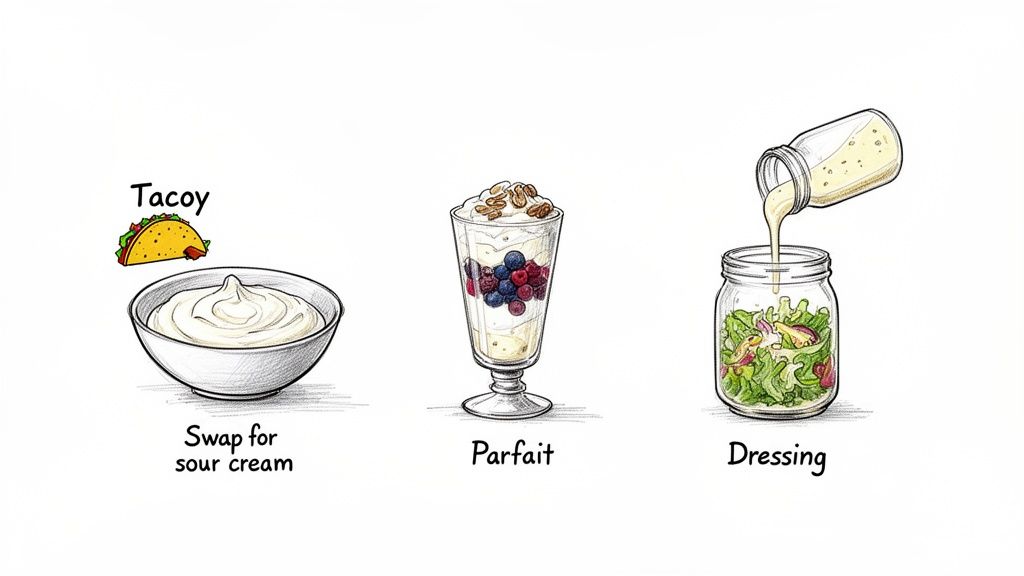
That tub of plain, low-carb yogurt in your fridge is a secret weapon. Sure, it’s a solid snack on its own, but eating the same thing every day is a surefire way to get bored and fall off track. To really stick with your health goals, you have to keep things interesting.
Think of that plain yogurt as a blank canvas. It’s your ticket to boosting protein, slashing unnecessary fats, and adding a rich, creamy texture to all sorts of dishes—both sweet and savory.
Make Smart Swaps in Savory Dishes
One of the simplest tricks in the book is using plain Greek yogurt as a stand-in for high-fat dairy like sour cream or mayonnaise. Its natural tang and thick texture make it a near-perfect substitute, but with a much friendlier nutritional profile.
Take a look at your go-to comfort foods. The dollop of sour cream on your chili or tacos? Swap it one-for-one with plain Greek yogurt. You get the same cool, creamy contrast, but with an extra hit of protein and far fewer calories. Suddenly, your favorite meals fit your macros without feeling like a compromise.
My personal go-to is making veggie dips. Forget the store-bought tubs. I just mix plain Greek yogurt with some ranch seasoning and fresh dill. It’s a high-protein dip that actually feels satisfying and keeps me full.
Here are a few other swaps I use all the time:
- Creamy Dressings: Instead of a mayo-heavy base, I’ll blend plain yogurt with lemon juice, fresh herbs (like chives or parsley), and a little olive oil for a fantastic ranch or caesar-style dressing.
- Tuna or Chicken Salad: Ditch the mayo completely. Greek yogurt binds everything together just as well, creating a lighter, tangier salad that’s absolutely packed with protein.
- Cooling Sauces: A quick tzatziki is my favorite way to dress up grilled chicken. Just stir some grated cucumber, minced garlic, and mint into your yogurt. It’s refreshing and simple.
Build a Better Breakfast (or Snack)
Of course, yogurt really shines in sweeter meals. But "sweet" doesn't have to mean a carb bomb. When you start with a plain, low-sugar base, you are in the driver's seat. This is your chance to build a truly satisfying breakfast or snack that works for you, not against you.
The classic yogurt parfait is popular for a reason—it’s all about the layers of flavor and texture. The key is to be strategic with your add-ins.
To put together a great low-carb parfait, you’ll want to layer your yogurt with ingredients that add nutrition and crunch without sending your carb count through the roof.
My Formula for a Perfect Parfait:
- The Base: Always start with a quality plain yogurt. Greek, Skyr, or a keto-friendly option like Two Good or Ratio will keep your starting carbs incredibly low.
- The Fruit: A small handful of berries is your best bet. Raspberries, blackberries, and strawberries deliver a pop of freshness and fiber with very little sugar.
- The Crunch: This is crucial for satisfaction. I finish my parfaits with a sprinkle of chopped almonds, chia seeds, or a good keto granola to add healthy fats and that much-needed texture.
Building your own means you can easily sidestep the pre-made parfaits from the grocery store, which can hide 20-30 grams of sugar in their sugary granola and fruit compotes. This way, you get a delicious, filling meal that’s perfectly dialed into your goals.
Smarter Nutrition Tracking with an AI Coach
You’ve done the hard work. You navigated the grocery store, deciphered nutrition labels, and brought home the perfect low-carb yogurt. But let's be honest, that's only half the battle. All that effort falls flat if you don't track what you eat consistently.
I've seen it time and time again: people get frustrated with tedious manual logging and eventually just give up. It’s slow, it’s a hassle, and it’s easy to let slide.
This is exactly where a modern AI-powered coach like BiteKit changes the game. It’s designed to remove all the friction that makes traditional meal logging feel like a chore. Instead of getting bogged down in databases, you can log your food as easily as talking to a friend.
Effortless Logging for Busy Lives
Think about making a quick yogurt parfait with some berries and a sprinkle of nuts. The old way meant manually searching for the specific brand of yogurt, guessing the amount of berries, finding the right type of nuts, and logging each one separately. It's enough to make you not want to eat the snack in the first place.
With BiteKit, you just snap a photo. That's it.
The app’s technology gets to work, instantly identifying the yogurt, the berries, and the nuts. It then estimates the portions and logs the macros for you, all from that single picture.
Here’s a look at the simple, clean interface you'd see.
Notice how the focus is squarely on your daily macros—carbs, protein, and fat. There’s no clutter, just immediate feedback showing you exactly how that yogurt snack fits into your goals for the day.
You can also just speak your meal into the app. Saying, “I had a bowl of Two Good yogurt with berries and nuts,” is all it takes for BiteKit to understand and accurately log the meal.
This real-time feedback loop is what truly helps build lasting habits. It connects your food choices directly to your macro targets without the frustrating data entry getting in the way.
This approach makes tracking feel less like a homework assignment and more like a quick, helpful conversation. When a tool is this simple, you’re far more likely to stick with it—and consistency is everything when it comes to reaching your fitness goals.
For anyone serious about dialing in their diet, comparing the best calorie tracking apps of 2026 can highlight just how much this technology has improved. This kind of instant analysis empowers you to make smarter choices on the fly, adjusting your next meal based on how that low-carb yogurt impacted your day.
Common Questions About Low Carb Yogurt
Stepping into the yogurt aisle can feel overwhelming when you're tracking carbs. With so many options, from classic Greek to keto-specific brands, it's easy to get lost. Let's clear up some of the most common questions so you can shop with confidence.
Is Plain Yogurt Always the Lowest in Carbs?
You’d think "plain" would automatically mean "lowest carb," but that’s not always the case. While unsweetened, plain yogurt is a fantastic starting point, some flavored products are specifically designed to have even fewer carbs.
Brands like Two Good and Chobani Zero Sugar, for example, use natural, non-caloric sweeteners like stevia or monk fruit. This lets them create delicious, flavored yogurts that can actually have fewer net carbs than plain versions that still contain some natural milk sugar (lactose).
My rule of thumb? Ignore the claims on the front of the package and head straight for the nutrition label. Always compare the net carbs of different brands, whether they're plain or flavored.
This simple habit ensures your choice is based on hard data, not just savvy marketing.
What Are Sugar Alcohols and Do They Count?
If you’ve flipped over a "zero sugar" yogurt, you’ve probably spotted ingredients like erythritol or xylitol. These are sugar alcohols, a class of carbohydrate that provides sweetness without the calories or blood sugar spike of regular sugar.
Even though they're listed under 'Total Carbohydrates' on the nutrition panel, your body doesn't fully digest them. Because of this, most people subtract the grams of sugar alcohols from the total carbs to get a more accurate 'net carb' count.
But it's important to know they aren't all the same:
- Erythritol: Has almost no impact on blood sugar. You can generally subtract its full gram count from your total carbs.
- Maltitol: This one can have a bigger effect. I usually recommend counting half of its grams toward your net carb total just to be safe.
- Xylitol & Sorbitol: These fall somewhere in the middle.
Knowing the difference helps you track your intake with much greater accuracy, especially since so many low-carb yogurts rely on these sweeteners.
Can I Eat Yogurt on a Strict Keto Diet?
Absolutely! Yogurt can be a fantastic addition to a ketogenic diet, as long as you choose the right kind and keep an eye on your portions. The trick is to find yogurts that are exceptionally low in net carbs.
A single serving of a brand like Ratio Keto or Two Good usually contains only 2 grams of net carbs, making it easy to fit into a strict keto plan (under 25 grams of carbs daily). Full-fat plain Greek yogurt is another solid choice because the straining process removes a lot of the lactose.
And beyond the macros, low-carb yogurts are some of the best fermented foods for digestion, which is a huge bonus for gut health.
Just be sure to double-check the label and make sure the serving size works with your daily carb budget. By sticking to these ultra-low-carb options, you can enjoy that creamy texture and protein punch without knocking yourself out of ketosis.