Protein Bars Nutrition Facts: A Scientific Guide for 2026
Decode protein bars nutrition facts to find genuinely healthy options. Learn to read labels, avoid hidden sugars, and pick the best bar for your fitness goals.

You can't walk into a grocery store or gas station anymore without facing a wall of protein bars. They’ve become a staple for everyone from serious athletes to busy parents who just need a quick, no-fuss snack. But as their popularity has soared, so has the confusion. Differentiating a genuinely beneficial bar from a candy bar with a marketing degree requires a closer look at the science behind the label.
Why Is Everyone Eating Protein Bars?

The protein bar aisle seems to grow every week, and this explosion comes down to two modern phenomena: a heightened focus on health and increasingly hectic schedules. Consumers are actively seeking convenient ways to support their fitness and dietary goals without extensive meal preparation.
The market data reflects this trend. The global protein bar market was valued at an estimated USD 5.46 billion in 2026, with projections showing continued strong growth. According to analysis from GrandViewResearch, this expansion is directly linked to increased health awareness and the global rise in fitness culture.
The Perfect Fit for a Hectic Life
At their best, protein bars provide a practical solution for modern nutritional challenges, offering a simple, portable fix for several key scenarios:
- Post-Workout Recovery: Providing essential amino acids to facilitate muscle protein synthesis and repair after exercise.
- Satiety and Snack Control: A convenient way to manage hunger between meals, often proving more satiating than high-carbohydrate alternatives.
- Achieving Protein Targets: An easy method to augment daily protein intake, particularly for athletes and active individuals who, according to evidence, may benefit from 1.6-2.2 grams of protein per kilogram of body weight to optimize muscle adaptation.
Scientifically speaking, a well-formulated protein bar is a tool for nutrient timing and macronutrient management. Its efficacy, however, is entirely dependent on its composition.
The critical issue is that not all bars are created equal. Understanding protein bars nutrition facts is essential. Without the ability to interpret the nutrition label, you risk consuming a product high in refined sugars and saturated fats, which could actively undermine your health goals.
This guide will deconstruct the marketing claims, enabling you to decode nutrition labels, identify common formulation red flags, and make evidence-based choices for your specific objective—be it weight management, muscle hypertrophy, or general wellness.
How to Read a Protein Bar Nutrition Label
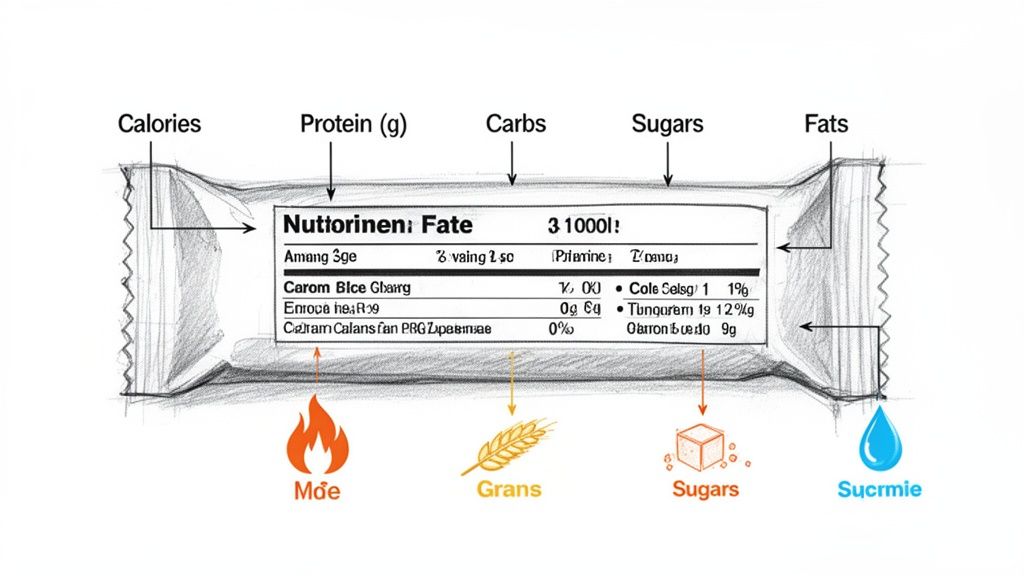
The front of a protein bar's packaging is marketing; the nutrition facts panel is science. This panel is the only objective source of information about the bar's composition. Mastering the ability to read and interpret it is the single most important skill for selecting a product that supports, rather than hinders, your physiological goals.
Becoming proficient in this area is a foundational step in nutritional autonomy. For a more exhaustive breakdown, consider our comprehensive guide on reading all types of nutrition labels.
Calories: The Unit of Energy
Calories, a unit of energy, are the first metric on the label. The optimal caloric content is not universally "low" or "high"; it is context-dependent and dictated by your goal.
- For weight loss or a light snack: A bar in the 180-250 calorie range can provide satiety without significantly impacting your daily energy budget.
- For muscle gain or a meal replacement: A more substantial energy contribution is required to fuel metabolic processes and support a caloric surplus. A bar between 250-400 calories is more appropriate.
Protein: The Anabolic Signal
As the bar's namesake, protein is the key macronutrient. A clinically effective dose to stimulate muscle protein synthesis and promote satiety is generally considered to be at least 15-20 grams.
The source of the protein is as critical as the quantity. Whey and casein, milk-derived proteins, are rich in essential amino acids (EAAs), particularly leucine, and are rapidly digested, making them ideal for post-exercise recovery. Plant-based proteins like pea, soy, and brown rice isolates are also effective, especially when combined in a blend to ensure a complete amino acid profile that mirrors that of animal-based sources.
From a biochemical standpoint, protein provides the amino acid substrates for tissue repair and synthesis. Insufficient intake of high-quality protein (i.e., a complete EAA profile) will blunt the adaptive response to training. A bar with less than 10g of protein is nutritionally insignificant for this purpose.
For a deeper dive into protein sources, a detailed guide to how to choose protein powder provides principles that are directly applicable to bars.
Carbohydrates: Fiber vs. Sugar
The "Total Carbohydrates" figure is less informative than its sub-components: dietary fiber and sugar.
Dietary Fiber: This is a crucial, non-digestible carbohydrate. Fiber promotes satiety, supports gut health, and attenuates the glycemic response of a meal. A bar containing over 5 grams of fiber is a good indicator of a well-formulated product.
Total Sugars: This is where many "health" products fail. Pay specific attention to the "added sugars" line. High amounts of added sugars like fructose or corn syrup can lead to rapid blood glucose spikes and subsequent crashes, promoting further hunger and fat storage. Aim for a bar with less than 5 grams of added sugar.
Fats: The Satiety Factor
Dietary fat is not the enemy. Healthy fats from whole-food sources like nuts, seeds, and avocados are essential for hormone production, nutrient absorption, and providing long-lasting satiety. A bar with 10-15 grams of fat derived from high-quality sources is beneficial.
The concern lies with high levels of saturated and trans fats, which are often indicative of cheap, inflammatory oils used as fillers.
A Note on Sugar Alcohols
Sugar alcohols (polyols) like erythritol, sorbitol, and maltitol are commonly used to provide sweetness without the calories of sucrose. They are partially or poorly absorbed in the small intestine, hence their reduced caloric value.
While this is an effective strategy for lowering the "net carb" count, it comes with a significant caveat: for many individuals, the unabsorbed polyols are fermented by gut bacteria, leading to gastrointestinal distress such as bloating, gas, and osmotic diarrhea. Maltitol is particularly notorious for these effects. If you have a sensitive GI tract, opt for bars sweetened with stevia, monk fruit, or limited amounts of erythritol, which is generally better tolerated.
Spotting Red Flags on The Ingredient List
The ingredient list provides the ultimate transparency into a bar’s quality, moving beyond the summarized protein bars nutrition facts panel. Ingredients are listed in descending order by weight, meaning the first few items comprise the bulk of the product. This is where you can truly assess whether a bar is a nutritional tool or simply ultra-processed food.
Deceptive Sugars and Fillers
The most prevalent red flag is the presence of sugar in its various forms. While the "Added Sugars" line is a useful metric, the ingredient list reveals the source. If sugar, high-fructose corn syrup, or other syrups appear in the top three ingredients, the bar is fundamentally a sugar-delivery system.
Additionally, be wary of fillers like soy protein isolate (in many non-vegan bars), palm kernel oil, and various starches. These are often used to add bulk and improve texture cheaply, offering minimal nutritional benefit and potentially contributing to inflammation.
A well-formulated bar is built on a foundation of whole-food ingredients. An ingredient list dominated by chemical-sounding names, syrups, and starches is a clear sign of a low-quality, highly processed product.
The Problem with Sugar Alcohols
As mentioned, sugar alcohols like sorbitol, xylitol, and especially maltitol are used to reduce the sugar content on the label. However, their physiological impact cannot be ignored.
Maltitol, in particular, has a relatively high glycemic index for a sugar alcohol and is well-documented to cause significant gastrointestinal distress. The fermentation of these unabsorbed carbohydrates in the large intestine can lead to bloating, flatulence, and a laxative effect, negating any perceived benefit of a low "net carb" count.
If you have a sensitive gut, seek out bars sweetened with non-nutritive, natural sweeteners such as:
- Stevia
- Monk Fruit
- Erythritol (generally the best-tolerated sugar alcohol)
Low-Quality Protein Blends
A "high protein" claim is meaningless if the protein is of low biological value. Manufacturers may use cheap sources to inflate the protein number on the label.
Watch out for protein blends that heavily feature gelatin or hydrolyzed collagen. While these proteins have benefits for connective tissue, they are incomplete proteins, lacking the full spectrum of essential amino acids (especially tryptophan) required to effectively stimulate muscle protein synthesis.
Ensure that a high-quality, complete protein source—such as whey protein isolate, casein, or a complementary blend of plant proteins like pea and rice—is listed as one of the primary ingredients. This is a non-negotiable sign of a bar designed for efficacy.
Matching The Right Protein Bar to Your Goal
The concept of a universally "perfect" protein bar is a fallacy. The optimal bar is defined by its ability to meet the specific physiological demands of your goal. A high-calorie, carbohydrate-rich bar designed for an endurance athlete is an inappropriate choice for a sedentary individual aiming for weight loss.
Before evaluating a product, you must first define your objective. Using a protein bar is a strategic nutritional intervention; you must choose the right tool for the right job by matching its macronutrient profile to your specific needs.
For Weight Loss and Management
For weight loss, the primary functions of a protein bar are to promote satiety and provide a low-calorie, nutrient-dense snack that displaces less healthy choices. This helps maintain a caloric deficit without experiencing excessive hunger.
The ideal bar will have a high protein-to-energy ratio. Look for at least 15 grams of protein and over 5 grams of fiber, a combination proven to enhance satiety. The total energy should be controlled, ideally under 250 calories. Critically, the added sugar content must be minimal (less than 5 grams) to prevent the insulin spikes and subsequent crashes that drive cravings.
In the context of weight management, a protein bar serves as a metabolic bridge. It is a tool to navigate the time between whole-food meals, helping you adhere to your caloric budget.
For Muscle Gain and Recovery
For muscle hypertrophy, a protein bar's role shifts from a simple snack to a targeted delivery of anabolic and restorative nutrients. It contributes to the necessary caloric and protein surplus required for tissue growth.
Here, a higher energy and protein content is desirable. Aim for over 20 grams of high-quality protein to maximally stimulate muscle protein synthesis post-exercise. The calorie count should be higher, typically 250 to 400 calories. The inclusion of carbohydrates is beneficial here, as they help replenish muscle glycogen stores depleted during training. The principles regarding the best time to take protein powder are directly relevant, with bars offering a convenient solid-food alternative.
For a Meal Replacement or General Energy
In situations where a whole-food meal is not feasible, a well-balanced bar can serve as a temporary meal replacement. To qualify, it must be nutritionally substantial.
These bars are formulated to be more calorically dense and balanced across all macronutrients, typically in the 300-400+ calorie range. A well-rounded profile would look like:
- Protein: 15-25 grams
- Carbohydrates: 25-40 grams
- Fats: 10-20 grams
Integrating bars into your diet effectively requires understanding your total daily needs. Our guide on how to calculate your protein intake can provide a personalized target.
To simplify selection, this table provides evidence-based macronutrient targets based on your primary goal.
Protein Bar Macro Guide by Fitness Goal
| Goal | Calories | Protein (g) | Carbs (g) | Sugar (g) | Fiber (g) |
|---|---|---|---|---|---|
| Weight Loss | < 250 | 15+ | < 20 | < 5 | 5+ |
| Muscle Gain | 250 - 400 | 20+ | 25 - 45 | < 15 | 3-10 |
| Meal Replacement | 300 - 400+ | 15 - 25 | 25 - 40 | < 15 | 5+ |
| Energy Boost | 200 - 300 | 10 - 20 | 20 - 35 | < 20 | 3-7 |
By using these guidelines to compare with a bar's nutrition label, you transition from a passive consumer to an active, informed participant in your own nutritional strategy.
Making Nutrition Tracking Effortless
Understanding a protein bar's nutritional profile is the first step. Consistently integrating that data into a broader tracking strategy is what drives long-term results. The primary obstacle to consistent tracking has always been the manual effort involved. This friction point is often where even the most motivated individuals abandon the habit.
Modern technology, however, has fundamentally changed this paradigm. The tedious process of manual data entry, barcode scanning, and database searching is becoming obsolete.
The Power of Instant Logging
Imagine finishing a workout and eating a protein bar. You take a photo of the packaging with your smartphone. An AI-powered app like BiteKit then instantly parses the protein bars nutrition facts from the image, automatically logging the calories, protein, carbs, and fats into your daily totals.
No manual input, no searching, no friction.
This near-instantaneous logging process removes the primary barrier to adherence. When the act of tracking requires less effort than the act of eating, it becomes a seamless and sustainable habit.
Here is a practical example from the BiteKit app, displaying a clear, concise dashboard of daily macronutrient intake.
This real-time feedback loop allows for immediate, informed decisions about your next meal, ensuring you stay aligned with your goals.
Technology That Keeps You Consistent
This level of automation does more than save time; it fosters the consistency that is the cornerstone of any successful body composition or weight management plan. The data collected becomes a powerful tool, especially when you understand the principles of how to track macros for weight loss.
Consistency is the engine of physiological adaptation. By removing the friction from nutritional tracking, technology empowers individuals to maintain the daily habits that compound into significant, long-term results.
This infographic summarizes how to align your protein bar choice with your primary fitness goal.
It serves as a quick reference, reinforcing the idea that the "best" bar is the one that is biochemically appropriate for your specific needs. By selecting the right product and tracking it effortlessly, you create a powerful, closed-loop system for success. You can consume a convenient protein bar with the full confidence that it is a strategic choice, perfectly aligned with your goals.
Frequently Asked Questions About Protein Bars
Even with a solid understanding of nutrition labels, certain questions persist, largely due to pervasive marketing myths. Here, we address the most common inquiries with a scientific, evidence-based approach.
Are Protein Bars Just Glorified Candy Bars?
Some unequivocally are; others are well-formulated nutritional tools. The distinction lies in the macronutrient ratio and ingredient quality.
A beneficial protein bar will contain at least 15+ grams of high-quality protein, more than 5 grams of dietary fiber, and minimal added sugar (ideally <5 grams). Many products marketed for "fitness" are, in fact, high in sugar and unhealthy fats, making them functionally equivalent to confectionery. The only way to differentiate is to ignore front-of-package claims and critically analyze the protein bars nutrition facts and ingredient list.
Is It Okay to Eat a Protein Bar Every Day?
For most healthy individuals, daily consumption of a high-quality protein bar is generally safe. The crucial qualifier is "high-quality."
However, they should function as a supplement to, not a replacement for, a diet rich in whole foods. Whole food sources like chicken, fish, legumes, and eggs provide a broader spectrum of micronutrients, phytochemicals, and fiber that cannot be replicated in a processed bar.
Think of a protein bar as a convenient tool for specific situations, like post-workout recovery or when a whole-food meal is impractical. It should not form the cornerstone of your nutritional intake.
It's also important to note that protein intake follows a law of diminishing returns. Research indicates that once daily protein needs are met for an individual, consuming excess protein does not confer additional benefits for muscle growth or performance. A daily bar must fit within a well-structured, goal-oriented diet.
Which Is Better: Whey or Plant-Based Protein?
Both protein sources can be highly effective for stimulating muscle protein synthesis. The "better" choice depends on individual dietary preferences, tolerances, and ethical considerations.
-
Whey Protein: A milk derivative, whey is a "complete" protein with a high concentration of all essential amino acids (EAAs), particularly leucine. It is rapidly digested and absorbed, making it an excellent choice for post-exercise recovery.
-
Plant-Based Protein: High-quality plant-based bars typically use a blend of sources (e.g., pea protein isolate, brown rice protein) to create a complete amino acid profile comparable to whey. They are an excellent option for vegans, individuals with lactose intolerance, or those who experience digestive issues with dairy.
From a muscle protein synthesis standpoint, the key is consuming a sufficient dose of a complete protein. Both high-quality whey and well-formulated plant blends achieve this.
Do Sugar Alcohols Count Toward My Daily Carbs?
This is a common point of confusion. Sugar alcohols (polyols) like erythritol and xylitol are structurally carbohydrates but are incompletely absorbed in the human gut. This is why they provide fewer calories per gram than sugar and are often subtracted to calculate "net carbs."
However, they are not metabolically inert. Their incomplete absorption can lead to osmotic diarrhea and fermentation by gut bacteria, causing significant gastrointestinal distress (bloating, gas) in sensitive individuals. If a protein bar consistently causes you digestive discomfort, sugar alcohols are a likely culprit. In such cases, seek out bars sweetened with non-caloric natural sweeteners like stevia or monk fruit.