Your Guide to the Protein Intake Calculator for Women
Use our protein intake calculator for women to find your optimal daily protein target for fitness, weight loss, or healthy aging. Calculate your needs now.
Figuring out exactly how much protein you need can feel like one of nutrition's biggest mysteries. A protein intake calculator for women cuts through that confusion. It's designed to give you a smart, personalized target based on your body, your lifestyle, and what you’re trying to achieve—not just some generic number.
Why a One-Size-Fits-All Protein Target Doesn't Work for Women
Let's get one thing straight: protein isn't just for bodybuilders chugging shakes. It's an absolute foundation of a woman's health, backed by extensive scientific research. It plays a crucial role in everything from metabolism and bone strength to hormone regulation and promoting satiety after meals.
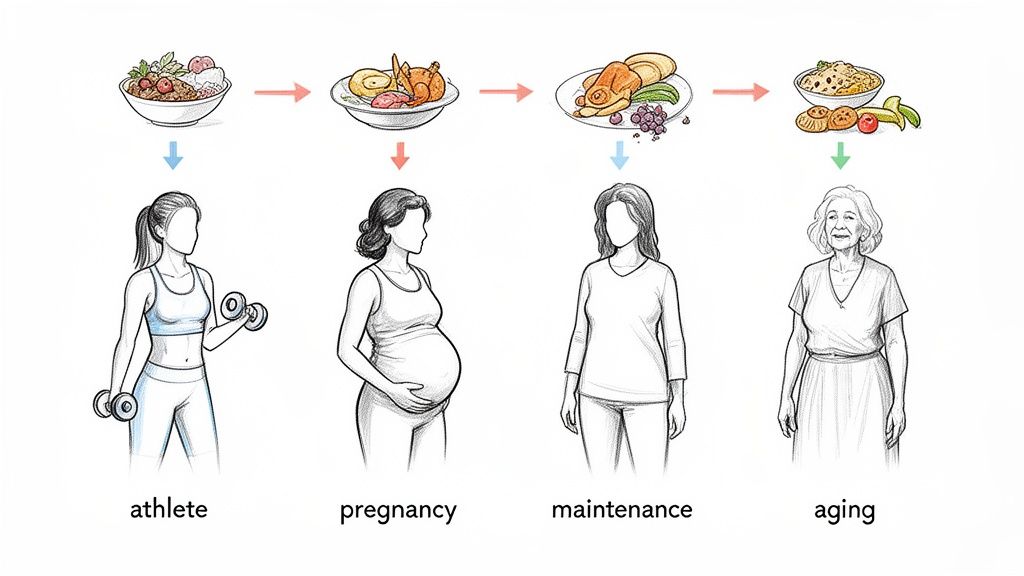
The problem is, the standard advice you see everywhere rarely accounts for the fact that a woman's body and needs are constantly changing. The protein requirements for a 25-year-old marathon runner are worlds apart from those of a 55-year-old navigating menopause and focused on healthy aging. These different life stages demand a much more tuned-in approach to nutrition.
Your Goals and Life Stage Call the Shots
If you're younger and very active, you'll need more protein to support muscle repair and growth. On the other hand, an older woman might need to prioritize protein to combat sarcopenia, the age-related loss of muscle mass. And of course, pregnancy and breastfeeding create a massive spike in protein demands to support both mother and baby.
When you rely on a generic formula, you're just guessing. You could easily be under-consuming protein, which can sabotage your goals by stalling fat loss, preventing muscle gain, or even weakening your immune system.
A personalized protein target is non-negotiable for achieving specific outcomes. Whether you want to lose fat without sacrificing muscle, build strength, or support your body through hormonal changes, knowing your number is the first step.
A Global Shift in How Women View Protein
This need for a more personalized approach is something we're seeing on a global scale. Women are now the main force behind the growing demand for protein worldwide—a major shift in the nutrition landscape.
Research from Euromonitor International has shown that younger women tend to link protein with fitness and body composition, while women over 40 see it as a critical tool for healthy aging and maintaining muscle mass.
This wave of awareness is exactly why a tool like a protein intake calculator for women is so valuable. It acts as your personal nutrition guide, taking you from vague advice to a clear, science-backed target. To get the most accurate number, you'll want to understand your body composition. A great starting point is to use our lean body mass calculator, which helps base your protein needs on your active tissue rather than just your total weight.
Finding Your Protein Starting Point
Before we get into tailoring your protein for specific goals, you need a solid baseline. The number you’ll see thrown around everywhere is the Recommended Dietary Allowance (RDA), which is 0.8 grams of protein per kilogram of body weight.
But here’s what most people miss: the RDA is the bare minimum to prevent deficiency. It's not the amount you need to truly thrive. For women who are active, trying to change their body composition, or just want to feel their best, hitting only the RDA can actually hold you back. Think of it as the absolute floor, not the ceiling.
How to Calculate Your Foundational Number
Let's make this real. Say you weigh 150 pounds. The formulas used in nutritional science are almost always in kilograms, so the first thing we have to do is a quick conversion.
- Pounds to Kilograms: Divide your weight in pounds by 2.205.
- Our Example: 150 lbs / 2.205 = 68.0 kg. We can round that to 68 kg to keep things simple.
Now, we can use that number to find your baseline protein need based on the RDA.
- RDA Formula: Your weight in kilograms x 0.8.
- Our Example: 68 kg x 0.8 g/kg = 54.4 grams of protein per day.
So, for a 150-pound woman, the absolute rock-bottom minimum she should aim for is about 54 grams of protein a day. This is just enough to handle basic repairs and keep your body running—it’s not designed to help you build muscle, recover faster from workouts, or support fat loss.
Why Your Baseline Is Just the Beginning
Having this number is a great start, but it's crucial to put it in perspective. Research shows that the median protein intake for women worldwide hovers right around this 0.8 g/kg mark. In fact, a study published on Frontiers found that only 33.7% of women of reproductive age are even meeting this official minimum.
At the same time, scientific evidence consistently shows that women who consume higher amounts of protein are far less likely to be overweight or obese. You can read more about these global protein intake trends on Frontiers.
This disconnect is a huge opportunity. Simply aiming for the bare minimum isn't the path to better health, a stronger body, or a leaner physique. This baseline is your launchpad for figuring out what your body really needs to perform at its peak.
For a deeper dive into adjusting this number, our guide on how to calculate protein intake covers more advanced methods to help you move from this baseline to a truly personalized target. Next, we’ll look at exactly how to tweak this number for goals like weight loss or muscle building.
How to Adjust Your Protein Intake for Your Specific Goals
Think of your baseline protein number as just that—a baseline. It’s the minimum you need to stay healthy, but it's not the number that will help you crush your specific fitness goals. Real results come from fine-tuning that number based on what you're actually trying to do with your body.
After all, the demands you place on your body are completely different if you're trying to lose weight versus training for a marathon or building serious muscle. Simply sticking to the bare minimum won't give your body the fuel it needs to adapt, repair, and grow.
This simple flowchart shows how to get that absolute baseline we talked about. We'll use this as our starting point.
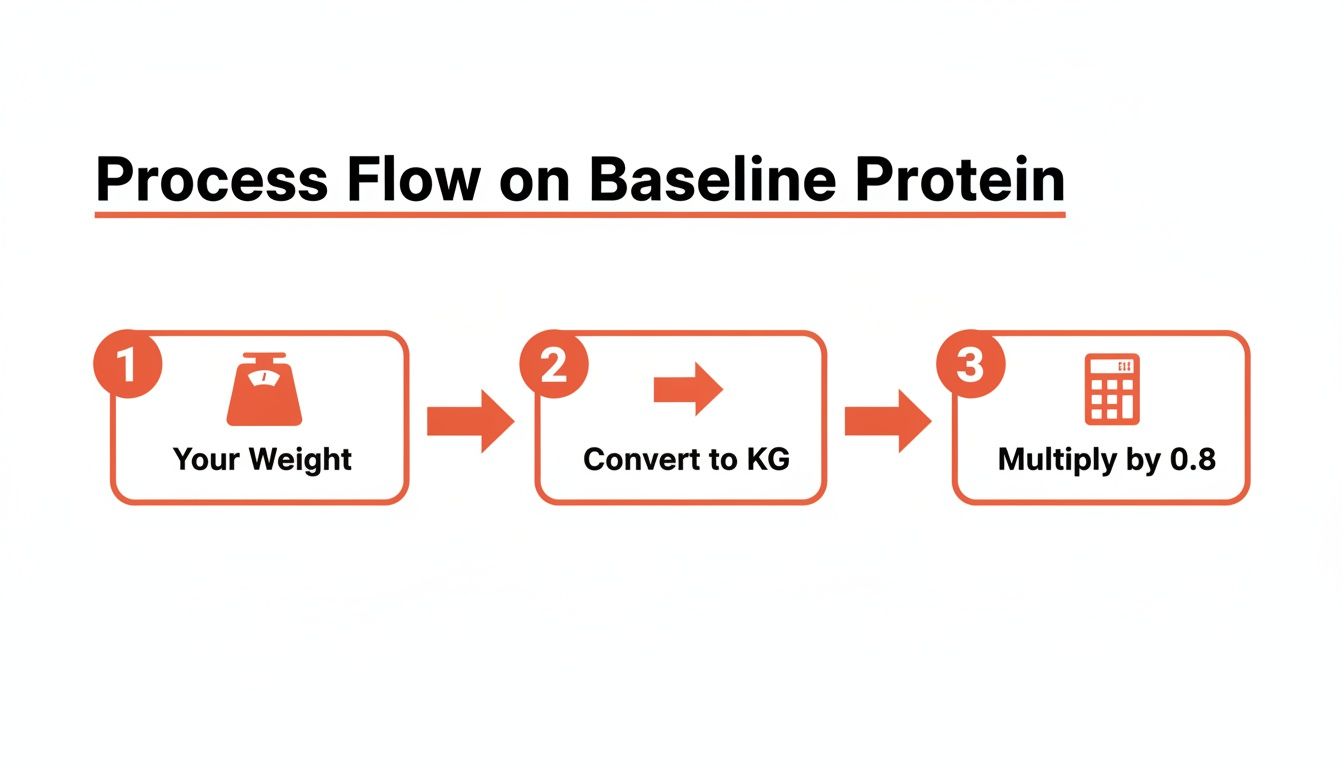
Remember, this calculation gives you the amount needed to prevent a deficiency. For targeted results, you'll need to aim a bit higher.
Protein for Weight Loss and Fat Reduction
If fat loss is your main objective, protein is your new best friend. It’s arguably the most important macronutrient to get right when you’re in a calorie deficit. Most scientific literature points to a higher intake, typically in the range of 1.6 to 2.2 grams per kilogram of body weight, for the best results.
Why so much? Two evidence-based reasons.
- It keeps you full. Protein has a high thermic effect of food (TEF) and is incredibly satiating. Consuming enough of it helps suppress hunger hormones and fend off cravings, making adherence to a lower-calorie plan much easier.
- It protects your muscle. During weight loss, you don't want to lose metabolically active muscle tissue. A high-protein diet helps preserve that lean mass, ensuring the pounds you're shedding are coming from fat, not muscle.
This strategy keeps your metabolism humming and helps you build a leaner, stronger physique in the process.
Fueling Muscle Growth and Strength
For women focused on building lean muscle and getting stronger, the protein recommendations look surprisingly similar to the weight loss range. To optimize muscle protein synthesis—the body's process for repairing and building new muscle—you'll want to aim for 1.6 to 2.2 grams per kilogram of body weight.
When you combine that level of protein with consistent resistance training, you send a clear anabolic signal to your body to build and maintain muscle. Without sufficient protein, your efforts in the gym won't deliver the desired physiological adaptations. For more ideas on hitting these higher numbers, check out our guide on how to eat more protein.
Protein Needs for Athletes and Healthy Aging
Your goals might be less about changing your body composition and more about performance or longevity. An endurance athlete, for instance, needs ample protein to repair the muscle damage that comes from hours of training. Likewise, women focused on healthy aging need enough protein to fight off sarcopenia—the natural muscle loss that happens as we get older.
In both of these scenarios, scientific consensus suggests a moderate-to-high intake of 1.2 to 1.7 grams per kilogram is a solid target. This helps preserve muscle, support bone density, and maintain the functional strength you need for life.
To see just how much these different goals can change your daily target, let's look at some real-world numbers.
Sample Protein Calculations for a 150 lb (68 kg) Woman
The table below shows how a 150-pound woman's protein needs can shift dramatically based on her primary focus.
| Primary Goal | Calculation (grams per kg) | Daily Protein Target (grams) |
|---|---|---|
| Healthy Aging | 1.4 g/kg | 95 grams |
| Weight Loss | 1.8 g/kg | 122 grams |
| Building Muscle | 2.2 g/kg | 150 grams |
As you can see, the same person could have a daily protein goal that varies by more than 50 grams! This is exactly why a one-size-fits-all approach to nutrition rarely works and why understanding how to adjust your numbers is key to getting where you want to go.
Putting Your Protein Target into Practice
Okay, so you’ve got your magic number from the protein calculator. That’s the first huge win. But how do you actually turn that number into food on your plate, day in and day out? This is where the plan becomes reality, and honestly, it's a lot simpler than it sounds.
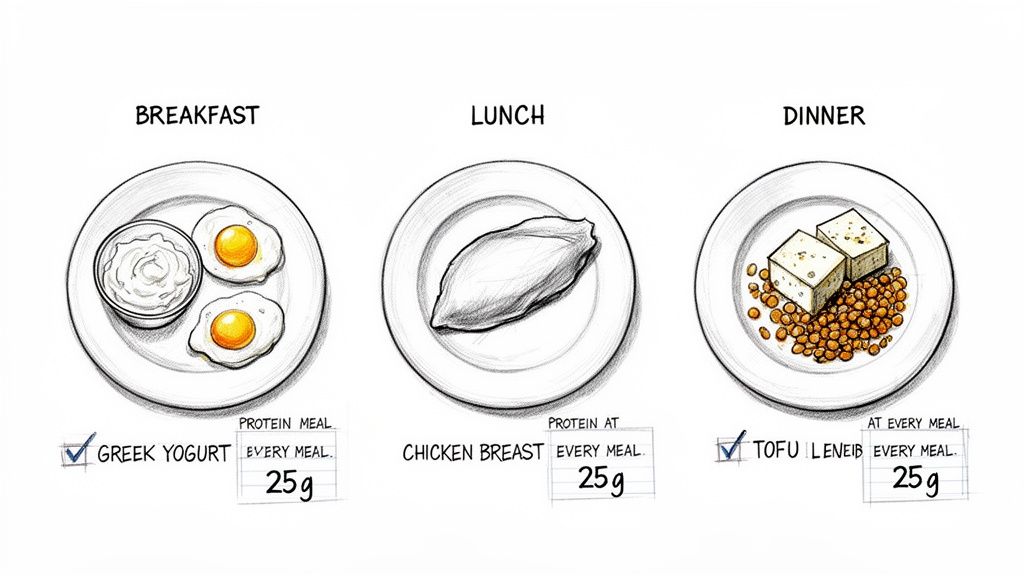
Staring at a target of, say, 120 grams can feel overwhelming if you think about it as one big lump. The secret is to break it down. If you aim for 30 grams of protein at each of your three main meals, that’s 90 grams right there. Add in two 15-gram snacks, and suddenly, that intimidating number seems completely doable.
This strategy does more than just make your goal feel achievable. Spreading your protein intake throughout the day is fantastic for keeping your energy levels steady and crushing those mid-afternoon hunger pangs. It shifts your focus from one massive, abstract number to small, actionable goals for each meal.
What Does Protein Look Like on Your Plate?
So, what does 25-30 grams of protein actually look like in the real world? It's probably not as much food as you're picturing. Getting a feel for portion sizes is the quickest way to get confident with your choices, so you don't have to live with a food scale glued to your hand.
A great rule of thumb I tell my clients is to aim for a portion of protein-rich food that’s about the size and thickness of your palm with every meal. It's a surprisingly accurate visual cue that works whether you're at home or out at a restaurant.
Here are a few real-world examples to help you visualize it:
- A 4-ounce chicken breast gets you about 31 grams of protein.
- A 4-ounce piece of salmon delivers around 28 grams.
- One cup of Greek yogurt can pack up to 23 grams.
- A cup of cooked lentils offers nearly 18 grams.
- A 4-ounce block of firm tofu comes in at about 20 grams.
Just by building your meals around one of these staples, you’re already most of the way to hitting your protein target for that meal.
A Quick Word on Protein Quality
It’s also helpful to know that not all protein sources are created equal. When we talk about protein quality, we’re really talking about how well your body can digest and use the amino acids from that food. Animal proteins—think meat, eggs, and dairy—are called "complete" because they contain all nine essential amino acids our bodies can't make themselves.
Most plant-based proteins, on the other hand, are "incomplete," meaning they’re missing or low in one or more of these essential amino acids. But this is an easy fix! You just need to eat a variety of plant sources throughout the day. For example, pairing rice (which is low in the amino acid lysine) with beans (low in methionine) gives you the complete set.
This doesn't mean one type of protein is inherently "better" than the other, but it does mean women following a vegetarian or vegan diet need to be a bit more strategic. By pairing complementary foods like grains and legumes, you can ensure you’re giving your body all the building blocks it needs to thrive. It's this mindful combination that's key for muscle repair and overall health.
Making Nutrition Tracking Effortless with Smart Tools
Let's be real: nobody enjoys manually tracking every single gram of protein. The constant label-checking, weighing food, and doing mental math can turn eating into a tedious chore. That kind of friction is the fastest way to give up on a new nutrition plan altogether.
Thankfully, we don't have to rely on spreadsheets or clunky food databases anymore. Modern tools can completely remove the guesswork and make logging your meals feel like a natural part of your day, not a second job. That shift is what makes new habits stick.
AI That Understands How You Eat
This is where AI-powered apps like BiteKit completely change the game. Instead of manually searching for every ingredient in your salad, you can log your food in a way that feels intuitive and, well, human.
The technology is designed to understand how we actually talk about and see our food. You can pick whatever method is easiest for you in the moment:
- Snap a Photo: Take a picture of your plate, and the AI will identify the food and estimate the portion sizes for you. It's incredibly fast.
- Use Your Voice: Just say, "I had a scoop of protein powder with almond milk," and the app translates your words into a full macro breakdown.
- Type a Quick Note: Text something simple like, “Grilled chicken salad with vinaigrette,” and you’ll get an instant calculation. No more searching for chicken, lettuce, and dressing separately.
This is how using a protein intake calculator for women goes from being a theoretical exercise to a practical, daily habit that doesn't interrupt your life.
The secret to consistency is making the process as frictionless as possible. When logging your food feels nearly invisible, you're far more likely to stick with it and see the results you want.
Real-Time Feedback That Guides Your Choices
One of the best things about using a tool like BiteKit is the immediate feedback. As you log your meals throughout the day, you see your progress update instantly. This isn't just about tracking; it's about empowering you to make smarter decisions on the fly.
This screenshot from BiteKit shows just how clean and simple it can be to see your progress at a glance.
You can clearly see how close you are to your daily protein, carb, and fat goals. That visual cue helps you decide what your next meal should look like.
For example, if you glance at the app before dinner and see your protein is lagging, you know to prioritize a protein-dense option. This immediate feedback loop is what helps you learn about food composition and portion sizes in a practical way. It turns abstract numbers into actionable choices, building your nutritional intuition without the burnout that comes with old-school tracking.
Common Protein Questions for Women Answered
As you start paying closer attention to your nutrition, you're bound to have questions. The world of protein can seem complicated, but I promise the answers are usually pretty straightforward. Let's dig into some of the most common questions I hear from women who are working on their protein intake.
Is All This Protein Bad for My Kidneys?
This is probably the number one concern I hear. For women with healthy, functioning kidneys, the overwhelming scientific consensus is that a higher protein intake is perfectly safe.
The confusion usually stems from recommendations for people who already have kidney disease. Think of it this way: when you digest protein, your kidneys filter out the waste products. A high-protein diet just means they have a bit more work to do. For healthy kidneys, this is like asking your legs to walk a little faster—it’s a task they are built for.
What About Plant-Based Diets and Protein Timing?
Getting enough protein on a vegan or vegetarian diet is another hot topic. It's 100% doable, but it does require a bit more thought. Most plant sources are "incomplete" proteins, meaning they don't contain all the essential amino acids on their own.
The solution? Eat a wide variety of sources throughout the day. By combining things like legumes, grains, nuts, and seeds, you create a complete amino acid profile.
And what about the infamous "anabolic window"? You’ve probably heard you need to slam a protein shake within 30 minutes of finishing your workout. While there's some truth to it, modern research shows that window is much wider than we once thought. What matters most is your total daily protein intake and spreading it out across your meals to give your muscles a steady supply of what they need to repair and grow.
Consistency is king. Hitting your daily protein target day-in and day-out will do far more for your goals than perfectly timing one shake after a workout.
What If I Keep Falling Short of My Goal?
It happens. If you're consistently struggling to hit your protein number, the last thing you should do is stress about it. Instead, focus on small, gradual improvements.
Let's say your goal is 120 grams, but you’re stuck around 80. Don't try to jump to 120 overnight. Just aim for 90 grams this week. Something as simple as adding a scoop of protein powder to your oatmeal or having a handful of edamame as a snack can easily tack on an extra 15-20 grams.
It's exciting to see this conversation growing, especially among younger women. A recent report even highlighted that women aged 15-19 in North America are now the most motivated group in the world to increase their protein. It's a powerful shift in health priorities. You can learn more about how women are shaping protein innovation on DairyReporter.com.