Is Cal AI accurate? What the evidence says about photo calorie tracking
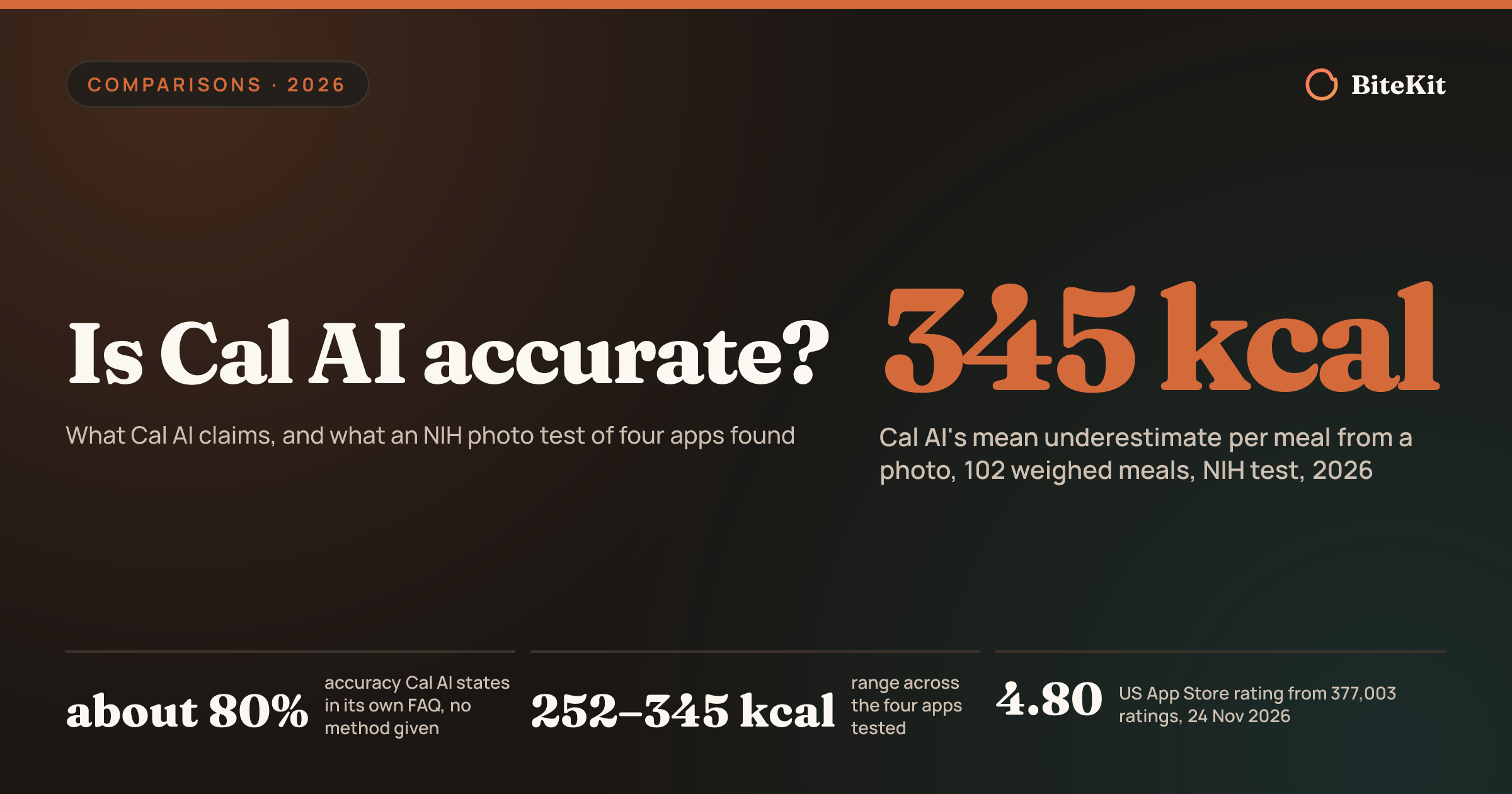
Cal AI says it is about 80% accurate. In a 2026 NIH test of 102 weighed meals, its photo estimates ran 345 kcal low on average; three other apps, 252 to 333.
·Updated ·9 min read
On this page
Cal AI's own support FAQ says the app is "about 80% accurate" and gives no method; in March 2025, TechCrunch reported that its creators put the figure at 90%. The one independent test we found that names Cal AI, an NIH study presented in July 2026, found that its photo estimates came out 345 kcal below the weighed reference per meal on average (95% CI 296 to 392) across 102 weighed meals. Three other apps tested the same way were 252 to 333 kcal under, and the study is a conference abstract, not a peer-reviewed paper.
BiteKit is our app and it competes with Cal AI, so treat our view as interested. We did not test Cal AI ourselves: every figure below comes from Cal AI's own pages, its US App Store listing, press reports and published studies, checked on 24 November 2026, as set out in the methodology.
Key findings
- 1Cal AI says it is "about 80% accurate". The figure is in Cal AI's support FAQ, last updated in November 2026, with no method given. Its terms of service say calorie estimates "are automated approximations and may be incomplete or inaccurate".
- 2An earlier figure was 90%. TechCrunch reported on 16 March 2025 that the app's creators say it is 90% accurate. We did not find that figure on calai.app.
- 3In an NIH test, Cal AI's photo estimates were 345 kcal low per meal on average. The 95% confidence interval was 296 to 392 kcal across 102 meals, according to Healio's report of an abstract presented at NUTRITION 2026; the American Society for Nutrition release says the meals' ingredients were weighed to the nearest 0.1 gram.
- 4All four apps in that test underestimated, by 252 to 345 kcal. Appediet was 252 kcal under, MyFitnessPal 327, Lose It! 333 and Cal AI 345, or about 33% across the four in Healio's summary. Cal AI's interval overlaps those of Lose It! and MyFitnessPal.
- 5Fat was underestimated by about 30 g in all four apps. The American Society for Nutrition release says the apps "tend to underestimate calories, especially from fats".
- 6In a study of a general AI model, ingredients with amounts cut the error by more than half. ChatGPT-5's average miss on 195 dishes fell from 123.03 kcal with the photo alone to 53.33 kcal with an ingredient list added, in a 2025 Nutrients study. That study did not test Cal AI.
about 80%
Accuracy Cal AI states in its own support FAQ, November 2026
no method given
Source: Cal AI support FAQ
345 kcal
Cal AI's mean underestimate per meal from a photo, 102 weighed meals
95% CI 296 to 392
Source: Healio, 4 Aug 2026
about 33%
Underestimate across the four apps in the NIH test
Healio's summary
Source: Healio, 4 Aug 2026
What Cal AI says about its own accuracy#
Cal AI logs a meal from a photo, a barcode or a description. Two accuracy figures are attached to its name, and they do not match.
"About 80% accurate". Cal AI's support FAQ, last updated in November 2026, says: "CalAI is about 80% accurate. No food tracking app is perfect, and calories and nutrition values can vary." It does not say what was measured, or against what.
"90% accurate". A TechCrunch profile of 16 March 2025 described "an app that the creators say is 90% accurate". We did not find that figure anywhere on calai.app.
"May be incomplete or inaccurate". Cal AI's terms of service, last updated on 28 November 2025, say that all calorie estimates "are automated approximations and may be incomplete or inaccurate". Its App Store description makes no percentage claim.
Both percentages are the company's own claims, and we found no published test behind either. A figure like "80% accurate" could mean the share of foods named correctly or the average size of the calorie miss, which are different things. That is why we don't set it against the study numbers below.
The same TechCrunch profile said Cal AI "uses models from Anthropic and OpenAI". And MyFitnessPal owns Cal AI: TechCrunch reported on 2 March 2026 that MyFitnessPal had acquired it, that it stays a separate app, and that it is now integrated with MyFitnessPal's food database.
What the NIH test found#
One independent test names Cal AI. NIH researchers ran standardized photos of 102 meals from a metabolic kitchen through four apps' photo features. The meals came from a diet study at the NIH, with ingredients weighed to 0.1 g, so each app's number could be compared with a precise reference.
Cal AI and three other apps underestimated calories from a photo
Mean kcal underestimated per meal, from a photo alone; 102 weighed meals; conference abstract, July 2026
| Label | Value |
|---|---|
| Cal AI | 345 kcal (95% CI 296 to 392) |
| Lose It! | 333 kcal (95% CI 282 to 383) |
| MyFitnessPal | 327 kcal (95% CI 269 to 385) |
| Appediet | 252 kcal (95% CI 210 to 295) |
Sources: Healio, 4 Aug 2026; American Society for Nutrition release, 25 Jul 2026
Cal AI had the largest average underestimate of the four, but only just. The 18 kcal between Cal AI and MyFitnessPal is small next to intervals about 100 kcal wide, and the reports we used give no test of the differences between apps. We read the result as four apps with the same problem, not as a ranking. Two of the four share an owner: MyFitnessPal owns Cal AI.
Healio's report puts the underestimate at about 33% across the four. All four underestimated fat by about 30 g, and Lose It! and Cal AI each underestimated carbohydrate by about 14 g.
What studies of general AI models show#
Most other published tests are of general-purpose AI models such as ChatGPT, Claude and Gemini, run through their chat apps or APIs. The studies in this section are studies of those models, not of Cal AI, and none of them tested Cal AI or any other tracker named on this page. They show how well this kind of technology estimates calories from a photo.
General AI models, not Cal AI: calorie error from a photo alone
Mean absolute percentage error of energy vs weighed food, 52 photos, models released 2024, paper 2025
| Label | Value |
|---|---|
| ChatGPT-4o | 35.8% (95% CI 27.3–45.1) |
| Claude 3.5 Sonnet | 35.8% (95% CI 27.9–44.7) |
| Gemini 1.5 Pro | 64.2% (95% CI 45.0–86.9) |
In that 2025 study in Current Developments in Nutrition, ChatGPT-4o and Claude 3.5 Sonnet both missed energy by a mean 35.8% on 52 weighed photos. Portion size was the weak point in a 2025 Nutrients study of ChatGPT-4: it put large meals at 529.5 g on average against an actual 798.1 g, and underestimated weight in 87 of 114 photos, while naming the foods with 93.0% precision.
The most useful finding for anyone using a photo logger is what happened when the model was told more.
A general AI model, not Cal AI: adding ingredients with amounts cut the error
ChatGPT-5 average calorie miss (MAE, kcal) by input, 195 dishes, 95% CI, 2025
| Label | Value |
|---|---|
| Photo only | 123.03 kcal (MAPE 30.51% · CI 108.61–138.78) |
| Photo + fat, sweetener and meat details | 92.04 kcal (MAPE 24.35% · CI 80.99–103.63) |
| Photo + ingredients with amounts | 53.33 kcal (MAPE 13.92% · CI 45.08–62.27) |
| Ingredients with amounts, no photo | 66.51 kcal (MAPE 18.05% · CI 56.06–77.45) |
Source: Rodríguez-Jiménez et al., Nutrients 2025, Tables 2–5
What makes a photo estimate better or worse#
These points come from the studies above. How far each applies inside Cal AI is not something anyone has published.
- Large portions. In the ChatGPT-4 study, estimates for large meals came out 33.6% under their weighed weight, while small meals were close.
- Bowls and hidden food. The ChatGPT-5 study found its largest outliers in dishes served in bowls. The ChatGPT-4 study's authors note that some foods were hidden by others, in soups, sandwiches and salads.
- Fat you can't see. Fat was underestimated in all four apps in the NIH test. A 2026 Scientific Reports study of 40 models found fat error 8.4 times higher, on its log-scale metric, for its hardest dishes (several components, hidden ingredients) than for easy ones.
- Amounts help; a list of foods alone barely does. Ingredients with amounts cut ChatGPT-5's miss by more than half. In the Scientific Reports study, a list of the foods without quantities improved error only slightly, and photos from more angles did not help.
- One wrong identification is costly. Recognition is usually right, but in the 52-photo study, Claude read scrambled eggs as a pasta dish and overestimated that meal's carbohydrate by 1,788%.
How to check a calorie app yourself#
This is our suggestion, not a validated protocol. It works for Cal AI or any other photo logger, and a free trial is long enough to do it (calai.app advertises a 3-day trial; see Is Cal AI free? for what it costs after that).
- Cook one meal at home and weigh every ingredient. Add up the calories from the packages. Labels have their own tolerance, as we cover in how accurate food label calories are, but they are the best reference you have at home.
- Photograph the plate and log it from the photo alone. Compare the total, then compare the fat grams, since fat was the largest miss in the NIH test.
- Repeat with a large portion and with something in a bowl. These are the cases that went worst in the studies above.
- Add the amounts and log it again. If the app accepts a description or lets you edit the result, see how far the number moves towards your weighed total.
A handful of meals tells you which direction an app leans, not how large its average error is.
Cal AI reviews and ratings#
On 24 November 2026, Cal AI had a 4.80 average from 377,003 ratings on the US App Store and 4.54 from 272,499 ratings on Google Play. Its home page advertises a 4.9 rating.
App Store ratings are user ratings, not test results. Someone leaving a rating has usually not weighed the meal, so a rating can't show whether the calories were right. Three of the apps from the NIH test show the gap.
Star ratings next to the NIH photo test
Sources: Apple iTunes lookup API, US storefront; Healio, 4 Aug 2026
Some dated events are worth knowing when you read reviews of Cal AI.
8 Apr 2024
16 Mar 2025
16 Mar 2025
TechCrunch profile reports the 90% figure
The article says the app's creators say it is 90% accurate.Source: TechCrunch
2 Mar 2026
2 Mar 2026
MyFitnessPal acquisition announced
TechCrunch reported that the deal closed in December 2025 and that Cal AI stays a separate app.Source: TechCrunch
Apr 2026
Apr 2026
Briefly removed from the App Store, then returned
Apple told TechCrunch the app had bypassed in-app purchase with an embedded Stripe payment flow and had a paywall that showed the weekly calculated price more prominently than the amount billed. The developer fixed the issues and the app returned.25 Jul 2026
25 Jul 2026
NIH photo test presented at NUTRITION 2026
Cal AI, Lose It!, MyFitnessPal and Appediet, on 102 weighed meals.
Apple removed the app in the week of 13 April 2026; TechCrunch and MacRumors reported Apple's reasons, and the app's return, on 21 April. Reviews written around then may describe a paywall that has since changed.
Where BiteKit fits#
BiteKit is our app. We make a competing photo, voice and text tracker for iPhone, and we have published no accuracy data for it. Its numbers are estimates. It was not in the NIH test and no study cited here tested it, so we make no claim about how its estimates compare with Cal AI's.
What we can describe is how it takes input. You can put a typed or spoken note next to the photo, such as an amount or "only ate half", which is the kind of extra detail that cut the error in the ChatGPT-5 study. That study did not test BiteKit either, so we can't say how much a note helps in our app.
Logging a meal in BiteKit from a photo and a note
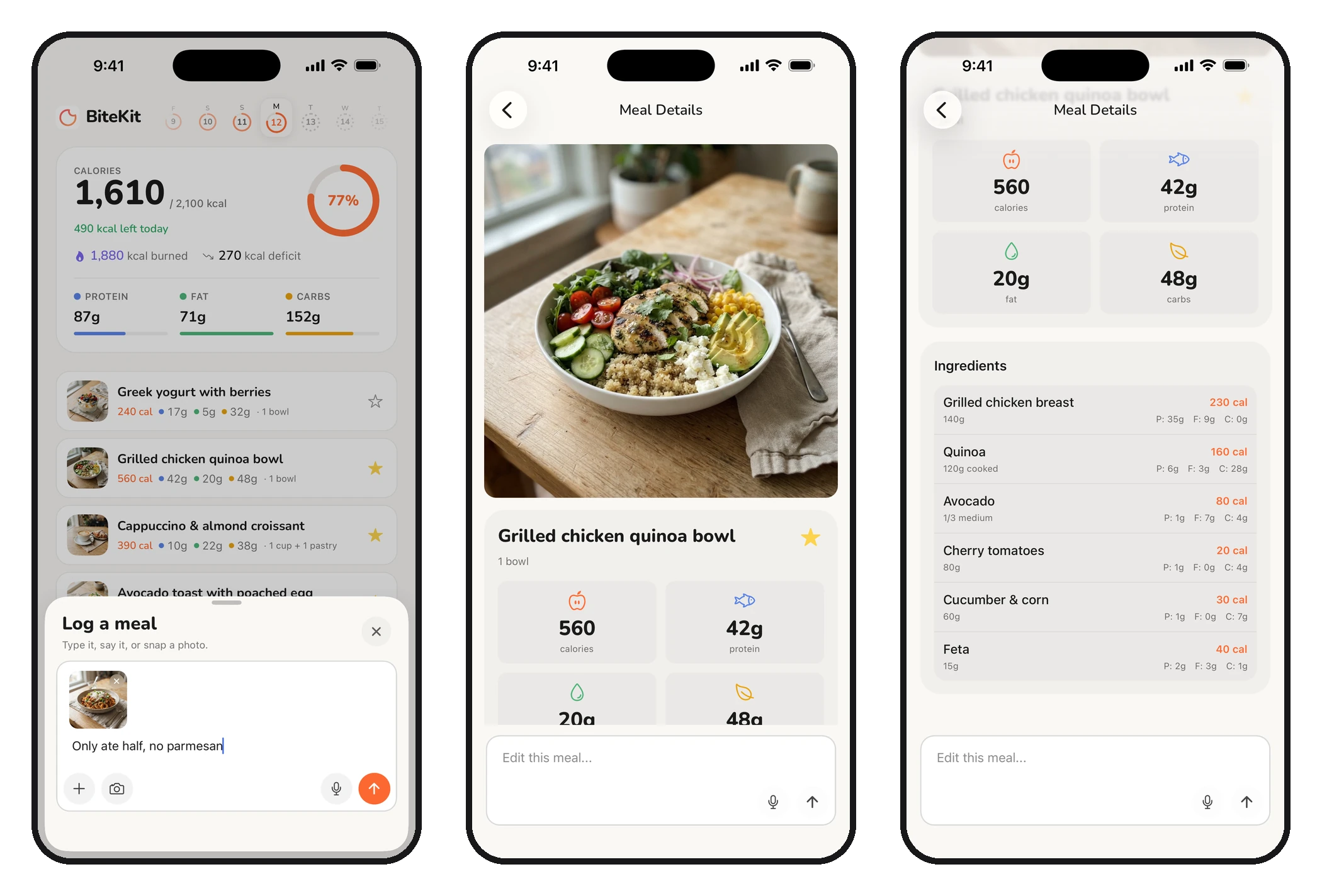
Source: BiteKit for iPhone, screenshots by the BiteKit team
It is paid: a 3-day free trial on every plan, then $3.99 a week, $9.99 a month or $49.99 a year in the US App Store. What it lacks: no barcode scanner (Cal AI has one), no water tracking, fasting timer, recipes, micronutrients or AI coach, and no Android, iPad or web app.
Which one should you pick#
- You want photo logging on iPhone or Android and can live with an estimate: Cal AI does that. Going by the NIH test, expect photo-only numbers to run low, and correct the result where the app lets you.
- You mostly eat packaged food: log from the barcode or the label, not from a photo of the food. Cal AI has a barcode scanner, and Cronometer and MyNetDiary include one in their free tiers, as covered in our MyFitnessPal alternatives comparison. BiteKit has none: you photograph the nutrition label instead.
- The number matters a lot to you: weigh the food and enter the amounts. None of the four apps in the NIH test came within 250 kcal of the weighed meals on average from a photo alone.
- Price is your real question: Cal AI states no price on its website. What we could verify is in Is Cal AI free?.
- You want to compare other AI trackers: see Cal AI alternatives. MacroFactor, SnapCalorie, Foodnoms and BiteKit were not in the NIH test, so there is no like-for-like accuracy ranking to offer.
- You want to add a typed or spoken note to a photo, on iPhone: BiteKit works that way. We have no accuracy data to show for it.
Methodology#
Sources. Cal AI's own support FAQ, terms of service and home page; its US App Store listing and Apple's iTunes lookup API for ratings; its Google Play listing; TechCrunch (16 March 2025, 2 March 2026, 21 April 2026) and MacRumors (21 April 2026) for dated events. The NIH test is cited from Healio and the American Society for Nutrition release; the abstract is Charles O et al., Current Developments in Nutrition 2026 (doi 10.1016/j.cdnut.2026.108738). The general-model studies are linked where they are cited.
Date checked. 24 November 2026, US storefront.
Disclosure. We make BiteKit, which competes with Cal AI. This page has no affiliate links. We did not run hands-on tests of Cal AI or any other app.
Limits.
- The NIH test is a conference abstract, not a peer-reviewed paper. We did not read the abstract text itself: the per-app numbers are from Healio, and the release confirms the apps, the 102 meals and a range of about 250 to 345 kcal.
- The test covers photo logging. It says nothing about Cal AI's barcode or description logging.
- Apps change with every update, and the test reflects the versions the researchers used.
- The other studies tested general AI models released from 2023 to 2025, not Cal AI. We don't know which models Cal AI runs today.
- "About 80%" and "90%" are vendor claims with no published method.
- Ratings change daily and are user ratings, not quality scores.
FAQ#
Is Cal AI accurate?#
Cal AI's own FAQ says it is "about 80% accurate", with no method given, as of November 2026. In the one independent test we found that names it, an NIH study of 102 weighed meals presented in July 2026, Cal AI's photo estimates were 345 kcal too low per meal on average (95% CI 296 to 392). That study is a conference abstract, not a peer-reviewed paper.
How accurate is Cal AI compared with MyFitnessPal and Lose It!?#
About the same, in the one test that covers all three. In an NIH study presented in July 2026, photo logging underestimated meals by 345 kcal on average in Cal AI, 333 kcal in Lose It! and 327 kcal in MyFitnessPal, with overlapping confidence intervals. A fourth app, Appediet, was 252 kcal under.
What rating does Cal AI have in app reviews?#
On 24 November 2026, Cal AI had a 4.80 average from 377,003 ratings on the US App Store and 4.54 from 272,499 ratings on Google Play. These are user ratings, not accuracy tests.
Was Cal AI removed from the App Store?#
Yes, briefly. Apple removed Cal AI in the week of 13 April 2026 over its payment flow and paywall design, according to TechCrunch and MacRumors on 21 April 2026, and the app returned after the developer fixed the issues. The removal was not about calorie accuracy.
How can I make a photo calorie estimate more accurate?#
Add amounts. In a 2025 study of a general AI model, ChatGPT-5, the average miss on 195 dishes fell from 123.03 kcal with the photo alone to 53.33 kcal when an ingredient list with amounts was added. That study did not test Cal AI or any other tracking app.