Decoding the Science of Bacon, Egg, and Cheese Calories
Unlock the real bacon egg and cheese on a roll calories. Learn how ingredients shift the numbers and how to track this deli classic for your fitness goals.
A typical bacon, egg, and cheese on a roll can range from 450 to over 700 calories. This wide variance is a critical factor in energy balance, the cornerstone of weight management. Understanding the "why" behind this number is more impactful than memorizing a single figure, as it empowers you to make dietary choices aligned with your health objectives.
Where your sandwich falls in that range is entirely determined by its preparation and composition.
The Caloric Reality of Your Go-To Breakfast Sandwich
Consider a standard, no-frills bacon, egg, and cheese as your baseline. For a real-world benchmark, the Nathan's Famous Bacon, Egg & Cheese on a Roll provides a consistent reference point, containing 470 calories in a 6.8-ounce (192-gram) serving.
This figure illustrates how seemingly minor variations can significantly alter the total energy content. A larger roll, extra bacon, or the liberal use of cooking fat can easily push an equivalent sandwich beyond 700 calories.
According to principles of energy balance, consistently consuming more calories than your body expends leads to weight gain. Understanding the caloric breakdown of your meals allows you to manage your intake effectively and work towards your fitness goals, whether that's weight loss, maintenance, or muscle gain.
To truly grasp the nutritional impact, let's deconstruct the sandwich into its core components.
Anatomy of a Deli-Style Bacon, Egg, and Cheese Sandwich
This table provides an overview of the approximate calorie and macronutrient breakdown for a standard sandwich, highlighting the nutritional role of each component.
| Nutrient | Average Amount | Scientific Relevance for Your Goals |
|---|---|---|
| Calories | 450-700 kcal | The total energy provided. This must align with your daily energy expenditure targets for weight management. |
| Protein | 20-30 grams | Essential for muscle protein synthesis and repair. Protein also has a higher thermic effect of food (TEF) and promotes satiety, which can aid in controlling overall calorie intake. |
| Fat | 25-45 grams | A primary source of calories, concentrated in the bacon, cheese, and cooking oils. The type of fat (saturated vs. unsaturated) is also a key health consideration. |
| Carbohydrates | 30-50 grams | The body's primary fuel source, primarily derived from the roll. Complex carbohydrates provide more sustained energy than simple ones. |
The protein from the egg and bacon is beneficial for satiety, but the high concentration of fat and refined carbohydrates is where the caloric load can quickly accumulate.
How Each Ingredient Shapes the Calorie Total
The composition of your bacon, egg, and cheese sandwich directly dictates its caloric and nutritional profile. Each ingredient choice—from the type of bread to the quantity of bacon—is a variable that determines whether your breakfast is a 450-calorie meal or a 700-calorie energy bomb.
The roll often represents the largest single source of calories. A standard kaiser roll contributes approximately 250-300 calories. Opting for a buttery croissant or a dense bagel can add another 100-150 calories before other ingredients are even considered.
This chart visualizes the potential caloric disparity.
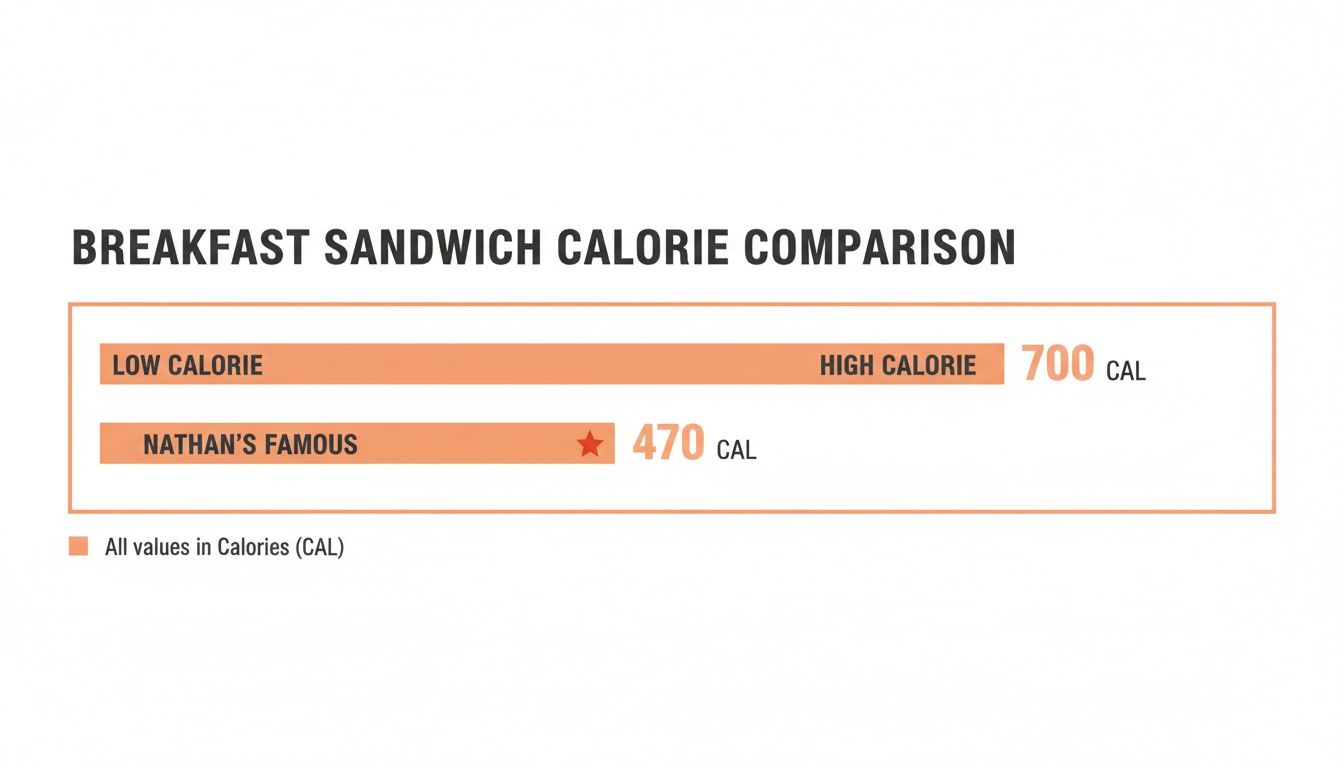
The difference between a moderately portioned sandwich and a fully-loaded version can easily exceed 250 calories, highlighting the profound impact of ingredient selection and portion size.
Breaking Down the Core Ingredients
Beyond the bread, each component contributes significantly to the final calorie count.
-
The Bacon: The cut and quantity are key. Two standard strips of bacon contain roughly 80-100 calories. However, thick-cut varieties or "extra bacon" requests can double this to 200+ calories, primarily from fat. For a detailed analysis, see these bacon nutrition facts.
-
The Eggs: One large egg, fried, is approximately 90 calories. The variable is the cooking medium. The addition of oil or butter to the griddle introduces extra calories from fat that must be accounted for.
-
The Cheese: A single slice of American or Swiss cheese adds another 70-100 calories. A request for "double cheese" is a simple way to add another hundred calories, often without conscious consideration of the nutritional impact.
This variability is not unique to this specific sandwich. An egg and cheese on a small English muffin might be as low as 240 calories, whereas a classic deli-style sandwich can surpass 475 calories. This demonstrates that the method of preparation is a critical determinant of a meal's caloric value.
How to Estimate Calories When There’s No Label
Most deli sandwiches lack the standardized nutrition labels found on packaged foods, making it challenging to quantify the "bacon egg and cheese on a roll calories." However, by using a "building block" approach, you can create a reasonably accurate estimate.
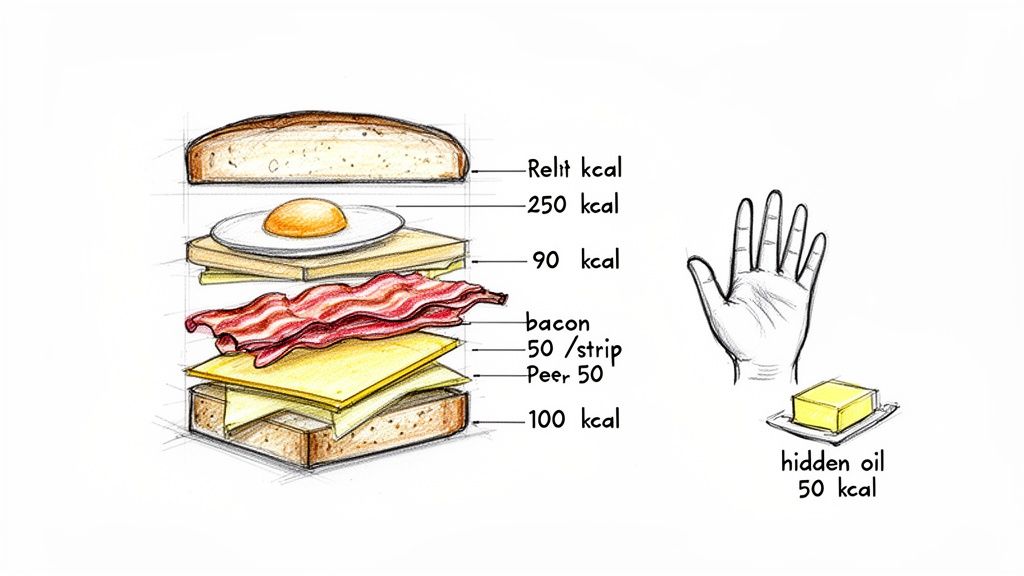
This method involves deconstructing the meal into its individual components and summing their estimated caloric values. This transforms calorie tracking from a guessing game into a solvable puzzle, a skill that becomes more intuitive with practice.
The Building Block Method
Begin by establishing a baseline for the bread, which is typically the most significant calorie contributor. Then, add the estimated calories for each filling.
Here is a quick reference guide:
- The Roll: A standard kaiser or hard roll is approximately 250-300 calories.
- The Egg: One large fried egg is about 90 calories.
- The Bacon: Each strip of regular bacon adds around 50 calories.
- The Cheese: A single slice of American or cheddar cheese is roughly 100 calories.
Using this math, a basic sandwich with one egg, two strips of bacon, and one slice of cheese on a kaiser roll totals approximately 540 calories (250 + 90 + 100 + 100). This simple calculation provides a remarkably close estimate.
Be mindful of "invisible" calories. A generous smear of butter on the roll or oil on the griddle can easily add an extra 50-100 calories. It is a sound practice to include a buffer for these hidden cooking fats in your estimation.
Mastering this estimation skill is invaluable for tracking non-packaged meals. To further refine this ability, you can learn more about how to calculate calories in homemade food. Employing visual cues, such as comparing the portion of bacon to the size of your palm, can also improve accuracy. These techniques empower you to move from uncertainty to an educated estimate—a crucial skill for achieving nutritional goals.
Taking the Guesswork Out of Tracking Your Meal
While visual estimation is a valuable skill, it remains an approximation. Deconstructing a sandwich to weigh each component is impractical in daily life. Modern technology offers a more efficient and accurate solution.
AI-powered nutrition applications like BiteKit are specifically designed to analyze complex, unlabeled meals, such as a custom deli sandwich, without requiring tedious manual data entry for each ingredient.
The Power of Photo Logging
Instead of manual input, you can simply capture a photo of your meal. The AI analyzes the image, identifies the components—the roll, eggs, bacon, and cheese—and estimates their respective portion sizes to calculate the nutritional information.
Here is a visual representation of the process. A photo is taken, and a full nutritional breakdown is generated within seconds.
This technology transforms a once-laborious process of guessing and manual logging into a single, effortless action, replacing guesswork with reliable data.
The process can be even more streamlined. For moments when taking a photo is inconvenient, you can log your meal via voice or text input.
Simply say or type “BEC on a roll from the deli,” and the application generates a detailed and accurate nutritional summary. This type of frictionless tracking is what enables consistent dietary monitoring, even on the most demanding days.
By removing the manual effort from tracking, you can enjoy your meal with the confidence that it has been accurately logged, making it easier to see how it aligns with your daily caloric and macronutrient targets.
Smart Swaps to Build a Healthier Sandwich
Achieving health goals does not necessitate the complete elimination of favorite foods. With a few strategic modifications, you can significantly reduce the "bacon egg and cheese on a roll calories" while preserving its satisfying flavor profile. This involves making small, targeted requests at the deli that yield substantial caloric savings.
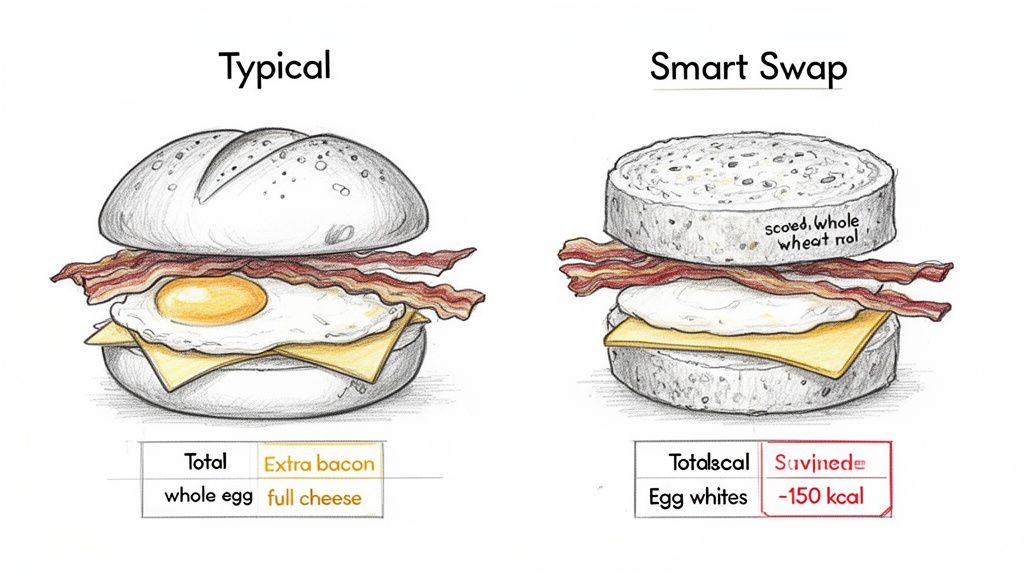
These swaps are simple and effective. By focusing on the most energy-dense ingredients—bread, bacon, and cooking fats—you can construct a sandwich that better supports your nutritional objectives.
High-Impact, Low-Effort Swaps
Each modification demonstrates how small changes can lead to a significant impact on your daily energy intake.
-
Ask for it "Scooped Out": Requesting that the soft interior of the roll be removed is a simple yet effective tactic. This reduces the overall carbohydrate content and saves approximately 50-70 calories with minimal change to the eating experience.
-
Go for Whole Wheat: Swapping a white kaiser roll for a whole-wheat alternative increases dietary fiber. A study published in the Annals of Internal Medicine found that simply aiming for 30 grams of fiber per day can support weight loss, independent of other dietary changes.
-
Opt for Egg Whites: A well-established strategy, requesting egg whites instead of whole eggs eliminates the fat and cholesterol from the yolk, saving around 60-70 calories per egg while retaining a significant amount of protein to enhance satiety.
These simple requests give you greater control over your meal's nutritional content. For more ideas, our Food Swap Suggester can help you identify healthier alternatives for common ingredients.
A study in the American Journal of Clinical Nutrition demonstrated that even modest reductions in portion size can lead to a significant decrease in total energy intake without a corresponding decrease in satisfaction. Requesting two strips of bacon instead of three or four is a practical application of this principle, saving 50-100 calories.
Your Top Questions, Answered
Let's address some frequently asked questions about the nutritional aspects of a bacon, egg, and cheese sandwich.
What’s the Biggest Calorie Culprit in the Sandwich?
The roll and the bacon are typically the most significant contributors to the calorie count. A large, dense roll (e.g., a large kaiser or bagel) can contain over 300 calories. The addition of several strips of thick-cut bacon can contribute another 150-200 calories, primarily from fat.
The cheese and "invisible" calories from cooking oil or butter also add to the total. The single large egg is often the most nutritionally balanced component, providing high-quality protein for a relatively modest 70-90 calories.
Is a Bacon, Egg, and Cheese Actually a Good Source of Protein?
Yes, it is a significant source. A standard deli sandwich typically provides 20 to 30 grams of protein. This amount is beneficial for promoting satiety, which helps control hunger later in the day, and is vital for muscle repair and maintenance.
However, this protein often comes with high levels of saturated fat and sodium. To improve the nutritional profile, you can request an extra egg or use egg whites to increase the protein-to-fat ratio.
How Accurate Is It to Just Snap a Photo to Track This?
For a complex, non-standardized meal, photo-based AI tracking with an app like BiteKit offers a substantial improvement in accuracy over manual estimation. While not as precise as a laboratory chemical analysis, the technology is designed to be more reliable than human visual estimation alone. The AI is trained on extensive image datasets to recognize different ingredients and preparation styles.
The key advantage lies in its ability to deconstruct the meal into its components and estimate their portion sizes. This automates a complex mental task and helps mitigate the common human errors of under- or overestimation.
Can I Really Eat a Bacon, Egg, and Cheese and Still Lose Weight?
Absolutely. Successful and sustainable weight loss is primarily determined by maintaining a consistent calorie deficit over time, not by eliminating specific foods. A 500-700 calorie sandwich can be incorporated into a balanced diet, particularly as a substantial first meal of the day.
The key is mindful consumption. By applying the strategies in this guide—making smart swaps to reduce calories and tracking your intake accurately with a tool like BiteKit—you can enjoy your favorite foods while progressing toward your health goals. The focus should be on making informed choices, not on deprivation.