Decoding Calories in Stir Fry Vegetables for Healthier Meals
Uncover the real calories in stir fry vegetables. Learn how oil, sauces, and cooking methods affect the count and get tips for delicious, low-calorie meals.
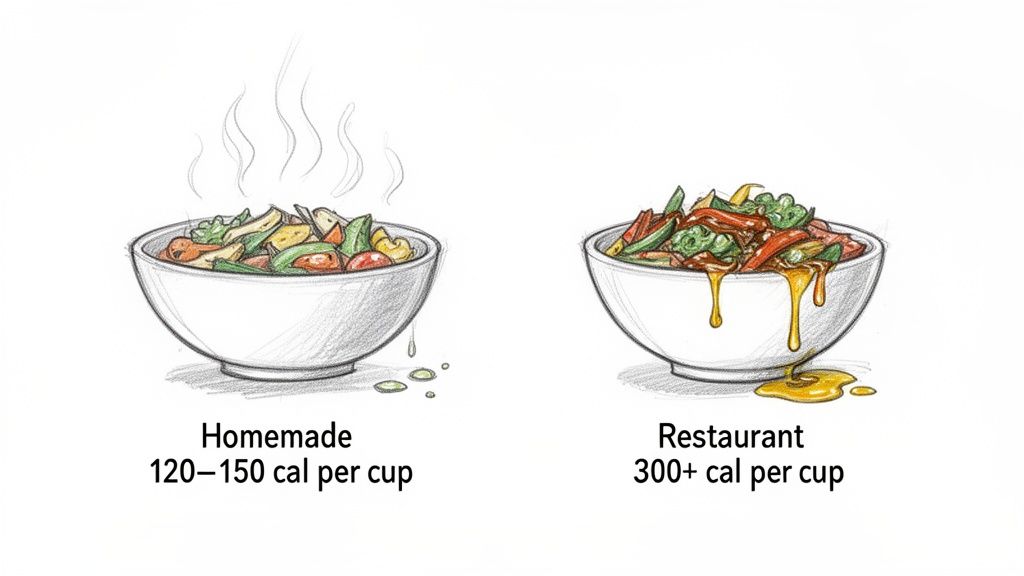
So, you're curious about the calories in stir fry vegetables? A homemade 1-cup serving can be a wonderfully light meal, typically landing in the 120-150 calorie range. But grab that same dish from your favorite takeout spot, and you could easily be looking at over 300 calories thanks to heavy-handed pours of oil and sweet sauces.
Let's dig into why that is.
The Truth About Calories in Your Vegetable Stir Fry
Stir-fried vegetables seem like a foolproof healthy choice. They're fast, colorful, and loaded with vitamins. But when you start counting calories, things get a little fuzzy. The vegetables themselves—think broccoli, bell peppers, carrots, and snap peas—are naturally low in calories. The real calorie story starts the moment they hit the wok.
The final count really comes down to whose kitchen it’s made in: yours or a restaurant's. At home, you’re in the driver’s seat. You control every drop of oil and every splash of soy sauce, which makes it easy to keep the dish light and healthy.
Why Homemade and Takeout Stir Fries Differ
The huge calorie gap comes down to the cooking methods and ingredients that professional kitchens use. To get that signature silky texture and deep, rich flavor, restaurants often rely on a lot more oil and sugar-packed sauces than you'd ever think to use at home.
For a little perspective, a standard 1-cup serving of a simple vegetable stir fry you make yourself often falls between 117 to 132 calories. In stark contrast, a seemingly identical portion from a restaurant can easily soar to 200-300 calories, sometimes even higher. Those hidden fats and sugars add up fast. You can dive deeper into these nutritional differences in restaurant foods to get a clearer picture of what you're eating when you dine out.
Here’s the key thing to remember: The vegetables are almost never the problem. It’s how they're cooked that decides if your stir fry is a lean, mean, nutrient-packed machine or a high-calorie meal in disguise.
Once you get a handle on this, you can make stir-fry work for you, whether you're cooking at home or carefully ordering takeout. Knowing where the sneaky calories hide gives you the power to build a delicious meal that actually fits your health goals.
What's Really Adding Calories to Your Stir Fry?
Ever wondered why a simple plate of stir-fried vegetables can have such a wildly different calorie count? It's almost never the vegetables themselves. The real story is in what you add to them. Three key players can quickly turn a light, healthy meal into something much heavier: the cooking oil, the sauce, and any extra proteins or starches you toss in.
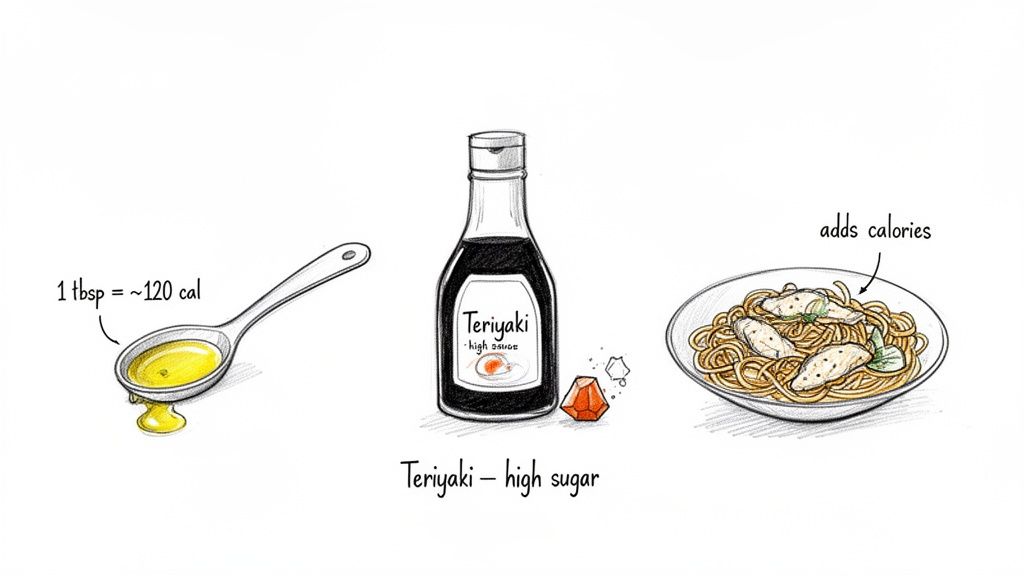
Let's start with the first thing that hits the pan: cooking oil. It’s a sneaky source of calories. Before you’ve even added a single piece of broccoli, you could be locking in a significant number. Just one tablespoon of oil—it doesn't matter if it's olive, sesame, or vegetable—packs around 120 calories, purely from fat. Keep in mind, restaurants often use a much more generous pour to get that perfect, glossy texture, which can send the calorie count soaring.
Beyond the Oil: Sauces and Add-Ins
Next up is the sauce. This is what gives a stir fry its soul, but many popular sauces are loaded with sugar. Think about common choices like teriyaki, hoisin, or sweet chili. Just two tablespoons of a standard teriyaki sauce can easily add another 30-60 calories, mostly from sugar. It's easy to see how those liquid calories can pile up without you even noticing.
A good rule of thumb: if a sauce is thick, sticky, and sweet, it's probably dense with calories. These are the sauces that can sabotage a perfectly good plate of veggies.
Finally, we have the "add-ins" that make the meal complete. Proteins and starches are essential for turning a snack into a satisfying meal, but they change the calorie math entirely. You just have to be aware of what you're adding.
- Proteins: A 4-ounce serving of chicken breast brings about 180 calories to the table, while the same amount of shrimp is closer to 100 calories.
- Carbohydrates: Tossing in a cup of cooked white rice or noodles? That's an extra 200-220 calories right there.
Knowing where the calories come from is half the battle. If you want to see just how much of a difference your oil choice makes, a good cooking oil calorie calculator can give you a precise breakdown. By keeping an eye on these three areas, you can take full control of the calories in your stir fry vegetables and build a meal that truly fits your goals.
The Power of Nutrient Density in Stir Fries
When you're looking at the calories in a stir-fry, you're only seeing half the picture. The real magic, and the reason this dish is a go-to for so many health-conscious people, lies in a concept called nutrient density.
Think of it as getting the most nutritional bang for your calorie buck. You want the most vitamins, minerals, and fiber possible for the fewest number of calories, and vegetables are the undisputed champions of this.
Because they're high-volume, low-calorie foods, you can pile your plate high and feel satisfied without overdoing it on calories. This is a game-changer for anyone trying to manage their weight. That feeling of fullness, or satiety, is what keeps you from snacking an hour later. A 100-calorie mountain of broccoli will always be more filling and do more for your body than a tiny 100-calorie bite of a chocolate bar.
The Best of Both Worlds: Macros and Micros
Lightly stir-frying vegetables is one of the best ways to cook them because it preserves their vital micronutrients. These are the vitamins and minerals your body needs to do everything from creating energy to fighting off a cold. Bell peppers, for instance, are loaded with Vitamin C, while leafy greens like spinach bring a healthy dose of iron and folate to the table. The full nutritional profile of spinach really shows how much goodness can be packed into a single, simple ingredient.
At the same time, the macronutrient breakdown of a basic vegetable stir-fry is fantastic for most fitness goals. It's naturally rich in fibrous carbohydrates from the veggies themselves (great for digestion) and is very low in fat and protein—at least until you decide to add them in.
Take a look at the data. A typical 132-gram serving of Asian stir-fry vegetables (with a little fat for cooking) clocks in at just 94 calories. That small bowl gives you 13g of carbs, 3.7g of fat, and 2.7g of protein. You can dig into these veggie stir fry nutritional values yourself to see the numbers.
This powerful combination—a filling meal, tons of micronutrients, and a lean macro profile—makes a good stir-fry an incredible tool. It’s perfect for anyone focused on weight loss or just living a healthier lifestyle, proving you can eat a satisfying, energizing meal without ever feeling deprived.
Estimating Calories Without a Food Scale
While a food scale is your best bet for pinpoint accuracy, let's be realistic—you're not always going to have one handy. So, how do you figure out the calories in your stir-fry when you’re ordering out or at a friend's place? Thankfully, you can get surprisingly close with a tool you always have with you: your hands.
The trick is to mentally deconstruct your meal into its three main parts: the veggies, the oil, and any add-ins like protein or sauces. Your fist, for instance, is a great stand-in for about one cup of chopped vegetables. The palm of your hand works as a guide for a 3-4 ounce serving of protein, like chicken or tofu.
You can dive deeper into these techniques in our full guide on how to measure food without a scale.
Putting It Into Practice: A Real-World Example
Let's walk through a quick visual estimate.
Imagine your plate. It's loaded with broccoli, bell peppers, and snap peas. If it looks like about two of your fists' worth, you're looking at roughly two cups of vegetables. That's your base, and it's only about 80-100 calories.
Now, think about the oil. Did the veggies look glossy? A single tablespoon of oil is about the size of your thumb tip, and that alone adds 120 calories. A few splashes of soy sauce for flavor? That's another 20 calories right there.
The big takeaway here is that the vegetables themselves aren't the calorie culprits. The oil and sauces are where the numbers really start to add up, which is why they’re the most important things to get a handle on.
This simple mental math turns a potentially intimidating meal into manageable pieces. The infographic below really drives this home, showing how starting with a nutrient-dense base like veggies gives you satisfying fuel for very few calories.
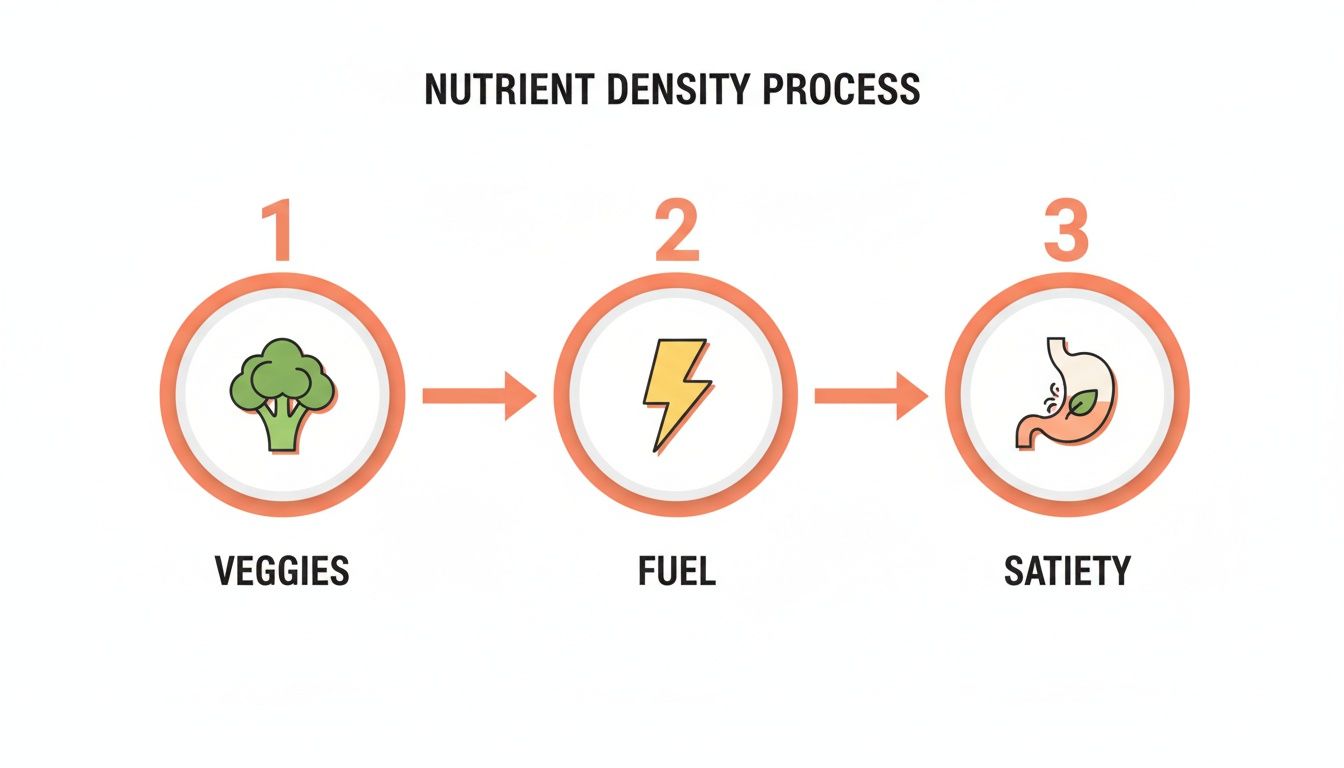
As you can see, loading up on vegetables provides lasting energy and a feeling of fullness. When you keep the cooking oil to a minimum, the final calorie count stays impressively low. For a little perspective, some frozen stir-fry vegetable mixes pack as few as 75 calories per 200-gram serving. That means a heaping plateful could easily come in under 120 calories!
Calorie Impact of Common Stir Fry Add-Ins
To help you get even better at these quick estimations, here's a table showing how quickly common additions can increase the calorie count of your meal.
| Ingredient | Serving Size | Approximate Calories |
|---|---|---|
| Sesame Oil | 1 Tbsp | 120 |
| Olive Oil | 1 Tbsp | 120 |
| Soy Sauce | 1 Tbsp | 10 |
| Hoisin Sauce | 1 Tbsp | 35 |
| Oyster Sauce | 1 Tbsp | 15 |
| Chicken Breast (diced) | 4 oz | 185 |
| Tofu (firm) | 4 oz | 85 |
| Shrimp | 4 oz | 110 |
| White Rice (cooked) | 1 cup | 205 |
| Udon Noodles (cooked) | 1 cup | 210 |
This chart makes it clear how ingredients like oil and starchy carbs can more than double the calories of a vegetable-heavy dish. Keep these numbers in mind next time you're building your bowl.
Crafting a Delicious Low Calorie Stir Fry
Knowing where the calories are hiding is half the battle. The other half is figuring out how to reduce them while still making a stir fry you actually want to eat. With a few smart techniques, you can slash the calories in stir fry vegetables without sacrificing flavor.
One of the best tricks is to rethink how you use oil. Instead of starting with a pool of oil in a hot pan, give “steam-frying” a shot. You start by cooking the veggies in a couple of tablespoons of water or broth. Then, right at the end, you add a tiny drizzle of a high-impact oil, like toasted sesame oil. You get all that amazing aroma and taste for a fraction of the fat.
Smart Swaps for Big Results
When it comes to oil, precision is everything. Ditching the free-pour and using a measuring spoon can honestly save you 100+ calories right there. An oil mister is another great tool—it gives you a fine, even coating with way less oil.
Sauces are the other major calorie trap, since so many store-bought options are loaded with sugar. A few simple swaps make a world of difference:
- Coconut Aminos: A great soy-free alternative to soy sauce that’s a little sweeter and lower in sodium.
- Low-Sodium Soy Sauce: Gives you that classic umami flavor you crave with a lot less salt.
- Rice Vinegar and a Touch of Honey: You can whip up a bright, zesty sauce where you control every single ingredient.
The goal isn’t to eliminate flavor, but to build it intelligently. You can create an incredibly vibrant dish using ingredients that add virtually zero calories while packing a powerful punch.
Don't forget about nature's best flavor boosters! Freshly grated ginger, minced garlic, a pinch of red pepper flakes, or a handful of cilantro or basil can completely transform a dish. These ingredients add layers of complexity for practically zero calories, proving that a healthier stir fry can easily be the most delicious one on the table.
Common Questions About Stir Fry Nutrition
When you're trying to eat healthier, stir-fries seem like a no-brainer. But once you start thinking about the details, a few questions always pop up. Getting a handle on these common queries can make all the difference, helping you build a genuinely healthy meal that fits your goals.
Let's clear up some of the most frequent questions about the calories in stir fry vegetables and how to build a better bowl.
Are Frozen Stir Fry Vegetables Less Nutritious Than Fresh?
It’s a common myth, but scientific studies often show the opposite. In fact, sometimes they’re even better. Frozen veggies are picked and flash-frozen at their absolute peak, a process that effectively locks in their vitamins and minerals right away.
Fresh produce, on the other hand, can lose nutrients during its long journey from the farm to the store and then to your fridge. As long as you're buying plain frozen vegetables—without any added sauces or salt—they are a fantastic, convenient, and budget-friendly choice for a nutritious stir-fry.
Think of frozen vegetables as nature's goodness, paused in time. They're a brilliant way to keep healthy ingredients on standby for those busy weeknights without sacrificing nutrition.
How Can I Add Protein Without Too Many Calories?
This is a great question because protein is what turns a simple veggie dish into a satisfying, complete meal that keeps you full for hours. The trick is to stick with lean sources.
Here are some excellent, low-calorie choices:
- A 4-ounce serving of boneless, skinless chicken breast is a go-to, adding around 180 calories.
- Shrimp is an even lighter option, with the same portion size coming in at just 100 calories.
- For plant-based power, firm tofu (around 120 calories per 4 oz) or edamame (about 150 calories per cup) are fantastic additions.
Adding one of these not only boosts the staying power of your meal but also makes it far more balanced, which is key for supporting any fitness or wellness goals.
What Is the Best Cooking Oil for a Low Calorie Stir Fry?
Here’s the thing about oil: almost all of them have around 120 calories per tablespoon. So, while some oils like avocado or canola are better for high-heat cooking because of their high smoke points, the real secret to a low-calorie stir-fry isn't about which oil you use, but how much.
This is where technique trumps ingredients. Instead of free-pouring from the bottle, which can easily add hundreds of extra calories, get out a measuring spoon. Limiting yourself to just one or two teaspoons for the whole dish is a game-changer.
Even better, an oil spray mister is a fantastic tool. It gives you a light, even coating of oil in the pan while saving you well over 100 calories.