Master Your Daily Calorie Intake Calculator for Real Results
Unlock your fitness goals with our guide to using a daily calorie intake calculator. Learn the science, avoid common mistakes, and get personalized results.

Figuring out your daily calorie needs is the first real step toward any fitness goal. The core principle is rooted in thermodynamics and metabolism: your Basal Metabolic Rate (BMR) multiplied by your activity level gives you your maintenance calories. This isn't just guesswork; it's a science-backed starting point for understanding what your body needs to operate.
Find Your Calorie Starting Point in Minutes
Before you can tweak your diet for weight loss, muscle gain, or maintenance, you need to know your baseline. This baseline is your Total Daily Energy Expenditure (TDEE), which is the total amount of energy you burn in a day.
To find it, we'll first calculate your BMR—the calories your body burns at rest—and then factor in your daily movement.
The Science Behind BMR Formulas
For decades, nutritional science has relied on a couple of key predictive equations. You might have heard of the Harris-Benedict equation, which has been around since 1918 (revised in 1984), or the more modern Mifflin-St Jeor equation from 1990.
While both have their place, the scientific consensus today favors the Mifflin-St Jeor equation as the more accurate predictor for most people. Research consistently shows it gets within 10% of a person’s actual resting metabolic rate as measured by indirect calorimetry, making it the gold standard we now rely on. Starting with a trusted formula is crucial for getting a number that actually works.
Matching an Activity Multiplier to Your Lifestyle
Once you've got your BMR, it's time to account for everything else—your workouts, your job, chasing the kids around, even just walking to the mailbox. We do this by multiplying your BMR by an activity factor to find your true daily calorie burn (your TDEE).
It's really important to be honest here. A common mistake is overestimating how active we are.
For example, someone with a desk job who hits the gym three times a week is "Lightly Active," not "Moderately Active." Why? Because most of their day is still spent sitting. Getting this right is key to an accurate calculation.
This table breaks down the multipliers. Look through the descriptions and find the one that best reflects your typical week.
Activity Level Multipliers for Calorie Calculation
Find your daily activity level to accurately calculate your Total Daily Energy Expenditure (TDEE).
| Activity Level | Description | Multiplier |
|---|---|---|
| Sedentary | Little to no exercise; typical for a desk job. | BMR x 1.2 |
| Lightly Active | Light exercise or sports 1-3 days per week. | BMR x 1.375 |
| Moderately Active | Moderate exercise or sports 3-5 days per week. | BMR x 1.55 |
| Very Active | Hard exercise or sports 6-7 days per week. | BMR x 1.725 |
| Extra Active | Very hard exercise, physical job, or training twice a day. | BMR x 1.9 |
Once you've found your multiplier, the math is simple. Just multiply it by your BMR, and you’ll have a solid estimate of your daily maintenance calories.
How to Calculate Your Personal Calorie Needs
Forget those generic online calculators for a minute. To truly get a handle on your calorie needs, you need to understand where the numbers come from. The starting point for everything is your Basal Metabolic Rate, or BMR.
Think of your BMR as your body's energy "fingerprint"—it's the minimum number of calories you burn just to stay alive. We're talking about basic functions like breathing, circulating blood, and cell production. When you calculate it yourself, you can actually trust the result because you see exactly how your own stats—age, gender, weight, and height—shape the outcome.
There are a few ways to get this number, but two formulas have stood the test of time: the Mifflin-St Jeor and the Harris-Benedict equations. While Mifflin-St Jeor is generally considered the modern gold standard for accuracy, both are excellent for establishing a reliable baseline.
Putting the Formulas to Work
Let’s get our hands dirty and actually look at the math. This isn't just for show; doing it yourself builds a gut-level understanding of your body's needs. Before you start, make sure you convert your weight to kilograms (pounds ÷ 2.2) and your height to centimeters (inches × 2.54).
-
Mifflin-St Jeor Equation:
- For Men: (10 × weight in kg) + (6.25 × height in cm) – (5 × age) + 5
- For Women: (10 × weight in kg) + (6.25 × height in cm) – (5 × age) – 161
-
Harris-Benedict Equation (Revised 1984):
- For Men: (13.397 × weight in kg) + (4.799 × height in cm) – (5.677 × age) + 88.362
- For Women: (9.247 × weight in kg) + (3.098 × height in cm) – (4.330 × age) + 447.593
Your BMR is the foundation, and everything else builds on top of it. Once you have this number, the next step is to account for your daily movement.
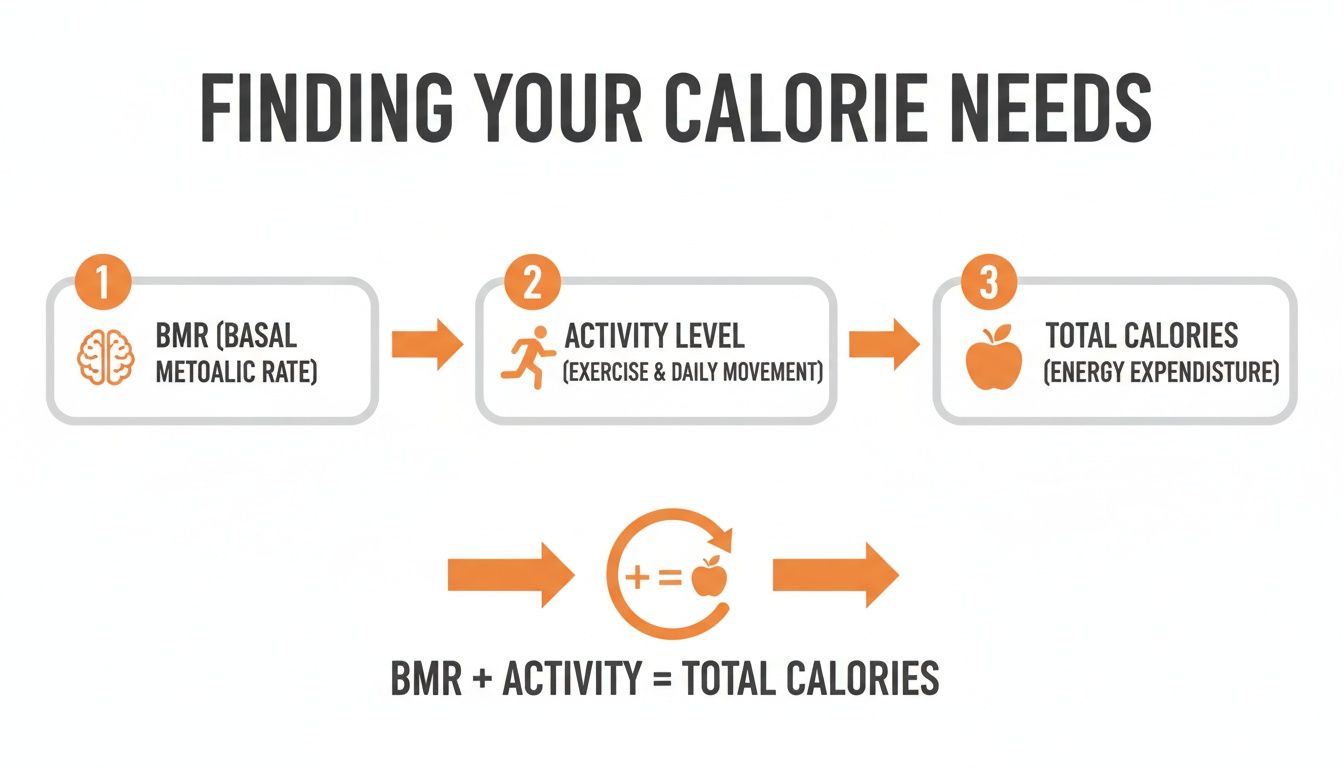
As you can see, your BMR is just the first piece of the puzzle. It’s your resting energy expenditure. Only after you’ve nailed this down can you add in your activity level to find your total daily burn.
A Real-World Calculation Example
Let's walk through a real-world scenario. Imagine a 35-year-old woman who is 5'7" (170 cm) tall and weighs 150 lbs (68 kg). She's just getting started on her fitness journey and needs a solid number to guide her.
First, let's use the Mifflin-St Jeor formula:
- BMR = (10 × 68) + (6.25 × 170) – (5 × 35) – 161
- BMR = 680 + 1062.5 – 175 – 161
- BMR = 1,406.5 calories
Now, let's try the Harris-Benedict formula for comparison:
- BMR = (9.247 × 68) + (3.098 × 170) – (4.330 × 35) + 447.593
- BMR = 628.796 + 526.66 – 151.55 + 447.593
- BMR = 1,451.5 calories
Notice how the results are slightly different but still in the same ballpark? This is completely normal. In my experience, the Mifflin-St Jeor result (~1,407 calories) is the more reliable starting point for most people today.
This BMR calculation isn’t the final calorie target. It's the rock-solid foundation. The next crucial step is to multiply this number by an activity factor to find the total calories needed to maintain your current weight—your Total Daily Energy Expenditure (TDEE).
To see how that next step works and find your complete daily energy burn, our guide on how to use a TDEE calculator breaks it all down. Getting this part right is the first real step toward building a nutrition plan that actually works for you.
Factor in Your Real-World Activity and Lifestyle
Think of your Basal Metabolic Rate (BMR) as the rent your body charges just to keep the lights on. It’s the bare minimum energy you need to exist. But let's be real—you do a lot more than just exist. Every single movement, from a grueling workout to just walking to your car, burns calories. This is where we get to the really important number: your Total Daily Energy Expenditure (TDEE).
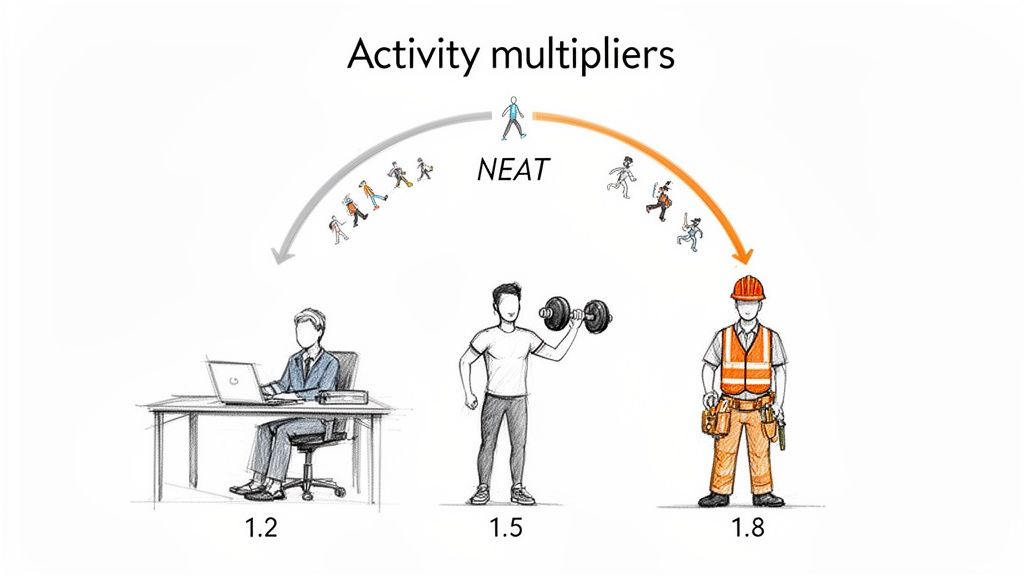
To figure out your TDEE, you have to be brutally honest about how much you actually move throughout the day. This isn't just about your time in the gym. A construction worker who is on their feet all day has a completely different energy demand than an office worker who hits the gym three times a week. A good daily calorie intake calculator helps you pinpoint this.
Beyond Formal Exercise
There's a massive, and often completely ignored, piece of the calorie-burning puzzle: Non-Exercise Activity Thermogenesis (NEAT). In simple terms, this is all the energy you use for activities that aren't sleeping or structured exercise.
It's the little stuff that adds up:
- Fidgeting while you sit at your desk.
- Choosing the stairs over the elevator.
- Doing chores like vacuuming or gardening.
- Walking the dog around the block.
These seemingly minor movements can make a huge difference. Imagine two people with the same desk job and workout schedule. If one paces during phone calls and is constantly fidgeting, while the other sits perfectly still all day, their TDEEs could be worlds apart. NEAT is a huge variable and a primary reason generic calorie goals so often miss the mark.
Your best tool here is honesty. I see it all the time: someone picks the "Moderately Active" multiplier because they hit the gym 3-4 times a week. But if the other 23 hours of the day are spent sitting, "Lightly Active" is a much more accurate reflection.
Choosing the wrong multiplier can easily throw your final calorie target off by hundreds, which is incredibly frustrating when you aren't getting the results you expect.
The Quality of Your Calories Matters, Too
Your daily routine doesn't just impact how many calories you burn; it also shapes the kind of calories you eat. In our fast-paced world, convenience often wins. A recent CDC data brief uncovered a startling trend: between 2017 and 2018, a whopping 57% of total daily calories for American youth came from ultra-processed foods. You can dig into the specifics in the full CDC report on dietary trends in the U.S..
This reliance on processed, calorie-dense foods makes it incredibly difficult to manage your intake accurately. This is why knowing your true activity level is only half the battle. The other half is tracking what you're eating to make sure you’re fueling your body with quality nutrients, not just empty calories. Marrying an accurate TDEE with mindful food choices is the real secret to getting results that last.
Fine-Tuning Your Calories for Your Fitness Goals
Once you've figured out your maintenance calories, or TDEE, you have your starting line. Think of this number not as a strict rule, but as a powerful baseline. Now, the real strategy begins: tweaking this number to match what you actually want to achieve, whether that's losing fat, building muscle, or a little of both.
This is where the terms calorie deficit and calorie surplus come in. It’s all about energy balance. To lose weight, you need to eat fewer calories than you burn. To build muscle, you need to give your body extra fuel to create new tissue. Simple as that.
Setting a Deficit for Sustainable Weight Loss
If fat loss is the name of the game, you'll need to create a calorie deficit. But the key here is to be smart and sustainable about it, which means consistently eating just a bit less than your TDEE.
A great starting point is a deficit of 300 to 500 calories per day. This is the sweet spot. It’s enough to encourage steady fat loss—usually about 0.5 to 1 pound per week—without being so drastic that your body fights back.
Slashing calories too aggressively might feel like a fast track, but it often backfires. Your body can respond by slowing down your metabolism and ramping up hunger signals, making it nearly impossible to stick with. A moderate deficit is how you preserve muscle and energy while effectively losing fat.
Let's go back to our example: the 35-year-old woman with a TDEE of 2,181 calories. For her to lose weight, she’d subtract 300-500 calories from that number. Her new daily target would land somewhere between 1,681 and 1,881 calories.
Want to dial in your own numbers? Our calorie deficit calculator can help you set up your personal targets.
Fueling Muscle Growth with a Calorie Surplus
Building muscle, on the other hand, requires the opposite approach. You need to give your body more energy than it needs for maintenance. This is called a calorie surplus.
For lean muscle gains, a small surplus of 250 to 400 calories above your TDEE is perfect. This gives your body just enough extra fuel to repair and build muscle tissue without piling on a lot of unwanted body fat. A common mistake is eating way too much "just to be safe," which usually just leads to more fat gain.
Let’s use our same example again. If that same woman wanted to focus on building strength, she'd add 250-400 calories to her 2,181 TDEE. This puts her new target for muscle gain in the 2,431 to 2,581 calorie range.
As you can see, a daily calorie intake calculator is much more than a tool to find your maintenance level—it’s the foundation for a truly personalized plan.
It’s no secret that managing this can be tough, especially when we're surrounded by food. In fact, a recent USDA report on food availability found that the average daily calorie availability in the U.S. was around 3,900 calories per person in 2020. That's far more than most of us need, which makes having a clear, personalized calorie goal more important than ever.
From Numbers on a Page to Food on Your Plate
Knowing your daily calorie target is a huge first step, but let's be real—a number on a spreadsheet doesn't automatically become a delicious, satisfying meal plan. The real test comes when you have to translate a target like "1,800 calories" into a full day of eating. This is often where things fall apart.
I’ve seen it happen time and again. People get motivated, run the numbers, and then face the soul-crushing task of manually weighing, logging, and adding up every single ingredient. It’s tedious. When life gets busy, food logging is usually the first habit to go. It's not that the goal was wrong; it’s that the process was just too exhausting to maintain.
Making Calorie Tracking Effortless
Thankfully, technology has finally caught up. Modern tools like BiteKit are built specifically to get rid of the friction that makes old-school logging so frustrating. The whole point is to make tracking a quick, seamless part of your day, not a chore you dread.
Think about how this works in the real world:
- Visual Logging: You snap a photo of your lunch—maybe some salmon, quinoa, and a green salad. The app's AI instantly identifies the food, estimates the portions, and gives you a full calorie and macro breakdown in seconds. No manual searching.
- Voice Logging: You just finished a workout and are rushing out the door. You can just say, "I had 250g of Greek yogurt and a banana," and BiteKit logs it without you ever touching the keyboard.
- Text Logging: You can also type a simple phrase like, "my usual morning oatmeal with berries and a scoop of protein," and the app intelligently figures it out.
This is exactly how a modern daily calorie intake calculator and tracker should work—it should fit into your life, not interrupt it.
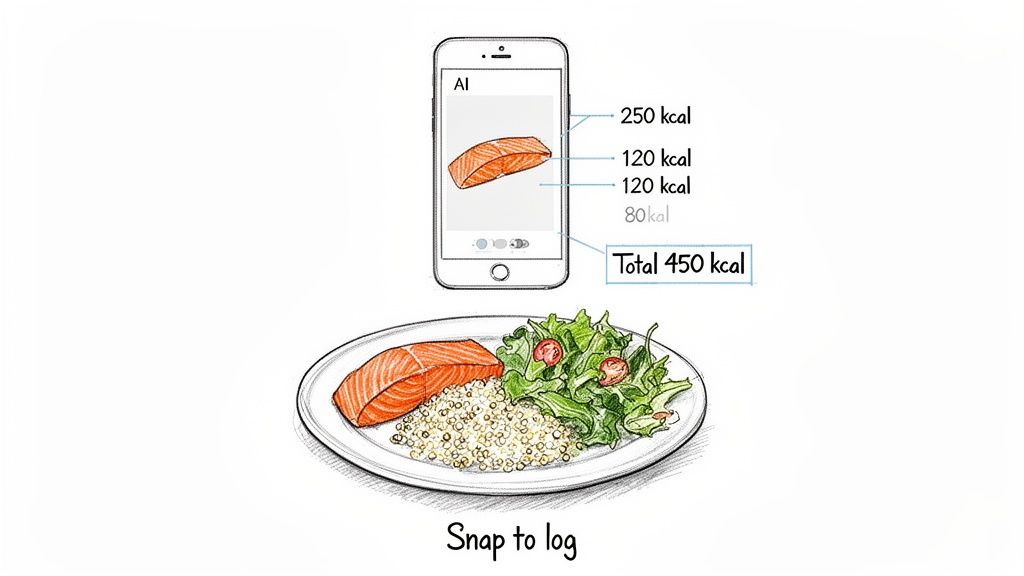
The immediate feedback is what truly changes the game. Instead of doing a guilty tally at the end of the night, you know exactly where you stand after each meal. This empowers you to make smarter choices for the rest of your day. And for those complex, multi-ingredient meals, you can even learn more about how to calculate calories in homemade food to dial in your accuracy.
Effortless tracking isn't about being lazy; it's about being consistent. When the barrier to logging is nearly zero, you’re far more likely to stick with it long enough to build lasting habits and see real results.
This approach is becoming even more important as our diets evolve. Projections from the OECD-FAO, for example, show that by 2032, the global share of calories from livestock and fish is expected to increase by 4%. For anyone watching their intake, this means that even "healthy" protein sources can easily push you into a calorie surplus if you aren't paying attention. You can dig into these trends in the full OECD-FAO Agricultural Outlook report.
By taking the manual labor out of the equation, smart trackers empower you to turn your goals into actual food choices, making the whole process feel natural instead of forced.
Common Questions About Calorie Calculation
Even after you've done the math and have your target numbers, putting it all into practice can be a different story. As you start turning those numbers into meals, questions are bound to pop up. Let's tackle some of the most common ones I hear from people when they first start tracking their intake.
How Often Should I Recalculate My Calorie Intake?
This is a big one. It's easy to set your calorie goal and then just forget about it, but your body is always changing, and your energy needs will change right along with it. A great rule of thumb is to recalculate your daily calorie intake whenever there's a significant shift in your body or lifestyle.
Think about re-running the numbers in these situations:
- You've Lost or Gained Weight: A good trigger is after every 10-15 pounds of change. A lighter body simply doesn't need as many calories to maintain itself, and a heavier one needs more.
- Your Activity Level Changes: Did you switch from a desk job to one on your feet? Or maybe you started a new, intense workout routine. On the flip side, if you become less active, your needs will drop. Any major change here warrants a recalculation.
- You've Hit a Plateau: If the scale hasn't budged for a few weeks despite you sticking to the plan, it's often a sign that your metabolism has adapted. Your body has become more efficient at the new weight, and it's time to adjust your targets.
I generally advise people to take a fresh look at their numbers every 2-3 months or after hitting a major milestone in their journey. This keeps your targets relevant and effective.
Why Do I Get Different Results from Online Calculators?
It’s incredibly frustrating, right? You put your stats into three different online calculators and get three different answers. This happens because they aren't all built the same way. Some use older formulas like Harris-Benedict, while others might use the more current Mifflin-St Jeor equation.
But the real wild card is the "activity level" multiplier. What one tool considers "lightly active," another might call "sedentary." There's no industry standard. This is exactly why learning the formulas for yourself—like we walked through earlier—is so powerful. It gives you a consistent, reliable starting point that you can trust.
Can I Just Eat 1500 Calories to Lose Weight?
It’s so tempting to just pick a nice round number like 1,500 calories, but this is a classic beginner's mistake. For a smaller, sedentary person, it might actually work. But for a taller, more active individual, dropping to 1,500 calories could be a drastic and even unhealthy cut.
Going too low, too fast can backfire. It often leads to losing precious muscle mass, missing out on key nutrients, and even slowing your metabolism down, which makes long-term weight loss much harder.
The smarter, safer, and more effective path is always to personalize. First, figure out your own unique TDEE. From there, subtract a moderate and sustainable 300-500 calories to create your deficit. This approach works with your body, not against it, setting you up for success that actually lasts.