Your Guide to a Sustainable Keto Meal Plan
Unlock sustainable weight loss with our science-backed keto meal plan. Get practical tips for calculating macros, building menus, and navigating challenges.
A successful keto meal plan is less a rigid diet and more a metabolic roadmap, guiding your body into a fat-burning state known as ketosis. This is achieved by carefully structuring what you eat: a diet that is high in healthy fats (70-75%), has a moderate amount of protein (20-25%), and is very low in carbohydrates—typically under 50 grams per day.
Understanding the Ketogenic Approach to Eating
The ketogenic diet is not just another low-carb trend; it represents a fundamental shift in how your body is fueled. By drastically reducing carbohydrate intake, you remove the body's primary energy source, glucose. In response, the liver begins to convert fat into molecules called ketones.
These ketones then become the new primary fuel source. This metabolic state is ketosis, the engine that drives the ketogenic process. The body is not starving; it is simply switching its metabolic pathway from burning sugar to burning fat. This physiological shift is credited with benefits such as sustainable weight loss, stable energy levels, and improved mental clarity. A well-structured meal plan is essential for making this transition smooth and effective.
The Science Behind the Switch
From a physiological standpoint, think of the body as a hybrid engine. Glucose from carbohydrates is like standard gasoline: it provides quick energy but burns rapidly, often leading to blood sugar fluctuations and subsequent energy crashes and cravings.
In contrast, ketones derived from fat are like a high-efficiency diesel fuel. They provide a steady, long-lasting energy source that maintains consistent performance for hours without frequent refueling.
This metabolic flexibility—the ability to switch between fuel sources—is an innate human capability. A keto meal plan is a strategic tool designed to intentionally activate this fat-burning mode.
The primary objective is to break the cycle of blood sugar spikes and crashes associated with a high-carbohydrate diet. By providing a consistent supply of fat for fuel, ketosis promotes satiety and reduces the persistent hunger signals that often derail weight management efforts.
This approach has moved firmly into the mainstream. According to a report by Persistence Market Research, the global market for ketogenic diet products is projected to reach US$20.7 billion by 2033. This growth indicates a shift from a niche diet to a recognized lifestyle for managing metabolic health.
Understanding the scientific rationale behind the diet is the first step toward successful implementation. A meal plan is more than a list of foods; it is a personal strategy for inducing and maintaining this metabolic switch.
And if you're curious about how your food choices affect the bigger picture, you might find our meal carbon footprint calculator interesting.
Figuring Out Your Personal Keto Macros
A one-size-fits-all keto meal plan is ineffective. Success depends on tailoring your dietary intake to your body's specific needs. This involves moving beyond generic percentages and calculating your personal macronutrient targets—your "macros"—to achieve ketosis efficiently.
These targets are your personalized metabolic blueprint. The process begins by determining your daily caloric needs, which are influenced by your age, sex, weight, height, and activity level. An individual with a sedentary job has vastly different energy requirements than a physically active person.
Once your daily calorie target is established, you can apply the standard keto macro ratio to create a framework for every meal and snack.
The Proven Keto Macro Ratios
The standard ketogenic diet is structured around a specific macronutrient split designed to promote fat oxidation while preserving lean muscle mass. The caloric intake is derived from these three sources in a precise balance:
- Fat: 70–75% of total daily calories. This is the cornerstone of the diet, serving as the primary fuel for the body and brain.
- Protein: 20–25% of total daily calories. Protein is crucial for satiety and muscle repair. However, excessive protein can be converted to glucose through a process called gluconeogenesis, potentially inhibiting ketosis.
- Carbohydrates: 5–10% of total daily calories. This strict limitation—typically under 50 grams per day—is the key trigger that forces the body to switch from glycolysis (burning sugar) to ketogenesis (burning fat).
This flow chart illustrates how adjusting these macros is central to entering ketosis.
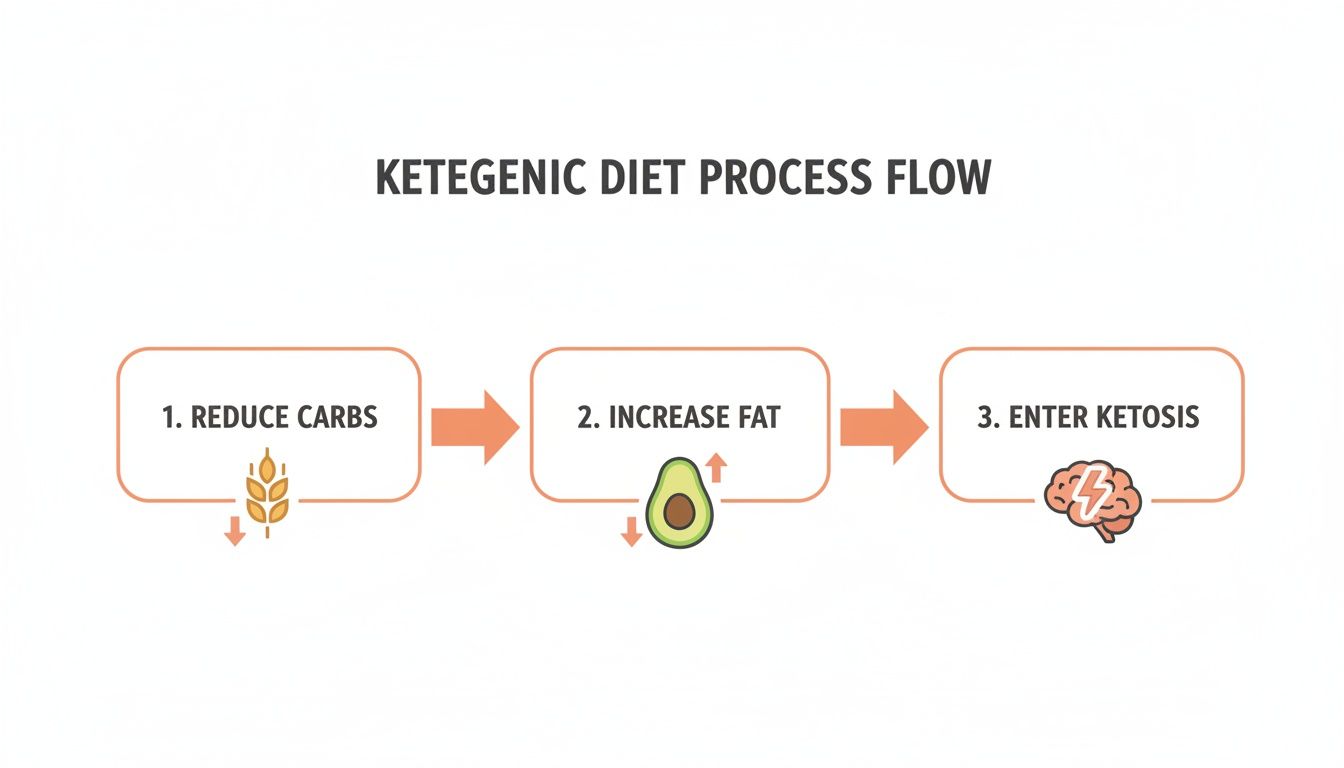
As shown, the metabolic shift to ketosis is a direct result of dramatic carbohydrate reduction and increased fat consumption, effectively reprogramming the body's energy production pathways.
From Percentages to Daily Grams
While percentages provide a useful framework, we consume food measured in grams. Therefore, these ratios must be converted into actionable, real-world numbers. This requires simple calculations using the caloric value of each macronutrient:
- Fat: 9 calories per gram.
- Protein: 4 calories per gram.
- Carbohydrates: 4 calories per gram.
Consider a 40-year-old woman with a daily caloric target of 1,800 calories for weight loss.
- Carbs (5%): 1,800 x 0.05 = 90 calories. Divided by 4 calories/gram = 22.5g of carbs.
- Protein (25%): 1,800 x 0.25 = 450 calories. Divided by 4 calories/gram = 112.5g of protein.
- Fat (70%): 1,800 x 0.70 = 1,260 calories. Divided by 9 calories/gram = 140g of fat.
Her daily targets would be approximately these values. In contrast, a highly active 25-year-old man requiring 2,500 calories would have different targets: roughly 31g of carbs, 156g of protein, and 194g of fat.
This level of personalization transforms a temporary diet into a sustainable lifestyle. Aligning macronutrient intake with your body's specific energy demands creates a plan that is not only effective but also far more satisfying and easier to adhere to long-term.
These calculations ensure you are not merely cutting carbs but also consuming sufficient protein for satiety and adequate fat for energy.
The table below provides a quick reference for how daily macro targets (in grams) vary based on different caloric goals.
Sample Daily Keto Macro Targets by Goal
| Daily Calorie Goal | Carbohydrates (g) | Protein (g) | Fat (g) |
|---|---|---|---|
| 1,600 | 20 | 100 | 124 |
| 1,800 | 23 | 113 | 140 |
| 2,000 | 25 | 125 | 156 |
| 2,200 | 28 | 138 | 171 |
| 2,500 | 31 | 156 | 194 |
Note how fat and protein grams scale with calorie intake, while carbohydrates remain consistently low.
For those who prefer to avoid manual calculations, a reliable calculator can streamline the process. Our free keto calculator can provide personalized targets in seconds. These gram-specific goals are the foundation upon which you will build your entire keto meal plan.
Building a Delicious 7-Day Keto Meal Plan
With personalized macro targets established, the next step is to translate those numbers into satisfying meals. This is where the ketogenic diet transitions from theory to practical application.
A well-designed keto meal plan is not about restriction but about abundance, built upon a wide variety of low-carb, high-fat ingredients. The key is to think in terms of building blocks: every meal should feature a quality protein source, a healthy fat, and a serving of low-carbohydrate vegetables. This flexible, modular approach promotes variety and prevents dietary fatigue.
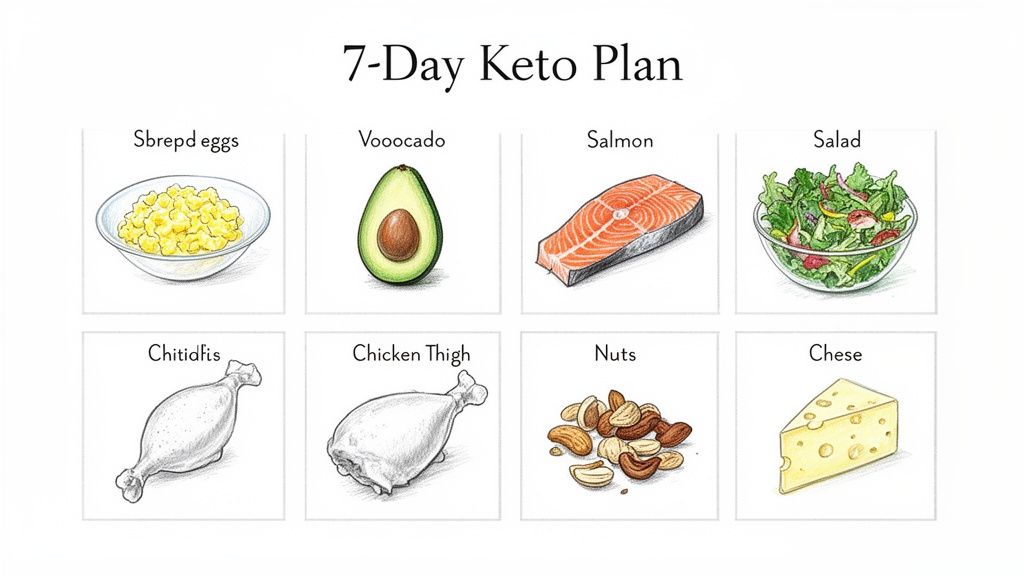
Core Components of a Keto Plate
Having a core list of keto-friendly foods makes meal construction intuitive. These staples form the basis of breakfasts, lunches, and dinners.
Go-To Protein Sources
- Fatty Fish: Salmon, mackerel, and sardines are excellent choices, providing high-quality protein and beneficial omega-3 fatty acids.
- Meat and Poultry: Chicken thighs, 80/20 ground beef, steak, and bacon are versatile keto staples.
- Eggs: An economical and versatile protein source suitable for any meal.
- Plant-Based Options: Tofu and tempeh are excellent low-carbohydrate, plant-based protein sources.
Healthy Fat Staples
- Oils: Extra virgin olive oil, avocado oil, and coconut oil are essential for cooking and dressings.
- Avocados: A cornerstone of the keto diet, rich in monounsaturated fats and fiber.
- Nuts and Seeds: Almonds, macadamia nuts, chia seeds, and flaxseeds provide healthy fats and texture.
- Full-Fat Dairy: Heavy cream, butter, and hard cheeses add flavor and help meet fat macros.
Low-Carb Vegetables
- Leafy Greens: Spinach, kale, and arugula form the foundation of many keto meals.
- Cruciferous Veggies: Broccoli, cauliflower, Brussels sprouts, and cabbage are nutrient-dense and low in carbohydrates.
- Other Favorites: Asparagus, bell peppers, zucchini, and mushrooms offer versatility in cooking.
With practice, assembling meals becomes second nature. A simple dinner could consist of baked salmon (protein) drizzled with olive oil (fat) and served with roasted asparagus (vegetable).
A Sample 7-Day Keto Meal Plan
This sample week serves as a template. Feel free to substitute ingredients based on your preferences and adjust portion sizes to align with your personal macro targets.
Monday
- Breakfast: Scrambled eggs cooked in butter with a side of sliced avocado.
- Lunch: Large spinach salad with grilled chicken thigh, macadamia nuts, and a creamy olive oil vinaigrette.
- Dinner: Baked salmon with asparagus roasted in avocado oil.
Tuesday
- Breakfast: Full-fat Greek yogurt with a sprinkle of chia seeds and a few raspberries.
- Lunch: Leftover baked salmon and asparagus.
- Dinner: Taco salad with seasoned ground beef, shredded lettuce, cheese, and sour cream.
Wednesday
- Breakfast: Keto smoothie with almond milk, spinach, avocado, and a scoop of protein powder.
- Lunch: Tuna salad (made with avocado oil mayonnaise) served in lettuce cups.
- Dinner: Pan-seared pork chops in butter with a side of creamed spinach.
Thursday
- Breakfast: Two fried eggs with bacon.
- Lunch: Leftover pork chops and creamed spinach.
- Dinner: Zucchini noodles ("zoodles") with a rich meat sauce and grated Parmesan.
Friday
- Breakfast: Keto-friendly "bulletproof" coffee and a small handful of almonds.
- Lunch: Leftover zoodles and meat sauce.
- Dinner: Steak cooked in butter with sauteed mushrooms and a side arugula salad.
Saturday
- Breakfast: Almond flour pancakes with butter and a few fresh blackberries.
- Lunch: BLT lettuce wraps (bacon, lettuce, tomato with mayonnaise).
- Dinner: Homemade cauliflower-crust pizza with cheese, pepperoni, and low-carb vegetables.
Sunday
- Breakfast: Tofu scramble with bell peppers and onions.
- Lunch: Leftover cauliflower pizza.
- Dinner: Roasted chicken with a side of steamed broccoli topped with melted cheese.
This sample demonstrates the variety and appeal of a ketogenic diet. This growing mainstream acceptance is reflected in market data; North America is projected to hold a dominant 38.87% share of the global ketogenic diet market by 2025. Reports on the ketogenic diet food market from Mordor Intelligence highlight that this growth is driven by an influx of keto-friendly products and widespread consumer adoption.
For those who find manual meal planning tedious, technology offers a solution. Tools like our AI meal plan generator can create customized plans based on food preferences and macro targets, providing structure without sacrificing flexibility.
Make Keto Tracking Effortless with BiteKit
Consistency is the determining factor for success on a ketogenic diet. A well-designed meal plan is a crucial first step, but without accurate tracking of your macronutrients—carbohydrates, protein, and fat—you are essentially operating without data. This is often where adherence breaks down. The daily routine of manual logging, barcode scanning, and navigating food databases can become overwhelming.
This tedious data entry is a significant reason for dietary non-adherence. On a busy day, the last thing one desires is to use a food scale and calculator before eating. This is precisely the problem tools like BiteKit were designed to solve—making the process of tracking seamless and intuitive.
Ditch the Manual Logging for Good
Imagine a world where you no longer need to painstakingly enter every ingredient from your meal. BiteKit leverages AI to automate the most tedious aspects of food logging, removing major barriers to consistent tracking.
Instead of navigating complex interfaces, you can log your food in a natural, conversational way:
- Log with a Photo: Simply take a picture of your meal. The AI identifies the foods on your plate—from a simple steak and asparagus to a complex keto casserole—and instantly calculates the macronutrient breakdown.
- Use Your Voice: For maximum efficiency, you can use voice commands. Saying "120 grams of chicken thigh with broccoli" is all it takes for BiteKit to log the meal.
- Text in Plain English: Alternatively, you can type your meal description as you would say it: "a cup of coffee with a splash of heavy cream and two scrambled eggs." The application understands and accurately logs the macros.
This functionality transforms the user experience. Tracking becomes a quick, intuitive action that integrates seamlessly into your daily routine, making it significantly easier to build a sustainable habit.
See Your Progress in Real-Time
Access to data is important, but its clear visualization is what enables informed, in-the-moment decision-making. A clear visual display of your daily progress is essential for understanding where you stand relative to your carb, protein, and fat targets.
This immediate feedback allows for on-the-fly adjustments. For example, if your macro breakdown after lunch shows you are approaching your daily carbohydrate limit, you know to plan a dinner composed almost entirely of fat and protein.
The screenshot below demonstrates how BiteKit provides a clear macro analysis for each meal, offering an instant understanding of its nutritional composition.
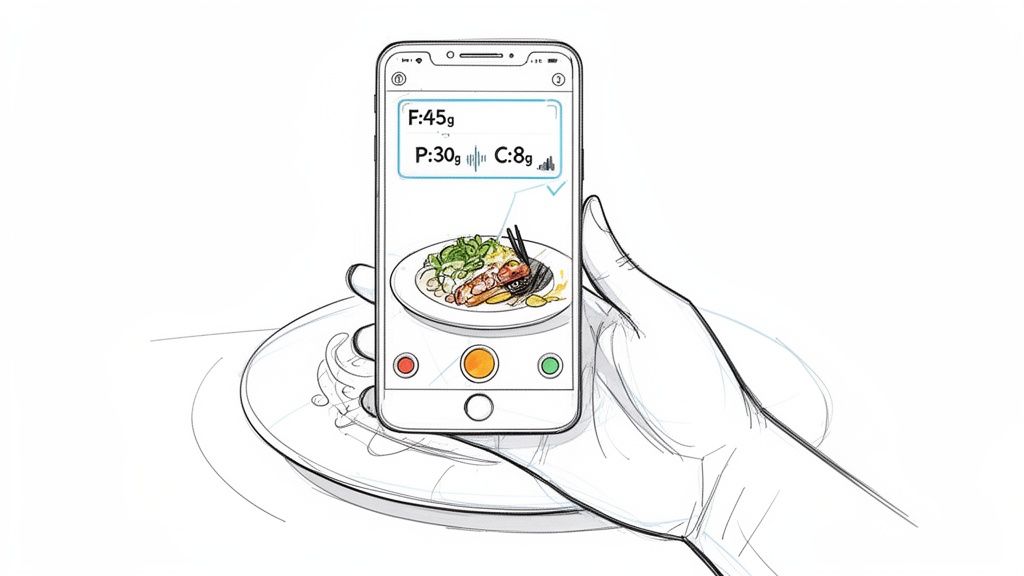
The simple, color-coded bars convey all necessary information: this meal is high in fat and protein while being very low in carbohydrates—a perfect keto profile.
This is not merely about retrospective logging; it's about empowering you to proactively plan your next meal. By making macro data easily digestible, you can focus your mental energy on your health, not on arithmetic.
Another critical feature is data privacy. With BiteKit, all nutritional data is stored locally on your device. There are no accounts to create and no cloud backups, ensuring your personal health information remains entirely private.
Ultimately, the most effective tracking tool is the one you will use consistently. By automating manual work and providing clear, actionable insights, you can maintain adherence and achieve the results you are working towards.
Navigating Common Keto Challenges
Embarking on a new dietary protocol is rarely a linear path to success. A robust keto meal plan is your foundation, but knowing how to navigate the inevitable challenges is what makes it a sustainable lifestyle.
One of the first hurdles many encounter is the "keto flu." As your body transitions from a glucose-based to a fat-based metabolism, it's common to experience symptoms like fatigue, headaches, and irritability for a few days. This is a normal and temporary physiological response.
Taming the Keto Flu
The underlying causes of the keto flu are primarily dehydration and electrolyte imbalance. When carbohydrate intake is drastically reduced, the body releases stored water, and essential minerals are flushed out along with it.
You can mitigate these symptoms with a few simple, evidence-based strategies:
- Increase Hydration: Water is crucial. Aim to consume more water than usual, especially during the first week of the transition.
- Replenish Sodium: The body's sodium requirements increase on a ketogenic diet. Adding high-quality sea salt to meals or drinking bone broth can make a significant difference.
- Mind Your Minerals: Consume foods rich in potassium (e.g., avocados, spinach) and magnesium (e.g., nuts, seeds). A sugar-free electrolyte supplement can also be beneficial during this initial phase.
Handling Cravings and Social Situations
Cravings for high-carbohydrate foods are a common experience. The most effective approach is not to rely on willpower but to have a strategic plan. Instead of deprivation, find a satisfying keto-friendly substitute. For a pizza craving, try a version with a "fathead" or cauliflower crust. For a sweet craving, a handful of berries with full-fat Greek yogurt is often sufficient.
Social events can present challenges, but they are manageable with preparation.
A proactive strategy for dining out is to review the menu online beforehand. Look for simple, easily adaptable dishes like steak with a side salad (no croutons, extra olive oil) or grilled fish with steamed vegetables. When attending a party, consuming a satiating keto meal before you go can help you avoid temptation.
This level of planning allows you to maintain control without feeling socially isolated.
Breaking Through a Weight Loss Plateau
It is common for weight loss to stall after the initial loss of water weight. The key is to analyze, not panic. Conduct an honest review of your food tracking. Are hidden carbohydrates from sauces or dressings creeping in? Also, consider lifestyle factors—chronic stress and poor sleep can disrupt hormonal balance and hinder progress.
Often, a small adjustment to your keto meal plan is all that is needed to resume progress.
Despite occasional fluctuations in public interest—social media mentions of keto saw an 18.5% year-on-year decrease by mid-2025—the diet's resilience is clear. The global keto market was valued at $12.45 billion, demonstrating that for many, keto is a long-term solution, particularly in the context of the global obesity epidemic affecting one in eight people. You can read more about the future of the keto diet and its market resilience.
By anticipating challenges and having a clear plan, you can transform potential roadblocks into minor adjustments on your path to improved health.
Your Keto Meal Plan Questions Answered
As you begin a ketogenic diet, questions are inevitable. This is a normal part of adopting a new nutritional framework. Below are answers to some of the most common inquiries to help you proceed with confidence.
How Do I Know If I Am in Ketosis?
While a blood ketone meter provides the most accurate measurement, your body offers several physiological signs that it has transitioned into ketosis. A common indicator is a distinct fruity or metallic odor on the breath, known as "keto breath," caused by the production of acetone, a type of ketone body.
Other common signs include:
- Increased Thirst: As the body releases water stores, thirst often increases.
- Reduced Hunger: The high-fat, moderate-protein composition of the diet promotes satiety, often leading to a natural decrease in appetite.
- A Shift in Energy: After an initial adaptation period (the "keto flu"), many people report experiencing sustained, clear-headed energy throughout the day.
For quantitative data, a blood ketone meter is the gold standard. A reading between 0.5–3.0 mmol/L is considered the optimal range for nutritional ketosis.
Can I Drink Alcohol on a Keto Diet?
Yes, but it requires careful selection. When you consume alcohol, your body prioritizes its metabolism over fat burning, which can slow your progress.
The key is to choose zero-carbohydrate options. Pure spirits like vodka, gin, tequila, and rum are generally acceptable when mixed with non-caloric mixers like soda water. Dry red and white wines are also low-carb choices. The primary sources of carbohydrates to avoid are beer, sweet wines, and sugary cocktails, as they can quickly disrupt ketosis. It's also important to note that alcohol tolerance may be lower on a ketogenic diet.
Is a Keto Diet Safe for Long-Term Health?
A growing body of scientific research suggests potential long-term benefits, particularly for the management of conditions like type 2 diabetes. The critical factor is ensuring the diet is "well-formulated." This means it is not just about carbohydrate restriction but about the quality of the foods consumed.
A sustainable, long-term ketogenic diet is built on a foundation of nutrient-dense whole foods. This includes healthy fats from sources like avocados and olive oil, high-quality proteins from fish and grass-fed meats, and ample fiber from leafy greens, non-starchy vegetables, and nuts.
To prevent potential micronutrient deficiencies, careful meal planning is essential, and supplementation may be necessary. Given that a high-fat diet can affect individuals differently, particularly regarding cholesterol levels, consulting with a healthcare professional is always recommended to ensure it aligns with your specific health needs.
What Happens If I Have a Cheat Meal on Keto?
A single high-carbohydrate meal will not derail your long-term progress. It will temporarily shift your body out of ketosis as it reverts to metabolizing the glucose you've consumed. You may experience bloating, fatigue, and a resurgence of carbohydrate cravings.
The best course of action is to immediately return to your planned keto diet. Avoid compensatory behaviors like over-restricting or fasting. Simply resume your standard keto meals, and your body will typically re-enter ketosis within a day or two of consistent low-carb eating.
A more sustainable long-term strategy than planned "cheat meals" is to find or create keto-friendly versions of your favorite foods. This allows you to satisfy cravings without compromising your metabolic state.