Apple Fritter Calories: Guide to Nutritional Values
Curious about apple fritter calories? Get the facts on calories by size & chain (360-570+). Track accurately & make healthier choices.
Apple fritter calories can vary a lot. A single fritter may be as low as 360 calories or as high as 564 calories in some common retail and institutional examples, and commercial versions can range even higher, from 470 to 716 calories depending on size and recipe.
That wide range is exactly why so many people feel confused standing in front of a bakery case. You look at one glossy, craggy fritter and think, “It’s just one pastry.” Then you check two different nutrition entries and get two very different answers. That isn’t you being bad at tracking. It’s the food itself.
An apple fritter is one of those treats that resists a simple, one-size-fits-all number. Size changes. Dough changes. Frying changes. Glaze changes. Even two fritters that look similar can land very differently in your calorie log.
If you’re tracking calories or macros, the question isn’t just “how many calories are in an apple fritter?” It’s “why is this so hard to estimate, and how can I make a better call without overthinking it?” That’s where the useful nutrition conversation starts.
That Tempting Apple Fritter in the Display Case
You’re in a coffee shop. Maybe you ordered a latte and planned on something small, but then you see the apple fritter. It’s oversized, irregular, shiny with glaze, and full of crisp edges that promise that perfect mix of soft apple and fried dough.
This is usually the moment people ask me, “How bad is it?”
I don’t love that wording, because foods aren’t moral tests. But I understand what people mean. They want to know whether this one choice eats up a big chunk of the day’s calories, and whether they can fit it into their goals without feeling like they blew it.
With apple fritters, the tricky part is that the answer depends heavily on which fritter you’re looking at. A smaller grocery bakery version may fall near the lower end of the known range, while a larger coffee shop or bakery version can be much more energy-dense. That’s why generic database entries often feel unreliable.
Practical rule: If a pastry is fried, glazed, and highly irregular in size, a generic calorie entry is usually less trustworthy than people think.
Readers often get confused because “apple fritter” sounds like a single food, the way “banana” or “egg” does. It isn’t. It’s more like “slice of cake.” The name tells you the category, not the exact calorie load.
That matters if you’re trying to lose weight, hit macros, or understand why one breakfast pastry can leave you full for a short time but still take a meaningful bite out of your daily intake.
Why Apple Fritter Calories Are So Inconsistent
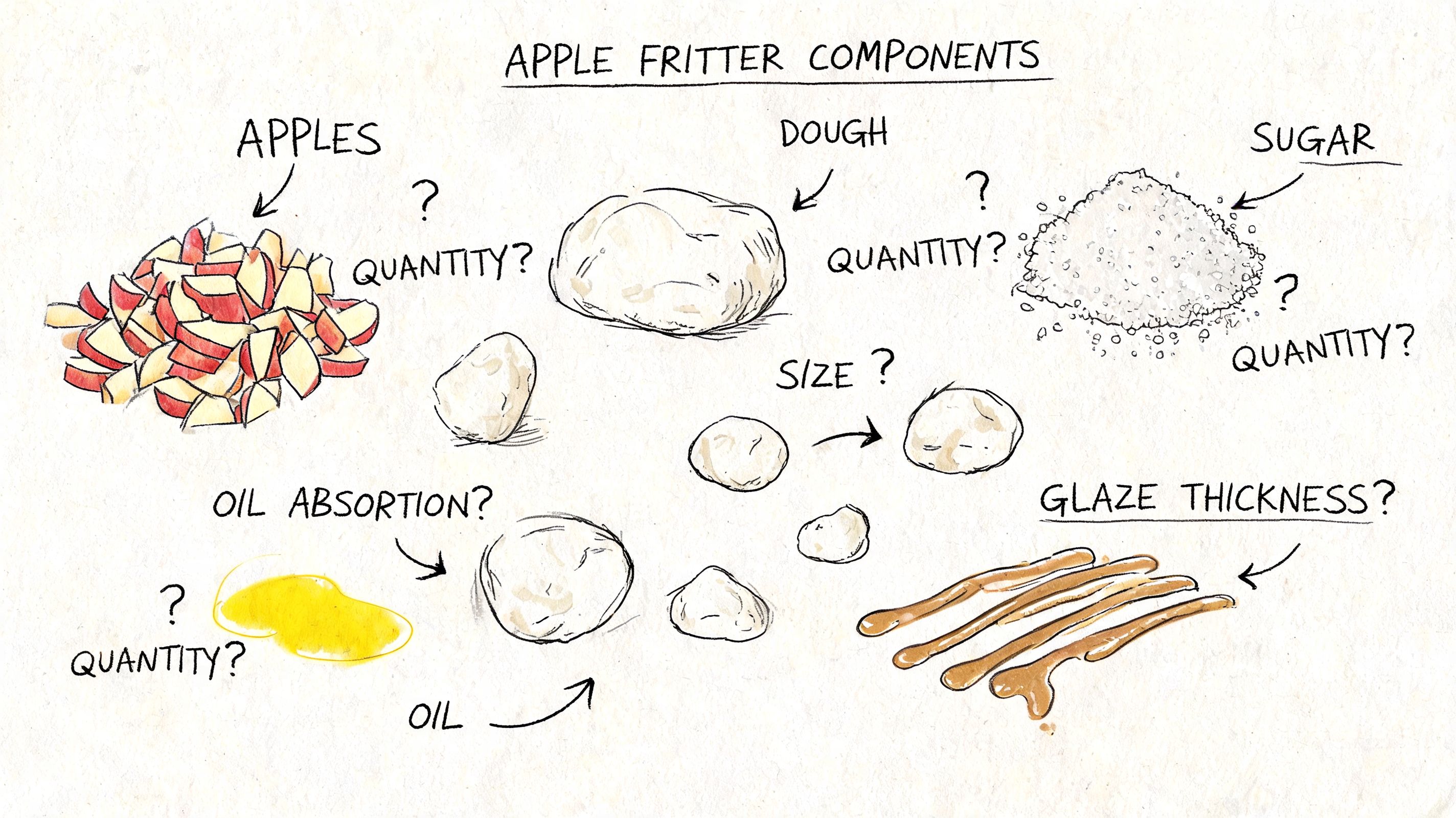
A fritter’s calorie count works like a total built from several moving parts. Change one part and the whole number shifts. Change three or four, and you can end up with a very different food even though it still looks like an apple fritter.
Portion size changes everything
The biggest driver is simple. Some fritters are much larger than others. One verified comparison shows apple fritters ranging from 360 calories for a standard grocery store fritter to 564 calories for a large institutional fritter, while many databases still display a generic estimate around 420 calories, which can hide the spread in portion size and formulation (QFC apple fritter nutrition example).
That’s why two people can both log “1 apple fritter” and still be far apart in accuracy. One may have eaten a compact grocery version. The other may have picked up a thick, bakery-style fritter with more dough folds, more glaze, and a heavier final weight.
Dough, glaze, and the frying process
The second factor is the dough itself. Some fritters are denser and richer. Others are more airy. A denser dough can hold more absorbed oil during frying, and that raises calories fast.
Then there’s the coating. A thin glaze and a heavy glaze are not nutritionally equivalent. Neither are a fritter with sparse apple bits and one with a generous, sugary filling. More glaze and more filling usually mean more carbohydrate load.
The frying step is where many people underestimate the total. Dough behaves a bit like a sponge in hot oil. Commercial apple fritters show 470 to 716 calories across examples, with differences tied to dough composition, coating thickness, and oil retention. In these products, total fat can reach 28 to 38 grams per fritter (commercial apple fritter comparison).
Why visual guessing is hard
People often think, “I can eyeball this.” Sometimes you can get close. But apple fritters are irregular by nature. They don’t have clean edges or uniform thickness. A thin-looking fritter with lots of ridges and glaze may still carry a hefty calorie load because those craggy surfaces trap oil and sugar.
A better visual check is to ask:
- How large is it overall? Bigger diameter usually means more dough.
- How thick is it? Thickness often signals more mass than width alone.
- How glossy is the glaze? A heavier sheen often means more sugar coating.
- How dense does it look in the middle? Dense folds often mean more absorbed oil.
That’s why apple fritter calories are inconsistent. The label sounds simple. The food isn’t.
Calorie Comparison of Popular Apple Fritters
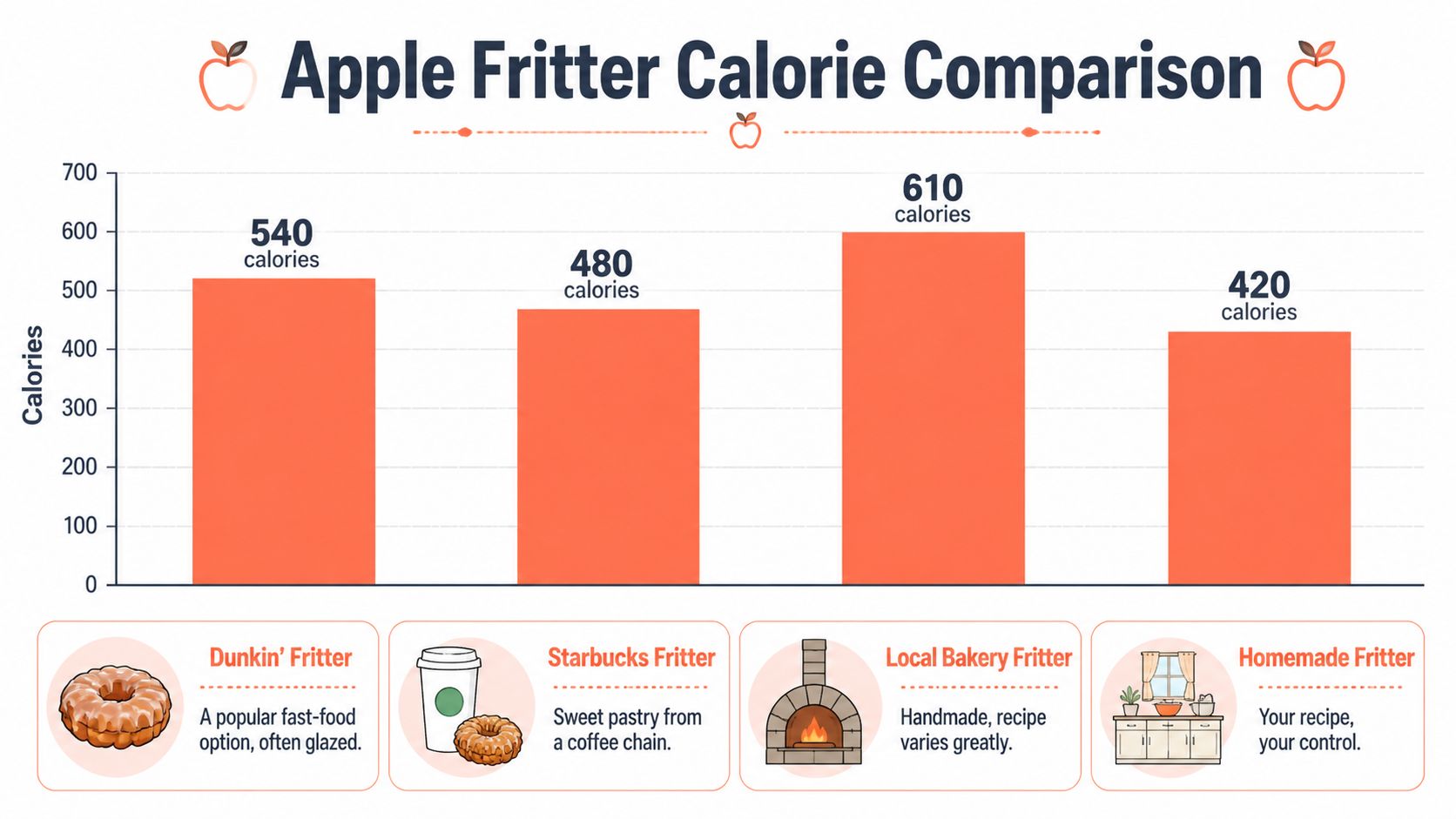
Standing in front of a bakery case, two apple fritters can look close enough to count as the same food. In practice, they can land very differently in your calorie budget.
A quick reality check on comparison data
Brand comparisons are useful, but they need context. Apple fritters are more like muffins from different bakeries than identical packaged snacks. The name stays the same while the recipe, size, oil absorption, and glaze can shift enough to change the calorie total in a meaningful way.
Earlier examples in this article showed a wide range across commercial fritters. That matters because many food logs still treat “apple fritter” like a single standard item. If you pick a generic entry, your estimate may be reasonably close, or it may miss by enough to change your day’s totals.
Apple Fritter Nutrition Facts Chain Comparison
| Retailer | Serving Size (g) | Calories | Total Fat (g) | Sugar (g) |
|---|---|---|---|---|
| Dunkin' | not specified in verified data | 470 to 510 | 28 to 38 | not specified in verified data |
| 7-Eleven | not specified in verified data | 580 | 28 to 38 | not specified in verified data |
| Grocery bakery example | 113g | 360 | not specified in verified data | not specified in verified data |
| Large institutional example | 128g+ | 564 | not specified in verified data | not specified in verified data |
The pattern is the point.
A fritter in the mid-300s is a very different snack from one pushing past 500 calories, even though both may be labeled “apple fritter.” For someone trying to maintain weight, create a calorie deficit, or match intake to hunger, that gap is large enough to matter.
What explains the gap between brands
Size is the easiest difference to notice, but it is not the only one. A taller, denser fritter usually contains more dough, and more dough means more flour, sugar, and absorbed oil. A heavily glazed surface adds another layer of calories that is easy to miss because it looks thin, but sugar spread across all those ridges adds up fast.
Preparation style matters too. Some versions are lighter and less saturated with oil. Others are richer, heavier, and closer to dessert than pastry. A good comparison is a sponge versus a towel. Both absorb liquid, but not in the same amount. Fritter dough behaves similarly during frying, which helps explain why two pastries of similar size can still differ quite a bit.
A few practical rules help:
- Smaller grocery bakery fritters often come in lower than oversized bakery versions.
- Convenience store and chain fritters often sit in the middle to higher range.
- Large bakery or institutional fritters can approach the calories of a full meal.
The bakery label tells you what the pastry is called. It does not tell you how much oil stayed in the folds or how much glaze was brushed on after frying.
Calorie tracking gets messy in real life because of these variations. Someone logs “apple fritter,” taps the first result, and assumes the number is close enough. Sometimes it is. Sometimes the difference is big enough to explain why progress stalls or why hunger feels off later.
That is also why photo-based logging is useful for foods like this. Irregular pastries do not fit neatly into generic database entries. If you want a second opinion on portion size and macro impact, a macro calculator for real-world food decisions can help, and BiteKit’s AI photo logging is built for exactly this kind of messy, hard-to-standardize food.
The practical takeaway is simple. Brand matters. Portion matters more than the name. If you know the store, use the closest brand entry you can find. If you do not, estimate based on size, density, and glaze rather than trusting the first generic listing.
Beyond Calories The Full Macronutrient Picture
Calories matter, but they don’t tell you how a food is likely to feel in your body. Two foods with similar calories can affect fullness very differently. Apple fritters are a strong example of that.
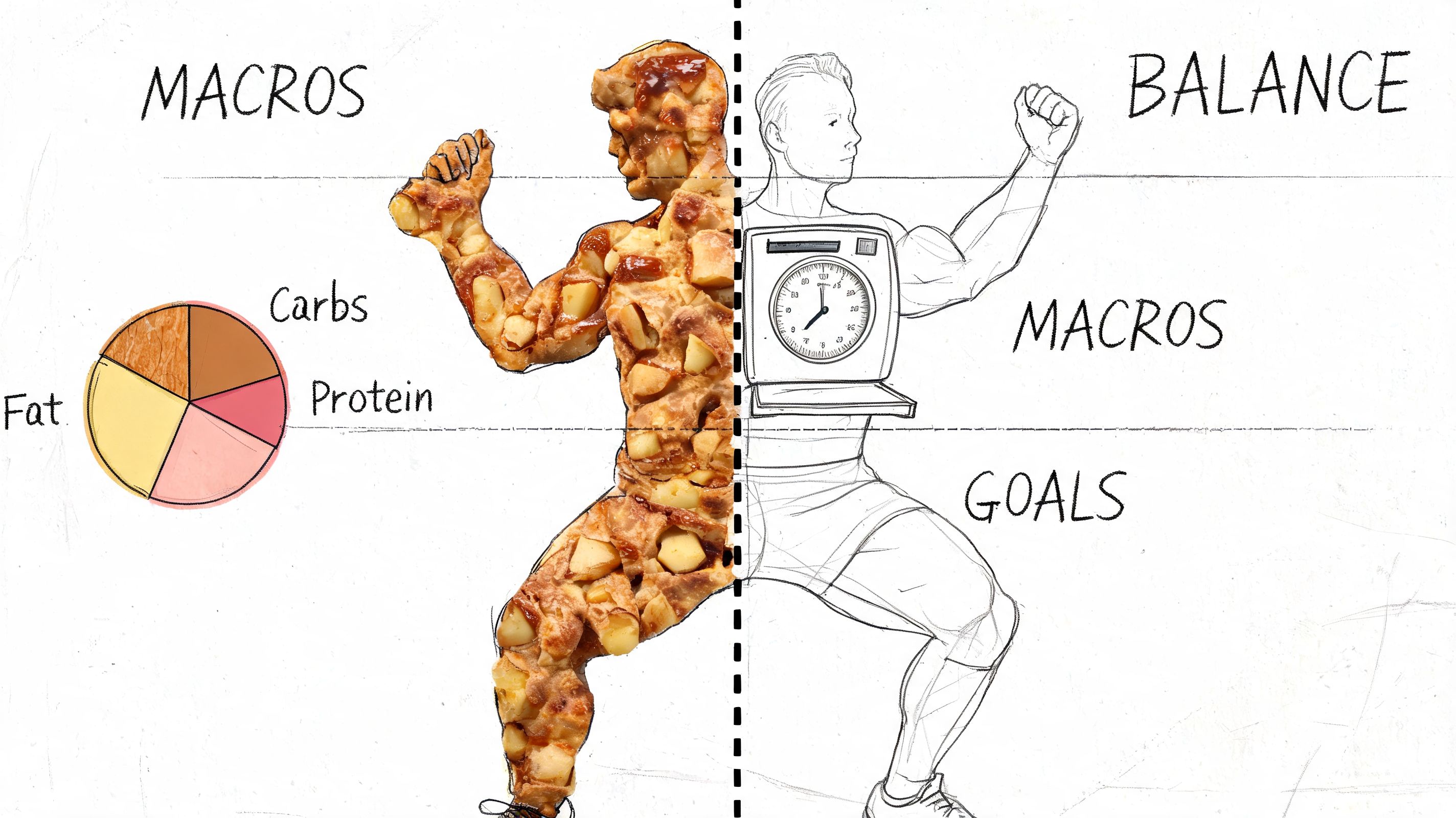
A verified nutrition profile shows apple fritters typically provide about 50 to 57% of calories from fat, 36 to 42% from carbohydrates, and 6 to 10% from protein, with only 1.6 to 2 grams of fiber (generic apple fritter macro profile). That combination helps explain why a fritter can be satisfying in the moment but not especially filling for long.
Why fullness fades fast
Protein and fiber usually do a lot of the heavy lifting for satiety. Apple fritters don’t bring much of either. They’re rich in fat and carbs, but light on the nutrients that tend to help people stay full.
That doesn’t mean a fritter is “bad.” It means it’s a treat food, not a balanced meal. If you eat one on its own for breakfast, you may notice that hunger returns sooner than you expected.
Many people get frustrated. They think, “I had plenty of calories, so why am I hungry again?” The answer often sits in the macro profile, not just the total energy number.
What this means for macro tracking
If you track macros, a fritter can use a lot of calorie budget while contributing relatively little protein. That matters for athletes, people trying to preserve muscle while losing fat, and anyone who feels better when meals are built around protein and fiber.
A good next step is checking your daily targets with a macro calculator so you can see whether a pastry fits better as a planned treat than as a core meal.
A short visual explanation can also help if you’re learning how satiety works in real life:
Calories are only part of the story
Here’s the mindset shift I want clients to make: don’t ask only, “Can I fit this into my calories?” Also ask, “What will this replace, and how will I feel afterward?”
- If it replaces breakfast, expect less staying power than a meal with more protein.
- If it’s a shared treat, it may be easier to enjoy without disrupting the rest of the day.
- If it follows a balanced meal, it often works better than eating it alone on an empty stomach.
That’s the full picture. Apple fritter calories matter. Apple fritter macros explain the experience.
Homemade Versus Store-Bought Fritters
A lot of people assume homemade automatically means healthier. Sometimes it does. But with apple fritters, that isn’t guaranteed.
Homemade gives you more control. You can choose the apples, adjust the sweetness, use a lighter glaze, or skip extra finishing touches. If you enjoy learning baking secrets for health, that kind of ingredient control can support more intentional choices in the kitchen.
What homemade improves
At home, you decide what goes in the bowl and what goes on top. That can help you make a fritter that better matches your preferences and goals.
For example, you can:
- Use less glaze if you want the apple flavor to stand out more.
- Make smaller portions instead of one oversized bakery-style piece.
- Balance the meal around it because you know in advance that you’re making a treat.
That said, homemade doesn’t solve the biggest tracking problem. It may make it harder.
What homemade makes harder
Store-bought items at least sometimes come with a label or a brand entry. Homemade fritters don’t. Once dough hits hot oil, calorie accuracy becomes harder because oil absorption isn’t obvious from appearance alone.
Portion inconsistency adds another layer. One homemade fritter may be thick and compact. Another may spread out more and fry differently. Even if you use the same batter, the final calorie count per piece can shift.
If you want a more realistic homemade estimate, track the full recipe and divide by the number of finished pieces, then adjust based on size differences rather than assuming every fritter is identical.
If you cook often, this guide on how to calculate calories in homemade food can make the process less frustrating.
Homemade can absolutely be a smart option. It just isn’t automatically low-calorie, and it isn’t automatically easier to log.
Smart Strategies for Enjoying Apple Fritters Guilt-Free
Many don’t need stricter food rules. They need better strategies.
Apple fritters tend to have a carb-to-protein ratio around 12:1, and a single fritter can contain 14 to 27 grams of added sugar, which helps explain why hunger may return later even after a calorie-dense treat (glazed apple fritter nutrition context). If you understand that, you can plan around it instead of feeling blindsided by it.
Four ways to make a fritter fit better
-
Split it
Half now and half later is one of the easiest strategies. You still get the experience, but the portion becomes easier to fit into your day.
-
Pair it with protein
If a fritter is mostly carbs and fat, add something that brings balance. Greek yogurt, eggs, cottage cheese, or a protein shake can make the meal feel more complete.
-
Don’t use it as your only breakfast by default
Some people do fine with a pastry and coffee. Many don’t. If you know you crash or get snacky mid-morning, your body is giving you useful feedback.
-
Choose the less dramatic option when you can
A smaller fritter or one with a lighter glaze is often the easiest win. You still get the flavor profile, just with fewer variables working against you.
A more helpful mindset
You don’t need to “earn” a fritter. You also don’t need to pretend it’s nutritionally identical to a balanced meal. A calm middle ground works better.
Try thinking in terms of intention:
- Craving and enjoyment are valid reasons to eat a treat.
- Planning makes that treat easier to enjoy.
- Compensation through extreme restriction later usually backfires.
A single apple fritter doesn’t define your diet. Repeatedly eating energy-dense foods without awareness can make your goals harder. Those are different ideas, and separating them helps people make better decisions.
Log Your Fritter in Seconds with BiteKit
Apple fritters are a perfect example of why food logging can feel annoying. You’re not logging a plain packaged snack with one standard entry. You’re logging an irregular, fried, glazed pastry that may look nothing like the generic database photo.
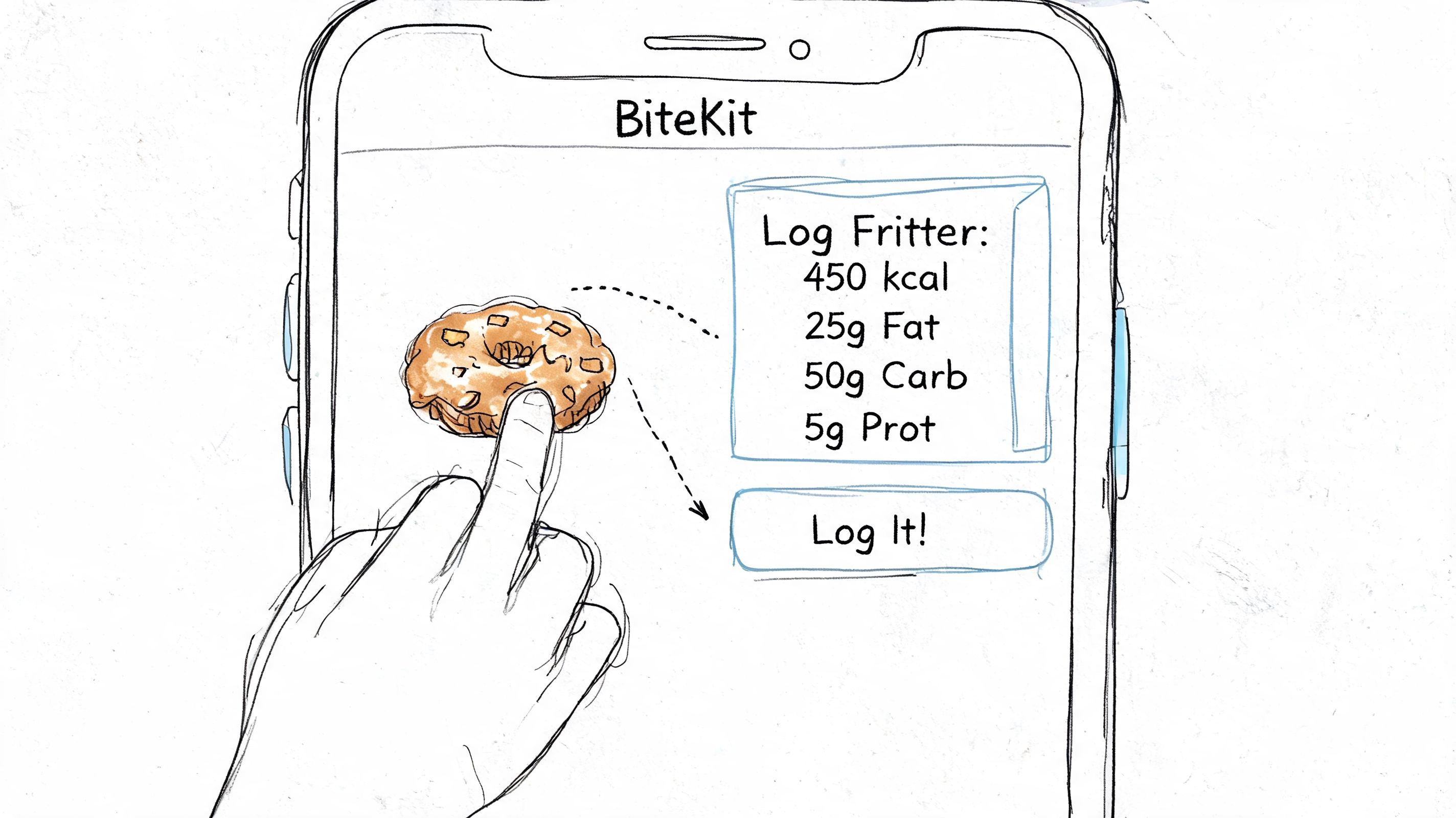
The old approach is familiar. Search “apple fritter.” Scroll through a long list. Pick the closest match. Hope it’s right. That works well enough for standard foods, but it gets shaky fast with pastries that vary by size, glaze, and oil retention.
A photo-based tool can reduce that guesswork. With an AI meal analyzer, you can snap a picture of the fritter and get an estimate based on what’s in front of you, rather than forcing a rough match from a giant list of generic entries.
Why this kind of tool fits this food
Apple fritters are visually distinctive. Size, thickness, surface texture, and glaze all influence the estimate you’d want to make. A tool that works from a meal photo matches the practical problem better than a text-only search when you don’t know the exact brand.
That doesn’t mean any estimate is magically perfect. It means the method is better aligned with a food that has so much visible variation.
If you’re someone who wants consistency without turning every coffee shop stop into a research project, that’s a practical shift. It keeps tracking fast enough to maintain the habit, which is what matters most over time.
Making Informed Choices in the Bakery Aisle
Apple fritter calories aren’t confusing because you’re missing something obvious. They’re confusing because the food itself varies a lot. Size, frying, dough, and glaze all change the final number, and the macro profile helps explain why a fritter can be satisfying at first but not especially filling later.
That knowledge is useful, not restrictive. It helps you decide when a fritter fits, how to balance it, and how to log it more realistically. No food needs to be off-limits. But foods do make more sense when you understand what you’re eating.
If you want calorie and macro tracking to feel simpler, BiteKit lets you log meals with photos, voice, or text so you can spend less time searching databases and more time making informed choices.