How to Estimate Calories When Eating Out: A Guide
Learn how to estimate calories when eating out with practical tips. Master portion control, menu decoding, and use tools for accurate tracking.
You’re at a restaurant, the menu looks reasonable, and then the food arrives. The salmon filet is bigger than expected. The rice is packed into a mound. There’s a glossy finish on the vegetables that definitely didn’t come from water alone. If you track calories, this is the moment where confidence disappears.
The difficulty isn't a lack of discipline. The struggle comes because restaurant food is designed to be hard to judge. Portions drift. Oils stay hidden. Sauces blur the line between a solid meal and a calorie bomb. The skill isn’t perfect accuracy. It’s learning how to estimate calories when eating out well enough that your weekly intake still reflects reality.
Why Restaurant Calories Are So Hard to Track
Eating out changes calorie intake in a predictable way. A USDA analysis found that each meal consumed away from home adds an average of 134 calories to daily intake compared to home-prepared meals, with the largest effect at lunch with 158 extra calories and dinner with 144 extra calories according to the USDA Economic Research Service analysis.
That’s why restaurant tracking feels strangely punishing. You can choose a meal that sounds healthy and still end up well above what you’d make at home. A grilled protein can be cooked in extra oil. Rice can be portioned generously. Dressings and butter can add energy without making the plate look much larger.
The real problem isn’t laziness
Most calorie tracking errors happen because restaurant food hides information. Menus don’t tell you how much oil hit the pan, whether the bun was buttered, or how aggressively the kitchen portions starches. If you also like off-menu items or customizations, the uncertainty gets worse. Reading about how brands streamline secret menu integration is a good reminder that what people order often differs from the standard menu listing.
A useful mindset is to treat estimation as a learnable field skill, not a math test. You’re trying to get into the right range, consistently. That matters more than chasing impossible precision on one dinner.
Good, better, best
There are three practical levels:
- Good: Make a smart choice before ordering and avoid the obvious calorie traps.
- Better: Estimate portions on the plate and break the meal into pieces.
- Best: Use a tool that speeds up the process and reduces manual guesswork, especially if you eat out often. If you want a walkthrough of app-based logging approaches, this guide on using a photo calorie counter for meals is a useful place to start.
Practical rule: A logged estimate beats an unlogged “cheat meal” almost every time, even if the estimate isn’t perfect.
Decoding the Menu Before You Order
The easiest calories to track are the ones you never order in the first place.
Before the plate hits the table, the menu usually gives away where the calories are hiding. Restaurant descriptions are rarely neutral. Certain words signal heavy cooking methods, richer sauces, and bigger calorie swings. Others usually point to simpler prep and easier estimating.
Red flags on a menu
These words don’t always mean “bad.” They mean “estimate higher.”
- Crispy or fried: breading and frying change the calorie profile fast.
- Creamy, alfredo, cheesy: sauces are dense and easy to underestimate.
- Smothered or loaded: usually means extras piled on top rather than served separately.
- Breaded, battered, crusted: less guesswork if you assume the higher side.
- Aioli, mayo, ranch, buttery: the calorie issue is often in the condiment, not the main ingredient.
If two dishes have the same base ingredient and one uses this language, that one is the harder meal to estimate and the riskier choice if fat loss is your goal.
Green flags that make tracking easier
Some menu terms create cleaner estimates because the components stay more visible.
- Grilled: you can usually see the portion.
- Baked or roasted: often simpler than heavily sauced dishes.
- Steamed: lower uncertainty.
- Plain or sauce on the side: easier to count what’s on the plate.
- Salad with protein added: workable if toppings and dressing are controlled.
A key distinction is visibility. If you can see the protein, starch, vegetables, and sauce separately, you can estimate much better later.
Questions worth asking
You don’t need to interrogate the server. A few simple questions can save a lot of guesswork.
-
Can I get the sauce on the side?
This is one of the cleanest ways to reduce uncertainty. -
What does it come with?
Some calories are hidden in automatic sides, finishing oils, or bread. -
Can I swap that side?
A side salad, plain potato, or vegetables are much easier to judge than fries drowned in seasoning oil. -
Is this portion large enough to split?
Many restaurant mains are easier to log as “ate about half” than to force down and estimate afterward.
If a menu description is vague, assume the kitchen is cooking for taste, not for your macro targets.
The menu stage is about reducing chaos. Smart ordering doesn’t remove the need to estimate, but it does make the estimate smaller, simpler, and more honest.
The Art of Visual Portion Estimation
Once the food arrives, your eyes become your measuring tool. This often leads to panic or giving up, with many people throwing in a random number. A better move is to anchor the meal to physical references you always have with you: your hands.
Nutrition coaches use visual portion guides because they work in noisy, real-world settings. You’re not pulling out a scale at dinner. You’re comparing what’s on the plate to familiar shapes.
The hand guide that actually helps
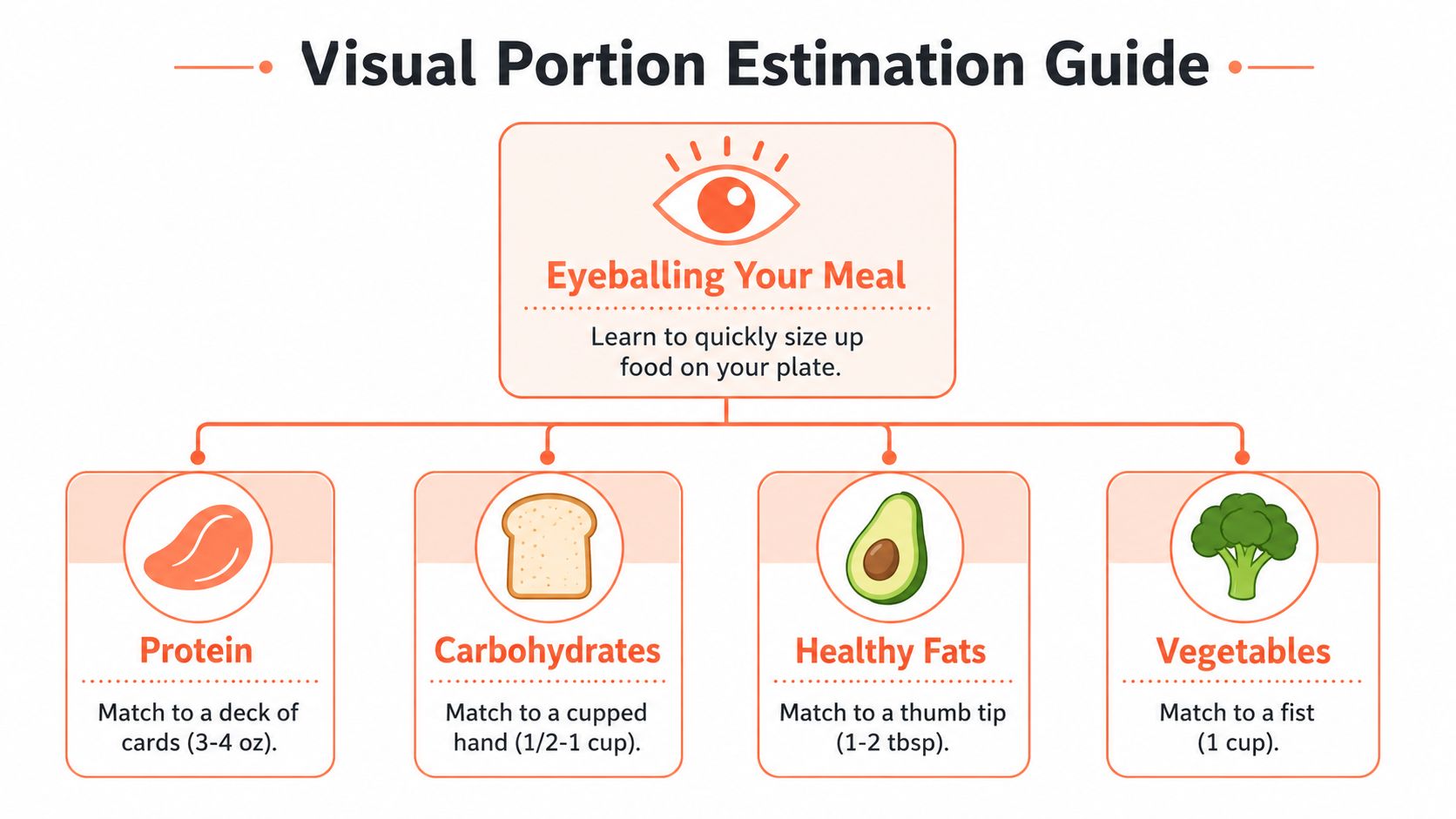
Use these quick references when you size up a meal:
- Protein: a palm or a deck of cards is about 3 to 4 ounces of meat.
- Rice or pasta: a fist is about 1 cup.
- Oil or dressing: a thumb tip is about 1 tablespoon.
- Vegetables: another fist-sized serving is a practical benchmark.
Those anchors matter because restaurant plates distort perception. A huge plate can make a normal portion look small. A stacked presentation can make a large portion look tidy. Hand references cut through that visual trick.
What to look at first
Don’t try to judge the whole meal at once. Scan in layers.
Start with the protein because it’s usually the easiest part to identify. Then assess the starch. Then look for visible fats: glossy coating, butter sheen, creamy dressing, mayonnaise, cheese, or pooled oil. The vegetables come last because they often matter less for calories than the extras sitting on top of them.
A plate of chicken, mashed potatoes, and broccoli is simpler than it looks if you do it in that order.
Practice beats theory
This skill gets better when you compare restaurant meals to foods you’ve weighed at home. If you’ve handled cooked rice, chicken breast, salmon, pasta, and oils in your own kitchen, your estimates improve quickly because you stop treating ounces and cups as abstract units.
If you want to sharpen that skill outside a restaurant, this guide on how to measure food without a scale is useful because it ties everyday objects and hand sizes to real food portions.
Coach’s shortcut: Don’t ask, “What are the exact calories?” Ask, “How many palms of protein, fists of carbs, and thumbfuls of fat am I looking at?”
Where people usually go wrong
The biggest visual mistakes are predictable:
- Under-calling protein portions: restaurant salmon and steak often look smaller than they are because they sit flat on the plate.
- Ignoring cooking fat: glossy food is rarely just “moist.”
- Treating sauces as decoration: they often carry more calories than the vegetables underneath.
- Logging the side as one serving when it’s clearly two: rice, fries, and pasta are common offenders.
Visual estimation won’t make every meal easy. It does give you a repeatable system, and that’s what matters when you’re learning how to estimate calories when eating out without obsessing over every forkful.
Deconstructing Your Plate Component by Component
Some meals deserve more than a quick eyeball. If the dish arrives with distinct parts, use itemized assessment. This is the method nutrition coaches rely on when they want a restaurant estimate that’s grounded in something more useful than a single wild guess.
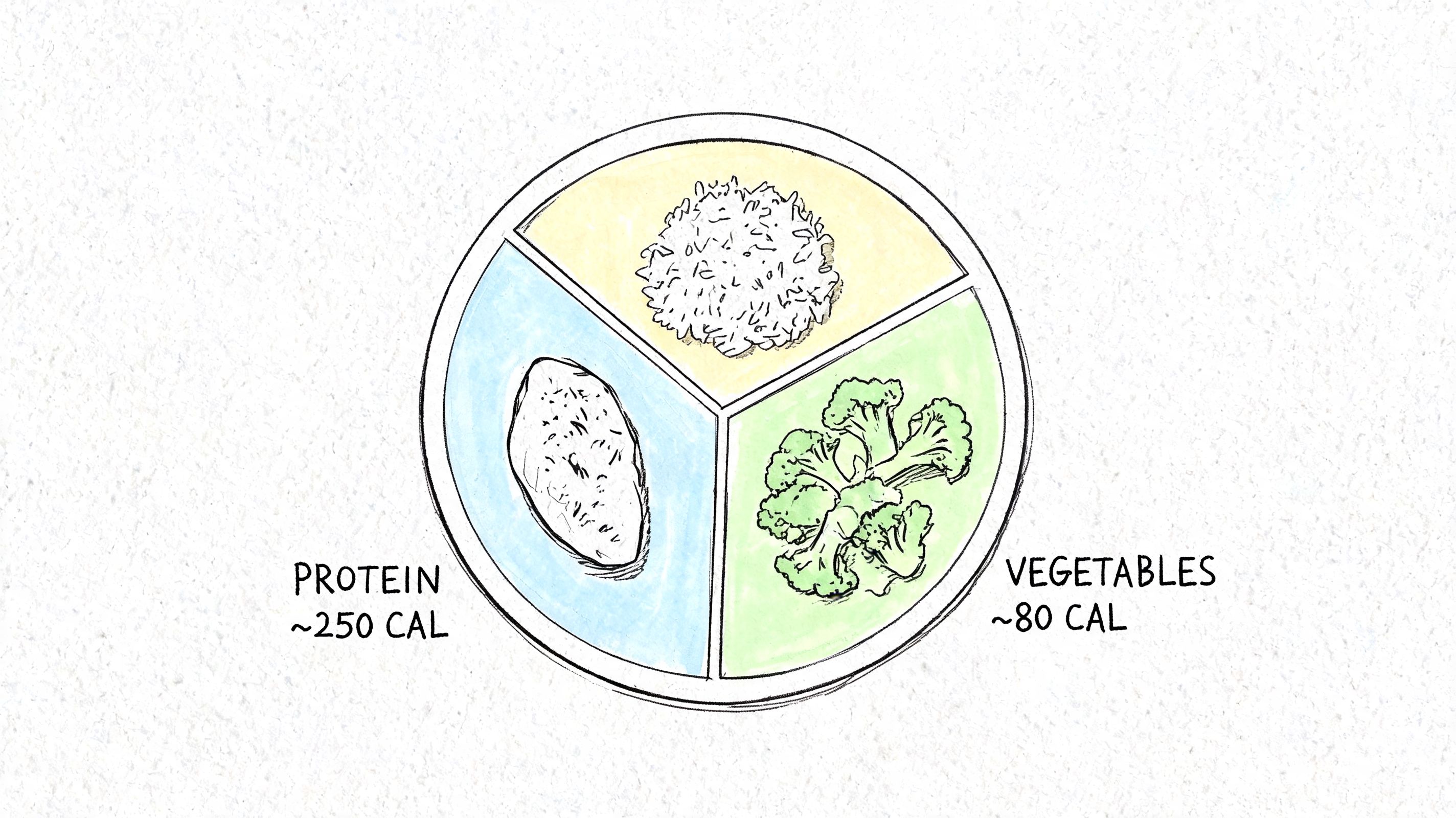
A coaching reference on estimating restaurant meals with itemized assessment describes the method clearly: break the meal into components, estimate portions, and apply a mandatory 20% upward adjustment for hidden fats and prep variation. That same source notes restaurant preparation can inflate calories by 10 to 38%, and people who practice this for 4 to 6 weeks can reach ±15% accuracy.
When this method works best
Use it for meals where the components are visually separated, such as:
- grilled salmon with risotto and asparagus
- steak with potatoes and green beans
- chicken breast with rice and side vegetables
- breakfast plates where eggs, toast, potatoes, and meat are distinct
It’s less useful for dishes like lasagna, burritos, curries, or casseroles where everything is blended together.
A worked example
Take a plate of salmon, risotto, and asparagus.
Start with the salmon. If the filet looks closer to 8 ounces than 4 ounces, and a common database estimate for 4 ounces of Atlantic salmon is about 240 calories, doubling the portion gives 480 calories.
Now assess the starch. If the risotto looks like roughly a fist-sized serving, that gives you a practical visual anchor for one cup. Then estimate that item from a reliable nutrition database entry you’d use in a tracker.
Do the same for the asparagus. Plain vegetables are rarely the issue, but restaurant vegetables often come finished with oil or butter, which is why the next step matters so much.
The step most people skip
After you total the visible items, add the 20% buffer.
That’s not pessimism. It’s accounting. Restaurants use oil, butter, glazes, sauces, and finishing fats that don’t always show up clearly on the plate. In the salmon example, 480 calories becomes 576 calories once that adjustment is applied.
Here’s the process in a simple sequence:
- Split the plate into separate foods.
- Estimate each portion visually.
- Match each item to a database entry you trust.
- Add the item calories together.
- Increase the final total by 20%.
That last step is what turns a decent estimate into a realistic one.
A short visual demo can help this click in practice:
Good, better, best inside one plate
There’s a useful hierarchy here.
Good: log the whole plate as one generic restaurant meal and choose the higher reasonable entry.
Better: split the meal into protein, starch, vegetables, and visible fats.
Best: split the meal, use comparable database entries, then apply the 20% adjustment.
A separated plate should almost never be logged as one mystery number. The visual separation is free information. Use it.
This approach takes a minute or two the first few times. Then it becomes fast. Furthermore, it teaches your eye what restaurant portions look like in the wild.
Quick Heuristics for Mixed Dishes and Independent Restaurants
Mixed dishes are where calorie tracking gets messy. Burritos, curries, creamy pasta, loaded salads, noodle bowls, and house specialties don’t come with clean boundaries. You can’t easily point to one section and call it rice or one section and call it oil.
In this instance, comparable dish averaging works better than plate deconstruction.
A practical coaching reference on estimating calories for mixed restaurant dishes recommends averaging 2 to 3 analogous items from chain menus and then adding a 20% buffer. That approach can land in the 75 to 85% ballpark for accuracy, and the same source notes that 62% of consumers overlook oils and dressings when they estimate.
How to build a fast estimate
Say you order a steak burrito at an independent restaurant. You probably won’t find that exact meal in a reliable database. Instead:
- Look up a few similar chain burritos with published nutrition.
- Ignore obviously tiny fast-food versions if they don’t match the style.
- Average the closest matches.
- Add the 20% restaurant buffer.
A common example from the verified data is a steak burrito averaged at 900 calories, which becomes 1,080 calories after the buffer. The point isn’t that every burrito equals that number. The point is that a structured estimate beats a hopeful guess.
What to do when the range is wide
If similar meals vary a lot, use judgment instead of blind averaging.
Choose analogs that match the restaurant style, portion size, and ingredients. A gourmet burger at a local pub shouldn’t be anchored to the smallest drive-thru cheeseburger you can find. A cream-heavy pasta from a sit-down Italian restaurant shouldn’t be matched to a light grocery meal entry.
This is one of the biggest trade-offs in calorie tracking. The more “chef-driven” the food is, the more you need to estimate conservatively.
Quick Calorie Estimates for Common Restaurant Meals
These are practical examples drawn only from the verified data examples and methods above. Use them as anchors, then adjust upward when the meal looks richer, larger, or more heavily dressed.
| Restaurant Dish | Typical Calorie Range (Before Buffer) |
|---|---|
| Atlantic salmon, 4 oz | 240 calories |
| Atlantic salmon, 8 oz | 480 calories |
| Steak burrito comparable average | 900 calories |
| Sit-down restaurant cheeseburger comparable average | ~880 calories |
| Comparable burger options used for averaging | 760 to 1,000 calories |
| Comparable steak burrito examples | 470 to 1,450 calories |
A few decision rules that help
- If it’s mixed and saucy, estimate from comparable meals.
- If the chain examples vary wildly, discard the low outlier and re-average the closer matches.
- If the dish looks glossy, creamy, or heavily dressed, don’t skip the 20% add-on.
- If you’re stuck between two entries, log the higher one.
The worst estimate is usually the one chosen because it feels emotionally safer, not the one that matches the food in front of you.
Independent restaurants are harder to log because they don’t hand you nutrition data. That doesn’t mean you’re powerless. It means your job is to build the most honest proxy you can, then stop chasing false precision.
Leveraging Technology for Faster, Smarter Estimates
Manual estimation is a valuable skill. It’s also slow when you’re busy, distracted, or eating something complicated. If you regularly dine out, technology can reduce friction by handling the repetitive parts: identifying foods, matching entries, and turning a messy meal into a usable log.
That matters because underestimation is a real pattern, not just a beginner mistake. A 2013 PMC study found that consumers systematically underestimate fast-food meal calories by 100 to 300 calories on average, and the same source notes that 70%+ of major US/EU chains now publish calorie data, which gives modern apps much better reference material for restaurant estimates through the PMC study on calorie underestimation.
What good tools actually solve
The manual process asks you to do several things at once:
- identify the likely ingredients
- estimate portion size
- search a database
- choose a comparable entry
- remember to account for hidden fats
That’s manageable sometimes. It’s annoying when you’re logging a work lunch, a shared dinner, or a mixed dish that doesn’t resemble any one database entry.
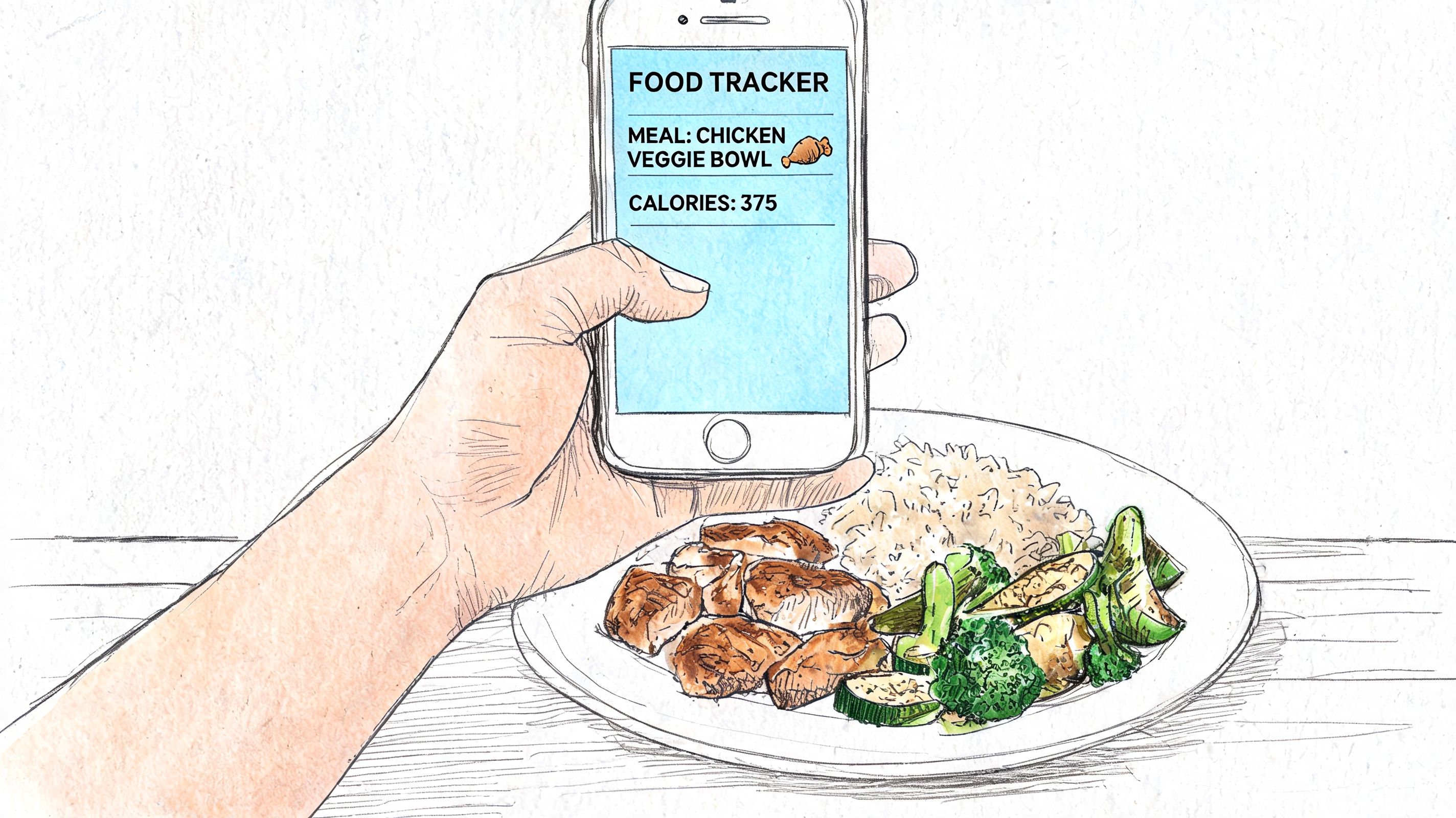
A tool like BiteKit’s AI dining out advisor can help because it’s built around photo, voice, and natural-language meal logging. Instead of manually hunting through entries, you can describe or photograph the meal and use that output as your starting estimate. That doesn’t remove judgment, but it does remove a lot of tedious search work.
Good, better, best in the real world
Here’s the practical version:
- Good: use menu clues and order a meal that’s easier to estimate.
- Better: apply visual portions and itemize the plate when possible.
- Best: combine those skills with a logging tool that speeds up identification and comparison so you stay consistent.
Consistency is the whole game. Many people know roughly what they should do, but they stop logging when life gets inconvenient. Tools help when they reduce the time and friction between eating the meal and recording it.
Technology doesn’t replace judgment. It makes good judgment easier to apply when you’re tired, rushed, or staring at a dish with five moving parts.
If you want to learn how to estimate calories when eating out without turning dinner into a spreadsheet, that’s the ideal approach. Use enough structure to stay honest, enough flexibility to stay sane, and enough support that you’ll still do it next week.
If you want calorie and macro tracking to feel less like detective work, BiteKit is a practical option. You can log meals with a photo, voice note, or plain text, which is especially useful for restaurant dishes where portion estimates and mixed ingredients get messy fast.