Calories in California Roll: Detailed Nutrition Guide
Discover the calories in california roll! Get a detailed breakdown of carbs, protein, & tips for logging and healthier choices to make in 2026.
You’re at a sushi restaurant, trying to make a reasonable choice. The fried specialty rolls look heavy, sashimi feels a little too lean for what you want, and the California roll seems like the safe middle ground. Then the question hits: how many calories are in california roll, really?
That confusion makes sense. A California roll can look simple, but the calories can swing a lot depending on how much rice the chef uses, whether the filling is imitation crab or real crab, and whether the roll comes plain or dressed up. If you’ve ever searched for one calorie number and found several, you’re not imagining it.
A California roll can fit many eating styles, but it helps to think beyond a single number. It’s more useful to understand what’s inside the roll, which parts drive calories up, and how to spot the versions that match your goals. If cholesterol is part of your bigger nutrition picture, VitzAi.com's cholesterol insights can also help you think through fat quality and food choices in a broader way.
Is a California Roll a Healthy Choice?
The honest answer is sometimes yes, with context.
A plain California roll is often one of the more approachable sushi choices because it usually contains rice, avocado, cucumber, nori, and crab or imitation crab. It isn’t a deep-fried roll, and it usually doesn’t rely on heavy cream cheese fillings. That alone makes many people assume it’s automatically “light.”
But healthy doesn’t mean the same thing to everyone. If your goal is steady energy before a workout, a California roll may work well because it leans heavily on rice. If your goal is a high-protein lunch that keeps you full for hours, it may fall short unless you pair it with something else. If you’re watching sodium, the same roll may deserve a closer look.
A California roll is better viewed as a moderate-calorie mixed meal than as a “diet food” or a “cheat meal.”
People often make a mistake here. They hear sushi and think “clean eating,” then forget that sushi rice is still a calorie source, just like bread, pasta, or potatoes. They also focus on avocado as the healthy part and miss that the rice usually contributes the most energy.
A better question than “Is it healthy?” is this: Does this version fit what I need right now? That shift makes the decision much easier and much less emotional.
The Anatomy of a Standard California Roll
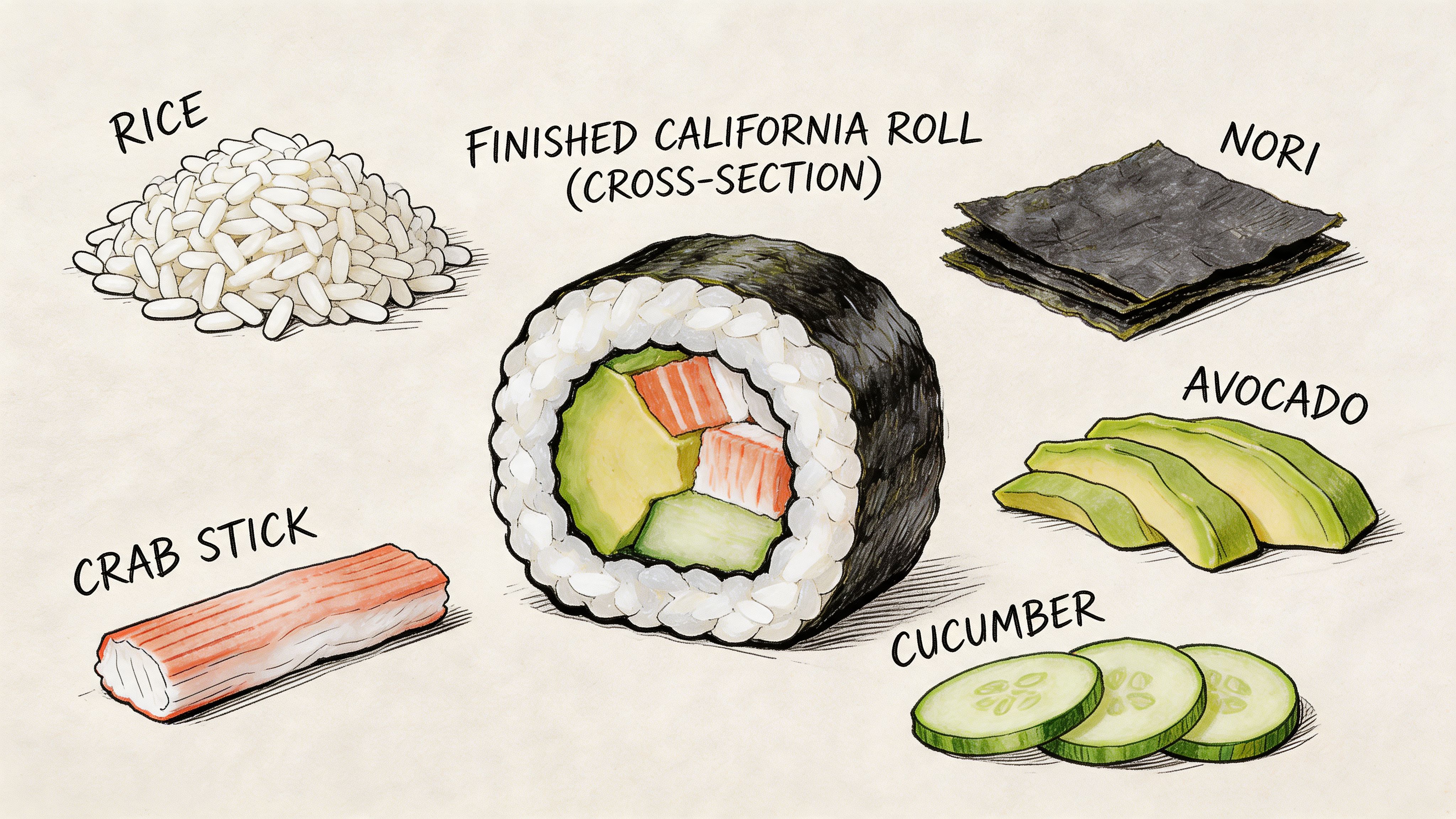
A California roll became popular in North America in the 1970s and is commonly made with inside-out rice, imitation crab, avocado, cucumber, and nori. A typical 7.3 oz serving tracked in Arise app data contained 4.5 oz of sushi rice, which provided 160 of the roll’s 265 calories, showing how strongly rice shapes the roll’s nutrition, as noted in Sushi Runner’s breakdown of California roll ingredients.
Rice does most of the heavy lifting
If you remember one thing, remember this: the rice is usually the main calorie source.
That surprises people because the avocado tastes richer and the crab feels like the “main filling.” But in most California rolls, rice makes up most of the volume. Think of the roll like a sandwich where the bread takes up more space than the filling. The filling matters, but the base is still doing a lot of the nutritional work.
Each ingredient plays a different role
Here’s a simple way to think about the parts:
- Seasoned sushi rice gives the roll structure and most of its carbohydrates.
- Avocado adds creaminess and contributes fat.
- Crab or imitation crab brings some protein and a slightly sweet seafood flavor. If you want a quick explainer on surimi, this guide offers useful kani insights for sushi lovers.
- Cucumber adds crunch and freshness.
- Nori acts like the wrapper holding everything together.
That balance is why the California roll feels so easy to eat. It has starch, softness, crunch, and a mild savory flavor without the intensity some people associate with raw fish.
Why avocado changes the feel more than the calorie total
Avocado often gets a lot of attention because it’s creamy and richer than cucumber or crab. Nutritionally, it contributes fat and makes the roll feel more satisfying. If you want more context on avocado itself, BiteKit has a helpful page on avocado nutrition details.
Practical rule: When a California roll tastes extra soft, dense, and rich, that usually reflects more avocado, more rice, or both.
That ingredient awareness matters because once you can “see” the roll in layers, calorie estimates stop feeling random.
California Roll Calorie and Macronutrient Breakdown
Let’s anchor this with actual numbers.
A standard 7-piece California roll weighing about 140g contains approximately 159.5 calories, 18.7g total carbohydrates, 6.5g fat, and 7.9g protein, according to CarbManager’s California roll entry. The same source also shows why tracking gets messy fast, because some institutional servings can be much larger, with one university food service listing 418 calories for an 8-slice serving.
That’s a big range, and it’s exactly why a single calorie number can mislead you.
What a standard serving tells you
The CarbManager entry also lists useful details for that same serving:
- 14g net carbs
- 3.6g fiber
- 817.7mg sodium
- 235.8mg potassium
- 23.6mg calcium
For someone eating around a 2,000-calorie diet, that standard serving lands in a moderate place. It isn’t tiny, but it isn’t automatically high-calorie either.
Here’s a simple snapshot using the verified baseline data.
Typical nutrition reference
| Nutrient | Amount | % Daily Value (2,000 Cal Diet) |
|---|---|---|
| Calories | 159.5 | 8% |
| Carbohydrates | 18.7g | |
| Fat | 6.5g | |
| Protein | 7.9g | |
| Sodium | 817.7mg | 35% |
| Calcium | 23.6mg |
The main takeaway is that calories in california roll usually come with a carb-forward macro profile. It has some protein and some fat, but it’s not a protein-dense food in the way salmon, chicken, Greek yogurt, or tofu can be.
If you’re scanning menus or packages, knowing how to read serving sizes matters almost as much as knowing the food itself. This quick guide on deciphering food labels for better snacks is useful for that skill.
One more detail matters here. The “standard” serving is often smaller than what restaurants place on the table. If your roll is oversized, tightly packed with rice, or served with extras, you’re no longer eating the textbook version.
What Drives Calorie Differences in California Rolls
Most of the variation comes from one thing first, and everything else second. Rice quantity is the biggest driver.
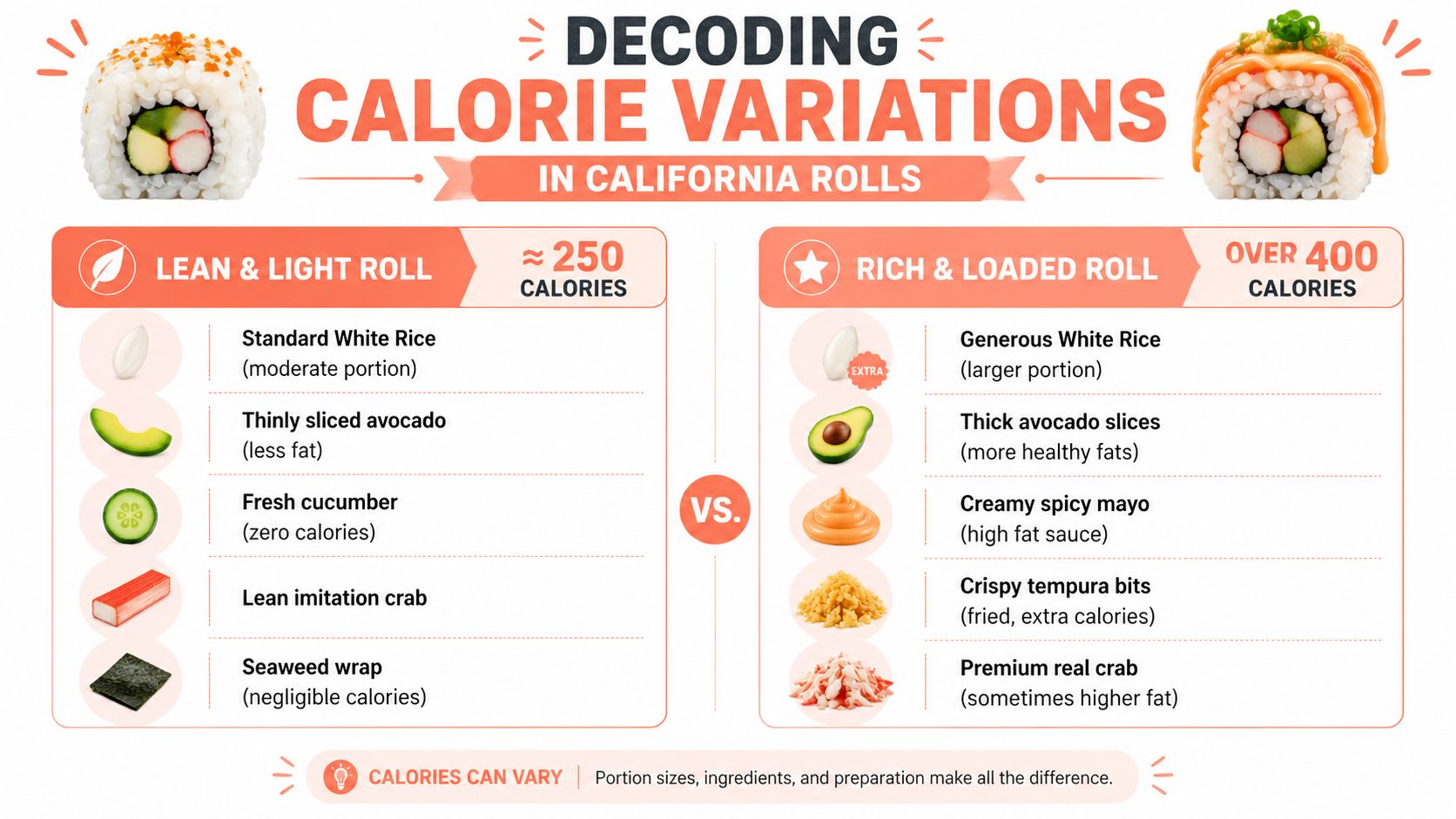
User-tracked app data shows a California roll’s calories are roughly 68% from carbs, 19% from fat, and 13% from protein, with the rice doing most of the work. The same source notes that short-grain sushi rice is high in amylopectin, which digests quickly and makes the rice portion the main factor in both calorie load and glycemic effect, according to Ketogenic’s California sushi roll analysis.
The roll can look similar and still eat very differently
Two California rolls may look almost identical from above. Once you cut into them, the differences show up:
- More rice packed around the outside means more carbs and more calories.
- Thicker avocado adds richness and pushes fat higher.
- Extra toppings or sauces can turn a plain roll into a much heavier one.
- Crunchy add-ons often make the roll more energy-dense even if the portion size looks similar.
This is why restaurant sushi can be hard to eyeball. A neat, compact roll and a bulky, oversized roll may both be called “California roll” on the menu.
A useful visual test
When you’re estimating calories in california roll, ask yourself these questions:
-
Does the rice layer look thick?
If yes, expect the calorie count to rise. -
Does the avocado look generous?
That usually means more fat and more total energy. -
Is there visible sauce, drizzle, or crunchy topping?
That pushes the roll away from the plain baseline. -
Is it restaurant-large or grocery-store compact?
Size matters more than people think.
If you prepare food at home, the same principle applies to homemade sushi. BiteKit has a practical guide on how to calculate calories in homemade food, which helps when your portions don’t match a database entry.
A California roll isn’t one fixed object. It’s closer to a formula. Change the rice, the filling thickness, or the add-ons, and the nutrition shifts with it.
That mental model is more useful than memorizing one calorie number. It helps you estimate restaurant sushi, grocery sushi, or homemade sushi with much more confidence.
Smart Swaps for a Healthier California Roll
If your goal is weight loss, macro balance, or better fullness, you don’t need to stop ordering California rolls. You just need to order them with a little more intention.
A typical California roll has a 5:1 carbohydrate-to-protein ratio, such as 45g carbs to 9g protein, which makes it a better fit for quick energy than for a high-protein eating pattern, as discussed in Tomo Restaurant’s nutrition explainer. That doesn’t make it bad. It just means you should use it strategically.
Better ways to build the meal
Try these adjustments:
- Ask for sauces on the side so you control how much ends up on the roll.
- Choose the plain version instead of the crunchy or spicy house variation.
- Pair it with a protein side if your day’s target is protein-focused.
- Add a light side dish like miso soup or seaweed salad if you want more volume without making the meal feel heavy.
Match the roll to the moment
A California roll often makes more sense when:
- you want something easy to digest before activity
- you’re craving sushi but don’t want a fried specialty roll
- you’re building a moderate lunch rather than a protein-heavy dinner
It tends to make less sense as the centerpiece of a low-carb or high-protein plan unless you intentionally balance the rest of the meal.
The smartest swap usually isn’t “don’t eat sushi.” It’s “order the version that matches your goal today.”
That mindset removes guilt and gives you options.
How to Log California Rolls Accurately with BiteKit
Tracking sushi gets frustrating when a roll looks simple but has hidden variation. One chef uses more rice. Another adds more avocado. Another cuts a larger roll into fewer pieces, making each piece seem bigger without making the meal easier to log.
A precisely made California roll with 60g rice, 40g crab, and 30g avocado has around 237 calories and 879mg sodium (38% DV), largely from the seasoned rice and processed crab, according to The Japanese Bar’s California roll nutrition breakdown. That kind of ingredient-level estimate is exactly why AI logging can help with restaurant foods.
Three easy ways to log it
With BiteKit’s sushi calorie calculator, you can estimate sushi meals without trying to reverse-engineer every ingredient by hand. In practice, there are three simple ways to handle a California roll:
-
Photo logging
Snap the plate, especially if you’re eating out. This helps estimate portion size and identify obvious extras like sauce or crunchy toppings. -
Voice logging
Say something like: “One California roll with extra avocado” or “California roll and miso soup.” That’s often faster than typing when you’re busy. -
Text entry
If you know the details, enter them directly. For example, a plain California roll is different from one with spicy mayo or a larger restaurant portion.
What to notice before you log
A quick scan helps improve accuracy:
- Count the pieces, but don’t rely on piece count alone.
- Look at the rice thickness because that often changes the estimate most.
- Note visible sauces or toppings before you take the first bite.
- Check whether it’s imitation crab or real crab if the menu says so.
That’s enough detail for a much better estimate than choosing a random generic entry and hoping it fits.
Enjoy Sushi Confidently on Your Health Journey
California rolls sit in the middle ground. They’re not automatically “clean,” and they’re not a food you need to fear. In many cases, they’re a moderate-calorie sushi option, but the final number depends heavily on rice amount, portion size, and extras.
If you remember the core lesson, make it this one: don’t ask only how many calories are in california roll. Ask what this specific roll is made of. That question gives you far more useful information. Rice usually drives the calories. Avocado adds richness. Crab contributes some protein. Sauces and oversized portions can shift the roll fast.
That kind of food awareness is what makes healthy eating sustainable. You don’t need perfect control, and you don’t need to avoid restaurant meals. You just need a clear mental model and a simple way to track what you’re eating.
If you want a faster way to log sushi, restaurant meals, and mixed dishes without digging through giant food databases, BiteKit lets you track meals with photos, voice, or plain text while estimating calories and macros in a few seconds.