The Science of Simple Calorie Counting for Sustainable Weight Loss
Discover how a simple calorie counting app makes tracking food effortless. This guide covers the science, features, and tips to reach your weight loss goals.
What exactly is a simple calorie counting app? Think of it as a tool laser-focused on one thing: making it incredibly fast and easy to log your meals. Instead of getting bogged down in complicated menus or typing everything out by hand, these apps use smart technology—like logging your food from just a photo—to get rid of the annoying friction that makes most people give up.
Why Simple Calorie Counting Is Your Key to Consistency
Let's be real for a moment. Most people who try to count calories don't fail because the idea is wrong. They fail because the day-to-day process is a total drag. It’s a chore.
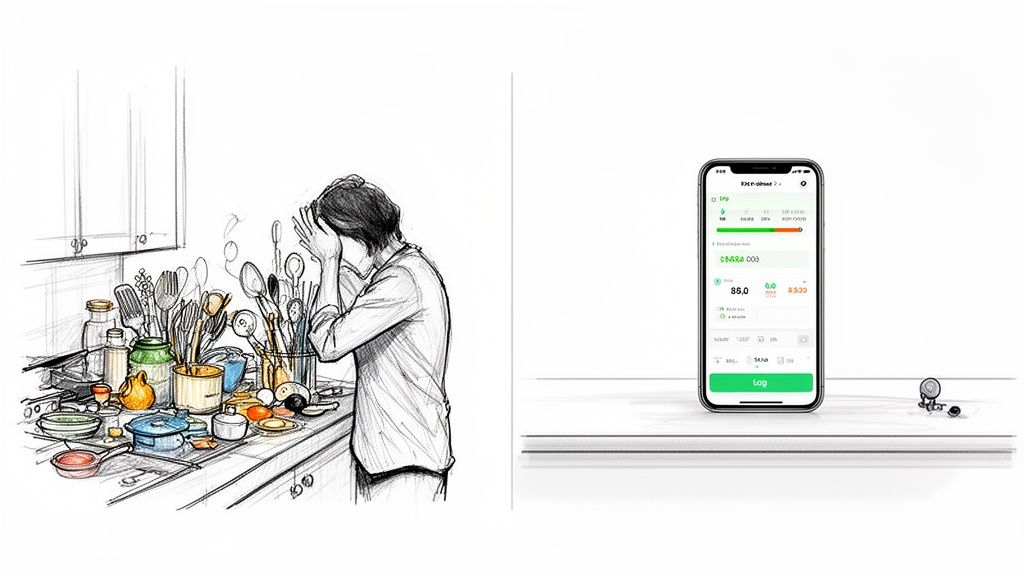
Imagine trying to cook a gourmet meal in a kitchen that’s an absolute disaster zone—dirty dishes piled high, utensils scattered everywhere. You’d get frustrated and probably just order a pizza. That’s exactly what it feels like to use a complicated, clunky tracking app.
A simple calorie counting app is the complete opposite. It’s like stepping into a clean, minimalist kitchen where everything you need is right at your fingertips. This makes the whole process feel smooth, easy, and almost automatic. That difference is everything when it comes to building the one habit that actually gets results: consistency.
The Psychology of Effortless Habits
There’s a science to why this works. Behavioral psychology tells us we’re hardwired to repeat habits that feel easy and give us a quick sense of reward. This is often called the "habit loop": a cue triggers a routine, which leads to a reward.
Here’s how it plays out with a complex app:
- Cue: Time to eat.
- Routine: You open the app and spend the next five minutes painstakingly searching for every single ingredient, guessing portion sizes, and manually entering data. The routine is a pain.
- Reward: You finally see the numbers, but any satisfaction is drowned out by how annoying the process was.
Now, let's flip the script with a simple app. The routine is completely different. You just snap a picture of your plate, and the app identifies the food for you in seconds. The reward—seeing your meal logged instantly—is immediate and satisfying. This positive feedback loop makes you want to do it again for your next meal.
Scientific studies on weight management consistently find a strong link between regular food journaling and achieving long-term weight loss. The secret isn't just tracking; it's sticking with it. Simplicity is the fuel for that adherence.
Friction Is the Enemy of Progress
Every extra tap, every confusing menu, every second you spend hunting through a food database—that’s friction. One little annoyance might not seem like a big deal, but they add up. Over the course of a day, this friction builds a huge mental wall that makes tracking feel like a second job.
A truly simple calorie counting app is designed from the ground up to demolish that wall. It's built on one core idea: remove all friction.
When logging your meal takes less time than choosing a show to watch, it stops feeling like a chore. That’s the magic. This ease of use is what turns calorie counting from a short-lived diet attempt into a sustainable habit for reaching your health and fitness goals.
What Makes a Calorie App Genuinely Simple?
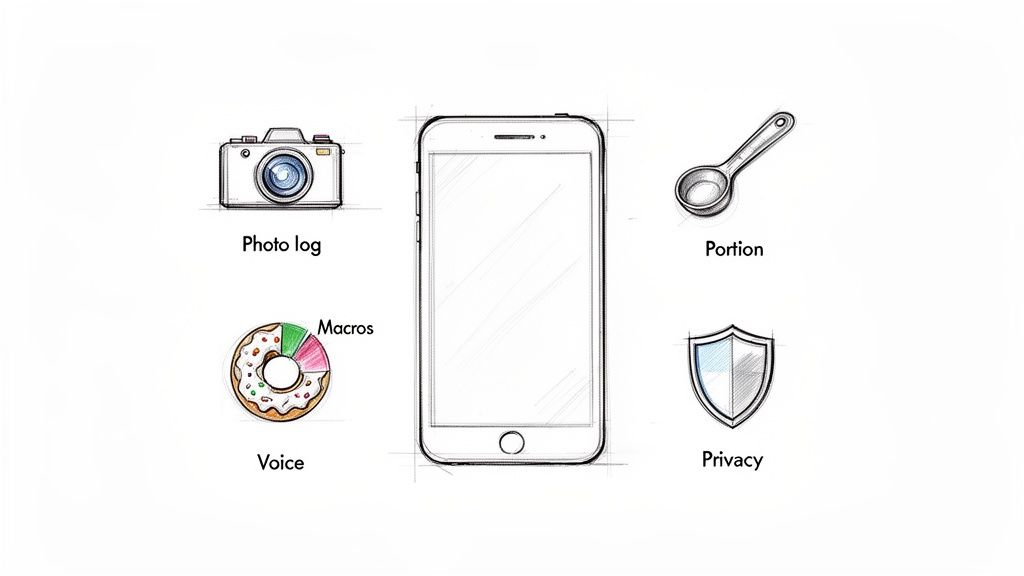
When an app claims to be "simple," what should that actually look like? It’s not about having fewer features; it's about having the right features—the ones that remove friction from your daily routine.
A truly simple calorie counter is a tool you barely notice. It’s defined by how fast you can log your food and get back to living your life. Anything less just creates more work, turning your phone into a glorified spreadsheet.
Here are the non-negotiable features that separate a helpful tool from a frustrating one.
Fast, AI-Powered Food Logging
Let’s be honest: the biggest reason people quit tracking is the sheer time it takes to manually enter every single ingredient. Modern apps get around this by using AI to make logging almost instantaneous. The goal is to make tracking an effortless background habit, not a chore.
Think about logging a meal at a restaurant. Instead of awkwardly typing "grilled salmon with asparagus and quinoa" into a search bar, you just snap a photo. A great app will identify everything on the plate for you. It’s that easy.
These are the features that make it happen:
- Photo Logging: Take a picture of your meal, and let the AI identify the food, estimate the calories, and log the macros. This is the new gold standard for speed and convenience.
- Voice Logging: Just say what you ate. Something like, "I had a bowl of oatmeal with blueberries and a scoop of protein powder," and the app should understand and log it correctly.
- Natural Language Text: Instead of searching for "chicken," "salad," and "whole wheat bread" separately, you should be able to just type "a chicken salad sandwich on whole wheat."
Smart Portion Sizing (No Scale Needed)
Another major headache is guessing portion sizes. While a food scale is the most accurate method, it’s not exactly practical to carry one everywhere you go. A truly simple app uses smart technology to give you an accurate-enough estimate for making consistent progress.
AI-driven portion estimation can be twice as accurate as the average person's visual guess. This is a game-changer for reducing common tracking errors without needing any extra gadgets.
This is where smart AI really makes a difference. By analyzing your photo, the app can use visual cues and your phone’s built-in sensors to estimate the weight of the food on your plate. It’s a "good enough" approach that is perfect for logging meals when you’re out and about, which is key to staying consistent.
Clear Calorie and Macro Totals
Of course, simplicity doesn't mean skimping on the data that matters. After you log a meal, the app needs to show you the most important numbers at a glance: calories, protein, carbs, and fats.
A simple app presents this information with clean progress bars or simple visuals, letting you see your daily totals update in real-time. This immediate feedback loop is what empowers you to make smarter choices for your next meal and actually hit your goals.
A Clean Experience and Rock-Solid Privacy
Finally, the app itself needs to be clean, fast, and respectful of your privacy. When you open it, you should see your daily progress right away, without having to navigate through cluttered menus. Looking back at your food history should feel as intuitive as scrolling through your camera roll.
Just as important is data privacy. Many apps force you to create an account, storing your personal health data on their servers. A user-first app like BiteKit takes a different approach by keeping all your information stored locally on your device. This ensures your food log stays exactly where it should be: with you.
The Science Behind Effortless Tracking and Lasting Results
Let’s be honest: the journey to getting healthier often kicks off with one big question: "How can I actually stick with it this time?" The answer, which comes up again and again in behavioral science, boils down to one powerful activity: consistently logging what you eat. Study after study confirms a direct link between food journaling and achieving long-term weight management.
But here’s the real secret: it’s not just about tracking, it’s about adherence. Can you do it day in and day out? This is where a simple calorie counting app becomes your secret weapon. By getting rid of the annoying obstacles—like spending ages manually searching for every ingredient—these apps make it so much easier to log your meals consistently. It stops being a battle of willpower and starts becoming the easiest choice you can make.
The Power of the Habit Loop
So much of what we do is driven by habits. Think of it as a simple loop: a cue triggers an action, and that action gives you a reward. A clunky, slow app creates a negative loop where the action is a total drag. On the other hand, a simple app builds a positive, reinforcing cycle that makes tracking feel almost second nature.
Here’s what that looks like in practice:
- Cue: You just finished eating.
- Routine: You take a quick picture of your plate. The app instantly identifies the food, figures out the portion size, and logs it. The whole thing takes just a few seconds.
- Reward: Right away, you see your daily numbers update with clean, easy-to-read progress bars. That immediate feedback gives you a small sense of accomplishment, which makes you want to do it again next time.
This instant feedback is the glue that makes the habit stick. Seeing your macros adjust in real-time isn't just about collecting data; it gives you a feeling of control and forward momentum. That psychological win is what keeps you coming back, meal after meal. You can dive deeper into this with our complete guide on the best way to count calories.
A landmark study in the New England Journal of Medicine discovered that the success of weight loss diets had little to do with whether they were low-carb or low-fat. What truly mattered? Adherence. The ability to stick to a reduced-calorie plan—made vastly simpler with effortless tracking—was the ultimate key to success.
Making Healthy Choices the Path of Least Resistance
When you get right down to it, the magic of a simple app is that it makes healthier decisions feel like the easiest option available. When logging your food is quick and even a little bit satisfying, you naturally become more mindful of your eating habits without feeling like it's a chore.
This shift is a game-changer for any health goal, whether you’re trying to lose fat, build muscle, or just feel more in tune with your body. For instance, if you’re trying to eat more protein, seeing that macro bar fall short every day is a clear, visual nudge to grab a protein-rich snack. The app doesn’t just document your past; it actively helps shape your future choices by making the impact of those choices crystal clear.
By transforming a tedious task into a seamless, two-second action, a simple calorie counting app provides the consistency you need to achieve results that actually last.
How to Choose the Right Simple Calorie App for You
Finding the right simple calorie counting app isn't about chasing the one with the most bells and whistles. It's about finding the tool that fits your life. The perfect app for a competitive athlete might be a confusing mess for someone just starting out.
Let's ditch the "one-size-fits-all" mindset. Instead, think about who you are and what you really need. Once you know your biggest challenges, you can zero in on the features that will make tracking feel less like a chore and more like a natural part of your day.
For the Beginner Building New Habits
Just getting started? Your biggest hurdle is simply showing up every day. Consistency beats perfection, hands down. An estimated log is infinitely better than an empty one.
Your top priorities should be:
- One-Tap Logging: Look for apps that make logging ridiculously easy, like with a quick photo. The fewer steps between you and a logged meal, the higher your chances of sticking with it.
- Simple Visuals: You don't need to drown in data. Clear, at-a-glance progress bars for your daily calories are all you need right now. Overcomplicating things with micronutrients at this stage will only lead to burnout.
For the Busy Professional Needing Speed
Time is your most precious commodity. You're grabbing lunch between meetings, eating at restaurants, and juggling a packed schedule. You can't afford to spend ten minutes weighing ingredients or scrolling through a massive food database. For you, speed is everything.
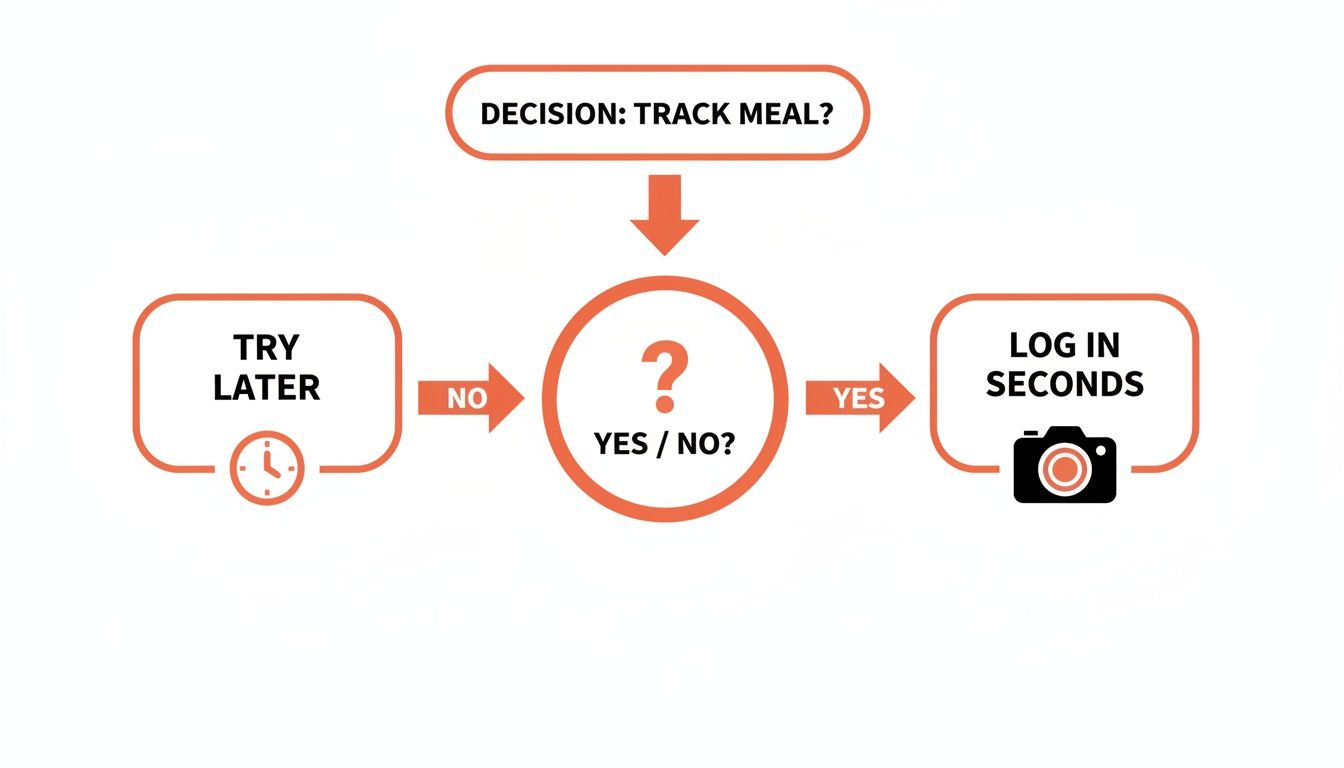
This kind of quick decision-making is what you need—a process that takes seconds, not minutes.
The features you can't live without are:
- AI Photo & Voice Recognition: Snapping a picture of your plate or just saying, "I had a chicken salad and a coffee," is a total game-changer. It gets rid of the manual entry that slows you down.
- Smart Portion Estimation: An app that can look at a photo and give you a solid portion estimate is a lifesaver. It provides the "good enough" data needed to stay on track without needing a food scale in your briefcase.
For the Athlete Optimizing Performance
You're not just tracking calories; you're fueling a high-performance machine. Your focus is precise, centered on hitting exact protein, carb, and fat numbers to maximize training, recovery, and muscle growth.
A growing body of scientific evidence shows that higher protein intake during a caloric deficit helps preserve lean body mass. For an athlete, hitting specific macro targets isn't just about calories—it's about protecting performance and body composition.
You need an app with these non-negotiable features:
- Customizable Macro Goals: Forget simple percentages. You need to set specific gram targets for protein, carbs, and fats to dial in your nutrition perfectly.
- Detailed Nutrient Tracking: Easily viewing your macro breakdown for each meal and the entire day is essential for making real-time adjustments. Some of the best free nutrition tracking apps are built specifically for this level of detail.
App Feature Priorities by User Goal
To make it even clearer, this table breaks down which features matter most for different people. Use it to quickly identify what you should be looking for.
| User Profile | Primary Goal | Most Important Feature | Secondary Feature |
|---|---|---|---|
| Beginner | Build consistency | Fast, one-tap logging | Simple, clear calorie visuals |
| Busy Professional | Save time | AI photo or voice logging | Smart portion estimation |
| Athlete | Optimize performance | Customizable macro goals | Detailed nutrient breakdown |
| Weight-Loss Seeker | Stay accountable | Accurate food database | Progress charts and trends |
By matching your personal needs with the right features, you’re not just downloading an app—you’re choosing a partner that will help you succeed in the long run.
How AI Is Changing the Game in Nutrition Tracking
The way we track our health and fitness is going through a massive overhaul. Gone are the days of tedious manual entry and clunky spreadsheets. We're now in an era where technology does the heavy lifting, and at the heart of this shift is Artificial Intelligence. AI is what makes a simple calorie counting app feel less like a chore and more like a helpful partner.
This isn't just a niche trend. We're seeing a global boom in health awareness, and the numbers back it up. The calorie counting app market was valued at USD 1.2 billion in 2024 and is projected to explode to USD 3.5 billion by 2033. This massive growth tells a clear story: people are hungry for tools that provide real-time insights and help build lasting habits, not just apps with frustrating interfaces. You can dive deeper into the market trends and see this incredible growth in calorie app demand for yourself.
So, How Does AI Actually Make Tracking Easier?
When you hear "AI," it's easy to think of complex, futuristic tech. But in a nutrition app, its purpose is incredibly practical: to make your life simpler. The main goal is to automate the most annoying parts of food logging, like scanning barcodes or endlessly scrolling through food databases.
AI pulls this off with a few clever technologies working behind the scenes:
- Photo Recognition: This is the real game-changer. You just snap a picture of your meal, and the AI gets to work identifying every item on your plate. It's been trained on millions of food images to tell the difference between a banana and a burrito.
- Natural Language Processing (NLP): This is the magic behind voice and text logging. Instead of manually searching for "grilled chicken," "brown rice," and "steamed broccoli," you can just say or type, "I had grilled chicken with rice and broccoli." The AI understands what you mean and logs all three items instantly.
- AI-Driven Portion Estimation: Let's be honest, guessing portion sizes is where most of us get it wrong. New AI uses your phone's camera to estimate how much food is on your plate just from a photo. While it's not a perfect replacement for a food scale, it's a huge leap forward from pure guesswork, especially when you're eating out.
The real power of AI isn't just about being fast. It's the combination of speed, accuracy, and simplicity that makes it so effective. By removing the friction from logging, AI helps you build the consistency needed to hit your health goals.
The Real-World Benefit: It’s All About You
At the end of the day, all this technology is there to make tracking effortless for you. An app like BiteKit, for example, uses AI to turn what used to be a five-minute task into a five-second tap. When you can log your entire meal from a photo before you even take the first bite, you’re far more likely to actually do it.
This move from manual work to smart automation is what makes modern nutrition tracking work. It stops being about obsessing over numbers and starts being about getting quick, useful feedback that guides you toward better choices, one meal at a time.
Your First Week with a Simple Calorie Counting App
Jumping into a new health habit can feel like trying to drink from a firehose. The secret isn't to dive into the deep end; it's about starting with small, manageable steps. This simple, 7-day plan will help you build a lasting tracking habit with your calorie counting app without feeling overwhelmed.
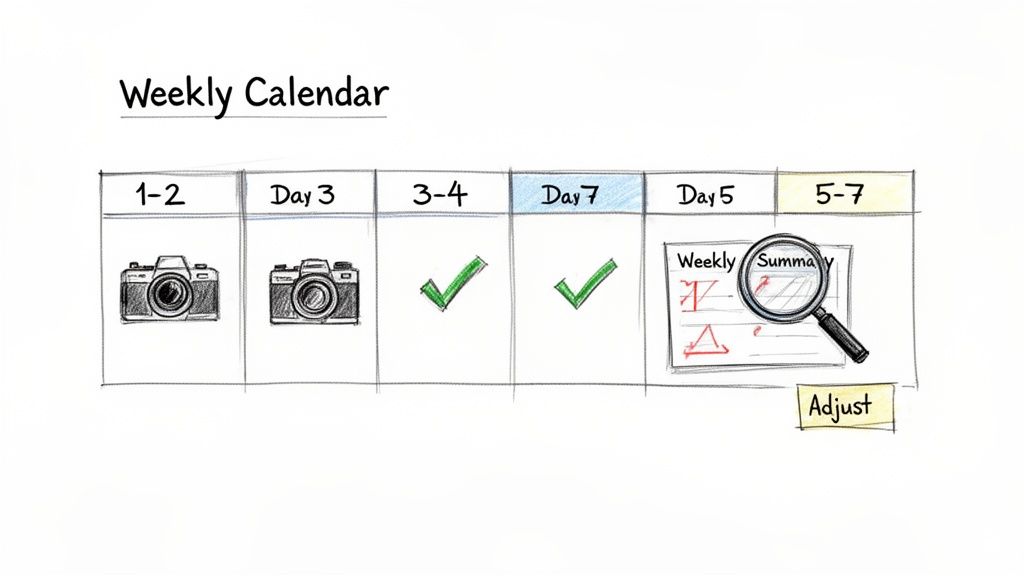
The goal for this first week isn't to radically change your diet. Far from it. The real aim is to master the single most important skill: consistent logging.
Days 1-2: Just Track
For the first two days, your mission is incredibly simple: track everything you eat and drink. That's it. Don't worry about hitting a specific calorie target or making different food choices. Just focus on getting comfortable with the app.
Find the fastest way to log your meals, whether that's snapping a quick photo or scanning a barcode. The idea is to make tracking a quick, thoughtless action, not a drawn-out chore. This initial phase builds the muscle memory you need to make logging a seamless part of your day.
Days 3-4: Focus on Consistency Over Perfection
By now, you’ve probably missed a snack or forgotten to log a drink. That's not just okay—it's completely normal. The key during this phase is to prioritize consistency over perfection. An estimated entry is always better than an empty one.
Remember, the whole point of a simple calorie counting app is to reduce friction. If you can’t remember the exact details of a meal, a quick photo or a text entry like "chicken salad for lunch" is perfectly fine. The habit of logging matters more than the precision of each individual log.
This mindset helps you sidestep the "all-or-nothing" thinking that so often derails progress. Every meal you log is a small victory that reinforces your new habit.
Days 5-7: Review and Make One Small Change
At the end of the week, open your app and take a look at your weekly summary. Don't judge the numbers; just observe them. What patterns do you notice? Maybe you're consistently low on protein at breakfast, or you tend to eat more on weekends. Keeping a consistent food diary app is the best way to uncover these personal insights.
From this review, identify one small, powerful change to focus on for the following week.
- Example 1: If your breakfasts are mostly carbs, your goal for next week could be as simple as adding a source of protein, like Greek yogurt or a hard-boiled egg.
- Example 2: If you notice you're dehydrated, your goal might be to drink just one extra glass of water each day.
This approach builds sustainable momentum. By starting small and focusing on one change at a time, you empower yourself to create lasting habits that lead to real, long-term results.
Common Questions About Simple Calorie Counting
Diving into calorie counting for the first time? You've probably got questions. Let's tackle some of the most common ones so you can get started on the right foot.
Do I Really Need a Food Scale to Lose Weight?
Nope, you absolutely don't. While a food scale is the gold standard for precision, let's be honest—it's a pain to use for every single meal. That hassle is often the very thing that makes people give up.
A simple calorie counting app gets around this by using smart estimation, like AI-powered photo logging. It gives you "good enough" accuracy, which is all you need for consistent, real-world weight loss.
For most of us, the power isn't in perfect measurement; it's in the daily habit of tracking. Ditching the scale makes it so much easier to stay consistent, and that's what truly drives results.
How Long Does It Take to Make Tracking a Habit?
You've probably heard that building a habit takes time. Behavioral science points to a wide range, anywhere from 18 to 254 days. But you can definitely get on the faster end of that spectrum by making the process as frictionless as possible.
When your app makes logging quick and easy, you can get into a solid groove within just 2-3 weeks. The secret is to focus on just showing up and doing it every day, not on being perfect from day one.
Should I Worry About Calories or Macros?
When you're just starting out, keep it simple: focus only on your daily calorie target. It’s the single most important factor for weight loss, and concentrating on that one number helps you build the core habit without getting overwhelmed.
Once you’re consistently hitting your calorie goal and tracking feels like second nature, then you can start paying attention to macros (protein, carbs, and fats). This is the next level, where you can start fine-tuning your diet to:
- Stay full and satisfied by prioritizing protein.
- Hold onto muscle while you're losing fat.
- Fuel your workouts and boost your energy.
The best apps will track both calories and macros for you. This way, you can start with the basics and gradually layer in more detail as you become more confident and knowledgeable.